%20%20--%3E%0A%3Csvg%20version%3D%221.1%22%20id%3D%22Layer_1%22%20xmlns%3D%22http%3A%2F%2Fwww.w3.org%2F2000%2Fsvg%22%20xmlns%3Axlink%3D%22http%3A%2F%2Fwww.w3.org%2F1999%2Fxlink%22%20x%3D%220px%22%20y%3D%220px%22%0A%09%20viewBox%3D%220%200%20684.6%2068.1%22%20style%3D%22enable-background%3Anew%200%200%20684.6%2068.1%3B%22%20xml%3Aspace%3D%22preserve%22%3E%0A%3Cg%3E%0A%09%3Cpath%20d%3D%22M444.1%2C29.3h-17.4v14.5h17.4V29.3z%20M36.4%2C68.1l29.3-50.8V0H50.4L32.9%2C36.8L15.5%2C0H0v68.1h16.7V45.8l12.4%2C22.3H36.4z%0A%09%09%20M49.1%2C68.1h16.6V23.4L49.1%2C52.1V68.1z%20M76.6%2C68.1h45V53.8H93.3V41.6h21V27.1h-21V14.8h28.3V0.1h-45V68.1z%20M175.6%2C68.1h17.3v-68%0A%09%09h-16.5v40.3L150%2C0.1h-17.6v68h16.7V27.7L175.6%2C68.1z%20M235.8%2C14.8h15.4V0.1h-47.4v14.7H219v53.2h16.8V14.8z%20M290.3%2C45.9h-17.1%0A%09%09l7.5-15.6h2L290.3%2C45.9z%20M298.7%2C68.1h18l-32.2-68h-5.7l-32%2C68h18l3.3-7.1h27.1L298.7%2C68.1z%20M325.2%2C68.1h46.2V53.8h-29.6V0.1h-16.7%0A%09%09V68.1z%20M423.7%2C14.8h27.2V0.1H407v68h16.7V14.8z%20M462%2C68.1h46.2V53.8h-29.6V0.1H462V68.1z%20M564.8%2C34.1c0%2C10.7-7.2%2C19.2-18.5%2C19.2%0A%09%09c-11.4%2C0-18.5-8.5-18.5-19.2s7.1-19.2%2C18.5-19.2C557.6%2C14.9%2C564.8%2C23.4%2C564.8%2C34.1%20M580.6%2C34.1c0-19-14.2-34-34.3-34%0A%09%09c-20.2%2C0-34.3%2C15-34.3%2C34c0%2C19%2C14.1%2C34%2C34.3%2C34C566.4%2C68.1%2C580.6%2C53.1%2C580.6%2C34.1%20M604.8%2C20.5c0-4.1%2C3.3-6.2%2C6.7-6.2%0A%09%09c4.4%2C0%2C6.6%2C3%2C6.6%2C6.6h14.7C631.8%2C9.1%2C625.1%2C0.1%2C611%2C0.1c-12%2C0-21.7%2C9.3-21.7%2C20.6c0%2C10.9%2C5.9%2C15.9%2C16.7%2C19.8%0A%09%09c5.2%2C1.8%2C11.5%2C3.2%2C11.5%2C8c0%2C3.3-2.4%2C5.5-6.4%2C5.5c-3.6%2C0-6.6-3-6.6-6.7h-15.2c0%2C11.5%2C7.9%2C20.8%2C21.8%2C20.8c12%2C0%2C21.6-9.3%2C21.6-20.6%0A%09%09c0-10-5.3-16.4-16.7-19.8C610.6%2C26.1%2C604.8%2C25.3%2C604.8%2C20.5%20M670%2C20.9h14.7C683.8%2C9.1%2C677.1%2C0.1%2C663%2C0.1c-12%2C0-21.7%2C9.3-21.7%2C20.6%0A%09%09c0%2C10.9%2C5.9%2C15.9%2C16.7%2C19.8c5.2%2C1.8%2C11.5%2C3.2%2C11.5%2C8c0%2C3.3-2.4%2C5.5-6.4%2C5.5c-3.6%2C0-6.6-3-6.6-6.7h-15.2c0%2C11.5%2C7.9%2C20.8%2C21.8%2C20.8%0A%09%09c12%2C0%2C21.6-9.3%2C21.6-20.6c0-10-5.3-16.4-16.7-19.8c-5.4-1.6-11.3-2.4-11.3-7.2c0-4.1%2C3.3-6.2%2C6.7-6.2C667.7%2C14.4%2C670%2C17.3%2C670%2C20.9%0A%09%09%22%2F%3E%0A%3C%2Fg%3E%0A%3C%2Fsvg%3E%0A)

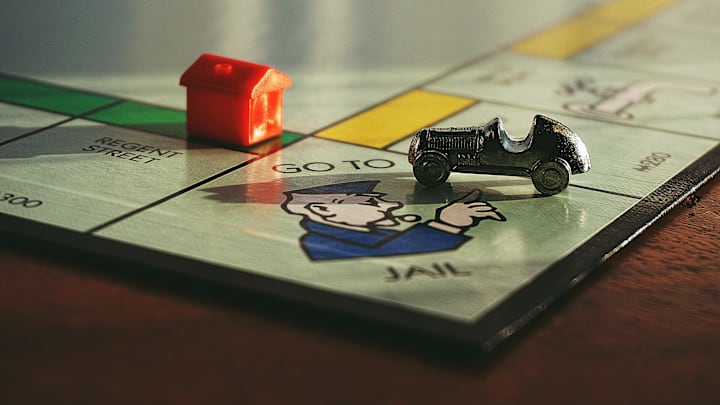
During World War II, the British secret service hatched a master plan to smuggle escape gear to captured Allied soldiers inside Germany. Their secret weapon? Monopoly boxes. The original notion was simple enough: Find a way to sneak useful items into prison camps in an unassuming form. But the idea to use Monopoly came from a series of happy coincidences, all of which started with maps.
Smooth As Silk
Maps are harder to smuggle than you might think. They fall apart when wet, and they make a lot of noise when unfolded. Allied officials feared paper maps might draw the attention of German troops, so they turned to an unlikely source for help—silk. Not only would silk maps hold up in all kinds of weather, but they’d also come with the life-saving benefit of being whisper quiet.
To produce these silent maps, the Brits turned to John Waddington Ltd., a company that had recently perfected the process of printing on silk and was already manufacturing silk escape maps for British airmen to carry. What else was Waddington known for? You guessed it—being the licensed manufacturer of Monopoly outside the United States.

Suddenly, the popular board game seemed like the perfect way to get supplies inside German-run POW camps. At the time, the Nazis were hard-pressed to get provisions to their own troops, much less to the Allied soldiers they’d captured. Wishing to hide this less-than-stellar upholding of the Geneva Convention, they happily welcomed Red Cross aid packages for POWs. So throwing Monopoly games into the care kits along with food and clothing was met with little scrutiny. Monopoly was already a well-known game throughout Europe, and the German guards saw it as the perfect way for their detainees to remain occupied for hours.
Community Chest
In 1941, the British Secret Service approached Waddington with its master plan, and before long, production of a “special edition” Monopoly set was underway. For the top-secret mission, the factory set aside a small, secure room—unknown to the rest of its employees—where skilled craftsmen sat and painstakingly carved small niches and openings into the games’ cardboard boxes. Along with the standard thimble, car, and Scotty dog, the POW version included additional “playing” pieces, such as a metal file and a magnetic compass—all neatly concealed in the game’s box.
Even better, some of the Monopoly money was real. Actual German, Italian, and French currency was placed underneath the play money for escapees to use for bribes. Also, because of its collaboration with the International Red Cross, Waddington could track which sets would be delivered to which camps, meaning escape maps specific to the area could be hidden in each game set. Allied soldiers and pilots headed to the front lines were told to look for the special edition game if they were captured. The identifying mark to check for? A red dot in the corner of the Free Parking space.
Get Out of Jail Free
By the end of the war, it’s estimated that more than 35,000 Allied POWs had escaped from German prison camps. And while there’s no way to set an exact figure on it, more than a few of those escapees certainly owe their breakout to the classic board game.
But despite its brave and noble role in all of it, Monopoly’s heroic war deeds would go unrecognized for decades. Strict secrecy about the plan was maintained during the war, not only so that the British could continue using the game to help POWs, but also because Waddington feared a targeted reprisal by German bombers. After the war, all remaining sets were destroyed, and everyone involved in the plan, including the escaped prisoners, were told to keep quiet. In the event of another large-scale war, Allied officials also wanted to make sure the seemingly innocent board game could go back into action.
Uncle Pennybags Goes Behind the Iron Curtain
Believe it or not, it wasn’t long before Monopoly found itself in the middle of yet another international conflict—this time defending itself from Communist leaders in Russia.
Being that Monopoly is essentially a game in which one player gets rich at the expense of others becoming poor, Soviet officials had long seen the board game as an overt symbol of capitalistic frivolity and greed. So, as its popularity soared, Communists took more and more efforts to curb the enthusiasm. Cuba, the U.S.S.R., and other Eastern Bloc countries outlawed the game for fear it would corrupt the public with positive notions about a free-market economy. Soviet leaders even tried coming up with their own Marxist-themed spin-off games designed to highlight the virtues of frugality. The title of one such knockoff from Communist-era Hungary loosely translated to “Save,” while another in Russia had a name that roughly meant “Manage.”

But bans and spin-offs couldn’t hold down the individualistic drive of the human spirit. Monopoly became an underground success, secretly coveted and played behind the Iron Curtain as a way of escaping the drudgery of Soviet life. It wasn’t until 1987, four years before the collapse of the Soviet Union, that Monopoly was allowed to be legally sold there.
Today, Monopoly is licensed in more than 100 countries, and no fewer than 200 spin-off versions exist. Of course, playing it in the cozy confines of your living room, it’s easy to take for granted that there was a time when, to many, Monopoly was a lot more than just a game.
Read More About Classic Board Games:
This article originally appeared in the November-December 2007 issue of mental_floss; it has been updated for 2025.