%20%20--%3E%0A%3Csvg%20version%3D%221.1%22%20id%3D%22Layer_1%22%20xmlns%3D%22http%3A%2F%2Fwww.w3.org%2F2000%2Fsvg%22%20xmlns%3Axlink%3D%22http%3A%2F%2Fwww.w3.org%2F1999%2Fxlink%22%20x%3D%220px%22%20y%3D%220px%22%0A%09%20viewBox%3D%220%200%20684.6%2068.1%22%20style%3D%22enable-background%3Anew%200%200%20684.6%2068.1%3B%22%20xml%3Aspace%3D%22preserve%22%3E%0A%3Cg%3E%0A%09%3Cpath%20d%3D%22M444.1%2C29.3h-17.4v14.5h17.4V29.3z%20M36.4%2C68.1l29.3-50.8V0H50.4L32.9%2C36.8L15.5%2C0H0v68.1h16.7V45.8l12.4%2C22.3H36.4z%0A%09%09%20M49.1%2C68.1h16.6V23.4L49.1%2C52.1V68.1z%20M76.6%2C68.1h45V53.8H93.3V41.6h21V27.1h-21V14.8h28.3V0.1h-45V68.1z%20M175.6%2C68.1h17.3v-68%0A%09%09h-16.5v40.3L150%2C0.1h-17.6v68h16.7V27.7L175.6%2C68.1z%20M235.8%2C14.8h15.4V0.1h-47.4v14.7H219v53.2h16.8V14.8z%20M290.3%2C45.9h-17.1%0A%09%09l7.5-15.6h2L290.3%2C45.9z%20M298.7%2C68.1h18l-32.2-68h-5.7l-32%2C68h18l3.3-7.1h27.1L298.7%2C68.1z%20M325.2%2C68.1h46.2V53.8h-29.6V0.1h-16.7%0A%09%09V68.1z%20M423.7%2C14.8h27.2V0.1H407v68h16.7V14.8z%20M462%2C68.1h46.2V53.8h-29.6V0.1H462V68.1z%20M564.8%2C34.1c0%2C10.7-7.2%2C19.2-18.5%2C19.2%0A%09%09c-11.4%2C0-18.5-8.5-18.5-19.2s7.1-19.2%2C18.5-19.2C557.6%2C14.9%2C564.8%2C23.4%2C564.8%2C34.1%20M580.6%2C34.1c0-19-14.2-34-34.3-34%0A%09%09c-20.2%2C0-34.3%2C15-34.3%2C34c0%2C19%2C14.1%2C34%2C34.3%2C34C566.4%2C68.1%2C580.6%2C53.1%2C580.6%2C34.1%20M604.8%2C20.5c0-4.1%2C3.3-6.2%2C6.7-6.2%0A%09%09c4.4%2C0%2C6.6%2C3%2C6.6%2C6.6h14.7C631.8%2C9.1%2C625.1%2C0.1%2C611%2C0.1c-12%2C0-21.7%2C9.3-21.7%2C20.6c0%2C10.9%2C5.9%2C15.9%2C16.7%2C19.8%0A%09%09c5.2%2C1.8%2C11.5%2C3.2%2C11.5%2C8c0%2C3.3-2.4%2C5.5-6.4%2C5.5c-3.6%2C0-6.6-3-6.6-6.7h-15.2c0%2C11.5%2C7.9%2C20.8%2C21.8%2C20.8c12%2C0%2C21.6-9.3%2C21.6-20.6%0A%09%09c0-10-5.3-16.4-16.7-19.8C610.6%2C26.1%2C604.8%2C25.3%2C604.8%2C20.5%20M670%2C20.9h14.7C683.8%2C9.1%2C677.1%2C0.1%2C663%2C0.1c-12%2C0-21.7%2C9.3-21.7%2C20.6%0A%09%09c0%2C10.9%2C5.9%2C15.9%2C16.7%2C19.8c5.2%2C1.8%2C11.5%2C3.2%2C11.5%2C8c0%2C3.3-2.4%2C5.5-6.4%2C5.5c-3.6%2C0-6.6-3-6.6-6.7h-15.2c0%2C11.5%2C7.9%2C20.8%2C21.8%2C20.8%0A%09%09c12%2C0%2C21.6-9.3%2C21.6-20.6c0-10-5.3-16.4-16.7-19.8c-5.4-1.6-11.3-2.4-11.3-7.2c0-4.1%2C3.3-6.2%2C6.7-6.2C667.7%2C14.4%2C670%2C17.3%2C670%2C20.9%0A%09%09%22%2F%3E%0A%3C%2Fg%3E%0A%3C%2Fsvg%3E%0A)

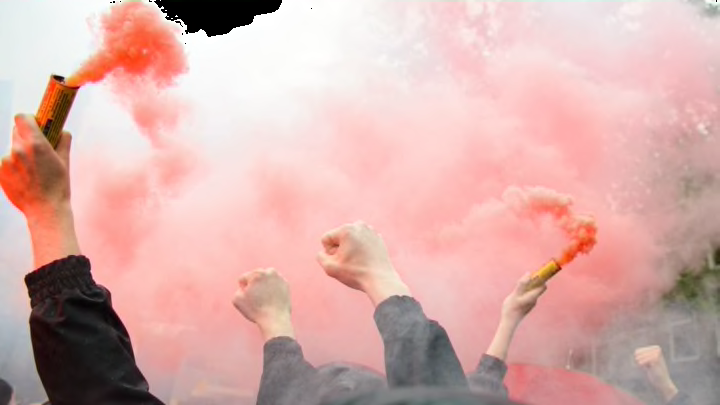
Spectator sports have a singular capacity to bring together disparate groups of people towards the common goal of cheering for a favorite team. However, this noble aim is occasionally forgotten by forty-thousand people collectively thinking, "Hey, I bet I could pick up this stadium chair and throw it at that guy! That'll teach him to support my team's rival." In the spirit of that mindset, here are a few riots you might have missed while watching the Pistons-Pacers Malice at the Palace on YouTube.
1. The Richard Riot
Montreal Candiens Hall of Famer Maurice "The Rocket" Richard was undoubtedly the top scorer of his era. As a result of this talent, he was also a target for opposing teams' abuse. On March 13, 1955, Richard snapped after Boston's Hal Laycoe high-sticked him in the head during a power play; Richard retaliated by repeatedly swinging his stick into Laycoe's face before punching out a linesman who tried to restrain him. NHL President Clarence Campbell responded by suspending Richard for the rest of the season and the playoffs, which caused outrage in Montreal.
The suspension of Richard may have been justified, but Campbell's decision to announce that he would attend the next Canadiens home game at the Forum was questionable. Montreal fans prepared well, and when Campbell arrived with his fiancee, he was greeted by a volley of eggs, vegetables, and anything else Canadiens fans could find to chuck his way. At some point a tear gas bomb was set off in the arena, but the smoke only angered the fans and forced them outside, where they began looting and vandalizing the area around the Forum in a full-blown riot that lasted most of the night, causing $500,000 worth of damage. The scene was likely described as "violent even by hockey standards."
In his public statement, Richard apologized and promised the fans he would return the next year to lead the team to the Stanley Cup. He made good on his promise; the Canadiens won the next five Stanley Cups.
2. Nika Riots
Modern racing fans may think their Dale Earnhardt, Jr. gear makes them intimidating, but the aficionados of sixth-century chariot racing at the Hippodrome of Constantinople put them to shame. Fans of the major Byzantine racing teams, the Blues and the Greens, functioned as something of a pair of politically conscious street gangs. On January 10, 532, several drivers were to be executed for deaths occurring at an earlier race, but a Blue and a Green escaped and hid. Their respective fans made impassioned pleas for leniency, and responding to public pressure, Emperor Justinian reduced their death sentences to life imprisonment and called for a set of races on January 13th.
The races didn't go so well for Justinian, though; the racing fans wanted the drivers pardoned entirely. By the end of the day's 22nd race, the Blues and the Greens had stopped cheering for their respective factions and started yelling "Nika!" ("conquer"), and in a rioting twist rarely seen since, the two sets of fans joined forces, leading to absolute mayhem. The unified group launched a siege of the imperial palace and set fire to the city.
Rather than looting, the mob then developed a more political agenda. Its leaders demanded and received the dismissal of three of Justinian's ministers and proclaimed Hypatius to be the new emperor. After five days of violence, Justinian's generals Belisarius and Mundus brutally suppressed the factions of fans. Estimates of the casualties reached as high as 30,000 dead, although history fails to record whether conservative sports commentators of the day blamed the incident on the influence of hip-hop on chariot racing culture.
3. A.C. Milan vs. Inter Milan
An April 2005 Champions League quarterfinal between A.C. and Inter Milan seemed like a great place to renew their bitter intercity rivalry "“ or at least wreak some senseless havoc. Although A.C. won the first of two matches and had gone up 1-0 in the second, Inter thought it had scored an equalizer on a header with twenty minutes left. Much to the displeasure of Inter fans, referee Markus Merk disallowed the goal because an Inter player had fouled A.C. goalkeeper Dida while jockeying for position.
Like any reasonable mob would, Inter fans responded by pelting the field with hails of bottles and that most European of riot weapons: the lit flare. As Dida cleared away bottles from the pitch to set up a goal kick, he was struck in the shoulder with a flare and received minor burns. The match was restarted after a thirty-minute delay, but more thrown flares led to its abandonment and A.C. Milan receiving credit for a 3-0 victory.
Inter Milan was fined a record 200,000 Euros for the riot, and their fans received the sports version of being sent to their rooms: the club's first four 2005-2006 home matches were played in empty stadiums, effectively making them the soccer equivalent of Atlanta Hawks home games. Here's some terrifying amateur video of the events:
4. Red Star Belgrade vs. PAOK Thessaloniki
During a 2006 game for the ULEB Cup (Europe's second-tier basketball league) in Belgrade, a handful of fans of Red Star's rival Partizan showed up to cheer for the visiting Greek squad. Red Star fans were understandably a bit perturbed, and a bit of a brawl ensued. As the hundred or so Partizan fans fought back, things quickly escalated into a heated riot, complete with flare-throwing, an especially questionable tactic in an enclosed arena with a wooden floor and plastic seats. Hundreds of fans streamed onto the court, and many chucked their stadium seats into the air or at fellow rioters.
Amazingly, only six people were injured in the melee, and after a thirty-minute delay, the game was started. Partizan fans apparently got what they came for, though, as PAOK won 85-81.
5. New York Yankees vs. Detroit Tigers
No list of violent sports episodes could be complete without an appearance by Ty Cobb. On June 13, 1924, the visiting Yankees were leading the Tigers 10-6 in the top of the ninth inning when Cobb, the Tigers' star and manager, allegedly signaled for Tigers pitcher Bert Cole to plunk the Yankees' Bob Meusel. As the story goes, Babe Ruth caught the sign and warned Meusel, who took the pitch on his back and charged the mound. A brawl erupted between players, including a tense staredown between Cobb and Ruth, and hundreds of fans flooded onto the field to join in on the fracas. Police eventually subdued the rioters, but Cole and Meusel both took suspensions from the American League. Ruth and Cole paid fines and the Tigers forfeited the game. On the bright side, the newly released Mitchell Report doesn't connect any of the players on the field that day to performance-enhancing drugs.
6. Andrew Golota vs. Riddick Bowe
Great fighters are often remembered for their signature punch, and Polish heavyweight Andrew Golota could throw a low blow as well as anyone. In July 1996, he got his first big-money fight against former champ Riddick Bowe at Madison Square Garden. Golota dominated the bout despite an absolute unwillingness to stop punching Bowe in the groin. He was ultimately disqualified for a fourth low blow in the seventh round that left Bowe writhing in pain on the mat. Naturally, an in-ring scrum broke out in which Golota was repeatedly bashed on the back of the head with a walkie-talkie by a member of Bowe's entourage.
At this point, a full riot fired up as HBO commentator George Foreman begged for sanity from the crowd. According to the New York Times' account of the event, Polish-flag-toting fans tried to storm the ring only to be stopped and fought by other members of the crowd, which had heavily favored Brooklyn's Bowe. Mayor Rudy Giuliani, who had been a spectator, spent over an hour hiding out in Golota's heavily guarded dressing room.
Predictably, Golota and Bowe fought a rematch in Atlantic City. This time things went marginally better for "The Foul Pole"; he made it all the way to the ninth round before being disqualified for three straight shots to Bowe's groin.
Madison Square Garden has been fairly peaceful since, but Knicks fans are only one more questionable Isiah Thomas trade away from making this donnybrook look like a tea party.
(If you want to jump to the rioting, fast forward to the 2:50 mark.)
7. Sydney Riot of 1879
In 1879 a touring team of English cricketers played a heated series of matches against New South Wales throughout Australia. After a little more than a day of play in the second match, New South Wales was batting while behind by 90 runs when their star player Billy Murdoch was given out by the English-chosen umpire George Coulthard after a close play.
The Australian crowd was less than pleased to see their hero given out by the English ref, and a surge of 2,000 fans burst onto the pitch to express their displeasure physically. What followed was an epic throwdown that included English captain Lord Harris being slapped with a stick, English batsman A.N. Hornby being stripped of his shirt, and other Englishmen wielding cricket stumps (pointy sticks) as weapons while trying to defend Coulthard. The crowd was cleared from the pitch twice but kept rushing back onto the field until the day's play was suspended. The match eventually resumed the next day, and the English team claimed the victory. If Ron Artest has a favorite nineteenth-century cricket match (and he almost certainly does), then this one has to be it.
Ethan Trex grew up idolizing Vince Coleman, and he kind of still does. Ethan co-writes Straight Cash, Homey, the Internet's undisputed top source for pictures of people in Ryan Leaf jerseys. His last mental_floss article looked at offbeat clauses in baseball contracts.