%20%20--%3E%0A%3Csvg%20version%3D%221.1%22%20id%3D%22Layer_1%22%20xmlns%3D%22http%3A%2F%2Fwww.w3.org%2F2000%2Fsvg%22%20xmlns%3Axlink%3D%22http%3A%2F%2Fwww.w3.org%2F1999%2Fxlink%22%20x%3D%220px%22%20y%3D%220px%22%0A%09%20viewBox%3D%220%200%20684.6%2068.1%22%20style%3D%22enable-background%3Anew%200%200%20684.6%2068.1%3B%22%20xml%3Aspace%3D%22preserve%22%3E%0A%3Cg%3E%0A%09%3Cpath%20d%3D%22M444.1%2C29.3h-17.4v14.5h17.4V29.3z%20M36.4%2C68.1l29.3-50.8V0H50.4L32.9%2C36.8L15.5%2C0H0v68.1h16.7V45.8l12.4%2C22.3H36.4z%0A%09%09%20M49.1%2C68.1h16.6V23.4L49.1%2C52.1V68.1z%20M76.6%2C68.1h45V53.8H93.3V41.6h21V27.1h-21V14.8h28.3V0.1h-45V68.1z%20M175.6%2C68.1h17.3v-68%0A%09%09h-16.5v40.3L150%2C0.1h-17.6v68h16.7V27.7L175.6%2C68.1z%20M235.8%2C14.8h15.4V0.1h-47.4v14.7H219v53.2h16.8V14.8z%20M290.3%2C45.9h-17.1%0A%09%09l7.5-15.6h2L290.3%2C45.9z%20M298.7%2C68.1h18l-32.2-68h-5.7l-32%2C68h18l3.3-7.1h27.1L298.7%2C68.1z%20M325.2%2C68.1h46.2V53.8h-29.6V0.1h-16.7%0A%09%09V68.1z%20M423.7%2C14.8h27.2V0.1H407v68h16.7V14.8z%20M462%2C68.1h46.2V53.8h-29.6V0.1H462V68.1z%20M564.8%2C34.1c0%2C10.7-7.2%2C19.2-18.5%2C19.2%0A%09%09c-11.4%2C0-18.5-8.5-18.5-19.2s7.1-19.2%2C18.5-19.2C557.6%2C14.9%2C564.8%2C23.4%2C564.8%2C34.1%20M580.6%2C34.1c0-19-14.2-34-34.3-34%0A%09%09c-20.2%2C0-34.3%2C15-34.3%2C34c0%2C19%2C14.1%2C34%2C34.3%2C34C566.4%2C68.1%2C580.6%2C53.1%2C580.6%2C34.1%20M604.8%2C20.5c0-4.1%2C3.3-6.2%2C6.7-6.2%0A%09%09c4.4%2C0%2C6.6%2C3%2C6.6%2C6.6h14.7C631.8%2C9.1%2C625.1%2C0.1%2C611%2C0.1c-12%2C0-21.7%2C9.3-21.7%2C20.6c0%2C10.9%2C5.9%2C15.9%2C16.7%2C19.8%0A%09%09c5.2%2C1.8%2C11.5%2C3.2%2C11.5%2C8c0%2C3.3-2.4%2C5.5-6.4%2C5.5c-3.6%2C0-6.6-3-6.6-6.7h-15.2c0%2C11.5%2C7.9%2C20.8%2C21.8%2C20.8c12%2C0%2C21.6-9.3%2C21.6-20.6%0A%09%09c0-10-5.3-16.4-16.7-19.8C610.6%2C26.1%2C604.8%2C25.3%2C604.8%2C20.5%20M670%2C20.9h14.7C683.8%2C9.1%2C677.1%2C0.1%2C663%2C0.1c-12%2C0-21.7%2C9.3-21.7%2C20.6%0A%09%09c0%2C10.9%2C5.9%2C15.9%2C16.7%2C19.8c5.2%2C1.8%2C11.5%2C3.2%2C11.5%2C8c0%2C3.3-2.4%2C5.5-6.4%2C5.5c-3.6%2C0-6.6-3-6.6-6.7h-15.2c0%2C11.5%2C7.9%2C20.8%2C21.8%2C20.8%0A%09%09c12%2C0%2C21.6-9.3%2C21.6-20.6c0-10-5.3-16.4-16.7-19.8c-5.4-1.6-11.3-2.4-11.3-7.2c0-4.1%2C3.3-6.2%2C6.7-6.2C667.7%2C14.4%2C670%2C17.3%2C670%2C20.9%0A%09%09%22%2F%3E%0A%3C%2Fg%3E%0A%3C%2Fsvg%3E%0A)

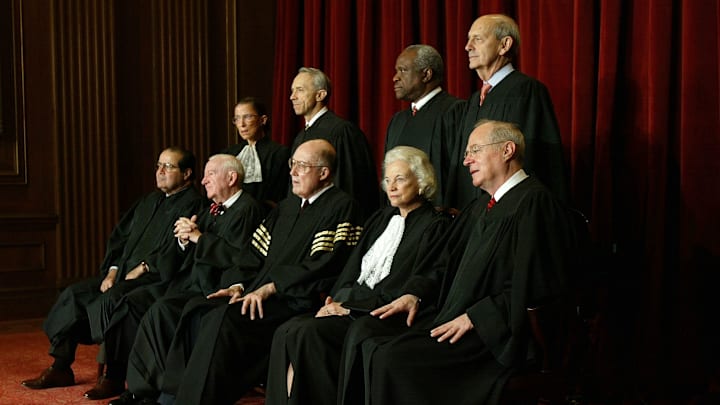
The U.S. Constitution doesn't specify how many Supreme Court justices are necessary—and there weren’t always nine on the bench. The Federal Judiciary Act of 1789 called for a chief justice and five associate justices. The court didn’t settle into the current lineup of eight associates and a chief until the late 1860s.
A sixth associate justice was added in 1807, a seventh and eighth in 1837, and a ninth in 1863. Congress sought to restructure the court during the contentious administration of Andrew Johnson, Abraham Lincoln’s controversial successor. A law passed in 1866 called for a decrease in the number of associate justices from nine to six through the process of attrition. Seven associates remained on the bench in 1869, when a law was passed to increase the number back to eight. By that time President Ulysses S. Grant had taken office.
That's how things stood until 1935, when a largely conservative court unanimously overturned three of President Franklin D. Roosevelt's New Deal provisions. Roosevelt was reelected by a landslide the next year. So, in 1937, he invested his political capital in making the court more likely to interpret laws from a liberal viewpoint.
Roosevelt proposed the Judiciary Reorganization Bill of 1937, known ever since as the “court-packing scheme.” Under this law, the Supreme Court would add one justice for every sitting justice over age 70. Roosevelt argued that the court, with six septuagenarians, wasn’t up to the job. (Because you’re surely wondering, the current court has four septuagenarians as of March 2025: Chief Justice John Roberts and Associate Justices Clarence Thomas, Samuel Alito, and Sonia Sotomayor.)
The bill caused an uproar—even among Roosevelt's allies— and, with the president refusing to give in, eventually died in Congress.
Are there special seats on the Supreme Court?
Barbara A. Perry, author of A “Representative” Supreme Court? The Impact of Race, Religion, and Gender on Appointments, told Mental Floss in 2008 that presidents have sought “balancing representation” in their nominations since the time of George Washington. The practice has given rise to the idea of “seats” for specific demographics groups.
The supposed “Jewish seat” on the bench was first occupied by Louis D. Brandeis, nominated by President Woodrow Wilson in 1916. Benjamin Cardozo joined Brandeis in 1932, and when Cardozo died, Franklin Delano Roosevelt chose another Jewish jurist, Felix Frankfurter, to replace him. Arthur Goldberg replaced Frankfurter in 1962, and Abe Fortas replaced Goldberg in 1965. But there is no evidence that a special seat was held: After Fortas resigned in 1969, another Jewish justice was not confirmed to the court until Ruth Bader Ginsburg in 1993.
After Thurgood Marshall, the first Black justice, retired in 1991, President George H. W. Bush nominated another Black jurist (Clarence Thomas) with a decidedly different approach to the law. And one reason that President George W. Bush nominated Harriet Miers was to have a woman succeed the retiring Sandra Day O’Connor, Perry said. “Bush really wanted to make Alberto Gonzales the first Hispanic justice,” after the death of Chief Justice William Rehnquist in 2005, Perry said, but he ended up nominating John Roberts.
“Later, religious seats developed,” she added, “but once a group enters the mainstream, presidents feel less compelled to reach out to them. The other way you know is if members of a group fill multiple seats.” For example, in 1956, President Dwight D. Eisenhower nominated William Brennan to ensure at least one Roman Catholic sat on the court. Today, six (possibly seven) of the current justices are Catholic, one is Protestant, and one is Jewish.
What is the role of the Supreme Court?
The framers of the Constitution considered the lack of a high court as one of the chief weaknesses of the Articles of Confederation, which the Constitution was intended to replace. Article III calls for Congress to create a Supreme Court.
“All nations have found it necessary to establish one court paramount to the rest, possessing a general superintendence, and authorized to settle and declare in the last resort a uniform rule of civil justice,” Alexander Hamilton argued in support of a Judiciary that would be an equal branch of government with Congress and the presidency.
Unlike the limited terms assigned to officers of the other branches of government, Article III says the members of the Supreme Court “shall hold their Offices during good Behaviour”—essentially until they resign or die. It describes the courts jurisdiction extending to “all Cases, in Law and Equity, arising under this Constitution, the Laws of the United States, and Treaties made, or which shall be made, under their Authority.”
It took the Federal Judiciary Act of 1789 to bring the Supreme Court and federal district courts into existence. The court’s first session opened on February 2, 1790, but the justices heard no arguments during their first three sessions. The court didn’t issue its first major decision until 1793 when, in Chisholm v. Georgia, it ruled the state of Georgia was not immune to a lawsuit from a citizen of another state. That decision was overturned by the Eleventh Amendment, ratified in 1795.
During their long periods of downtime, the early justices were occupied with riding the muddy roads of the country, settling cases as circuit judges. Sitting on a circuit court is still part of a justice’s job description.
Does the Supreme Court enforce its decisions?
It can’t on its own—it relies on the executive branch for support. This arrangement was a big selling point when the Constitution was being shopped around in 1787. The judiciary, Alexander Hamilton wrote, “has no influence over either the sword or the purse ... It may truly be said to have neither force nor will, but merely judgment.” The court, Hamilton believed, would be “the least dangerous” branch of government.
Discover More Facts About the Law:
A version of this story was published in 2008; it has been updated for 2025.