%20%20--%3E%0A%3Csvg%20version%3D%221.1%22%20id%3D%22Layer_1%22%20xmlns%3D%22http%3A%2F%2Fwww.w3.org%2F2000%2Fsvg%22%20xmlns%3Axlink%3D%22http%3A%2F%2Fwww.w3.org%2F1999%2Fxlink%22%20x%3D%220px%22%20y%3D%220px%22%0A%09%20viewBox%3D%220%200%20684.6%2068.1%22%20style%3D%22enable-background%3Anew%200%200%20684.6%2068.1%3B%22%20xml%3Aspace%3D%22preserve%22%3E%0A%3Cg%3E%0A%09%3Cpath%20d%3D%22M444.1%2C29.3h-17.4v14.5h17.4V29.3z%20M36.4%2C68.1l29.3-50.8V0H50.4L32.9%2C36.8L15.5%2C0H0v68.1h16.7V45.8l12.4%2C22.3H36.4z%0A%09%09%20M49.1%2C68.1h16.6V23.4L49.1%2C52.1V68.1z%20M76.6%2C68.1h45V53.8H93.3V41.6h21V27.1h-21V14.8h28.3V0.1h-45V68.1z%20M175.6%2C68.1h17.3v-68%0A%09%09h-16.5v40.3L150%2C0.1h-17.6v68h16.7V27.7L175.6%2C68.1z%20M235.8%2C14.8h15.4V0.1h-47.4v14.7H219v53.2h16.8V14.8z%20M290.3%2C45.9h-17.1%0A%09%09l7.5-15.6h2L290.3%2C45.9z%20M298.7%2C68.1h18l-32.2-68h-5.7l-32%2C68h18l3.3-7.1h27.1L298.7%2C68.1z%20M325.2%2C68.1h46.2V53.8h-29.6V0.1h-16.7%0A%09%09V68.1z%20M423.7%2C14.8h27.2V0.1H407v68h16.7V14.8z%20M462%2C68.1h46.2V53.8h-29.6V0.1H462V68.1z%20M564.8%2C34.1c0%2C10.7-7.2%2C19.2-18.5%2C19.2%0A%09%09c-11.4%2C0-18.5-8.5-18.5-19.2s7.1-19.2%2C18.5-19.2C557.6%2C14.9%2C564.8%2C23.4%2C564.8%2C34.1%20M580.6%2C34.1c0-19-14.2-34-34.3-34%0A%09%09c-20.2%2C0-34.3%2C15-34.3%2C34c0%2C19%2C14.1%2C34%2C34.3%2C34C566.4%2C68.1%2C580.6%2C53.1%2C580.6%2C34.1%20M604.8%2C20.5c0-4.1%2C3.3-6.2%2C6.7-6.2%0A%09%09c4.4%2C0%2C6.6%2C3%2C6.6%2C6.6h14.7C631.8%2C9.1%2C625.1%2C0.1%2C611%2C0.1c-12%2C0-21.7%2C9.3-21.7%2C20.6c0%2C10.9%2C5.9%2C15.9%2C16.7%2C19.8%0A%09%09c5.2%2C1.8%2C11.5%2C3.2%2C11.5%2C8c0%2C3.3-2.4%2C5.5-6.4%2C5.5c-3.6%2C0-6.6-3-6.6-6.7h-15.2c0%2C11.5%2C7.9%2C20.8%2C21.8%2C20.8c12%2C0%2C21.6-9.3%2C21.6-20.6%0A%09%09c0-10-5.3-16.4-16.7-19.8C610.6%2C26.1%2C604.8%2C25.3%2C604.8%2C20.5%20M670%2C20.9h14.7C683.8%2C9.1%2C677.1%2C0.1%2C663%2C0.1c-12%2C0-21.7%2C9.3-21.7%2C20.6%0A%09%09c0%2C10.9%2C5.9%2C15.9%2C16.7%2C19.8c5.2%2C1.8%2C11.5%2C3.2%2C11.5%2C8c0%2C3.3-2.4%2C5.5-6.4%2C5.5c-3.6%2C0-6.6-3-6.6-6.7h-15.2c0%2C11.5%2C7.9%2C20.8%2C21.8%2C20.8%0A%09%09c12%2C0%2C21.6-9.3%2C21.6-20.6c0-10-5.3-16.4-16.7-19.8c-5.4-1.6-11.3-2.4-11.3-7.2c0-4.1%2C3.3-6.2%2C6.7-6.2C667.7%2C14.4%2C670%2C17.3%2C670%2C20.9%0A%09%09%22%2F%3E%0A%3C%2Fg%3E%0A%3C%2Fsvg%3E%0A)

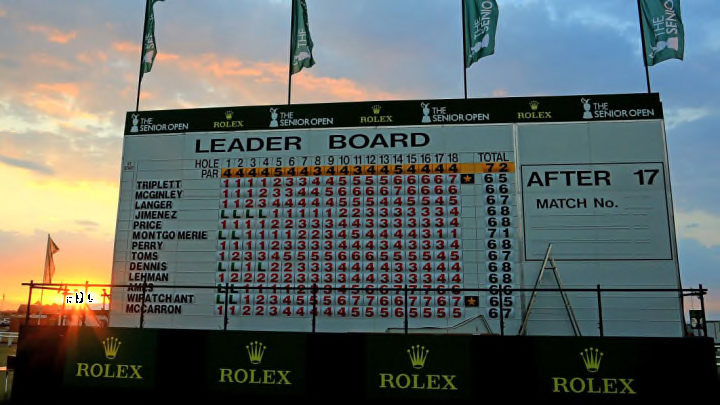
Scoreboards have come a long way since the turn of the 20th century, when operators climbed ladders to update boards with chalk or hang a different number to indicate the start of a new inning or quarter. Manually operated boards slowly gave way to more efficient electric boards, which eventually incorporated video and grew bigger and brighter by the year. Here's a look at how scoreboards have evolved over the past 100+ years.
Early Scoreboards
Leave it to a couple of Ivy League schools to pioneer the use of scoreboards, or score boards as they were known at the time. Harvard claims that its athletic association unveiled the nation's first scoreboard during a football game on Thanksgiving Day 1893, while others credit Penn, which opened Franklin Field in 1895, with that distinction. For what it's worth, one of the earliest mentions of a score board in the New York Times was on November 11, 1894, in an account of Penn's 12-0 win over Princeton at the Trenton Fairgrounds.
Scoring Goes Electric
In 1908, Chicago inventor George A. Baird developed an electric baseball scoreboard that recorded balls, strikes, and outs. While Baird's invention was tested by Boston's two major league clubs, it didn't immediately catch on across the league. Team owners were hesitant to provide information to fans for fear that it would cut into the sale of scorecards, but the electric scoreboard signaled an eventual shift in the in-game experience at stadiums and arenas. Over the next two decades, manually operated scoreboards evolved to feature more information than the score. Lineups with player names and numbers were displayed, along with scores and pitchers' numbers from games around the league.
The Origins of Gametracker
While baseball teams weren't initially keen on electric scoreboards, newspapers embraced the technology. Before games were broadcast on the radio, fans could gather outside of newspaper buildings to follow games that were reproduced using lights and simple graphics on boards operated by workers who received telegraph messages from the site of the game. Crowds in excess of 10,000 would sometimes gather in front of these scoreboards for World Series games.
Scoreboard Watching at the Theater
Around the same time that newspapers debuted their own electric scoreboards, fans could pay for admission to theaters and clubs to follow games on even fancier scoreboard contraptions. As early as 1901, college football fans gathered in New York's Knickerbocker Athletic Club to track games taking place across the country on a scoreboard invented by Arthur Irwin, the brains behind the scoreboard that Harvard reportedly unveiled in 1893. The "Coleman Life-like Scoreboard," which is pictured above and featured in a series of fascinating photos on Shorpy.com, debuted in 1913 at the National Theater in Washington, DC. Advertisements for Coleman's invention, which took 10 years to build, heralded it as "the greatest baseball invention in the world." Operated by five men, including a telegraph operator, the scoreboard featured 19,000 feet of wire and 400 stereopticon slides. Light bulbs translated play-by-play information received via telegraph into graphical displays on a 30-foot screen. "You see every play as it is made upon the field, with life-like pictures of players that hit the ball, run the bases, get put out or slide to safety," the ads proclaimed. "The ball sails through the air, actual players run, catch, or pick up the ball and make the play"¦Bring the ladies."
Dial-a-Down
Stadiums primarily featured manually operated scoreboards throughout the 1920s and 30s. This diagram from a 1932 issue of Popular Mechanics depicts an innovation that allowed a single operator to update a football scoreboard while remaining hidden from view. The operator would watch the game through a peephole and rotate numbered metal disks that displayed the score, quarter, down, and yards to go.
Yankee Stadium and the "Electronic Miracle"
When Yankee Stadium opened in 1923, it featured a large manually operated scoreboard in right field that was visible to every spectator in the park. In 1950, the Yankees unveiled an electric scoreboard that the team called "the most efficient scoreboard ever built and, in general, a big stride forward." The Yankees' new scoreboard was operated by two men as opposed to five and featured a non-glare enamel covering.
Before the 1959 season, the Yankees made another upgrade, installing the first scoreboard to feature a changeable message display. The New York Times, which dubbed the new scoreboard "the electronic miracle," provided the specifics: "The board will contain 11,210 lamps with a wattage of 115,000, 619,000 feet of electric cable, will weigh 25 tons (not including the steel supporting structure), will have more than 4,860 push buttons on the master control console and will have a total face area of 4,782 square feet."
Clearing the Scoreboard at Wrigley Field
Wrigley Field's iconic 89-foot scoreboard was built in 1937 under the direction of flamboyant club treasurer and future White Sox owner Bill Veeck, whose father was team president until he died in 1933. Most of the original Wrigley Field scoreboard, which still stands today, is manually operated, but the batter's number, balls, strikes, and outs are displayed electronically in the center portion of the board. The original control panel is still in use. While no baseball player has managed to hit the scoreboard, golfer Sam Snead cleared it with a drive from home plate in 1951. Snead was invited to take aim at the scoreboard while he was in Chicago to get an X-ray of his broken right hand. According to newspaper accounts, Snead hit the scoreboard with a 4-iron before clearing it with a 2-iron.
"What's baseball coming to?"
That's what former White Sox manager Jimmy Dykes asked after Comiskey Park's exploding scoreboard, which featured multi-colored pinwheels and shot off fireworks after every home run by a Chicago player, was unveiled in 1960. "All I know is that if I was a pitcher whose home run ball had started that Fourth of July celebration, I'd fire my next pitch at the head of the next hitter," Dykes told a reporter. While some opponents resented the extravagant display, which was another one of Veeck's ideas, the unique scoreboard design was retained when Chicago's current stadium opened in 1991.
Bigger and Better
When the Houston Astrodome opened in 1965, its 474-foot wide scoreboard was the largest in all of sports. The scoreboard featured 50,000 lights that erupted in a 45-second animated display of cowboys, ricocheting bullets, flags, steers, and fireworks after every Astros home run or victory. The display was set to a soundtrack that included "The Eyes of Texas."
Diamond Vision
The Los Angeles Dodgers unveiled a $3 million, 875-square foot video board at the 1980 All-Star Game. Mitsubishi's Diamond Vision, which enabled operators to show replays using a VCR, was the first video board of its kind and a sign of things to come. Similar video boards soon became standard in stadiums and arenas, as the resolution and functionality of the screens improved and Sony entered the market with its popular JumboTron. In 2009, the Dallas Cowboys unveiled the world's largest high-definition video display, an LED scoreboard developed by Mitsubishi.
Other Iconic Baseball Scoreboards
In baseball more than any other sport, the scoreboard helps define a stadium. Here's a look at some of the more famous baseball scoreboards from the past and present:
Ebbetts Field
The scoreboard at Brooklyn's Ebbetts Field featured a "Hit Sign, Win Suit" advertisement for Abe Stark. The "˜h' or the "˜e' in the Schaefer beer sign would flash to indicate the official scorer's ruling on hits and errors. Oriole Park at Camden Yards pays homage to that creative detail by flashing the "˜h' or the "˜e' in the sign atop its scoreboard.
Crosley Field
The 58-foot tall scoreboard at Cincinnati's Crosley Field was installed in 1957. Houston's Jimmy Wynn, a Cincinnati native, hit what is considered the longest home run at Crosley Field in 1967. Wynn cleared the scoreboard with a blast than landed on I-75.
Fenway Park
The manually operated scoreboard at the base of Fenway Park's Green Monster was installed in 1934. The initials of the team's former owners, Thomas A. Yawkey and Jean R. Yawkey, are written in Morse code in two vertical stripes on the scoreboard.
Anaheim Stadium
The Big A, the 230-foot high scoreboard support in Anaheim, cost $1 million and was unveiled in 1966. It was moved to the parking lot in 1980.
Kauffman Stadium
The Royals replaced their 12-story, crown-shaped centerfield scoreboard as part of their $256 million renovation to Kauffman Stadium in 2007. The new scoreboard, which was unveiled on Opening Day 2008, is 8,736 square feet, more than twice the size of the original.
Herschel Greer Stadium
Minor league ballparks feature some noteworthy scoreboards, too. The guitar-shaped scoreboard at Herschel Greer Stadium, home of the Nashville Sounds, was installed in 1993.
Have you been to a ballpark with a scoreboard that deserves to be mentioned?