%20%20--%3E%0A%3Csvg%20version%3D%221.1%22%20id%3D%22Layer_1%22%20xmlns%3D%22http%3A%2F%2Fwww.w3.org%2F2000%2Fsvg%22%20xmlns%3Axlink%3D%22http%3A%2F%2Fwww.w3.org%2F1999%2Fxlink%22%20x%3D%220px%22%20y%3D%220px%22%0A%09%20viewBox%3D%220%200%20684.6%2068.1%22%20style%3D%22enable-background%3Anew%200%200%20684.6%2068.1%3B%22%20xml%3Aspace%3D%22preserve%22%3E%0A%3Cg%3E%0A%09%3Cpath%20d%3D%22M444.1%2C29.3h-17.4v14.5h17.4V29.3z%20M36.4%2C68.1l29.3-50.8V0H50.4L32.9%2C36.8L15.5%2C0H0v68.1h16.7V45.8l12.4%2C22.3H36.4z%0A%09%09%20M49.1%2C68.1h16.6V23.4L49.1%2C52.1V68.1z%20M76.6%2C68.1h45V53.8H93.3V41.6h21V27.1h-21V14.8h28.3V0.1h-45V68.1z%20M175.6%2C68.1h17.3v-68%0A%09%09h-16.5v40.3L150%2C0.1h-17.6v68h16.7V27.7L175.6%2C68.1z%20M235.8%2C14.8h15.4V0.1h-47.4v14.7H219v53.2h16.8V14.8z%20M290.3%2C45.9h-17.1%0A%09%09l7.5-15.6h2L290.3%2C45.9z%20M298.7%2C68.1h18l-32.2-68h-5.7l-32%2C68h18l3.3-7.1h27.1L298.7%2C68.1z%20M325.2%2C68.1h46.2V53.8h-29.6V0.1h-16.7%0A%09%09V68.1z%20M423.7%2C14.8h27.2V0.1H407v68h16.7V14.8z%20M462%2C68.1h46.2V53.8h-29.6V0.1H462V68.1z%20M564.8%2C34.1c0%2C10.7-7.2%2C19.2-18.5%2C19.2%0A%09%09c-11.4%2C0-18.5-8.5-18.5-19.2s7.1-19.2%2C18.5-19.2C557.6%2C14.9%2C564.8%2C23.4%2C564.8%2C34.1%20M580.6%2C34.1c0-19-14.2-34-34.3-34%0A%09%09c-20.2%2C0-34.3%2C15-34.3%2C34c0%2C19%2C14.1%2C34%2C34.3%2C34C566.4%2C68.1%2C580.6%2C53.1%2C580.6%2C34.1%20M604.8%2C20.5c0-4.1%2C3.3-6.2%2C6.7-6.2%0A%09%09c4.4%2C0%2C6.6%2C3%2C6.6%2C6.6h14.7C631.8%2C9.1%2C625.1%2C0.1%2C611%2C0.1c-12%2C0-21.7%2C9.3-21.7%2C20.6c0%2C10.9%2C5.9%2C15.9%2C16.7%2C19.8%0A%09%09c5.2%2C1.8%2C11.5%2C3.2%2C11.5%2C8c0%2C3.3-2.4%2C5.5-6.4%2C5.5c-3.6%2C0-6.6-3-6.6-6.7h-15.2c0%2C11.5%2C7.9%2C20.8%2C21.8%2C20.8c12%2C0%2C21.6-9.3%2C21.6-20.6%0A%09%09c0-10-5.3-16.4-16.7-19.8C610.6%2C26.1%2C604.8%2C25.3%2C604.8%2C20.5%20M670%2C20.9h14.7C683.8%2C9.1%2C677.1%2C0.1%2C663%2C0.1c-12%2C0-21.7%2C9.3-21.7%2C20.6%0A%09%09c0%2C10.9%2C5.9%2C15.9%2C16.7%2C19.8c5.2%2C1.8%2C11.5%2C3.2%2C11.5%2C8c0%2C3.3-2.4%2C5.5-6.4%2C5.5c-3.6%2C0-6.6-3-6.6-6.7h-15.2c0%2C11.5%2C7.9%2C20.8%2C21.8%2C20.8%0A%09%09c12%2C0%2C21.6-9.3%2C21.6-20.6c0-10-5.3-16.4-16.7-19.8c-5.4-1.6-11.3-2.4-11.3-7.2c0-4.1%2C3.3-6.2%2C6.7-6.2C667.7%2C14.4%2C670%2C17.3%2C670%2C20.9%0A%09%09%22%2F%3E%0A%3C%2Fg%3E%0A%3C%2Fsvg%3E%0A)

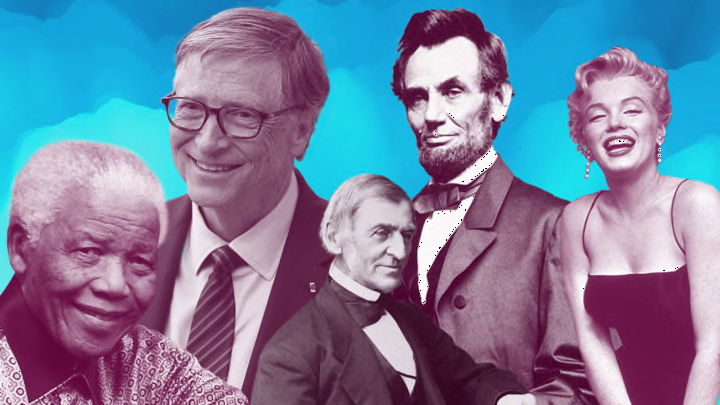
If you use social media, it's nearly impossible not to be continuously confronted with the wisdom of Martin Luther King, Mark Twain, and Marilyn Monroe (usually written in flowing script over an artistically filtered photo). Fact-checking frequently matters less than whether the image looks good on your Pinterest board. But all too often, that particular figure never uttered that particular bon mot. Here are 15 famous and often-misattributed quotes that would have sounded great coming from these 15 famous mouths—even though they didn't.
1. “ONLY WHEN IT IS DARK ENOUGH, CAN YOU SEE THE STARS …” —RALPH WALDO EMERSON
This one is pretty easy to fact check, as long as The Complete Works of Ralph Waldo Emerson is what it claims to be. The closest Emerson comes to talking about seeing stars in the dark is a passage in Conduct of Life where he talks about exploring the Mammoth Caves in Kentucky. The tour guide took him to “the Star Chamber,” and turned off all the lanterns the group had brought. A hidden lamp reflected off the crystals in the roof of the cave to look like a brilliant starry sky. Ripe for allusion, to be sure, but Emerson himself never actually makes it.
2. “BE THE CHANGE YOU WISH TO SEE IN THE WORLD.” —GANDHI
The thing that turns a sentence into a saying is repetition and exposure. This means more than one person has to encounter it, which is why most great quotes come from speeches or books. The above wisdom might have come from Gandhi, but if it did only one person heard it: his grandson, Arun Gandhi. Author Keith Akers put a lot of effort into tracking down the origin of this phrase, and the only thing he could discover with certainty was that it wasn’t in anything directly attributed to Gandhi. Arun claims in print that it (or at least something similar) was something he often heard his grandfather say.
3. "OUR DEEPEST FEAR IS NOT THAT WE ARE INADEQUATE. OUR DEEPEST FEAR IS THAT WE ARE POWERFUL BEYOND MEASURE." —NELSON MANDELA
Many people believe this comes from the address Mandela delivered when he became the first black president of South Africa in 1994. However, as Snopes reveals, Mandela did not speak these words during that speech or any other that we know of. If he had, he would have been repeating the words of Marianne Williamson, written in her 1992 book A Return to Love. Williamson knows that her words are often credited to Mandela, and says it would have been an honor to have been quoted by him.
4. NANCY ASTOR: "WINSTON IF YOU WERE MY HUSBAND, I'D PUT POISON IN YOUR COFFEE." // WINSTON CHURCHILL: "NANCY, IF YOU WERE MY WIFE, I'D DRINK IT."
Nancy Astor was, by early 20th century standards, a real piece of work. She was the first female member of the British Parliament, which some doubted she deserved since she was born American and had taken over the post after her second, wildly wealthy, husband Waldorf Astor vacated it. She was reportedly out of touch, not too interested in politics, and supported causes that were unpopular in England, like temperance. Winston Churchill was, as you know, The Man. Or at least that's how history remembers him. And although this interchange could have happened, it probably didn’t—the joke had existed for decades in other forms. Incidentally, there is a name for misattributing quotes to Churchill, one coined by Nigel Rees and called Churchillian Drift.
5. "ONE MAN CAN MAKE A DIFFERENCE AND EVERY MAN SHOULD TRY." —JOHN F. KENNEDY
This one is pretty close. One of the first publications of this quote is from a 1989 book, Respectfully Quoted: A Dictionary of Quotations, and it’s attributed to Jackie Kennedy, not her late husband. It was written on a card in a traveling exhibit celebrating the opening of the JFK Library in 1979. The 2010 reprint of the quote book still contains the passage and attribution, likely meaning no one was able to contest that it was Jackie who said it in the intervening years.
6. “IF YOU LOOK FOR THE BAD IN MANKIND EXPECTING TO FIND IT, YOU SURELY WILL.” —ABRAHAM LINCOLN
It’s not your fault if you were sure Lincoln actually said this. It’s Disney’s. Besides manufacturing completely unrealistic expectations for little girls' weddings and hairstyles, they also manufacture the occasional Abraham Lincoln quote. In this case, it was the line inscribed in Pollyanna’s dead father’s locket, in the 1960 film Pollyanna. Roy Disney loved the quote and had it inscribed on thousands of lockets to sell in the Disneyland gift shops, which greatly disturbed the screenwriter David Swift, who had made up the quote. When Swift called Disney with the bad news, all the lockets were recalled.
7. “ANY MAN WORTH HIS SALT WILL STICK UP FOR WHAT HE BELIEVES RIGHT, BUT IT TAKES A SLIGHTLY BETTER MAN TO ACKNOWLEDGE INSTANTLY AND WITHOUT RESERVATION THAT HE IS IN ERROR.” —ANDREW JACKSON
President Andrew Jackson was perhaps not the most reflective of men. He was more a man of action, joining the American Revolution at the age of 13 and never slowing down (as an old man, he beat down an attempted assassin with his cane). One could even argue he didn’t have a habit of acknowledging he was in error, because he did have a habit of dueling to prove he was right. Some historians say he participated in up to 100 duels. He’s thought to have killed only one man: Charles Dickinson, whom he shot after calmly taking Dickinson’s bullet straight to the chest. (Jackson survived with just two broken ribs.) At any rate, the above quote is most likely from American General Peyton March, who worked in a much more diplomatic manner than Jackson, and received medals of honor from at least 11 other countries during his years of service as a military attaché and Army Chief of Staff.
8. “I AM ONLY ONE; BUT STILL I AM ONE. I CANNOT DO EVERYTHING, BUT STILL I CAN DO SOMETHING. I WILL NOT REFUSE TO DO SOMETHING I CAN DO.” —HELEN KELLER
Keller was a prodigious writer, penning 12 books and countless smaller pieces in her life. She wrote a lot of inspiring stuff—but she didn’t write this. Her friend, author Edward Everett Hale, did. She began writing him letters, as she enjoyed his books, from an early age. They were friends until his death in 1909.
9. “SOMETIMES A CIGAR IS JUST A CIGAR.” —SIGMUND FREUD
Freud understood that sometimes the human brain needs metaphors—objects to represent feelings, especially in dreams. The cigar is blatantly phallic, and people stick it in their mouths, making it the perfect Freudian imagery. So it was refreshing to think that the father of psychoanalysis could admit not everything had to mean something deeper. Sometimes a cigar isn’t a penis representing how your mother’s love castrated you. Sometimes it’s just for smoking.
The problem, as noted by The Quote Investigator, is that he really wrote a good deal about cigars being penises. And breasts, and … just lots more than a cigar. And there is no record of him saying otherwise. People started attributing this to him in the mid-1950s, long after his death. Freud was fond of cigars, and it might have been hard to accept, in that era, that Freud himself was toting around a substitute phallus/breast/symbol of psychological trauma everywhere he went.
10. “BE NICE TO NERDS. CHANCES ARE YOU’LL END UP WORKING FOR ONE.” —BILL GATES
There are no doubt a few employees in Microsoft’s empire who would have given 14-year-old Gates a swirly or two, but Gates never pointed it out with this particular witticism. Snopes sussed this one out thoroughly: The quote comes from one of those awful email forwards our loved ones bombarded us with in the late '90s. It was part of a much longer list written by author Charles J. Sykes, titled "Rules Kids Won’t Learn in Schools." It was printed in many newspapers across the country in 1996 and was the basis of his similarly named book, released in 2007.
11. “IF YOU CAN DREAM IT, YOU CAN DO IT.” —WALT DISNEY
This is rather vague line would be meaningless if spoken by anyone except a guy who dedicated his life to suspending reality. But Walt never said it: It was written by a Disney Imagineer named Tom Fitzgerald to be part of the Horizons ride at Epcot Center in 1983. It was apparently used repeatedly in the development and production of that ride, and since people were sitting in a Disney attraction when they read it, the connection came naturally. Fitzgerald has said he finds it amusing that his words are attributed to Walt, and that he supposes he should be flattered.
12. “WOMEN WHO SEEK TO BE EQUAL WITH MEN LACK AMBITION.” —MARILYN MONROE
If you type “Marilyn Monroe” and “Quote” into any social media that supports pictures, you will be deluged. Just assume half of the quotes are wrong. Part of this misattribution phenomenon is likely because of just how many beautiful photographs there are of Monroe, just begging to have wisdom written over them. It’s also a continuance of what made Marilyn so popular in life: You could project onto her. And even though she spoke millions of words in interviews and on-screen … she didn’t say much. So we get to attach our own sentiments to her. For the record, this quote is believed to come from 1960s counterculture icon Timothy Leary.
13. “LIFE SEEMS BUT A QUICK SUCCESSION OF BUSY NOTHINGS.” —JANE AUSTEN
This is an example of a writer’s words being tidied into bumper-sticker-length profundity. There is a passage containing the words “quick succession of busy nothings,” in the book Mansfield Park, but it’s not intended to be a revelation of the desperate futility of existence. It’s describing a specific period of time as the characters wait for a carriage. Jane Austen’s books relied on a succession of busy nothings; they are part of the charm of her world. It’s doubtful she’d ever truly profane them.
14. “THOSE WHO MIND DON’T MATTER AND THOSE WHO MATTER DON’T MIND.” —DR. SEUSS
It certainly feels Seussian, doesn’t it? All topsy-turvy and self-affirming. But he never wrote it. It was something the extremely successful businessman and presidential adviser Bernard Baruch said to a newspaper columnist who asked him how he handled the seating of all the rich bigwigs at his dinner parties. “I never bother about that. Those who matter don’t mind, and those who mind don’t matter.” However, Baruch was probably quoting an already well-known phrase from the 1930s coined by that great philosopher Anonymous. The sometimes-mentioned first part of the quote, “Be who you are ...” just attached itself over the years.
15. “WHEN I WAS A BOY OF 14, MY FATHER WAS SO IGNORANT I COULD HARDLY STAND TO HAVE THE OLD MAN AROUND. BUT WHEN I GOT TO BE 21, I WAS ASTONISHED AT HOW MUCH THE OLD MAN HAD LEARNED IN SEVEN YEARS.” —MARK TWAIN
Like Marilyn Monroe, Americans tend to use Twain as a catch-all for unsourced wisdom. Not because Twain was a blank slate, like Marilyn, but because he said so much. Twain wrote endlessly, both fiction and non-fiction, and almost all of it contained cheerful winks of sarcasm. Some witticisms, whose real originators are lost to history, fit Twain so well that they are handed over to him. This one was likely not Twain, as both Snopes and Quote Investigator reveal. The first written record of this saying appeared five years after Twain’s death, and since Twain’s own father died when he was 11, this quote would have had to come from a character of his creation. None of his works of fiction have been found to contain these famous lines.
A version of this story first ran in 2016.