%20%20--%3E%0A%3Csvg%20version%3D%221.1%22%20id%3D%22Layer_1%22%20xmlns%3D%22http%3A%2F%2Fwww.w3.org%2F2000%2Fsvg%22%20xmlns%3Axlink%3D%22http%3A%2F%2Fwww.w3.org%2F1999%2Fxlink%22%20x%3D%220px%22%20y%3D%220px%22%0A%09%20viewBox%3D%220%200%20684.6%2068.1%22%20style%3D%22enable-background%3Anew%200%200%20684.6%2068.1%3B%22%20xml%3Aspace%3D%22preserve%22%3E%0A%3Cg%3E%0A%09%3Cpath%20d%3D%22M444.1%2C29.3h-17.4v14.5h17.4V29.3z%20M36.4%2C68.1l29.3-50.8V0H50.4L32.9%2C36.8L15.5%2C0H0v68.1h16.7V45.8l12.4%2C22.3H36.4z%0A%09%09%20M49.1%2C68.1h16.6V23.4L49.1%2C52.1V68.1z%20M76.6%2C68.1h45V53.8H93.3V41.6h21V27.1h-21V14.8h28.3V0.1h-45V68.1z%20M175.6%2C68.1h17.3v-68%0A%09%09h-16.5v40.3L150%2C0.1h-17.6v68h16.7V27.7L175.6%2C68.1z%20M235.8%2C14.8h15.4V0.1h-47.4v14.7H219v53.2h16.8V14.8z%20M290.3%2C45.9h-17.1%0A%09%09l7.5-15.6h2L290.3%2C45.9z%20M298.7%2C68.1h18l-32.2-68h-5.7l-32%2C68h18l3.3-7.1h27.1L298.7%2C68.1z%20M325.2%2C68.1h46.2V53.8h-29.6V0.1h-16.7%0A%09%09V68.1z%20M423.7%2C14.8h27.2V0.1H407v68h16.7V14.8z%20M462%2C68.1h46.2V53.8h-29.6V0.1H462V68.1z%20M564.8%2C34.1c0%2C10.7-7.2%2C19.2-18.5%2C19.2%0A%09%09c-11.4%2C0-18.5-8.5-18.5-19.2s7.1-19.2%2C18.5-19.2C557.6%2C14.9%2C564.8%2C23.4%2C564.8%2C34.1%20M580.6%2C34.1c0-19-14.2-34-34.3-34%0A%09%09c-20.2%2C0-34.3%2C15-34.3%2C34c0%2C19%2C14.1%2C34%2C34.3%2C34C566.4%2C68.1%2C580.6%2C53.1%2C580.6%2C34.1%20M604.8%2C20.5c0-4.1%2C3.3-6.2%2C6.7-6.2%0A%09%09c4.4%2C0%2C6.6%2C3%2C6.6%2C6.6h14.7C631.8%2C9.1%2C625.1%2C0.1%2C611%2C0.1c-12%2C0-21.7%2C9.3-21.7%2C20.6c0%2C10.9%2C5.9%2C15.9%2C16.7%2C19.8%0A%09%09c5.2%2C1.8%2C11.5%2C3.2%2C11.5%2C8c0%2C3.3-2.4%2C5.5-6.4%2C5.5c-3.6%2C0-6.6-3-6.6-6.7h-15.2c0%2C11.5%2C7.9%2C20.8%2C21.8%2C20.8c12%2C0%2C21.6-9.3%2C21.6-20.6%0A%09%09c0-10-5.3-16.4-16.7-19.8C610.6%2C26.1%2C604.8%2C25.3%2C604.8%2C20.5%20M670%2C20.9h14.7C683.8%2C9.1%2C677.1%2C0.1%2C663%2C0.1c-12%2C0-21.7%2C9.3-21.7%2C20.6%0A%09%09c0%2C10.9%2C5.9%2C15.9%2C16.7%2C19.8c5.2%2C1.8%2C11.5%2C3.2%2C11.5%2C8c0%2C3.3-2.4%2C5.5-6.4%2C5.5c-3.6%2C0-6.6-3-6.6-6.7h-15.2c0%2C11.5%2C7.9%2C20.8%2C21.8%2C20.8%0A%09%09c12%2C0%2C21.6-9.3%2C21.6-20.6c0-10-5.3-16.4-16.7-19.8c-5.4-1.6-11.3-2.4-11.3-7.2c0-4.1%2C3.3-6.2%2C6.7-6.2C667.7%2C14.4%2C670%2C17.3%2C670%2C20.9%0A%09%09%22%2F%3E%0A%3C%2Fg%3E%0A%3C%2Fsvg%3E%0A)

Whether they're filled with chocolates or tchotchkes, cracking open colorful eggs on Easter Sunday is a time-honored tradition. But some Easter eggs come with far more than a sweet surprise: Peter Carl Fabergé’s jeweled creations, once made for Russian royalty in the 19th century, are now worth millions.
Inside these famed Imperial Easter Eggs, you’ll find everything from miniature carriages to mechanical birds, all crafted with gold and gemstones—ornate features that have helped them fetch eight-figure sums at auction and in private sales over the years. Below are six of the most valuable Fabergé Easter Eggs that make a chocolate bunny look like a bargain.
- Winter Egg
- Third Imperial Easter Egg
- Rothschild Clock Egg
- Coronation Egg
- Bay Tree Egg
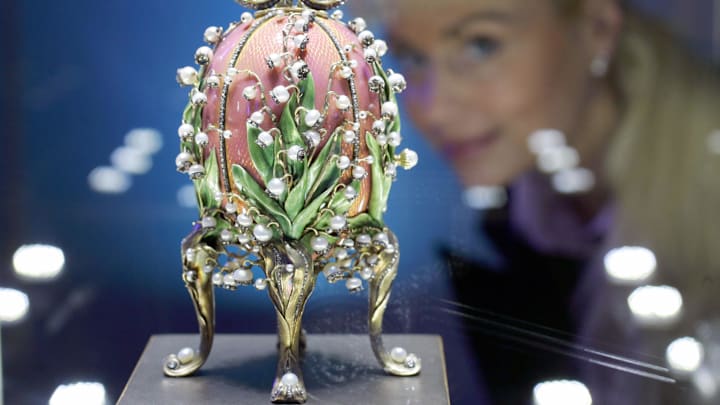
- Lilies of the Valley Egg
Winter Egg

Value: $30.2 million
Like an early spring bud peeking out of the snow, the famous Winter Egg is as delicate as can be, featuring a clear, glass-like crystal exterior covered in small white quartz snowflakes and set with approximately 4,500 tiny diamonds, all perched on a rock crystal base resembling melting ice. Designed by Alma Pihl, it was inspired by frost patterns on a workshop window, giving the piece its intricate, icy design.
Inside, the egg opens to reveal a hidden surprise—a miniature platinum basket filled with wood anemones and other carved flowers, symbolizing the return of spring. Created in 1913 as a gift from Tsar Nicholas II to his mother, it also marked the 300th anniversary of the Romanov dynasty.
In 2025, the Winter Egg sold at Christie’s in London for over $30 million, setting a world record as the highest auction price ever paid for a Fabergé Egg. It also marked the first Imperial Egg to be offered at public auction in more than 23 years.
Third Imperial Easter Egg

Value: ~$33 million
The Third Imperial Easter Egg is known not only for its 18-karat gold exterior, accented with sapphires and diamonds, but also for its mysterious disappearance during the Russian Revolution. Created in 1887, the egg opens to reveal a 14-karat gold Vacheron Constantin lady’s watch, adding to its rarity and significance. It was commissioned by Tsar Alexander III for Maria Feodorovna.
Originally crafted in Peter Carl Fabergé’s workshop, the egg vanished for decades before resurfacing nearly a century later in 2004 at a flea market, where a Midwest scrap metal dealer purchased it for just $14,000. Recognizing its true value, he sought out guidance from London dealer and Fabergé expert Wartski. In 2012, the egg was identified via a Google search as the lost Imperial Egg, confirming its historical significance.
In 2014, Wartski helped facilitate the sale of the egg to a private collector in the United States for an undisclosed price, though it’s estimated to be worth around $33 million.
Rothschild Clock Egg

Value: ~$25 million
This playful Fabergé Egg may share a resemblance to a cuckoo clock, with its crowing cockerel that pops up from the top every hour—but it’s far more than a whimsical timepiece. The pink-and-gold egg, along with its diamond- and pearl-encrusted clock, reflects the immense wealth of the Rothschild family, who commissioned it, while even the diamond-studded bird adds to its opulence.
One of the few Fabergé Eggs not created for the Russian Imperial family, the Rothschild Clock Egg was crafted in 1902 in the workshop of Michael Perchin at the request of Béatrice Ephrussi de Rothschild. After being lost to history, it resurfaced in 2007 and sold for $11.9 million, setting multiple auction records at the time. Today, the egg resides in the Hermitage Museum in St. Petersburg, and its estimated value has climbed to around $25 million, rivaling some of its Imperial counterparts.
Coronation Egg

Value: ~$18-24 million
As its name suggests, the Coronation Egg was commissioned by Tsar Nicholas II in 1897 as an Easter gift for his wife, Alexandra Feodorovna, to commemorate her coronation. The jeweled Fabergé Egg features a gold and yellow enamel exterior with a starburst pattern inspired by the cloth-of-gold robe worn by the Tsarina during the ceremony.
Inside, it opens to reveal a detailed gold and diamond miniature of the imperial carriage used at the coronation, adding to its historical significance and craftsmanship. The egg was sold to Malcolm Forbes for $2.16 million in 1979 and later acquired by Victor Vekselberg in 2004 as part of a larger collection of Fabergé Eggs.
The Imperial Coronation Egg could have become the most expensive decorative art object ever sold at auction had it reached the upper end of its estimated $18 million to $24 million value. Today, it’s housed at the Fabergé Museum in St. Petersburg, Russia.
Bay Tree Egg

Value: ~$15 million
Created in 1911, the beautiful Bay Tree Egg looks like it could be a part of a decorative Easter display to this day. The egg was commissioned by Tsar Nicholas II as a gift for his mother, the Dowager Empress Maria Feodorovna, and crafted from nephrite and enamel under the direction of Fabergé, with intricate details made of jade, diamonds, and rubies.
Its design is remarkably lifelike, with delicate branches adorned with leaves, blossoms, and tiny birds nestled among the foliage, giving the piece a sense of movement and life. Hidden inside is a mechanical surprise that showcases the level of craftsmanship Fabergé is known for, blending artistry with ingenuity. Like the Coronation Egg and the Lilies of the Valley Egg, it was sold to Vekselberg in 2004 and is now on display at the Fabergé Museum, where it’s estimated to be worth around $15 million.
Lilies of the Valley Egg

Value: ~$15-18 million
Unlike most Fabergé Eggs, the Lilies of the Valley Egg is crafted in the elegant Art Nouveau style. It was commissioned by Tsar Nicholas II in 1898 for his wife, Alexandra Feodorovna, reflecting the Tsarina’s well-known fondness for the delicate flower.
The egg’s soft pink enamel surface serves as a backdrop for an intricate arrangement of pearl- and diamond-studded lilies of the valley, their blossoms appearing to rise from slender stems of green and gold. Adding to its charm, a diamond-set button at the crown activates a hidden mechanism that opens the egg to reveal miniature portraits of the Tsar and his daughters, Grand Duchesses Olga and Tatiana.
Like others on this list, the Lilies of the Valley Egg was sold in 2004 from the Forbes Collection to Vekselberg for an estimated $15 million to $18 million and is currently exhibited at the Fabergé Museum.