%20%20--%3E%0A%3Csvg%20version%3D%221.1%22%20id%3D%22Layer_1%22%20xmlns%3D%22http%3A%2F%2Fwww.w3.org%2F2000%2Fsvg%22%20xmlns%3Axlink%3D%22http%3A%2F%2Fwww.w3.org%2F1999%2Fxlink%22%20x%3D%220px%22%20y%3D%220px%22%0A%09%20viewBox%3D%220%200%20684.6%2068.1%22%20style%3D%22enable-background%3Anew%200%200%20684.6%2068.1%3B%22%20xml%3Aspace%3D%22preserve%22%3E%0A%3Cg%3E%0A%09%3Cpath%20d%3D%22M444.1%2C29.3h-17.4v14.5h17.4V29.3z%20M36.4%2C68.1l29.3-50.8V0H50.4L32.9%2C36.8L15.5%2C0H0v68.1h16.7V45.8l12.4%2C22.3H36.4z%0A%09%09%20M49.1%2C68.1h16.6V23.4L49.1%2C52.1V68.1z%20M76.6%2C68.1h45V53.8H93.3V41.6h21V27.1h-21V14.8h28.3V0.1h-45V68.1z%20M175.6%2C68.1h17.3v-68%0A%09%09h-16.5v40.3L150%2C0.1h-17.6v68h16.7V27.7L175.6%2C68.1z%20M235.8%2C14.8h15.4V0.1h-47.4v14.7H219v53.2h16.8V14.8z%20M290.3%2C45.9h-17.1%0A%09%09l7.5-15.6h2L290.3%2C45.9z%20M298.7%2C68.1h18l-32.2-68h-5.7l-32%2C68h18l3.3-7.1h27.1L298.7%2C68.1z%20M325.2%2C68.1h46.2V53.8h-29.6V0.1h-16.7%0A%09%09V68.1z%20M423.7%2C14.8h27.2V0.1H407v68h16.7V14.8z%20M462%2C68.1h46.2V53.8h-29.6V0.1H462V68.1z%20M564.8%2C34.1c0%2C10.7-7.2%2C19.2-18.5%2C19.2%0A%09%09c-11.4%2C0-18.5-8.5-18.5-19.2s7.1-19.2%2C18.5-19.2C557.6%2C14.9%2C564.8%2C23.4%2C564.8%2C34.1%20M580.6%2C34.1c0-19-14.2-34-34.3-34%0A%09%09c-20.2%2C0-34.3%2C15-34.3%2C34c0%2C19%2C14.1%2C34%2C34.3%2C34C566.4%2C68.1%2C580.6%2C53.1%2C580.6%2C34.1%20M604.8%2C20.5c0-4.1%2C3.3-6.2%2C6.7-6.2%0A%09%09c4.4%2C0%2C6.6%2C3%2C6.6%2C6.6h14.7C631.8%2C9.1%2C625.1%2C0.1%2C611%2C0.1c-12%2C0-21.7%2C9.3-21.7%2C20.6c0%2C10.9%2C5.9%2C15.9%2C16.7%2C19.8%0A%09%09c5.2%2C1.8%2C11.5%2C3.2%2C11.5%2C8c0%2C3.3-2.4%2C5.5-6.4%2C5.5c-3.6%2C0-6.6-3-6.6-6.7h-15.2c0%2C11.5%2C7.9%2C20.8%2C21.8%2C20.8c12%2C0%2C21.6-9.3%2C21.6-20.6%0A%09%09c0-10-5.3-16.4-16.7-19.8C610.6%2C26.1%2C604.8%2C25.3%2C604.8%2C20.5%20M670%2C20.9h14.7C683.8%2C9.1%2C677.1%2C0.1%2C663%2C0.1c-12%2C0-21.7%2C9.3-21.7%2C20.6%0A%09%09c0%2C10.9%2C5.9%2C15.9%2C16.7%2C19.8c5.2%2C1.8%2C11.5%2C3.2%2C11.5%2C8c0%2C3.3-2.4%2C5.5-6.4%2C5.5c-3.6%2C0-6.6-3-6.6-6.7h-15.2c0%2C11.5%2C7.9%2C20.8%2C21.8%2C20.8%0A%09%09c12%2C0%2C21.6-9.3%2C21.6-20.6c0-10-5.3-16.4-16.7-19.8c-5.4-1.6-11.3-2.4-11.3-7.2c0-4.1%2C3.3-6.2%2C6.7-6.2C667.7%2C14.4%2C670%2C17.3%2C670%2C20.9%0A%09%09%22%2F%3E%0A%3C%2Fg%3E%0A%3C%2Fsvg%3E%0A)

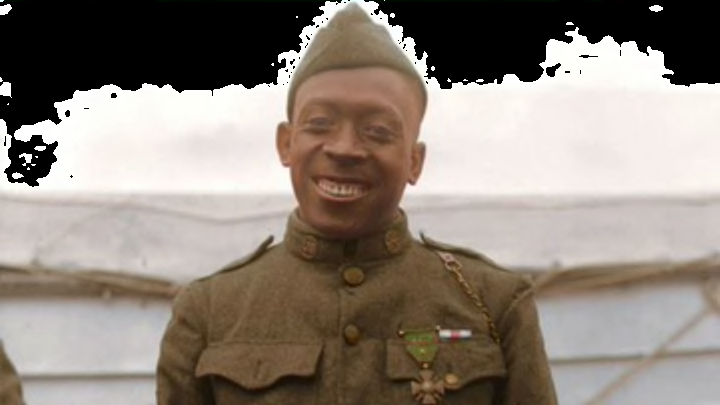
It was after midnight on May 15, 1918 when William Henry Johnson began to hear the rustling. Johnson was a long way from his home in Albany, New York, guarding a bridge in the Argonne Forest in Champagne, France. Sleeping next to him was Needham Roberts, a fellow soldier. Both men had enlisted in the New York National Guard just a few months earlier and were now part of the French Army, donated by U.S. forces to their understaffed allies in the thick of World War I.
As Johnson continued hearing the strange noises late into the night, he urged his partner to get up. A tired Roberts waved him off, believing Johnson was just nervous. Johnson decided to prepare himself just in case, piling up his assortment of grenades and rifle cartridges within arm's reach. If someone was coming, he would be ready.
The rustling continued. At one point, Johnson heard a clipping noise—what he suspected was the sound of the perimeter fence being cut. He again told Roberts to wake up. "Man," he said, "You better wake up pretty soon or you [might] never wake up."
The two began lobbing grenades into the darkness, hoping to discourage whoever might be lurking around the perimeter. Suddenly, in the middle of the French forest, Johnson saw dozens of German soldiers come charging, bayonets pointed toward him. They began to fire.
What transpired over the next hour would become an act of heroism that prompted former President Theodore Roosevelt to declare Johnson one of the bravest Americans to take up arms in the war. Johnson would even lead a procession back in New York City, with crowds lined up along the street to greet him.
Johnson may or may not have felt like a hero, though he certainly was. But he must have also felt something else—a sense of confusion. A man of color, he had been dispatched to a segregated regiment, where he received paltry combat training and was assigned menial tasks like unloading trucks. Even his homecoming parade was split up according to race. Henry Johnson, decorated virtually head to toe in French military honors, returned to a country that considered him both hero and a second-class citizen.
Though officers would later verify much of Johnson’s account of that night in the woods, his early life is harder to pin down. It has been reported that Johnson himself wasn’t quite sure when he was born. No one appeared to have kept a close eye on his birth certificate, which came out of Winston-Salem, North Carolina. The official U.S. Army website honoring Johnson’s service lists an approximate birth date of July 15, 1892. Other research indicates he could have been born as early as 1887 or as late as 1897.
After moving to New York as a teenager, Johnson took on an assortment of odd jobs; he was a chauffeur and a soda mixer, among other occupations. Depending on the account, he was living in Albany working either in a coal yard or as a railway porter when he opened a newspaper in the spring of 1917 and read that the 15th New York Infantry Regiment of the New York National Guard was accepting enlistees. The regiment was comprised entirely of black soldiers.

Johnson showed up on June 5, 1917, weighing a slight 130 pounds and standing 5 feet, 4 inches tall. Assigned to Company C of the 15th—which later became known as the 369th U.S. Infantry Regiment—he was quickly dispatched to Camp Wadsworth in South Carolina, where he trained along with the rest of the segregated unit. Though minorities had served in the U.S. military since the Revolutionary War, they often lacked support from officials and got inferior training compared to their white counterparts. At Camp Wadsworth, Johnson was said to have been used primarily as labor, unloading supplies and digging latrines. If there was one bright spot during this time, it was that he married his wife, Georgina Edna Jackson, that September.
Johnson and the 369th were sent to France on January 1, 1918. There they continued laboring, which frustrated their commander, Colonel William Hayward. Hayward lobbied his superiors to give his men a chance in combat. Since France was experiencing a shortage of men, the 369th—which later became known as the Harlem Hellfighters because many of their members had come from Harlem in New York City—joined the 161st Division of the French Army, even wearing the jackets and helmets of the foreign military.
To the French, Johnson and his fellow soldiers were a welcome solution to their lack of manpower. Sent to the front lines in March 1918, Johnson and the others learned enough French to understand commands from superiors. They were armed with rifles and held on to the bolo knives used by the U.S. Army. The imposing 14-inch blades weighed more than a pound and had much of their weight running along the back, giving them a cleaving action similar to a machete. Johnson would soon be glad he had such a weapon on his waist.
Along with Needham Roberts—a man from Trenton, New Jersey—Johnson was assigned sentry duty on the western edge of the Argonne Forest. Patrolling near a bridge, Johnson and Roberts were given the late shift, on patrol until midnight on the evening of May 14. It would be a night neither he nor Roberts would ever forget.
As their shift wound down, Johnson saw two relief soldiers approaching. The soldiers were young and inexperienced, and Johnson felt uncomfortable leaving them alone. He stayed put and surveyed the area while Roberts went to rest in a trench. Shortly thereafter, he began to hear the rustling noises, which eventually became German soldiers rushing through the darkness. Johnson realized they were surrounded, and urged Roberts to run for help. But Roberts didn't get far before he decided to come back and help, and was soon hit by the shrapnel of a grenade in his arm and hip.
Still conscious, Roberts handed Johnson grenades to toss. When those ran out, Johnson began firing his rifle while being hit by bullets in his side, hand, and head. Quickly, Johnson shoved an American cartridge into his French rifle, but the ammunition and the weapon were incompatible. The rifle jammed. As the Germans swarmed him, Johnson began using the rifle like a club, smashing it over their heads and into their faces.
After the butt of the rifle finally fell apart, Johnson went down with a blow to the head. But he climbed back up, drew his bolo knife, and charged forward. The blade went deep into the first German he encountered, killing the man. More gruesome work with the weapon followed, with Johnson hacking and stabbing bodies even as bullets continued to strike him.

At one point, Johnson noticed the Germans had grabbed Roberts and were attempting to haul him away. He intervened, stabbing more soldiers, including one in the ribs.
The melee went on for roughly an hour, he said. When reinforcements finally arrived, the remaining Germans fled. Johnson was given medical attention. So was Roberts. Both lived.
The next day, military officials visited the scene of the battle. German helmets rested on the ground, along with puddles of blood. Four bodies were left behind. The officials estimated Johnson had wounded up to 24 others. Some men who walked the site said the death toll was six, with Johnson injuring 32 men. After all the fighting, Johnson had prevented the Germans from breaking the French line.
The nicknames came fast. The bridge was declared “the Battle of Henry Johnson.” Johnson himself was given the unofficial label “the Black Death” and the official rank of sergeant. He was headed back home.
Before they departed, the French honored Johnson and Roberts with the Croix de Guerre, one of France’s highest awards for valor. They were the first two Americans to receive it. Johnson’s was amended with the addition of the Gold Palm, intended to signify extraordinary valor.
It was an honor, though one that came with a heavy price. Johnson later estimated he had been shot five times, the bullets striking both feet, his thigh, his arm, and even his head. A scar stretched over his lip. A bayonet had been plunged into his torso—twice. He had to have a metal plate inserted into his left foot. In all, Johnson endured 21 injuries as a result of his defiant stand against the Germans.
Back home, he convalesced as the country sang his praises. Often, such reports of his bravery took pains to note he was a man of color. "When proudly speaking of fighting races we must not overlook the American Negro," read an editorial in the New York Evening Telegram. Other times, Johnson found himself in the peculiar position of being celebrated while simultaneously being reminded of his purportedly inferior status. The parade that honored the Harlem Hellfighters in February 1919 ran for seven miles, with Johnson leading the procession in an open-topped cab. But the Hellfighters could not march with their white counterparts.

Unfortunately, Johnson’s postwar life remains as murky as his earliest years. He reportedly received disability payments from the government as well as medical care, but it’s unknown to what extent that supported him or how badly his injuries kept him from employment opportunities. (He did ask for, and received, as much as $100 per minute during speaking engagements in cities such as St. Louis—well over $1000 in today's money.) An attempt was made by the Albany Afro-American Association to raise money to build him a home as a way of expressing gratitude for his service, but it’s unclear whether the effort was successful. On July 1, 1929, Johnson died of myocarditis (an inflammation of the heart muscle) while living in Washington, D.C. He was awarded a posthumous Purple Heart in 1996.
For years, it was unclear what became of Johnson's remains. In 2002, when the historians at the New York Division of Military and Naval Affairs researched his service at the behest of his descendants (though it was later discovered they were mistaken and not actually related to Johnson), the historians determined Johnson was buried at Arlington National Cemetery with full military honors. With confirmation of the gravesite, Johnson also became eligible for and was awarded the Distinguished Service Cross in 2002.
In 2015, President Barack Obama awarded him the Medal of Honor, which was accepted on Johnson’s behalf by Sergeant Major Louis Wilson of the New York National Guard. And every June 5, Albany celebrates Henry Johnson Day in acknowledgement of the day he enlisted. The city also gives out a Henry Johnson Award for Distinguished Community Service for those making contributions in the area.
Those honors joined the Croix de Guerre, which Johnson was said to have worn with humility. He sometimes needed to be prodded into discussing his act of bravery, as if it were of no major consequence. “There wasn’t anything so fine about it,” he said. “[I] just fought for my life. A rabbit would have done that."