%20%20--%3E%0A%3Csvg%20version%3D%221.1%22%20id%3D%22Layer_1%22%20xmlns%3D%22http%3A%2F%2Fwww.w3.org%2F2000%2Fsvg%22%20xmlns%3Axlink%3D%22http%3A%2F%2Fwww.w3.org%2F1999%2Fxlink%22%20x%3D%220px%22%20y%3D%220px%22%0A%09%20viewBox%3D%220%200%20684.6%2068.1%22%20style%3D%22enable-background%3Anew%200%200%20684.6%2068.1%3B%22%20xml%3Aspace%3D%22preserve%22%3E%0A%3Cg%3E%0A%09%3Cpath%20d%3D%22M444.1%2C29.3h-17.4v14.5h17.4V29.3z%20M36.4%2C68.1l29.3-50.8V0H50.4L32.9%2C36.8L15.5%2C0H0v68.1h16.7V45.8l12.4%2C22.3H36.4z%0A%09%09%20M49.1%2C68.1h16.6V23.4L49.1%2C52.1V68.1z%20M76.6%2C68.1h45V53.8H93.3V41.6h21V27.1h-21V14.8h28.3V0.1h-45V68.1z%20M175.6%2C68.1h17.3v-68%0A%09%09h-16.5v40.3L150%2C0.1h-17.6v68h16.7V27.7L175.6%2C68.1z%20M235.8%2C14.8h15.4V0.1h-47.4v14.7H219v53.2h16.8V14.8z%20M290.3%2C45.9h-17.1%0A%09%09l7.5-15.6h2L290.3%2C45.9z%20M298.7%2C68.1h18l-32.2-68h-5.7l-32%2C68h18l3.3-7.1h27.1L298.7%2C68.1z%20M325.2%2C68.1h46.2V53.8h-29.6V0.1h-16.7%0A%09%09V68.1z%20M423.7%2C14.8h27.2V0.1H407v68h16.7V14.8z%20M462%2C68.1h46.2V53.8h-29.6V0.1H462V68.1z%20M564.8%2C34.1c0%2C10.7-7.2%2C19.2-18.5%2C19.2%0A%09%09c-11.4%2C0-18.5-8.5-18.5-19.2s7.1-19.2%2C18.5-19.2C557.6%2C14.9%2C564.8%2C23.4%2C564.8%2C34.1%20M580.6%2C34.1c0-19-14.2-34-34.3-34%0A%09%09c-20.2%2C0-34.3%2C15-34.3%2C34c0%2C19%2C14.1%2C34%2C34.3%2C34C566.4%2C68.1%2C580.6%2C53.1%2C580.6%2C34.1%20M604.8%2C20.5c0-4.1%2C3.3-6.2%2C6.7-6.2%0A%09%09c4.4%2C0%2C6.6%2C3%2C6.6%2C6.6h14.7C631.8%2C9.1%2C625.1%2C0.1%2C611%2C0.1c-12%2C0-21.7%2C9.3-21.7%2C20.6c0%2C10.9%2C5.9%2C15.9%2C16.7%2C19.8%0A%09%09c5.2%2C1.8%2C11.5%2C3.2%2C11.5%2C8c0%2C3.3-2.4%2C5.5-6.4%2C5.5c-3.6%2C0-6.6-3-6.6-6.7h-15.2c0%2C11.5%2C7.9%2C20.8%2C21.8%2C20.8c12%2C0%2C21.6-9.3%2C21.6-20.6%0A%09%09c0-10-5.3-16.4-16.7-19.8C610.6%2C26.1%2C604.8%2C25.3%2C604.8%2C20.5%20M670%2C20.9h14.7C683.8%2C9.1%2C677.1%2C0.1%2C663%2C0.1c-12%2C0-21.7%2C9.3-21.7%2C20.6%0A%09%09c0%2C10.9%2C5.9%2C15.9%2C16.7%2C19.8c5.2%2C1.8%2C11.5%2C3.2%2C11.5%2C8c0%2C3.3-2.4%2C5.5-6.4%2C5.5c-3.6%2C0-6.6-3-6.6-6.7h-15.2c0%2C11.5%2C7.9%2C20.8%2C21.8%2C20.8%0A%09%09c12%2C0%2C21.6-9.3%2C21.6-20.6c0-10-5.3-16.4-16.7-19.8c-5.4-1.6-11.3-2.4-11.3-7.2c0-4.1%2C3.3-6.2%2C6.7-6.2C667.7%2C14.4%2C670%2C17.3%2C670%2C20.9%0A%09%09%22%2F%3E%0A%3C%2Fg%3E%0A%3C%2Fsvg%3E%0A)

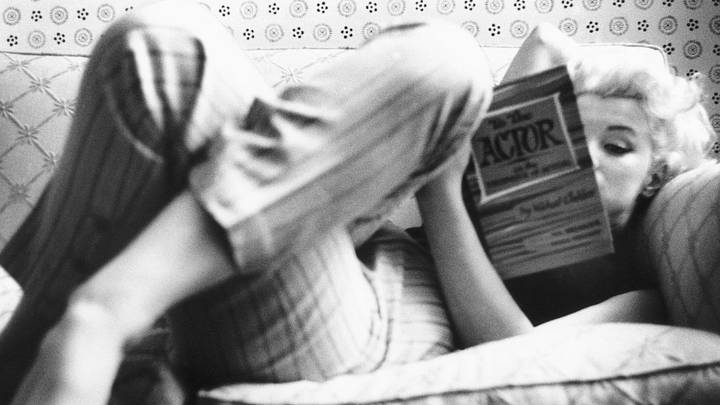
Marilyn Monroe was many things—an actress, a model, and a cultural icon who remains one of the most recognizable faces ever to come out of the American entertainment industry, to name a few.
She was also an avid reader who deeply loved literature. At the time of her death, her personal library contained over 400 books. According to biographers, Monroe lived in 49 different places over the course of her 36 years, and her books accompanied her through much of that instability.
Marilyn Monroe’s Love of Reading

Literary figures were a large part of Monroe’s life. She crossed paths with writers from Vladimir Nabokov to John Steinbeck and was married to the playwright Arthur Miller. Her library, meanwhile, included hefty texts by authors from Marcel Proust to Albert Camus, as well as poetry by William Blake and Walt Whitman, biographies of Sigmund Freud, and more.
In 1951, just as her career was taking off, Monroe enrolled in two 10-week literature classes at UCLA. Some people called this a publicity stunt, an accusation that continued to plague Monroe. Many people also had trouble believing she actually was reading the book Ulysses by James Joyce after being photographed in the park with it, even though the photographer later confirmed Monroe had been reading for a while before the photos were taken.
But Monroe’s love of reading was genuine, according to Gale Crowther’s book Marilyn and Her Books, which tells the story of Monroe’s lifelong love affair with reading. The actress, who suffered from crippling insecurities and imposter syndrome during her life, is believed to have frequently read books in an effort at self-improvement.
“It is worth considering that much of Marilyn’s reading was her attempt to ‘better’ herself,” Crowther writes, pointing out that her collection didn’t contain many contemporary bestsellers of her time. “If she felt a genre was not going to help with that, or worse still, if she would become a joke for reading it, then it may go some way to explain why she avoided it.”
Monroe had strong opinions about the books she read, too. “Those big tough guys are so sick, they aren’t even all that tough,” she once said of Hemingway. “…They always want to kill something to prove themselves.”
Yet journalists rarely asked her about books and reading habits. She also struggled to be seen as intelligent among her social circles, and claimed that friends of her then-husband Arthur Miller treated her like “a dull little sex object with no brains and talked to me like a high school principal with a backward student.” Miller also famously insulted Monroe’s intelligence in a diary which she found and read, an event that led to their divorce.
How Marilyn Monroe’s Personal Library Became Public

Monroe would be turning 100 in 2026 if she had not died at age 36. Her dreams for the future were literary, too—she dreamed of playing Lady Macbeth and Ophelia, and even imagined launching a Marilyn Monroe Shakespeare Festival.
We can only speculate about whether she might have published some books of her own had she lived. We do know that she loved writing poetry and used it as a way to process her emotions, which were often overwhelming; Monroe suffered from crippling anxiety, insomnia, and other ailments. And we also know that she lived her life surrounded by books, many of which were dog-eared and covered in notes and commentary.
Monroe passed away in 1962 after overdosing on barbiturates. After her death, no one quite knew what to do with her stacks of books. They were moved from Los Angeles to a storage unit in Manhattan, where they remained until her acting coach Lee Strasberg—who had been the recipient of most of Monroe’s estate—died in 1982.
Following that, Strasberg’s third wife Anna Strasberg inherited ownership of the books. In 1999, she had Christie’s auction house sell off Monroe’s property, including her library. Below is the full list.
Marilyn Monroe's Personal Library: Literary Fiction and Classics
Winesburg, Ohio — Sherwood Anderson
The Unnamable — Samuel Beckett
The Woman Who Was Poor — Léon Bloy
God’s Little Acre — Erskine Caldwell
The Fall — Albert Camus
The Rebel — Albert Camus
Mr. Roberts — Joyce Cary
The Secret Agent — Joseph Conrad
The American Claimant & Other Stories & Sketches — Mark Twain
The Adventures Of Huckleberry Finn — Mark Twain
In Defense Of Harriet Shelley & Other Essays — Mark Twain
Roughing It — Mark Twain
The Sound And The Fury / As I Lay Dying — William Faulkner
Invisible Man — Ralph Ellison
Camille — Alexandre Dumas
Justine — Lawrence Durrell
Balthazar — Lawrence Durrell
Madame Bovary — Gustave Flaubert
From Russia With Love — Ian Fleming
Spartacus — Howard Fast
Tender Is The Night — F. Scott Fitzgerald
The Great Gatsby — F. Scott Fitzgerald
A European Education — Romain Gary
Brighton Rock — Graham Greene
A Farewell To Arms — Ernest Hemingway
The Sun Also Rises — Ernest Hemingway
The War Lover — John Hersey
Green Mansions — W.H. Hudson
Ulysses — James Joyce
The Last Temptation Of Christ — Nikos Kazantzakis
On The Road — Jack Kerouac
Fowlers End — Gerald Kersh
Independent People — Halldór Laxness
The Best Of All Worlds, Or, What Voltaire Never Knew — Hans Jørgen Lembourn
Hear Us O Lord From Heaven Thy Dwelling Place — Malcolm Lowry
The Assistant — Bernard Malamud
The Magic Barrel — Bernard Malamud
The Deer Park — Norman Mailer
Death In Venice & Seven Other Stories — Thomas Mann
Last Essays — Thomas Mann
The Thomas Mann Reader — Thomas Mann
The Magic Christian — Terry Southern
Hawaii — James Michener
The Story Of Esther Costello — Nicholas Monsarrat
The Guide — R.K. Narayan
Jonathan — Russell O’Neill
The Contenders — John Wain
The Carpetbaggers — Harold Robbins
The Mark Of The Warrior — Paul Scott
The 7th Cross — Anna Seghers
The Dancing Bear — Edzard Schaper
Strike For A Kingdom — Menna Gallie
The Building — Peter Martin
The Mermaids — Boros
The Story Of A Novel — Thomas Wolfe
Look Homeward, Angel — Thomas Wolfe
A Stone, A Leaf, A Door — Thomas Wolfe
Thomas Wolfe’s Letters To His Mother — Thomas Wolfe
The Devil’s Advocate — Morris L. West
Miss America — Daniel Stren
The Cat With 2 Faces — Gordon Young
The Rains Came — Louis Bromfield
Lust For Life — Irving Stone
The Little Prince — Antoine de Saint-Exupéry
Swann’s Way — Marcel Proust
The Guermantes Way — Marcel Proust
Cities Of The Plain — Marcel Proust
Within A Budding Grove — Marcel Proust
The Sweet Cheat Gone — Marcel Proust
The Captive — Marcel Proust
Nana — Émile Zola
Crime And Punishment — Fyodor Dostoevsky
The House Of The Dead — Fyodor Dostoevsky
The Brothers Karamazov — Fyodor Dostoevsky
Smoke — Ivan Turgenev
Redemption & Other Plays — Leo Tolstoy
Poetry
Selected Poems — Rafael Alberti
The Portable Blake — William Blake
Poems Of Robert Burns — Robert Burns
Poe: Complete Poems — Edgar Allan Poe
Poet In New York — Federico García Lorca
The Poetry & Prose Of Heinrich Heine — Heinrich Heine
Selected Poetry — Robinson Jeffers
Aragon: Poet Of The French Resistance — Hannah Josephson & Malcolm Cowley
Selected Poems — D.H. Lawrence
The Vapor Trail — Ivan Lawrence Becker
Collected Sonnets — Edna St. Vincent Millay
The Poetical Works Of John Milton — John Milton
Poems — John Tagliabue
The Portable Walt Whitman
Robert Frost’s Poems — Robert Frost
Selected Poems — Rainer Maria Rilke
The Poetical Works Of Shelley — Percy Bysshe Shelley
William Shakespeare: Sonnets — William Shakespeare
Wordsworth — Richard Wilbur
Poems Of W.B. Yeats — W.B. Yeats
Drama and Theater
Peace And Lysistrata — Aristophanes
Antigone — Jean Anouilh
Bell, Book And Candle — John Van Druten
The Women — Clare Boothe Luce
Born Yesterday — Garson Kanin
Golden Boy — Clifford Odets
Clash By Night — Clifford Odets
The Country Girl — Clifford Odets
6 Plays Of Clifford Odets — Clifford Odets
Long Day’s Journey Into Night — Eugene O’Neill
Anna Christie / The Emperor Jones / The Hairy Ape — Eugene O’Neill
Red Roses For Me — Sean O’Casey
I Knock At The Door — Sean O’Casey
Selected Plays — Sean O’Casey
The Green Crow — Sean O’Casey
Plays — Molière
Selected Plays Of George Bernard Shaw — George Bernard Shaw
The Potting Shed — Graham Greene
Psychology, Philosophy, and Spirituality
Theory Of Poetry And Fine Art — Aristotle
Metaphysics — Aristotle
The Magic Of Believing — Claude M. Bristol
The Power Within You — Claude M. Bristol
The Tales Of Rabbi Nachman — Martin Buber
The Masks Of God: Primitive Mythology — Joseph Campbell
The Wisdom Of The Sands — Antoine de Saint-Exupéry
Moses And Monotheism — Sigmund Freud
The Psychopathology Of Everyday Life — Sigmund Freud
The Art Of Loving — Erich Fromm
What Is A Jew? — Morris Kertzer
Man Against Himself — Karl A. Menninger
Peace Of Mind — Joshua Loth Liebman
The Prophet — Kahlil Gibran
Jesus — Kahlil Gibran
Why I Am Not A Christian — Bertrand Russell
Our Knowledge Of The External World — Bertrand Russell
Common Sense And Nuclear Warfare — Bertrand Russell
The Philosophy Of Plato
The Philosophy Of Schopenhauer — Irwin Edman
The Philosophy Of Spinoza — Joseph Ratner
The Saviours Of God: Spiritual Exercises — Nikos Kazantzakis
Acting, Film, and Performance
To The Actor — Michael Chekhov
How Stanislavsky Directs — Nikolai Gorchakov
An Actor Prepares — Konstantin Stanislavski
The Flower In Drama And Glamour — Stark Young
Marilyn Monroe — George Carpozi
Let’s Make Love — Matthew Andrews
Politics, History, and Social Criticism
The Wall Between — Anne Braden
The Roots Of American Communism — Theodore Draper
Das Kapital — Karl Marx
Democracy In America — Alexis de Tocqueville
The Truth About The Munich Crisis — Viscount Maugham
Minister Of Death: The Adolf Eichmann Story — Quentin Reynolds, Ephraim Katz & Zwy Aldouby
The Devil In Massachusetts — Marion Starkey
Journey To The Beginning — Edgar Snow
Biography, Memoir, and Correspondence
Act One — Moss Hart
Dance To The Piper — Agnes de Mille
Close To Colette — Maurice Goudeket
The Summing Up — W. Somerset Maugham
Goodness Had Nothing To Do With It — Mae West
Napoleon — Emil Ludwig
Eleonora Duse: A Biography — William Weaver
Art, Photography, and Music
Renoir — Albert Skira
Jean Dubuffet — Daniel Cordier
The Family Of Man — Carl Sandburg
Beethoven: His Spiritual Development — J.W.N. Sullivan
Schubert — Ralph Bates
Music For The Millions — David Ewen
Science, Medicine, and Reference
Out Of My Later Years — Albert Einstein
The Open Mind — J. Robert Oppenheimer
Of Stars And Men — Harlow Shapley
Baby & Child Care — Benjamin Spock
The Boston Cooking-School Cook Book — Fannie Merritt Farmer
The New Joy Of Cooking — Irma S. Rombauer & Marion Rombauer Becker
Roget’s Pocket Thesaurus — C.O. Mawson & K.A. Whiting
Hugo’s Pocket Dictionary: French-English And English-French
Travel, Humor, and Miscellaneous
How To Travel Incognito — Ludwig Bemelmans
To The One I Love Best — Ludwig Bemelmans
A Time In Rome — Elizabeth Bowen
London — Jacques Boussard
Man-Eaters Of India — Jim Corbett
Jungle Lore — Jim Corbett
My India — Jim Corbett
How To Talk At Gin — Ernie Kovacs
Snobs — Russell Lynes
How To Do It, Or, The Art Of Lively Entertaining — Elsa Maxwell
Wake Up, Stupid — Mark Harris
The Little Engine That Could — Watty Piper