%20%20--%3E%0A%3Csvg%20version%3D%221.1%22%20id%3D%22Layer_1%22%20xmlns%3D%22http%3A%2F%2Fwww.w3.org%2F2000%2Fsvg%22%20xmlns%3Axlink%3D%22http%3A%2F%2Fwww.w3.org%2F1999%2Fxlink%22%20x%3D%220px%22%20y%3D%220px%22%0A%09%20viewBox%3D%220%200%20684.6%2068.1%22%20style%3D%22enable-background%3Anew%200%200%20684.6%2068.1%3B%22%20xml%3Aspace%3D%22preserve%22%3E%0A%3Cg%3E%0A%09%3Cpath%20d%3D%22M444.1%2C29.3h-17.4v14.5h17.4V29.3z%20M36.4%2C68.1l29.3-50.8V0H50.4L32.9%2C36.8L15.5%2C0H0v68.1h16.7V45.8l12.4%2C22.3H36.4z%0A%09%09%20M49.1%2C68.1h16.6V23.4L49.1%2C52.1V68.1z%20M76.6%2C68.1h45V53.8H93.3V41.6h21V27.1h-21V14.8h28.3V0.1h-45V68.1z%20M175.6%2C68.1h17.3v-68%0A%09%09h-16.5v40.3L150%2C0.1h-17.6v68h16.7V27.7L175.6%2C68.1z%20M235.8%2C14.8h15.4V0.1h-47.4v14.7H219v53.2h16.8V14.8z%20M290.3%2C45.9h-17.1%0A%09%09l7.5-15.6h2L290.3%2C45.9z%20M298.7%2C68.1h18l-32.2-68h-5.7l-32%2C68h18l3.3-7.1h27.1L298.7%2C68.1z%20M325.2%2C68.1h46.2V53.8h-29.6V0.1h-16.7%0A%09%09V68.1z%20M423.7%2C14.8h27.2V0.1H407v68h16.7V14.8z%20M462%2C68.1h46.2V53.8h-29.6V0.1H462V68.1z%20M564.8%2C34.1c0%2C10.7-7.2%2C19.2-18.5%2C19.2%0A%09%09c-11.4%2C0-18.5-8.5-18.5-19.2s7.1-19.2%2C18.5-19.2C557.6%2C14.9%2C564.8%2C23.4%2C564.8%2C34.1%20M580.6%2C34.1c0-19-14.2-34-34.3-34%0A%09%09c-20.2%2C0-34.3%2C15-34.3%2C34c0%2C19%2C14.1%2C34%2C34.3%2C34C566.4%2C68.1%2C580.6%2C53.1%2C580.6%2C34.1%20M604.8%2C20.5c0-4.1%2C3.3-6.2%2C6.7-6.2%0A%09%09c4.4%2C0%2C6.6%2C3%2C6.6%2C6.6h14.7C631.8%2C9.1%2C625.1%2C0.1%2C611%2C0.1c-12%2C0-21.7%2C9.3-21.7%2C20.6c0%2C10.9%2C5.9%2C15.9%2C16.7%2C19.8%0A%09%09c5.2%2C1.8%2C11.5%2C3.2%2C11.5%2C8c0%2C3.3-2.4%2C5.5-6.4%2C5.5c-3.6%2C0-6.6-3-6.6-6.7h-15.2c0%2C11.5%2C7.9%2C20.8%2C21.8%2C20.8c12%2C0%2C21.6-9.3%2C21.6-20.6%0A%09%09c0-10-5.3-16.4-16.7-19.8C610.6%2C26.1%2C604.8%2C25.3%2C604.8%2C20.5%20M670%2C20.9h14.7C683.8%2C9.1%2C677.1%2C0.1%2C663%2C0.1c-12%2C0-21.7%2C9.3-21.7%2C20.6%0A%09%09c0%2C10.9%2C5.9%2C15.9%2C16.7%2C19.8c5.2%2C1.8%2C11.5%2C3.2%2C11.5%2C8c0%2C3.3-2.4%2C5.5-6.4%2C5.5c-3.6%2C0-6.6-3-6.6-6.7h-15.2c0%2C11.5%2C7.9%2C20.8%2C21.8%2C20.8%0A%09%09c12%2C0%2C21.6-9.3%2C21.6-20.6c0-10-5.3-16.4-16.7-19.8c-5.4-1.6-11.3-2.4-11.3-7.2c0-4.1%2C3.3-6.2%2C6.7-6.2C667.7%2C14.4%2C670%2C17.3%2C670%2C20.9%0A%09%09%22%2F%3E%0A%3C%2Fg%3E%0A%3C%2Fsvg%3E%0A)

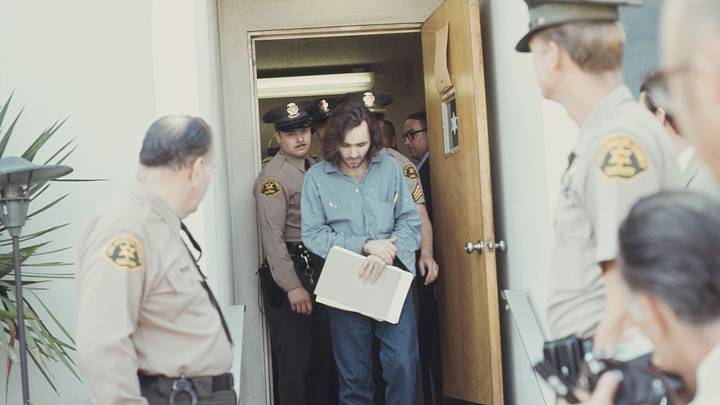
Over the years, Charles Manson and the web of horror he created have evolved to become fixtures of popular culture. Manson, his cult, and their bloody actions have inspired everything from films like Quentin Tarantino’s Once Upon a Time... in Hollywood to Emma Cline’s bestselling novel The Girls. Then, of course, there’s the cottage industry of documentaries that have popped up around Manson, including Netflix's recent Conversations with a Killer: The Charles Manson Tapes.
Manson relished all this popularity and fed it while he was alive, intentionally creating a media circus during his trial and famously giving interviews and engaging with the huge amounts of mail he received behind bars. Of course, with great fame comes a great amount of misinformation. Some popular beliefs about Manson are just plain wrong—so just how accurate are your own beliefs about this infamous cult leader of the 1960s?
- Misconception: Charles Manson was a serial killer
- Misconception: Manson specifically chose to kill Sharon Tate
- Misconception: Manson’s followers were all completely brainwashed
- Misconception: Helter Skelter was the sole reason for the Manson family murders
- Misconception: Manson was a genuine hippie
- Misconception: Manson was a criminal mastermind
- Misconception: Manson was clinically insane
Misconception: Charles Manson was a serial killer

The cult Manson led, called the Family, was indeed responsible for killing seven people across two nights in Los Angeles. In total, they killed nine people in the summer of 1969. Yet Manson himself was not the person who actually committed these murders. Instead, he successfully manipulated his followers into doing so on his behalf.
Manson was nowhere near 10050 Cielo Drive on the night his followers killed the actress Sharon Tate, her friends Wojciech Frykowski, Abigail Folger, and Jay Sebring, and a 19-year-old visitor named Steven Parent. But he did personally tie up victims Leno and Rosemary LaBianca the following night after being “displeased at the sloppiness of the previous night's murders,” per CNN, and then left after ordering his followers to finish the job.
Misconception: Manson specifically chose to kill Sharon Tate

As Manson’s most famous victim, many people automatically assume that Manson chose to target Sharon Tate and her unborn child. Yet there is no indication that Manson had any idea who was staying at 10050 Cielo Drive that night.
Instead, it is believed that he may have sent his followers to that specific house in order to scare its previous owner, Terry Melcher, a record executive who had declined to sign Manson to a recording deal. Unfortunately, Tate—then the pregnant wife of Roman Polanski and a Hollywood star with a thriving career—was an unintended victim.
Misconception: Manson’s followers were all completely brainwashed

Many of Manson’s followers were indeed deeply under Manson's influence, drawn in by manipulation tactics including heavy drug use, sleep deprivation, isolation from the rest of the world, and other strategies that left them completely convinced he was a kind of all-knowing, benevolent messiah.
In total, Manson’s cult reportedly consisted of over 100 people at different times, with about 20 or 30 being core followers. Of course, Manson was not able to keep all of them under his spell, and some left after Manson’s gospel became more violent. And while some followers have never been able to shake off Manson’s influence, many have grown to regret their actions in later years. Linda Kasabian, a Manson follower who was present at the Tate murders, testified that she tried to stop the killings as they occurred and later testified against Manson and his group.
Misconception: Helter Skelter was the sole reason for the Manson family murders

At the time of the Manson murders, the driving force behind them was widely believed to have been Manson’s belief that an apocalyptic race war called Helter Skelter was coming, which he claimed would leave his cult—called the Family—in power. During his trial, the prosecution alleged that Manson believed the Tate-LaBianca murders would incite this war.
Still, there may have been other, less grandiose (but no less evil) reasons behind the killings. In July 1969, Family members Bobby Beausoleil and Susan Atkins tortured and killed a man named Gary Hinman after Hinman reportedly sold them bad drugs, though some have claimed Hinman was killed for money that members of the Family believed he had.
Beausoleil was arrested shortly after the killing, and according to one popular theory, Manson may have ordered the Tate-LaBianca murders because he wanted authorities to think Hinman’s killer was still at large and therefore release Beausoleil. Simple vengeance may have also played a role, as some have blamed the Tate murders on the fact that the house where they took place was previously home to Melcher.
The Manson family was also responsible for the death of Donald “Shorty” Shea, who was a friend of George Spahn, the owner of the Family’s home base of Spahn Ranch. Shea’s murder may have been partly motivated by the fact that Shea was part of a plan to kick the Family off the ranch. Some also believe that the famously racist and white supremacist Manson took issue with the fact that Shea, a white man, was married to a Black woman.
Misconception: Manson was a genuine hippie

Manson is often associated with the hippie and counterculture movements, and indeed, most of the people he preyed on were part of this movement or wanted to be. Manson and his followers certainly did embody some of its stereotypes, from the LSD- and hash-fueled haze his Family lived in to the men’s long hair and the followers' general dirtiness.
But Manson actually disdained the hippie movement. “As [Manson] saw it, hippies were weak and ineffectual, and where they aimed to expand their consciousness, he wanted his followers ‘dead in the head,’” wrote Tom O'Neill and Dan Piepenbring for The Washington Post.
At the end of the day, the actual machinations of Manson’s cult and life were fundamentally different from the peace and love ideals of the hippie movement. “The murders weren’t random at all, nor were they a reactionary backlash to normative American culture; rather, they were an outgrowth of Manson’s warped sense that he was entitled to all the power and fortune he desired,” wrote Aja Vermano for Vox, per Bunk History. “Manson, like many psychotically predatory men whose violence has hypnotized American culture, was really just an everyday misogynist. He wasn’t a product of ’60s counterculture—he was a master manipulator of it, one who used the ‘free love’ ethos of the time to prey on a cadre of troubled, abused young women, who continued to carry out his thirst for violence even after he was in jail.”
Misconception: Manson was a criminal mastermind

While creating her documentary Helter Skelter: An American Myth, director Lesley Chilcott told Vanity Fair that she was partly motivated by the fact that “the myth that Charlie was this intelligent criminal mastermind needed to be busted.”
In actuality, Manson was largely unsuccessful at many of his efforts throughout his life. He was unsuccessful as a musician, a husband and father, and even as a criminal. At 16, he was arrested for driving a stolen car over state lines and was imprisoned in 1951 and released in 1952. He was then imprisoned again from 1956 to 1958 and again from 1960 to 1967 after attempting to become a pimp. Manson was a master manipulator, but he also seems to have been very good at getting caught.
Misconception: Manson was clinically insane

Early theories blamed Manson’s violent and erratic behavior on schizophrenia, but more recent assessments have poked holes in this belief. In 1985, Manson was declared “not mentally ill” following a stay in a psychiatric facility and was sent back to prison. Still, the widespread belief that he was schizophrenic persisted.
In 2017, following Manson’s death, a team of psychologists was given access to a full psychiatric evaluation of Manson that had been conducted in 1997. “The takeaway is Manson was not schizophrenic. That’s the main, really clear thing,” said Dr. Joni Mihura, a psychology professor at The University of Toledo. “From our contemporary analysis, it looks like he might have a little bit of hypomania, but not mania. It also became really clear how his narcissism fueled his need to be the focus of attention, and he maintained that focus until he died.”
Manson did indeed seem to be adept at presenting a facade of madness in order to manipulate law enforcement and the public, sometimes adopting a persona he nicknamed “Crazy Charlie” during court appearances and other encounters.
Certainly, he was able to convince his followers of his sanity. “Charlie told us then that if he was ever arrested, he would put on his ‘Crazy Charlie’ act until he convinced the police that he was insane and not responsible for what he might have done,” Family member Leslie Van Houten told Simon & Schuster. “He told us that while he was sure he could fool everyone else, we needed to remember it was just an act. And it was. He was never crazy at all.”