%20%20--%3E%0A%3Csvg%20version%3D%221.1%22%20id%3D%22Layer_1%22%20xmlns%3D%22http%3A%2F%2Fwww.w3.org%2F2000%2Fsvg%22%20xmlns%3Axlink%3D%22http%3A%2F%2Fwww.w3.org%2F1999%2Fxlink%22%20x%3D%220px%22%20y%3D%220px%22%0A%09%20viewBox%3D%220%200%20684.6%2068.1%22%20style%3D%22enable-background%3Anew%200%200%20684.6%2068.1%3B%22%20xml%3Aspace%3D%22preserve%22%3E%0A%3Cg%3E%0A%09%3Cpath%20d%3D%22M444.1%2C29.3h-17.4v14.5h17.4V29.3z%20M36.4%2C68.1l29.3-50.8V0H50.4L32.9%2C36.8L15.5%2C0H0v68.1h16.7V45.8l12.4%2C22.3H36.4z%0A%09%09%20M49.1%2C68.1h16.6V23.4L49.1%2C52.1V68.1z%20M76.6%2C68.1h45V53.8H93.3V41.6h21V27.1h-21V14.8h28.3V0.1h-45V68.1z%20M175.6%2C68.1h17.3v-68%0A%09%09h-16.5v40.3L150%2C0.1h-17.6v68h16.7V27.7L175.6%2C68.1z%20M235.8%2C14.8h15.4V0.1h-47.4v14.7H219v53.2h16.8V14.8z%20M290.3%2C45.9h-17.1%0A%09%09l7.5-15.6h2L290.3%2C45.9z%20M298.7%2C68.1h18l-32.2-68h-5.7l-32%2C68h18l3.3-7.1h27.1L298.7%2C68.1z%20M325.2%2C68.1h46.2V53.8h-29.6V0.1h-16.7%0A%09%09V68.1z%20M423.7%2C14.8h27.2V0.1H407v68h16.7V14.8z%20M462%2C68.1h46.2V53.8h-29.6V0.1H462V68.1z%20M564.8%2C34.1c0%2C10.7-7.2%2C19.2-18.5%2C19.2%0A%09%09c-11.4%2C0-18.5-8.5-18.5-19.2s7.1-19.2%2C18.5-19.2C557.6%2C14.9%2C564.8%2C23.4%2C564.8%2C34.1%20M580.6%2C34.1c0-19-14.2-34-34.3-34%0A%09%09c-20.2%2C0-34.3%2C15-34.3%2C34c0%2C19%2C14.1%2C34%2C34.3%2C34C566.4%2C68.1%2C580.6%2C53.1%2C580.6%2C34.1%20M604.8%2C20.5c0-4.1%2C3.3-6.2%2C6.7-6.2%0A%09%09c4.4%2C0%2C6.6%2C3%2C6.6%2C6.6h14.7C631.8%2C9.1%2C625.1%2C0.1%2C611%2C0.1c-12%2C0-21.7%2C9.3-21.7%2C20.6c0%2C10.9%2C5.9%2C15.9%2C16.7%2C19.8%0A%09%09c5.2%2C1.8%2C11.5%2C3.2%2C11.5%2C8c0%2C3.3-2.4%2C5.5-6.4%2C5.5c-3.6%2C0-6.6-3-6.6-6.7h-15.2c0%2C11.5%2C7.9%2C20.8%2C21.8%2C20.8c12%2C0%2C21.6-9.3%2C21.6-20.6%0A%09%09c0-10-5.3-16.4-16.7-19.8C610.6%2C26.1%2C604.8%2C25.3%2C604.8%2C20.5%20M670%2C20.9h14.7C683.8%2C9.1%2C677.1%2C0.1%2C663%2C0.1c-12%2C0-21.7%2C9.3-21.7%2C20.6%0A%09%09c0%2C10.9%2C5.9%2C15.9%2C16.7%2C19.8c5.2%2C1.8%2C11.5%2C3.2%2C11.5%2C8c0%2C3.3-2.4%2C5.5-6.4%2C5.5c-3.6%2C0-6.6-3-6.6-6.7h-15.2c0%2C11.5%2C7.9%2C20.8%2C21.8%2C20.8%0A%09%09c12%2C0%2C21.6-9.3%2C21.6-20.6c0-10-5.3-16.4-16.7-19.8c-5.4-1.6-11.3-2.4-11.3-7.2c0-4.1%2C3.3-6.2%2C6.7-6.2C667.7%2C14.4%2C670%2C17.3%2C670%2C20.9%0A%09%09%22%2F%3E%0A%3C%2Fg%3E%0A%3C%2Fsvg%3E%0A)

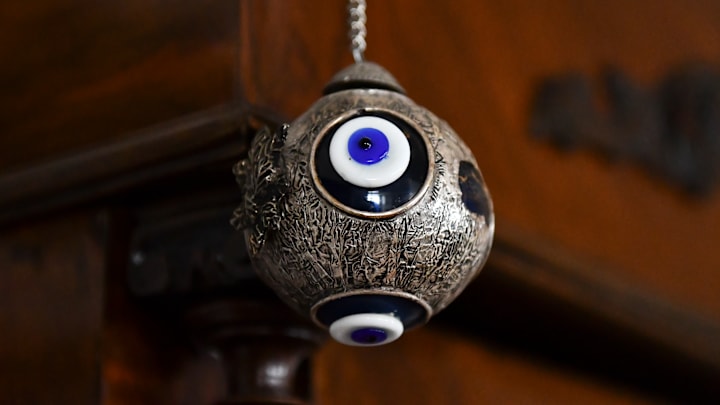
You’ve certainly seen it—either on the arm of a celebrity, in a roadside shop somewhere in Athens or Istanbul, in your grandmother’s kitchen, or maybe hanging on a chain around your own neck.
That distinctive round (or sometimes oval-shaped) blue-and-white eye-shaped talisman is widely described as the “evil eye.” In actuality, what we normally refer to by that name is a protective amulet meant to guard against the evil eye. However, these amulets are commonly called “evil eyes” due to their purported ability to deflect negative energy coming from their namesakes.
What Is the Evil Eye?

In general, the evil eye is said to be a curse that someone can put upon another by looking at them with envy. It connects to a folk belief that holds that bad luck can befall someone if they are being gazed at by someone jealous of their success, wealth, or good fortune.
In some belief systems, the evil eye could cause symptoms like emotional pain, insomnia, fever, headaches, lethargy, and nausea. This curse was also said to be able to harm anything from children to crops and machines.
People like pregnant women, young children, and those who recently came into great fortunes were often said to be particularly vulnerable to the evil eye. Typically, societal outcasts, people with blue or green eyes (which were relatively rare in the Near East), and strangers were associated with giving the evil eye, though in some stories, the evil eye could be deployed entirely accidentally, even by an envious person with no intention of doing harm.
The History of the Evil Eye

The concept of the evil eye is incredibly widespread and can be found in ancient cultures all across the world. Ancient Mesopotamian texts include chants designed to fend off evil looks, and evil eye-esque talismans known as "Eye Idols" dating back to as far as 3,300 BC have been found in modern-day Syria. Ancient Egyptians, meanwhile, had the Eye of Horus, an eye symbol that was thought to ward off evil—much like evil eye amulets.
The evil eye was a specific object of fascination for ancient Greek philosophers like Plutarch, who described the evil eye in Quaestiones Convivales, explaining that a person’s negative emotions could fill up their body and could then be sent out through the eyes in the form of damaging rays.
Other Greek scholars, like Plato and Aeschylus, also mentioned how dangerous being the object of someone’s envy could be. “When any one looks at what is excellent with an envious eye he fills the surrounding atmosphere with a pernicious quality, and transmits his own envenomed exhalations into whatever is nearest to him,” the Greek philosopher Heliodorus of Emesa wrote in the romance Aethiopica.
Mentions of the evil eye also appear in religious texts like the Bible and the Quran. “Eat thou not the bread of him that hath an evil eye, neither desire thou his dainty meats,” reads a line in Proverbs 23:6. Today, evil eye beliefs remain widespread everywhere from Ghana and Pakistan to Mexico and of course, Greece and Turkey.
How to Protect Yourself From the Evil Eye

Any culture that has stories about the evil eye also has ideas about how to protect oneself from it. This, of course, is where the famous eye-shaped amulets we know today come from.
Evidence of eye-shaped talismans that may have been designed to ward off the evil eye have been found in Sumer, Babylonia, and the Mediterranean region, and date back to 3000 B.C. Some historians believe that these talismans may be connected to the Eye of Horus, which was said to be a symbol of protection, healing, and resurrection, though there is little clear evidence to link the two.
Meanwhile, the dark blue glass we associate with evil eye talismans today may have been popularized by the Phoenicians, a people who lived in the Eastern Mediterranean in 1500–300 B.C. and often adorned their jewelry with blue eyes meant for protection.
These objects are generally meant to deflect the power of the evil eye, sometimes by simply absorbing bad intentions and other times by volleying them right back at whoever sent them in the first place.
Additionally, hamsa hands—often found in North Africa, the Middle East, and Jewish and Islamic cultures—are popular ways to deflect the evil eye and to call in protection. Also called the “Hand of Fatima,” these symbols are sometimes traced back to ancient Mesopotamia and are also found in cultures all over the world. “If you think about a magnet, and you put two negative poles together, they repel each other with negative energy,” journalist Dr. Ellen Frankel told How Stuff Works of the ways hamsa hands supposedly repel malevolent intent. “So it's often an effect referred to as an anti-demonic device or an anti-demonic symbol or amulet.”
Additionally, each culture has its own specific unique folk techniques for breaking curses and deflecting the evil eye. In Spain, where the evil eye was frequently linked to witchcraft, people would often burn certain herbs to ward off bad energy. In India, amulets made of lemons and chilis were thought to fend off curses.
On the island of Cyprus, camel drivers would sometimes dress their animals in harnesses covered in half-moon designs, which were thought to ward off ill will from anyone who might be envious of their steeds. In the Middle Ages, excessive praise for children was thought to bring bad luck and invite in the evil eye, so children were often prayed for rather than praised directly. And in Turkey and other Mediterranean cultures, it has long been common practice to bring evil eye amulets to newborn babies.
When it comes to protecting yourself from the evil eye, it seems that wearing an amulet is not a bad idea, and neither is praying, performing cleansing rituals, and using protective herbs or incense on your body or in your home.
But of course, another way to protect yourself from the evil eye is to not be overly braggadocious in the first place—lest someone see you, envy you, and accidentally (or purposefully) blast you with a curse.