%20%20--%3E%0A%3Csvg%20version%3D%221.1%22%20id%3D%22Layer_1%22%20xmlns%3D%22http%3A%2F%2Fwww.w3.org%2F2000%2Fsvg%22%20xmlns%3Axlink%3D%22http%3A%2F%2Fwww.w3.org%2F1999%2Fxlink%22%20x%3D%220px%22%20y%3D%220px%22%0A%09%20viewBox%3D%220%200%20684.6%2068.1%22%20style%3D%22enable-background%3Anew%200%200%20684.6%2068.1%3B%22%20xml%3Aspace%3D%22preserve%22%3E%0A%3Cg%3E%0A%09%3Cpath%20d%3D%22M444.1%2C29.3h-17.4v14.5h17.4V29.3z%20M36.4%2C68.1l29.3-50.8V0H50.4L32.9%2C36.8L15.5%2C0H0v68.1h16.7V45.8l12.4%2C22.3H36.4z%0A%09%09%20M49.1%2C68.1h16.6V23.4L49.1%2C52.1V68.1z%20M76.6%2C68.1h45V53.8H93.3V41.6h21V27.1h-21V14.8h28.3V0.1h-45V68.1z%20M175.6%2C68.1h17.3v-68%0A%09%09h-16.5v40.3L150%2C0.1h-17.6v68h16.7V27.7L175.6%2C68.1z%20M235.8%2C14.8h15.4V0.1h-47.4v14.7H219v53.2h16.8V14.8z%20M290.3%2C45.9h-17.1%0A%09%09l7.5-15.6h2L290.3%2C45.9z%20M298.7%2C68.1h18l-32.2-68h-5.7l-32%2C68h18l3.3-7.1h27.1L298.7%2C68.1z%20M325.2%2C68.1h46.2V53.8h-29.6V0.1h-16.7%0A%09%09V68.1z%20M423.7%2C14.8h27.2V0.1H407v68h16.7V14.8z%20M462%2C68.1h46.2V53.8h-29.6V0.1H462V68.1z%20M564.8%2C34.1c0%2C10.7-7.2%2C19.2-18.5%2C19.2%0A%09%09c-11.4%2C0-18.5-8.5-18.5-19.2s7.1-19.2%2C18.5-19.2C557.6%2C14.9%2C564.8%2C23.4%2C564.8%2C34.1%20M580.6%2C34.1c0-19-14.2-34-34.3-34%0A%09%09c-20.2%2C0-34.3%2C15-34.3%2C34c0%2C19%2C14.1%2C34%2C34.3%2C34C566.4%2C68.1%2C580.6%2C53.1%2C580.6%2C34.1%20M604.8%2C20.5c0-4.1%2C3.3-6.2%2C6.7-6.2%0A%09%09c4.4%2C0%2C6.6%2C3%2C6.6%2C6.6h14.7C631.8%2C9.1%2C625.1%2C0.1%2C611%2C0.1c-12%2C0-21.7%2C9.3-21.7%2C20.6c0%2C10.9%2C5.9%2C15.9%2C16.7%2C19.8%0A%09%09c5.2%2C1.8%2C11.5%2C3.2%2C11.5%2C8c0%2C3.3-2.4%2C5.5-6.4%2C5.5c-3.6%2C0-6.6-3-6.6-6.7h-15.2c0%2C11.5%2C7.9%2C20.8%2C21.8%2C20.8c12%2C0%2C21.6-9.3%2C21.6-20.6%0A%09%09c0-10-5.3-16.4-16.7-19.8C610.6%2C26.1%2C604.8%2C25.3%2C604.8%2C20.5%20M670%2C20.9h14.7C683.8%2C9.1%2C677.1%2C0.1%2C663%2C0.1c-12%2C0-21.7%2C9.3-21.7%2C20.6%0A%09%09c0%2C10.9%2C5.9%2C15.9%2C16.7%2C19.8c5.2%2C1.8%2C11.5%2C3.2%2C11.5%2C8c0%2C3.3-2.4%2C5.5-6.4%2C5.5c-3.6%2C0-6.6-3-6.6-6.7h-15.2c0%2C11.5%2C7.9%2C20.8%2C21.8%2C20.8%0A%09%09c12%2C0%2C21.6-9.3%2C21.6-20.6c0-10-5.3-16.4-16.7-19.8c-5.4-1.6-11.3-2.4-11.3-7.2c0-4.1%2C3.3-6.2%2C6.7-6.2C667.7%2C14.4%2C670%2C17.3%2C670%2C20.9%0A%09%09%22%2F%3E%0A%3C%2Fg%3E%0A%3C%2Fsvg%3E%0A)

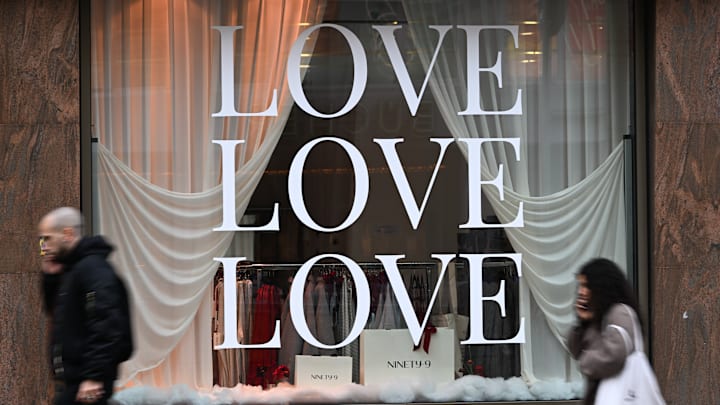
We all know what Valentine’s Day looks like. It’s red and pink balloons at the store, heart-shaped candies, and boxes of chocolates. It’s anxious new couples planning elaborate dates, and established couples following their annual traditions.
The ins and outs of Valentine’s Day are obvious, but do we really know the history behind the holiday?
Unlike other holidays, Valentine’s Day lacks TV specials and stories that capture its deeper meaning, leading to widespread misconceptions about its origins and significance. How many times have you heard that Valentine’s Day was made up by greeting card and candy companies, or conversely that it predates the very saint it’s named after?
Here are seven myths about St. Valentine’s Day and the history they hide.
- It's a Hallmark holiday
- Saint Valentine was known for his protection of lovers
- Valentine’s Day is a Christianized version of the Roman festival Lupercalia
- It's all about love
- The symbols are arbitrary
- Valentine's Day is universal
- There is no Valentine's Day for singles
It's a Hallmark holiday

"Hallmark holidays" were either entirely invented by greeting card companies (like Hallmark) or were substantially altered for commercial purposes. While Valentine's Day is certainly a profitable time of year for these businesses, its history began long before greeting card companies existed.
While it's difficult to nail down a specific date for the first Valentine’s Day celebration, the first written mention of the holiday comes from Geoffrey Chaucer in 1382. 50 years later, Charles, Duke of Orléans, wrote the first known Valentine's Day love letter to his wife, Bonne of Armagnac. In his poem, Charles referred to Bonne as “my very gentle Valentine.”
Handwritten letters were customary at the time, and books were published that instructed people on words to woo their loved ones. People began using pre-made Valentine’s cards during the Industrial Revolution, with Esther Howland credited as the first to commercialize the practice in America. Her company, the New England Valentine Company, was incorporated in 1870, 40 years before Hallmark Cards, Inc. was even founded.
Saint Valentine was known for his protection of lovers

There are a few religious figures who bear the name “Valentine.” While not specifically cited, most sources agree that Valentine's Day honors either Valentine of Rome (martyred in 269) or Valentine of Terni (martyred in 273). Some believe that they are the same man.
Valentine of Rome was highly respected, which earned the attention of Emperor Claudius Gothicus. The emperor hoped to convert Valentine away from Christianity, but his miracles ended up converting pagans to Christianity—and sealed his fate. Valentine of Terni was brought to Rome to heal the son of a philosopher. When he did, he too converted a vast number of people to Christianity, including the Roman Prefect’s son, which led to his execution.
Whether they were the same person or not, there is no real reason to connect either story with love. Later additions claimed that St. Valentine conducted illegal Christian marriages, but there is not much evidence to support that. His connection with love is tied to the timing of his feast day, which coincides with the rebirth of spring. Thus, honoring him should have far more to do with healing, Christian reflection, and nature than love.
Valentine’s Day is a Christianized version of the Roman festival Lupercalia

Those who acknowledge the extensive history of Valentine's Day often refer back to Ancient Rome, but that is likely an overcorrection. Although the Christian church has incorporated certain pagan customs into its celebrations, the widely held belief that Valentine’s Day originated from the Roman festival of Lupercalia is, at best, weakly supported by evidence.
The Roman holiday celebrated the mythical founders of Rome, who had been rescued and raised by a wolf. During this celebration, which took place in mid-February, priests would run naked through the city, whipping people to fend off evil spirits and ensure fertility. The people might have engaged in random matchmaking for sexual or romantic purposes. However, the evidence supporting these activities is limited and unreliable.
Many people suggest that the festival was then transformed into Valentine’s Day as the region was Christianized. Although Pope Gelasius I officially ended Lupercalia celebrations in 494 and began the celebrations of Valentine’s Day two years later, there is no other tangible link between the two. The feast day of St. Valentine had nothing to do with romance until the 14th century.
It's all about love

While some Christians celebrated St. Valentine immediately after his death, the modern interpretations and symbols didn’t emerge for 1,000 years. Geoffrey Chaucer released the poemParliament of Fowls in 1382, which connected Saint Valentine’s Day with the ritual of birds choosing mates.
After this poem’s release, the popular association between Valentine’s Day and romance began. It did not take long for Valentine’s letters to spread, and other poetry was created connecting mating seasons to the holiday. Several of the legends that connect St. Valentine to love and marriage began circulating in the next few centuries, and Valentine’s Day appeared to be a significant enough celebration to be mentioned in two of Shakespeare’s plays and Edmund Spenser’s epic poem, The Faerie Queene.
Modern celebrations were added over the centuries. As literacy increased and manufacturing processes developed, more intricate Valentine’s letters and cards circulated in the 1800s. Heart-shaped boxes of chocolates adorned the shelves in 1868, and conversation hearts launched in 1902.
The symbols are arbitrary

Although many Valentine’s Day traditions seem to have developed by chance, the symbols associated with the holiday have their own fascinating histories. For example, the common abbreviation “XO” is derived from using the letter “X” as a symbol for Christ or for solemn vows, while the letter “O” originated with Jewish immigrants or the game of tic-tac-toe. Over time, these symbols came to represent hugs and kisses in written correspondence, a meaning that later carried over into Valentine’s cards.
Cupid, on the other hand, came from pagan roots. He is the son of Venus in Roman mythology, and the domain of romantic passion and sexual desire. Traditional myths depicted him as either a winged man with a bow, whose arrows could produce uncontrollable lust or utter revulsion in those they struck. While his mythological version wreaked chaos, the modern version guides people to their true love. Some legends suggest that St. Valentine wore an amethyst ring with an etching of Cupid, which strengthened his connection to the holiday.
Finally, the traditional colors of Valentine’s Day have multiple historical roots. For those who insist on connecting Valentine’s Day with Lupercalia, they argue that red represents blood sacrifices and white the milk used to dispel the blood. However, red is also connected with Venus’s creation of the anemone flower after Adonis’s death, and both red and pink are associated with love and passion. Furthermore, pink is connected with the almond tree supposedly planted by St. Valentine’s grave, which symbolizes love and friendship.
Valentine's Day is universal

Although Valentine’s Day is often associated with a flurry of pink and red decorations, boxes of heart-shaped candy, and overpriced date nights for couples, that is merely one way that people celebrate the holiday. In Italy, it is common to decorate with oranges and gather at Terni for a special mass, or to visit St. Valentine’s tomb. In South Korea and Japan, nearly all the festivities encompass women giving chocolate to the men in their lives, with the men responding in kind on March 14.
Other countries, especially those with large Muslim populations, find the celebration of Valentine’s Day to be wrong, either because of the focus on sex and romance or because of its associations with America and the Western world. There have been official bans on celebrating Valentine’s Day in parts of Pakistan, Saudi Arabia, Malaysia, and Iran.
Even in countries that allow Valentine's Day, many have their own, historically grounded holidays that they prefer. In Wales, it is more common to celebrate St. Dwynwen's Day (January 25), which includes local traditions like carving lovespoons. Other examples include Israel’s Tu B’Av, China’s Qixi Festival, and Colombia’s Love and Friendship Day.
There is no Valentine's Day for singles

Over the years, it has become common for people who are not in romantic relationships to celebrate Valentine’s Day in a different way. Galentine’s Day comes from Parks and Recreation, where Leslie Knope threw a party for her female friends on February 13. Similarly, Palentine’s Day, which can be celebrated on both the 13th and 14th, is a gender-neutral celebration of platonic love.
Then there’s International Quirkyalone Day, celebrated on the 14th, which honors those who would rather be alone than settle for a bad relationship. Finally, many people enjoy celebrating Singles Awareness Day (celebrated on February 15) and National Singles Day (celebrated on March 11).
While these days were seemingly all created in response to Valentine’s Day, there are other days that directly celebrate singledom. Those seeking romance celebrate the feast days of St. Raphael the Archangel (September 29), who is associated with finding love, and St. Nicholas (December 6), who helps unmarried individuals overcome obstacles with their partners. Furthermore, St. Christopher (July 25) and St. Agnes (January 21) are patrons of bachelors and unmarried women, respectively. Finally, St. Mel of Ardagh (February 7), St. Faustinus (February 15), and Saint Emilina of Boulancourt (October 27) are all patrons for those happy to remain single.
Xo, Mental Floss

Several myths about Valentine’s Day have sprung up over the centuries. While some have an element of truth to them, others seem to appear unexpectedly. While common stories about this holiday tend to be myths, that does not mean it lacks historical grounding. So long as you read with a critical eye, Valentine’s Day can be a fascinating opportunity to explore historical rituals and symbols from the Ancient Romans to today.