%20%20--%3E%0A%3Csvg%20version%3D%221.1%22%20id%3D%22Layer_1%22%20xmlns%3D%22http%3A%2F%2Fwww.w3.org%2F2000%2Fsvg%22%20xmlns%3Axlink%3D%22http%3A%2F%2Fwww.w3.org%2F1999%2Fxlink%22%20x%3D%220px%22%20y%3D%220px%22%0A%09%20viewBox%3D%220%200%20684.6%2068.1%22%20style%3D%22enable-background%3Anew%200%200%20684.6%2068.1%3B%22%20xml%3Aspace%3D%22preserve%22%3E%0A%3Cg%3E%0A%09%3Cpath%20d%3D%22M444.1%2C29.3h-17.4v14.5h17.4V29.3z%20M36.4%2C68.1l29.3-50.8V0H50.4L32.9%2C36.8L15.5%2C0H0v68.1h16.7V45.8l12.4%2C22.3H36.4z%0A%09%09%20M49.1%2C68.1h16.6V23.4L49.1%2C52.1V68.1z%20M76.6%2C68.1h45V53.8H93.3V41.6h21V27.1h-21V14.8h28.3V0.1h-45V68.1z%20M175.6%2C68.1h17.3v-68%0A%09%09h-16.5v40.3L150%2C0.1h-17.6v68h16.7V27.7L175.6%2C68.1z%20M235.8%2C14.8h15.4V0.1h-47.4v14.7H219v53.2h16.8V14.8z%20M290.3%2C45.9h-17.1%0A%09%09l7.5-15.6h2L290.3%2C45.9z%20M298.7%2C68.1h18l-32.2-68h-5.7l-32%2C68h18l3.3-7.1h27.1L298.7%2C68.1z%20M325.2%2C68.1h46.2V53.8h-29.6V0.1h-16.7%0A%09%09V68.1z%20M423.7%2C14.8h27.2V0.1H407v68h16.7V14.8z%20M462%2C68.1h46.2V53.8h-29.6V0.1H462V68.1z%20M564.8%2C34.1c0%2C10.7-7.2%2C19.2-18.5%2C19.2%0A%09%09c-11.4%2C0-18.5-8.5-18.5-19.2s7.1-19.2%2C18.5-19.2C557.6%2C14.9%2C564.8%2C23.4%2C564.8%2C34.1%20M580.6%2C34.1c0-19-14.2-34-34.3-34%0A%09%09c-20.2%2C0-34.3%2C15-34.3%2C34c0%2C19%2C14.1%2C34%2C34.3%2C34C566.4%2C68.1%2C580.6%2C53.1%2C580.6%2C34.1%20M604.8%2C20.5c0-4.1%2C3.3-6.2%2C6.7-6.2%0A%09%09c4.4%2C0%2C6.6%2C3%2C6.6%2C6.6h14.7C631.8%2C9.1%2C625.1%2C0.1%2C611%2C0.1c-12%2C0-21.7%2C9.3-21.7%2C20.6c0%2C10.9%2C5.9%2C15.9%2C16.7%2C19.8%0A%09%09c5.2%2C1.8%2C11.5%2C3.2%2C11.5%2C8c0%2C3.3-2.4%2C5.5-6.4%2C5.5c-3.6%2C0-6.6-3-6.6-6.7h-15.2c0%2C11.5%2C7.9%2C20.8%2C21.8%2C20.8c12%2C0%2C21.6-9.3%2C21.6-20.6%0A%09%09c0-10-5.3-16.4-16.7-19.8C610.6%2C26.1%2C604.8%2C25.3%2C604.8%2C20.5%20M670%2C20.9h14.7C683.8%2C9.1%2C677.1%2C0.1%2C663%2C0.1c-12%2C0-21.7%2C9.3-21.7%2C20.6%0A%09%09c0%2C10.9%2C5.9%2C15.9%2C16.7%2C19.8c5.2%2C1.8%2C11.5%2C3.2%2C11.5%2C8c0%2C3.3-2.4%2C5.5-6.4%2C5.5c-3.6%2C0-6.6-3-6.6-6.7h-15.2c0%2C11.5%2C7.9%2C20.8%2C21.8%2C20.8%0A%09%09c12%2C0%2C21.6-9.3%2C21.6-20.6c0-10-5.3-16.4-16.7-19.8c-5.4-1.6-11.3-2.4-11.3-7.2c0-4.1%2C3.3-6.2%2C6.7-6.2C667.7%2C14.4%2C670%2C17.3%2C670%2C20.9%0A%09%09%22%2F%3E%0A%3C%2Fg%3E%0A%3C%2Fsvg%3E%0A)

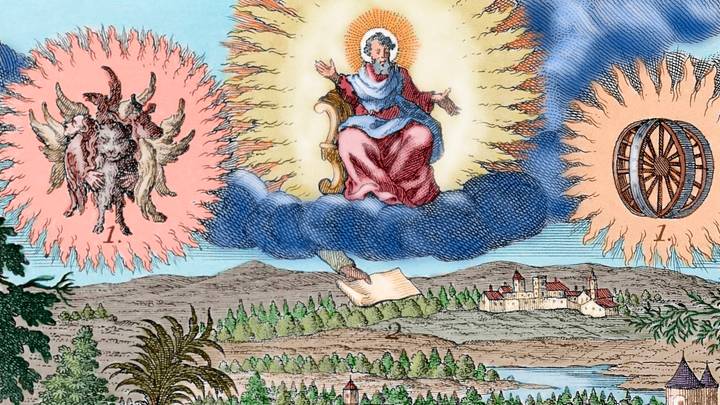
What comes to mind when you think of an angel? Most likely, you envision a winged man or woman in a flowing white gown and a halo. There's a chance that you might also imagine a cluster of spinning wheels and wings covered in eyes, which is how so-called “biblically accurate angels” are often depicted on social media.
The word “angel” is not actually used to describe a specific class of beings in the Bible. Instead, the term is translated from the Hebrew word malach and the Greek word angelos, both of which mean “messenger.” In the Bible, “angel” is often used to refer to messengers that God sends to aid people in times of need. These messengers’ appearances are most often left ambiguous, though they sometimes appear in the guise of ordinary-looking men.
The Bible does also mention a variety of other creatures that sometimes have fearsome and awe-inspiring appearances, including the aforementioned many-eyed wheels. These beings, along with a number of others, were later incorporated into angelology by Christian theologians. Here's a brief overview of how the Bible actually describes them.
Seraphim

These beings appear only once in the Old Testament: in Isaiah 6:2, where they are seen flying above God’s throne. They are said to have six wings: two that cover their faces, two they use to fly, and two that cover their feet. They can be heard saying “Holy, holy, holy is the Lord Almighty” over and over in booming voices that make the temple tremble and fill it with smoke. At one point in the passage, one of the seraphim flies over to Isaiah and places a coal at his lips, and tells him he is free from sin.
The word “seraphim” comes from a Hebrew word meaning “burning” or “to burn,” so these creatures are also often associated with fire. They are sometimes considered the highest-ranking angels due to their physical proximity to God.
Cherubim / Living Creatures

Cherubim are said to stand guard by the Tree of Life in the Garden of Eden, though their appearances are not described in this context. They are, however, described in detail in Ezekiel 1:5, where they are seen drawing God’s chariot and are called “living creatures.” Here, they are depicted as winged creatures who have four different faces: one human, one lion, one ox, and one eagle.
“From the midst of it came the likeness of four living creatures,” Ezekiel says. “And this was their appearance: they had a human likeness, but each had four faces, and each of them had four wings. Their legs were straight, and the soles of their feet were like the sole of a calf’s foot. And they sparkled like burnished bronze. Under their wings on their four sides they had human hands. And the four had their faces and their wings thus: their wings touched one another. Each one of them went straight forward, without turning as they went. As for the likeness of their faces, each had a human face. The four had the face of a lion on the right side, the four had the face of an ox on the left side, and the four had the face of an eagle. Such were their faces. And their wings were spread out above. Each creature had two wings, each of which touched the wing of another, while two covered their bodies.”
He continues to describe them as fiery beings who flash like lightning as they move. “As for the likeness of the living creatures,” he says, “their appearance was burning coals of fire, like the appearance of torches moving to and fro among the living creatures.” He later mentions them in Ezekiel 10, where he confirms that the living creatures he previously saw were the same as the cherubim.
Similar creatures also appear in the New Testament in Revelation 4:6, albeit this time as four distinct beings with distinct faces. “And around the throne, on each side of the throne, are four living creatures, full of eyes in front and behind: the first living creature like a lion, the second living creature like an ox, the third living creature with the face of a man, and the fourth living creature like an eagle in flight,” reads the passage. “And the four living creatures, each of them with six wings, are full of eyes all around and within, and day and night they never cease to say.” In sections from Samuel and Psalms, meanwhile, God is said to be “enthroned on the cherubim,” though the appearances of the cherubim are not specified here.
Ophanim

Another one of the most vivid and detailed images we have of angelic beings comes from Ezekiel’s mystical encounters in chapters 1 and 10 of the Old Testament. Here, he describes seeing clusters of wheels covered in eyes. They are, he observes, spiritually and physically connected to the aforementioned cherubim, with each going where the other goes and moving where the other moves. He did not name these entities, but they were later dubbed the ophanim, a Hebrew word that translates to “wheels.”
“As I looked at the living creatures, I saw a wheel on the ground beside each creature with its four faces,” Ezekiel recalls in 1:15-18. “This was the appearance and structure of the wheels: They sparkled like topaz, and all four looked alike. Each appeared to be made like a wheel intersecting a wheel. As they moved, they would go in any one of the four directions the creatures faced; the wheels did not change direction as the creatures went. Their rims were high and awesome, and all four rims were full of eyes all around.”
They are also described in Ezekiel 10:9-13, where they also appear alongside the four-faced cherubim. “And then I saw four wheels beside the cherubim, one beside each cherub,” Ezekiel says. “The wheels radiating were sparkling like diamonds in the sun. All four wheels looked alike, each like a wheel within a wheel. When they moved, they went in any of the four directions but in a perfectly straight line. Where the cherubim went, the wheels went straight ahead. The cherubim were full of eyes in their backs, hands, and wings. The wheels likewise were full of eyes. I heard the wheels called ‘wheels within wheels.’” In each of these contexts, these beings are seen in close proximity to God’s luminous throne.
The Angels and Archangels

The history of archangels is long and complex. These beings are mentioned in a number of ancient apocryphal texts, including the Book of Enoch, an ancient Jewish writing that is not canonical in the Hebrew scriptures, which references seven archangels: Michael, Gabriel, Raphael, Uriel, Raguel, Phanuel, and Sariel. In the Book of Tobit, another ancient text accepted in Catholic and Orthodox Christian biblical canons, Raphael mentions the number seven again, saying “I am Raphael, one of the seven angels who stand and serve before the Glory of the Lord” (Tobit 12:15). None of these archangels’ appearances are described in detail.
Michael and Gabriel are the only angels directly named in the Old Testament. There, Michael is described as a protective “prince” (Daniel 12-1), and Gabriel appears to deliver important messages (Luke 1-19). Michael also appears in the Quran as Mīkāl.
Different segments of Christianity have highly specific and nuanced views on angels and archangels. The Catholic Church recognizes three archangels: St. Michael, St. Gabriel, and St. Raphael. Michael appears in the New Testament in Revelation 12:7-12, where he is seen leading an army against Satan. Archangel Michael is generally recognized as a chief or preeminent angel, and in popular interpretations, he is frequently portrayed as a winged humanoid figure carrying a sword.
However, none of these angels’ appearances are actually described in detail in the canonical Scriptures, though they sometimes appear to take the form of ordinary men in order to deliver their messages. In recent years, modern interpretations have suggested that this may be because they have no true form, but rather exist as pure energy that can take various forms at will in order to enact God’s will.