%20%20--%3E%0A%3Csvg%20version%3D%221.1%22%20id%3D%22Layer_1%22%20xmlns%3D%22http%3A%2F%2Fwww.w3.org%2F2000%2Fsvg%22%20xmlns%3Axlink%3D%22http%3A%2F%2Fwww.w3.org%2F1999%2Fxlink%22%20x%3D%220px%22%20y%3D%220px%22%0A%09%20viewBox%3D%220%200%20684.6%2068.1%22%20style%3D%22enable-background%3Anew%200%200%20684.6%2068.1%3B%22%20xml%3Aspace%3D%22preserve%22%3E%0A%3Cg%3E%0A%09%3Cpath%20d%3D%22M444.1%2C29.3h-17.4v14.5h17.4V29.3z%20M36.4%2C68.1l29.3-50.8V0H50.4L32.9%2C36.8L15.5%2C0H0v68.1h16.7V45.8l12.4%2C22.3H36.4z%0A%09%09%20M49.1%2C68.1h16.6V23.4L49.1%2C52.1V68.1z%20M76.6%2C68.1h45V53.8H93.3V41.6h21V27.1h-21V14.8h28.3V0.1h-45V68.1z%20M175.6%2C68.1h17.3v-68%0A%09%09h-16.5v40.3L150%2C0.1h-17.6v68h16.7V27.7L175.6%2C68.1z%20M235.8%2C14.8h15.4V0.1h-47.4v14.7H219v53.2h16.8V14.8z%20M290.3%2C45.9h-17.1%0A%09%09l7.5-15.6h2L290.3%2C45.9z%20M298.7%2C68.1h18l-32.2-68h-5.7l-32%2C68h18l3.3-7.1h27.1L298.7%2C68.1z%20M325.2%2C68.1h46.2V53.8h-29.6V0.1h-16.7%0A%09%09V68.1z%20M423.7%2C14.8h27.2V0.1H407v68h16.7V14.8z%20M462%2C68.1h46.2V53.8h-29.6V0.1H462V68.1z%20M564.8%2C34.1c0%2C10.7-7.2%2C19.2-18.5%2C19.2%0A%09%09c-11.4%2C0-18.5-8.5-18.5-19.2s7.1-19.2%2C18.5-19.2C557.6%2C14.9%2C564.8%2C23.4%2C564.8%2C34.1%20M580.6%2C34.1c0-19-14.2-34-34.3-34%0A%09%09c-20.2%2C0-34.3%2C15-34.3%2C34c0%2C19%2C14.1%2C34%2C34.3%2C34C566.4%2C68.1%2C580.6%2C53.1%2C580.6%2C34.1%20M604.8%2C20.5c0-4.1%2C3.3-6.2%2C6.7-6.2%0A%09%09c4.4%2C0%2C6.6%2C3%2C6.6%2C6.6h14.7C631.8%2C9.1%2C625.1%2C0.1%2C611%2C0.1c-12%2C0-21.7%2C9.3-21.7%2C20.6c0%2C10.9%2C5.9%2C15.9%2C16.7%2C19.8%0A%09%09c5.2%2C1.8%2C11.5%2C3.2%2C11.5%2C8c0%2C3.3-2.4%2C5.5-6.4%2C5.5c-3.6%2C0-6.6-3-6.6-6.7h-15.2c0%2C11.5%2C7.9%2C20.8%2C21.8%2C20.8c12%2C0%2C21.6-9.3%2C21.6-20.6%0A%09%09c0-10-5.3-16.4-16.7-19.8C610.6%2C26.1%2C604.8%2C25.3%2C604.8%2C20.5%20M670%2C20.9h14.7C683.8%2C9.1%2C677.1%2C0.1%2C663%2C0.1c-12%2C0-21.7%2C9.3-21.7%2C20.6%0A%09%09c0%2C10.9%2C5.9%2C15.9%2C16.7%2C19.8c5.2%2C1.8%2C11.5%2C3.2%2C11.5%2C8c0%2C3.3-2.4%2C5.5-6.4%2C5.5c-3.6%2C0-6.6-3-6.6-6.7h-15.2c0%2C11.5%2C7.9%2C20.8%2C21.8%2C20.8%0A%09%09c12%2C0%2C21.6-9.3%2C21.6-20.6c0-10-5.3-16.4-16.7-19.8c-5.4-1.6-11.3-2.4-11.3-7.2c0-4.1%2C3.3-6.2%2C6.7-6.2C667.7%2C14.4%2C670%2C17.3%2C670%2C20.9%0A%09%09%22%2F%3E%0A%3C%2Fg%3E%0A%3C%2Fsvg%3E%0A)

When Louisa May Alcott reluctantly wrote Little Women in 1868, she had no idea it would become a defining portrait of girlhood—one that would inspire seven screen adaptations, spanning Hollywood’s Golden Age to the streaming era.
Set in 19th-century New England, Little Women follows four sisters growing up during the Civil War. With each chapter of their lives—and of the book itself—the March girls’ story unfolds into an aspirational yet authentic tale of sisterhood that still feels fresh today.
Over the decades, filmmakers have reimagined Meg, Jo, Beth, and Amy for new audiences, but critical reception hasn’t always been equal. In fact, on Rotten Tomatoes, the highest- and lowest-ranked adaptations were released just one year apart.
Here’s how the major Little Women films stack up by Tomatometer score, and how each interprets Alcott’s classic.
- Little Women (2019)
- Little Women (1994)
- Little Women (1933)
- Little Women (1949)
- Little Women (2018)
- Marching to the Finish Line
Little Women (2019)
Rotten Tomatoes Tomatometer: 95%
Greta Gerwig’s Little Women is widely celebrated as one of the most memorable adaptations of Alcott’s novel. On Rotten Tomatoes, it holds a near-perfect score, and for good reason: Gerwig, also known for directing Barbie, infuses the story with wit, insight, and a sharp understanding of what it means to grow up female. Unlike previous adaptations, she didn’t just stick to the novel: she mined Alcott’s letters and other writings, giving the film a richness and authenticity that makes the March sisters feel fully alive.
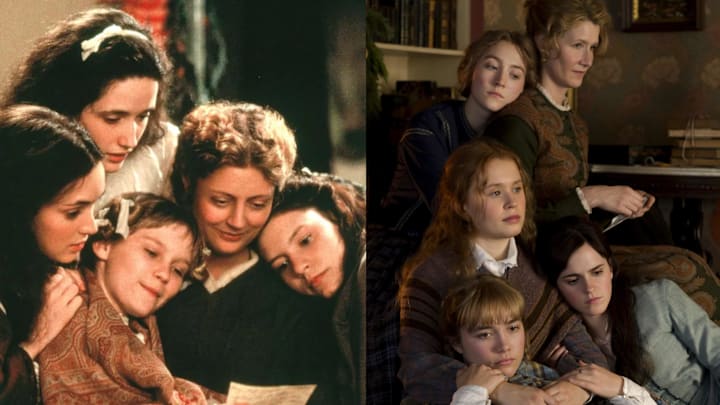
The movie jumps back and forth in time, following Saoirse Ronan’s Jo, Emma Watson’s Meg, Florence Pugh’s Amy, and Eliza Scanlen’s Beth as they move from daydreams and dramatics inside their cozy Massachusetts home to the challenging realities of womanhood. Ronan’s complex portrayal of Jo does justice to the messy yet motivated main character and earned her an Oscar nomination for Best Actress. At the same time, Pugh’s Amy sheds her usual "antagonist" label to reveal a misunderstood underbelly of yearning, youngest-sister syndrome, and artistic ambitions constrained by society.
The rest of the cast—including Laura Dern, Timothée Chalamet, and Meryl Streep—adds warmth, humor, and heart to a story that balances laughter, heartbreak, and sisterly chaos. The film racked up six Academy Award nominations—including Best Picture, Best Actress, Best Supporting Actress, Best Adapted Screenplay, and Best Original Score—and took home the Oscar for Best Costume Design. Gerwig honors Alcott’s original while giving it a modern feminist twist, creating a Little Women that feels both classic and completely of its time.
Little Women (1994)
Rotten Tomatoes Tomatometer: 92%
If you thought the 2019 cast was stacked, check out the 1994 Little Women’s star-studded lineup: Winona Ryder as Jo, Claire Danes as Beth, Kirsten Dunst as Amy, Trini Alvarado as Meg, Susan Sarandon as Marmee, and Christian Bale as Laurie. Paving the way for Gerwig, Gillian Armstrong made history as the first woman to direct a feature adaptation of Alcott’s novel, delivering period authenticity through a nostalgically ’90s lens. On Rotten Tomatoes, it holds a 92% score, with critics praising its heartfelt performances and cozy, Christmas-infused atmosphere.
Ryder’s Jo is as fiercely independent as she is intellectually competent, unwilling to give up her dreams for domestic life, while Professor Bhaer—played by Gabriel Byrne—steps in as her mentor who becomes her partner, creating a romance that feels both compelling and believable. Armstrong gives each sister room to shine, highlights Marmee’s importance, and balances humor, heart, and feminist undertones that felt strikingly modern for the ’90s. The three Academy Award nominations it earned are just icing on the cake for a film that still feels like one of the warmest and most thoughtfully crafted takes on Alcott’s story.
Little Women (1933)
Rotten Tomatoes Tomatometer: 89%
Although two silent-film adaptations of Little Women preceded it, George Cukor’s 1933 version remains the earliest surviving adaptation, as the earlier films are now lost.
Shot in black-and-white, the film brought the March sisters to life in a way that felt vivid and immediate—even without color. Katharine Hepburn starred as Jo, with Joan Bennett as Amy, Frances Dee as Meg, and Jean Parker as Beth. RKO Radio Pictures’ adaptation was lavish for its time, yet it still poignantly captured the family’s modest means, striking a chord with Depression-era audiences.
Hepburn, a four-time Oscar winner, stole the show with her passionate, stubborn, and honest portrayal of Jo, perfectly capturing the spirit Alcott had written. The film’s focus on the sisters’ perspectives, with male characters like Laurie (Douglass Montgomery) in supporting roles, was innovative for its era in both cinema and society. A box office hit, the film earned three Academy Award nominations, including Best Picture and Best Director for Cukor, cementing its place as a landmark in literary adaptations.
Little Women (1949)
Rotten Tomatoes Tomatometer: 75%
Although the 1949 adaptation boasted an Oscar-winning Elizabeth Taylor as Amy and notable stars like Janet Leigh as Meg, June Allyson as Jo, and Margaret O’Brien as Beth, it failed to capture the enduring charm of the 1933 black-and-white classic. As the first color adaptation of Little Women, it offered visual novelty but couldn’t compensate for the story’s omissions, despite borrowing heavily from the earlier script. Key scenes, such as the group picnic and the ice incident, were left out, dulling the film’s warmth and character depth.
Critics also took issue with Allyson’s Jo, whose tomboyishness felt more caricature than the fiery spirit so memorably embodied by Hepburn in 1933. Jo and Laurie’s best-friendship dynamic was reduced to a brief subplot, and Laurie and Amy’s European journey was largely absent, muting the tension and drama of Amy’s perceived betrayal. Technicolor may have added visual appeal, but in terms of storytelling and emotional resonance, Mervyn LeRoy’s take fell short compared to its predecessor—though it still ranks above some modern retellings.
Little Women (2018)
Rotten Tomatoes Tomatometer: 31%
The second-most recent Little Women, directed by Clare Niederpruem, was released to mark the 150th anniversary of Alcott’s novel and takes a bold—if not always successful—approach by setting the story in the present day. On Rotten Tomatoes, the film officially hit “Rotten” status, proving that even the March sisters can’t charm every critic.
Rather than the Civil War–era backdrop of most adaptations, this version places the March sisters in the early 2000s, with Sarah Davenport, Melanie Stone, Allie Jennings, and Elise Jones starring as Jo, Meg, Beth, and Amy, respectively, as they navigate modern challenges and relationships. While the adaptation keeps the sisters’ bonds at its core, critics argued that the characters sometimes lacked the depth of Alcott’s originals and that the modern update softened the novel’s timeless charm, placing it in last.
Marching to the Finish Line
Even after more than 150 years, the March sisters continue to bring the female experience to life—both the good and the bad, which, fittingly, mirrors how critics have responded to the various adaptations. On Rotten Tomatoes, the 2019 Little Women leads the pack with a score of 95%, followed by the 2018 modern retelling at 92%, and the oldest black-and-white adaptation from 1933 at 89%. The other versions fill out the middle, each offering its own style and era-specific flair to the March family saga.
Through all the retellings, one thing remains clear: Louisa May Alcott’s story of ambition, love, and the occasional bout of anger continues to resonate. From sweeping period dramas to contemporary updates, the March sisters charm audiences across generations, but it’s the classic, period-piece adaptations that consistently earn critics’ praise.
No matter the era, Little Women endures—and like the March sisters themselves, we’ll keep arguing over who’s our favorite for decades to come.