%20%20--%3E%0A%3Csvg%20version%3D%221.1%22%20id%3D%22Layer_1%22%20xmlns%3D%22http%3A%2F%2Fwww.w3.org%2F2000%2Fsvg%22%20xmlns%3Axlink%3D%22http%3A%2F%2Fwww.w3.org%2F1999%2Fxlink%22%20x%3D%220px%22%20y%3D%220px%22%0A%09%20viewBox%3D%220%200%20684.6%2068.1%22%20style%3D%22enable-background%3Anew%200%200%20684.6%2068.1%3B%22%20xml%3Aspace%3D%22preserve%22%3E%0A%3Cg%3E%0A%09%3Cpath%20d%3D%22M444.1%2C29.3h-17.4v14.5h17.4V29.3z%20M36.4%2C68.1l29.3-50.8V0H50.4L32.9%2C36.8L15.5%2C0H0v68.1h16.7V45.8l12.4%2C22.3H36.4z%0A%09%09%20M49.1%2C68.1h16.6V23.4L49.1%2C52.1V68.1z%20M76.6%2C68.1h45V53.8H93.3V41.6h21V27.1h-21V14.8h28.3V0.1h-45V68.1z%20M175.6%2C68.1h17.3v-68%0A%09%09h-16.5v40.3L150%2C0.1h-17.6v68h16.7V27.7L175.6%2C68.1z%20M235.8%2C14.8h15.4V0.1h-47.4v14.7H219v53.2h16.8V14.8z%20M290.3%2C45.9h-17.1%0A%09%09l7.5-15.6h2L290.3%2C45.9z%20M298.7%2C68.1h18l-32.2-68h-5.7l-32%2C68h18l3.3-7.1h27.1L298.7%2C68.1z%20M325.2%2C68.1h46.2V53.8h-29.6V0.1h-16.7%0A%09%09V68.1z%20M423.7%2C14.8h27.2V0.1H407v68h16.7V14.8z%20M462%2C68.1h46.2V53.8h-29.6V0.1H462V68.1z%20M564.8%2C34.1c0%2C10.7-7.2%2C19.2-18.5%2C19.2%0A%09%09c-11.4%2C0-18.5-8.5-18.5-19.2s7.1-19.2%2C18.5-19.2C557.6%2C14.9%2C564.8%2C23.4%2C564.8%2C34.1%20M580.6%2C34.1c0-19-14.2-34-34.3-34%0A%09%09c-20.2%2C0-34.3%2C15-34.3%2C34c0%2C19%2C14.1%2C34%2C34.3%2C34C566.4%2C68.1%2C580.6%2C53.1%2C580.6%2C34.1%20M604.8%2C20.5c0-4.1%2C3.3-6.2%2C6.7-6.2%0A%09%09c4.4%2C0%2C6.6%2C3%2C6.6%2C6.6h14.7C631.8%2C9.1%2C625.1%2C0.1%2C611%2C0.1c-12%2C0-21.7%2C9.3-21.7%2C20.6c0%2C10.9%2C5.9%2C15.9%2C16.7%2C19.8%0A%09%09c5.2%2C1.8%2C11.5%2C3.2%2C11.5%2C8c0%2C3.3-2.4%2C5.5-6.4%2C5.5c-3.6%2C0-6.6-3-6.6-6.7h-15.2c0%2C11.5%2C7.9%2C20.8%2C21.8%2C20.8c12%2C0%2C21.6-9.3%2C21.6-20.6%0A%09%09c0-10-5.3-16.4-16.7-19.8C610.6%2C26.1%2C604.8%2C25.3%2C604.8%2C20.5%20M670%2C20.9h14.7C683.8%2C9.1%2C677.1%2C0.1%2C663%2C0.1c-12%2C0-21.7%2C9.3-21.7%2C20.6%0A%09%09c0%2C10.9%2C5.9%2C15.9%2C16.7%2C19.8c5.2%2C1.8%2C11.5%2C3.2%2C11.5%2C8c0%2C3.3-2.4%2C5.5-6.4%2C5.5c-3.6%2C0-6.6-3-6.6-6.7h-15.2c0%2C11.5%2C7.9%2C20.8%2C21.8%2C20.8%0A%09%09c12%2C0%2C21.6-9.3%2C21.6-20.6c0-10-5.3-16.4-16.7-19.8c-5.4-1.6-11.3-2.4-11.3-7.2c0-4.1%2C3.3-6.2%2C6.7-6.2C667.7%2C14.4%2C670%2C17.3%2C670%2C20.9%0A%09%09%22%2F%3E%0A%3C%2Fg%3E%0A%3C%2Fsvg%3E%0A)

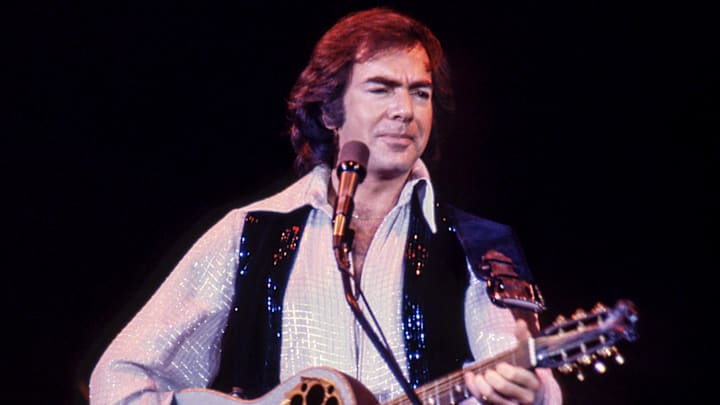
Neil Diamond's biggest song may be “Sweet Caroline,” which remains a karaoke and wedding staple over half a century after its release. Diamond’s discography also consists of countless other charming favorites, from “Cracklin’ Rosie” and “Song Sung Blue” to “Cherry, Cherry” and “Solitary Man.” Across his 60-year career, Diamond has also sold over 130 million records and has netted 13 Grammy nominations, in addition to a Grammy Lifetime Achievement Award.
Diamond was also a prolific songwriter. He began writing songs at 16 after seeing a Pete Seeger concert while at summer camp in the Catskills, and considered himself a songwriter above all else; he only began writing songs for himself when the songs he wrote for others failed to perform well at the beginning of his career. Still, sometimes, the tunes he penned for others wound up soaring to the tops of the charts. Here are some hits you may not know Diamond was behind.
- “I’m a Believer” // The Monkees
- “Red Red Wine” // UB40
- “The Boat That I Row” // Lulu
- “And the Grass Won’t Pay No Mind” // Elvis Presley
- “Girl, You'll Be a Woman Soon” // Urge Overkill
- “Sunday and Me” // Jay & the Americans
- “Kentucky Woman” // Deep Purple
“I’m a Believer” // The Monkees
Long before Smash Mouth's boisterous cover of this song made the Shrek soundtrack, Neil Diamond himself dreamed up the song as a struggling songwriter.
In 1966, Diamond landed his first Billboard Hot 100 top 10 hit with “Cherry, Cherry.” That same year, he wrote a number one hit for another artist—The Monkees, whose version of Diamond’s song “I’m a Believer” became one of the best-selling singles of the 1960s.
Diamond’s record company wasn’t pleased that he’d written such a big hit for someone other than himself. But for Diamond—who considered himself to be more of a songwriter than a performer, but had been fired multiple times by different publishing houses before the success of “I’m a Believer”—the song’s popularity was a triumph.
“The head of my record company was very angry—I’d given away a number one hit—but I was thrilled,” Diamond told Guitar Player. “See, I was a songwriter, first and foremost. I kind of reluctantly became a recording artist, you know? I wanted to write songs and have other people record them…but nobody would record my stuff, so I had to sing the songs myself. So having the Monkees get the number one was as good as if I had recorded it, honestly.”
Diamond did note that he’d originally imagined the track as a country tune, perhaps for the artist Eddy Arnold. Instead, it became a pop-rock hit in the hands of the Monkees. Later, Smash Mouth recorded an even more energized version that will forever soundtrack Shrek and Fiona’s happy ending in some fans’ minds.
“Red Red Wine” // UB40
Diamond released “Red Red Wine” on his sophomore album Just For You, which came out in 1967. In Diamond’s hands, the song was a gentle ballad, and his version achieved just a modicum of chart success. Still, the song soon became a popular choice for artists looking for a great song to cover.
Everyone from Dutch artist Peter Tetteroo to Jamaican musician Tony Tribe scored hits with renditions of the tune, but pop-reggae outlet UB40 released the most successful cover of the song in 1983.
The song became a sensation after its release, but it exploded in popularity after UB40 performed it at a 1988 concert in honor of Nelson Mandela’s 70th birthday at Wembley Stadium, going on to hit number one on the U.S. charts.
Intriguingly, even the band had no idea that the song had been written by Diamond when they recorded it. “The funny thing about the song is we only knew it as a reggae song. We had no idea that Neil Diamond wrote it,” singer Ali Campbell said, per the Financial Times. “Even when we saw the writing credit which said N. Diamond, we thought it was a Jamaican artist called Negus Diamond or something,” added band member “Astro” Wilson.
Diamond, meanwhile, cited UB40’s cover as one of his top two favorite covers of his own songs, along with Frank Sinatra’s rendition of “Sweet Caroline.”
“The Boat That I Row” // Lulu
Diamond’s version of “The Boat That I Row” appeared as the B-side of his 1966 hit “I Got the Feelin' (Oh No No),” and also appeared on his sophomore album Just For You. The song’s lyrics exude a sense of self-assuredness and independence that would come to define Diamond’s discography. Meanwhile, in 1967, Scottish singer Lulu released a version that hit No. 6 on the UK Singles Chart. Memorably, Diamond and Lulu reunited to perform a duet of the song in 2010.
“And the Grass Won’t Pay No Mind” // Elvis Presley
Elvis Presley and Neil Diamond crossed paths a number of times during their careers, even living side-by-side in Los Angeles at one point when they both had young children. “I remember how his little girl and my son would talk to each other through the link fence,” Diamond once recalled to ABC.
Presley also covered Diamond songs a number of times, releasing a famous live cover of “Sweet Caroline” as well as a studio recording of “And the Grass Won’t Pay No Mind.” Ironically, Elvis reportedly bumped Diamond out of his recording slot at American Sound Studios to fit in the session during which he recorded the latter song in 1969.
Still, the pair appeared to have a mutual affection for each other. When Diamond attended one of Presley’s Las Vegas shows, the King asked him to stand up and then publicly praised him in front of the audience. But when the crowd started demanding that the pair sing a duet, Presley “saw I was uncomfortable with it. He said, 'Well, he's on holiday now, so leave him alone. Let him enjoy the show'. And they did,” Diamond recalled.
“Girl, You'll Be a Woman Soon” // Urge Overkill
Diamond penned this song specifically for his legions of teenage female fans, many of whom had been following him for years when the song came out in 1967. The track had a second life when Urge Overkill’s cover played during a pivotal scene in Quentin Tarantino’s smash hit film Pulp Fiction.
Initially, Diamond had been resistant to agreeing to let the film feature his song. “At the point in my career I wrote it, my audience was teenage girls, and the song came out of that context,” he said in 2018. “I wrote it while I was on a Dick Clark Where the Action Is tour. The audience sparked it. And then when Quentin Tarantino a few years later came around and wanted to use it for ‘Pulp Fiction,’ I turned him down because I had a promise to myself I wouldn’t use any of my songs for drug references or even smoking cigarettes.”
Yet after a friend persuaded him that Tarantino was the real deal, Diamond acquiesced.
“Sunday and Me” // Jay & the Americans
Diamond wrote this song at the very start of his career, before he was a successful artist or songwriter. Jay & the Americans released it in 1965 and it reached No. 18 on the Billboard Hot 100, and became Diamond’s very first songwriting hit.
The triumph came after a period of uncertainty for Diamond. In 1960, he had dropped out of NYU—where he was pre-med and in his senior year—to take a songwriting job at Sunbeam Music Publishing that paid $50 per week. However, he wasn’t rehired after 16 weeks there.
He went on to spend years writing in New York’s Brill Building, a famous establishment where other songwriters, including Carole King and Gerry Goffin, wrote their megahits. At last, he scored a hit with “Sunday and Me” in 1965. By then, his solo career was gaining some traction, but he’d been writing in the trenches in relative obscurity before “Sunday and Me” helped him break out as a songwriter.
“Kentucky Woman” // Deep Purple
Diamond penned this tune when he was touring in the American South. Released in 1968, it peaked at No. 22 in the U.S. that year. But it was also at the center of a debate that wound up changing the trajectory of Diamond’s career.
When it came time to decide on what single to release, Diamond pushed for the song “Shilo,” which was more personal and intimate. But Bert Berns, who had originally signed Diamond to Bang Records and oversaw his early career, pushed for “Kentucky Woman.” Diamond wound up leaving Bang soon after the song’s release.
Meanwhile, Deep Purple released a vastly different cover of the song in 1968. The track performed well, and came at a great time for the band. “I was quite happy playing it, because I just had no direction at the time and was very happy to be in a band with some financial backing behind us,” Deep Purple guitarist Ritchie Blackmore recalled of the song, per the book The Guitar Greats by Stuart Grundy and John Tobler.
“We were living in a haunted chateau in St Albans, and I think ‘Kentucky Woman’ was Jon Lord’s suggestion, putting it to the type of beat which Mitch Ryder & the Detroit Wheels would have used,” he continued. “And it worked—I think it got quite high in the charts in America, as our second single.” The track was also later featured in Quentin Tarantino’s Once Upon a Time in Hollywood.