%20%20--%3E%0A%3Csvg%20version%3D%221.1%22%20id%3D%22Layer_1%22%20xmlns%3D%22http%3A%2F%2Fwww.w3.org%2F2000%2Fsvg%22%20xmlns%3Axlink%3D%22http%3A%2F%2Fwww.w3.org%2F1999%2Fxlink%22%20x%3D%220px%22%20y%3D%220px%22%0A%09%20viewBox%3D%220%200%20684.6%2068.1%22%20style%3D%22enable-background%3Anew%200%200%20684.6%2068.1%3B%22%20xml%3Aspace%3D%22preserve%22%3E%0A%3Cg%3E%0A%09%3Cpath%20d%3D%22M444.1%2C29.3h-17.4v14.5h17.4V29.3z%20M36.4%2C68.1l29.3-50.8V0H50.4L32.9%2C36.8L15.5%2C0H0v68.1h16.7V45.8l12.4%2C22.3H36.4z%0A%09%09%20M49.1%2C68.1h16.6V23.4L49.1%2C52.1V68.1z%20M76.6%2C68.1h45V53.8H93.3V41.6h21V27.1h-21V14.8h28.3V0.1h-45V68.1z%20M175.6%2C68.1h17.3v-68%0A%09%09h-16.5v40.3L150%2C0.1h-17.6v68h16.7V27.7L175.6%2C68.1z%20M235.8%2C14.8h15.4V0.1h-47.4v14.7H219v53.2h16.8V14.8z%20M290.3%2C45.9h-17.1%0A%09%09l7.5-15.6h2L290.3%2C45.9z%20M298.7%2C68.1h18l-32.2-68h-5.7l-32%2C68h18l3.3-7.1h27.1L298.7%2C68.1z%20M325.2%2C68.1h46.2V53.8h-29.6V0.1h-16.7%0A%09%09V68.1z%20M423.7%2C14.8h27.2V0.1H407v68h16.7V14.8z%20M462%2C68.1h46.2V53.8h-29.6V0.1H462V68.1z%20M564.8%2C34.1c0%2C10.7-7.2%2C19.2-18.5%2C19.2%0A%09%09c-11.4%2C0-18.5-8.5-18.5-19.2s7.1-19.2%2C18.5-19.2C557.6%2C14.9%2C564.8%2C23.4%2C564.8%2C34.1%20M580.6%2C34.1c0-19-14.2-34-34.3-34%0A%09%09c-20.2%2C0-34.3%2C15-34.3%2C34c0%2C19%2C14.1%2C34%2C34.3%2C34C566.4%2C68.1%2C580.6%2C53.1%2C580.6%2C34.1%20M604.8%2C20.5c0-4.1%2C3.3-6.2%2C6.7-6.2%0A%09%09c4.4%2C0%2C6.6%2C3%2C6.6%2C6.6h14.7C631.8%2C9.1%2C625.1%2C0.1%2C611%2C0.1c-12%2C0-21.7%2C9.3-21.7%2C20.6c0%2C10.9%2C5.9%2C15.9%2C16.7%2C19.8%0A%09%09c5.2%2C1.8%2C11.5%2C3.2%2C11.5%2C8c0%2C3.3-2.4%2C5.5-6.4%2C5.5c-3.6%2C0-6.6-3-6.6-6.7h-15.2c0%2C11.5%2C7.9%2C20.8%2C21.8%2C20.8c12%2C0%2C21.6-9.3%2C21.6-20.6%0A%09%09c0-10-5.3-16.4-16.7-19.8C610.6%2C26.1%2C604.8%2C25.3%2C604.8%2C20.5%20M670%2C20.9h14.7C683.8%2C9.1%2C677.1%2C0.1%2C663%2C0.1c-12%2C0-21.7%2C9.3-21.7%2C20.6%0A%09%09c0%2C10.9%2C5.9%2C15.9%2C16.7%2C19.8c5.2%2C1.8%2C11.5%2C3.2%2C11.5%2C8c0%2C3.3-2.4%2C5.5-6.4%2C5.5c-3.6%2C0-6.6-3-6.6-6.7h-15.2c0%2C11.5%2C7.9%2C20.8%2C21.8%2C20.8%0A%09%09c12%2C0%2C21.6-9.3%2C21.6-20.6c0-10-5.3-16.4-16.7-19.8c-5.4-1.6-11.3-2.4-11.3-7.2c0-4.1%2C3.3-6.2%2C6.7-6.2C667.7%2C14.4%2C670%2C17.3%2C670%2C20.9%0A%09%09%22%2F%3E%0A%3C%2Fg%3E%0A%3C%2Fsvg%3E%0A)

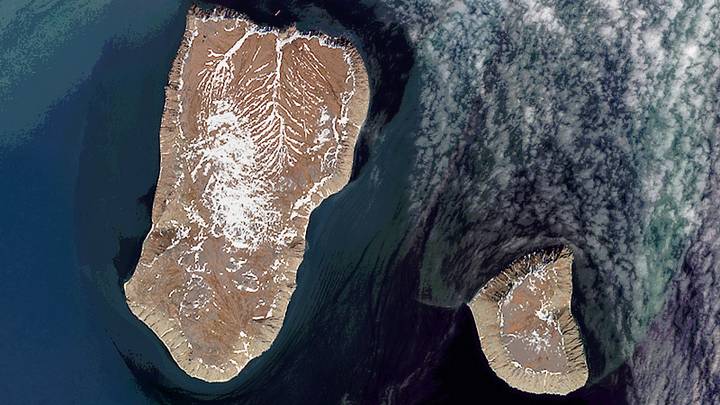
It’s easy to think of Russia and America as lands that are extremely geographically (not to mention culturally) distant from one another. Yet there’s a place out in the icy waters of the Bering Strait where the two nations are just a paltry 2.4 miles apart.
This is the reality for Little Diomede, which is part of Alaska, and Big Diomede, which is in Russia. The two small volcanic islands are also separated not only by nationality but also by the International Date Line, meaning that Big Diomede is a full 21 hours ahead of Little Diomede. Because of this, Little Diomede has been nicknamed “Yesterday Island,” while Big Diomede is sometimes called “Tomorrow Island.”
Despite these differences, these two islands are so close that inhabitants can see one another, peering across both nations and time in the process. Yet crossing between the two neighboring islands is not a simple thing.
The History of Big Diomede and Little Diomede

Ancient peoples regularly crossed between modern-day Siberia and North America on a land bridge called Beringia. This is believed to have happened frequently during the last Ice Age around 15,000 to 30,000 years ago, when low sea levels allowed ancient travelers to migrate southwards into North America.
This bridge is believed to have flooded some 13,000 years ago, yet this did not stop people from crossing the strait by sea. The islands themselves became inhabited and used for hunting by Yupik peoples roughly 3,000 years ago. The first Europeans to arrive there were Russian explorer Semyon Dezhnev in 1648 and Danish navigator Vitus Bering in 1728.
In the early 18th century, Siberian traders, Russian Orthodox missionaries, and Indigenous peoples regularly crossed this stretch of frigid waters between Russia and the United States, resulting in cultural cross-pollination that is still evident on both sides of the strait today.
Even after Alaska became part of the United States in 1867, the islands of Little Diomede and Big Diomede remained inhabited by a community of Indigenous peoples, who often paddled or dog-sledded between the two islands when the ice between them was thick enough. However, in 1948, the Soviet Union closed the border with the United States, forcing inhabitants of Big Diomede to relocate to Siberia and creating a so-called “ice curtain.” Families were separated, and many did not see each other for decades.
In 1987, U.S.-Soviet relations had improved enough that an American swimmer named Lynne Cox swam between the two islands, a peace gesture supported by both the U.S. and Russia that became a worldwide symbol of harmony. By 1988, an Alaska Airlines jet was able to take some Alaska Native elders to Russia. There, they were able to see family members whom they had been apart from since childhood or only knew from stories.
For some decades, relations between Alaska and Russia ran more smoothly. Numerous additional collaborative projects between the two took place, including a 1991 expedition of American and Soviet mushers and skiers who dog-sledded over 1,000 miles to promote unity.
Things changed between Big Diomede and Little Diomede in the early 2000s, though, when Russian President Vladimir Putin began discouraging relations between the U.S. and Russia, leading the border to freeze over once again.
Life on Big Diomede and Little Diomede

Today, Little Diomede has a population of approximately 80 people. Most are Iñupiat people, who live close together on the western shore facing the sea and often subsist on fishing and hunting. Islanders are also known for their ivory carvings, which are frequently sold on mainland Alaska.
The island is often shrouded by heavy fog, and there are no roads or modern sewage systems. There is a small school, a store, a church, and a laundromat, and mail and cargo arrive by barge or helicopter, which are often delayed due to weather. In more recent years, the island’s inhabitants have faced ever-more extreme challenges from climate change, which increasingly threatens their food supply and ways of life.
Big Diomede, meanwhile, is uninhabited today. The few people there can be found at a weather station, which is the island’s only functional building.
In winter, the waters between Little Diomede and Big Diomede freeze over, making it technically possible to walk between the two islands. However, unauthorized border crossings are highly illegal and are guaranteed to result in arrest. In 1986, a San Francisco drifter named John Weymouth made the crossing on foot but was quickly taken into Soviet custody, where he was kept for several weeks until being returned to the United States.
Meanwhile, discussions about building a link between the two nations across the Bering Strait have been ongoing for decades. In 1904, U.S. railroad magnates proposed a tunnel linking the Bering Strait. In the 1960s, the idea was revived as a potential “Kennedy-Khrushchev World Peace Bridge” that appeared on a Soviet-era map. In 2007, Russia revived the idea, proposing a tunnel under the strait that would cost between $10 and $12 billion. In 2025, the idea was proposed yet again by Putin envoy Kirill Dmitriev, though it drew pushback from Ukrainian President Volodymyr Zelensky. For now, the smallest gap between Russia and the U.S. remains a frozen, militarized no-man's land.