%20%20--%3E%0A%3Csvg%20version%3D%221.1%22%20id%3D%22Layer_1%22%20xmlns%3D%22http%3A%2F%2Fwww.w3.org%2F2000%2Fsvg%22%20xmlns%3Axlink%3D%22http%3A%2F%2Fwww.w3.org%2F1999%2Fxlink%22%20x%3D%220px%22%20y%3D%220px%22%0A%09%20viewBox%3D%220%200%20684.6%2068.1%22%20style%3D%22enable-background%3Anew%200%200%20684.6%2068.1%3B%22%20xml%3Aspace%3D%22preserve%22%3E%0A%3Cg%3E%0A%09%3Cpath%20d%3D%22M444.1%2C29.3h-17.4v14.5h17.4V29.3z%20M36.4%2C68.1l29.3-50.8V0H50.4L32.9%2C36.8L15.5%2C0H0v68.1h16.7V45.8l12.4%2C22.3H36.4z%0A%09%09%20M49.1%2C68.1h16.6V23.4L49.1%2C52.1V68.1z%20M76.6%2C68.1h45V53.8H93.3V41.6h21V27.1h-21V14.8h28.3V0.1h-45V68.1z%20M175.6%2C68.1h17.3v-68%0A%09%09h-16.5v40.3L150%2C0.1h-17.6v68h16.7V27.7L175.6%2C68.1z%20M235.8%2C14.8h15.4V0.1h-47.4v14.7H219v53.2h16.8V14.8z%20M290.3%2C45.9h-17.1%0A%09%09l7.5-15.6h2L290.3%2C45.9z%20M298.7%2C68.1h18l-32.2-68h-5.7l-32%2C68h18l3.3-7.1h27.1L298.7%2C68.1z%20M325.2%2C68.1h46.2V53.8h-29.6V0.1h-16.7%0A%09%09V68.1z%20M423.7%2C14.8h27.2V0.1H407v68h16.7V14.8z%20M462%2C68.1h46.2V53.8h-29.6V0.1H462V68.1z%20M564.8%2C34.1c0%2C10.7-7.2%2C19.2-18.5%2C19.2%0A%09%09c-11.4%2C0-18.5-8.5-18.5-19.2s7.1-19.2%2C18.5-19.2C557.6%2C14.9%2C564.8%2C23.4%2C564.8%2C34.1%20M580.6%2C34.1c0-19-14.2-34-34.3-34%0A%09%09c-20.2%2C0-34.3%2C15-34.3%2C34c0%2C19%2C14.1%2C34%2C34.3%2C34C566.4%2C68.1%2C580.6%2C53.1%2C580.6%2C34.1%20M604.8%2C20.5c0-4.1%2C3.3-6.2%2C6.7-6.2%0A%09%09c4.4%2C0%2C6.6%2C3%2C6.6%2C6.6h14.7C631.8%2C9.1%2C625.1%2C0.1%2C611%2C0.1c-12%2C0-21.7%2C9.3-21.7%2C20.6c0%2C10.9%2C5.9%2C15.9%2C16.7%2C19.8%0A%09%09c5.2%2C1.8%2C11.5%2C3.2%2C11.5%2C8c0%2C3.3-2.4%2C5.5-6.4%2C5.5c-3.6%2C0-6.6-3-6.6-6.7h-15.2c0%2C11.5%2C7.9%2C20.8%2C21.8%2C20.8c12%2C0%2C21.6-9.3%2C21.6-20.6%0A%09%09c0-10-5.3-16.4-16.7-19.8C610.6%2C26.1%2C604.8%2C25.3%2C604.8%2C20.5%20M670%2C20.9h14.7C683.8%2C9.1%2C677.1%2C0.1%2C663%2C0.1c-12%2C0-21.7%2C9.3-21.7%2C20.6%0A%09%09c0%2C10.9%2C5.9%2C15.9%2C16.7%2C19.8c5.2%2C1.8%2C11.5%2C3.2%2C11.5%2C8c0%2C3.3-2.4%2C5.5-6.4%2C5.5c-3.6%2C0-6.6-3-6.6-6.7h-15.2c0%2C11.5%2C7.9%2C20.8%2C21.8%2C20.8%0A%09%09c12%2C0%2C21.6-9.3%2C21.6-20.6c0-10-5.3-16.4-16.7-19.8c-5.4-1.6-11.3-2.4-11.3-7.2c0-4.1%2C3.3-6.2%2C6.7-6.2C667.7%2C14.4%2C670%2C17.3%2C670%2C20.9%0A%09%09%22%2F%3E%0A%3C%2Fg%3E%0A%3C%2Fsvg%3E%0A)

For most of the 20th century, historians argued that medieval parents didn't treat childhood as a stage of life worth marking, and then archaeologists started pulling toys out of the mud. The Thames foreshore alone has produced hundreds of miniature pewter playthings, and the London Museum's holdings of early base-metal toys are reckoned the largest of their kind anywhere.
Wood, cloth and wax rotted, so what survived skews toward metal, bone and fired clay—what you get below is shaped by soil chemistry as much as by taste.
- The Knight on Horseback
- The Miniature Jug
- Clay Figurines
- The Hobby Horse
- The Bird With the Moving Tongue
- The Buzz Bone
- The Clay Whistle
- Bone Ice Skates
The Knight on Horseback

The medieval action figure was mass-produced, and it looked the part. The London Museum's hollow-cast pewter rider wears a hauberk and carries a sword, his helmet long gone, and the armor style dates him to within a decade of 1300: the museum calls him the earliest hollow-cast pewter figure known in England. The Walters Art Museum has a bronze one of the 13th or 14th century whose fist once gripped a lance, probably wooden. The weapon going missing first is extremely believable.
The Miniature Jug

If you want the most common medieval toy in the ground, it's a tiny pewter vessel. The London Museum holds a lead-alloy toy jug of the mid-13th to early 14th century, 39 millimeters tall, copying the full-size ceramic jugs Londoners used from roughly 1250 to 1350, and a 15th-century toy ewer pulled from the Thames measures 43 millimeters. The stone mould for casting them came out of a 15th-century deposit on Berrington Street in Hereford, one of only two medieval toy moulds known from Britain. The museum's reading is that these were girls' toys.
Clay Figurines

The best evidence for a medieval toy industry is a workshop, and one turned up in 2025 under a Freiburg construction site. Rescue excavation of roughly 4,000 square meters in the Neuburg quarter, run by the Baden-Württemberg heritage office, found pottery kilns of the 13th and 14th centuries, one belonging to a potter who—per Bertram Jenisch, the archaeologist in charge—specialized in clay toys in the early 14th century.
Reports of the dig put the haul at fragments of more than 40 figurines: women in headdresses, men in caps, horses, and mothers holding babies.
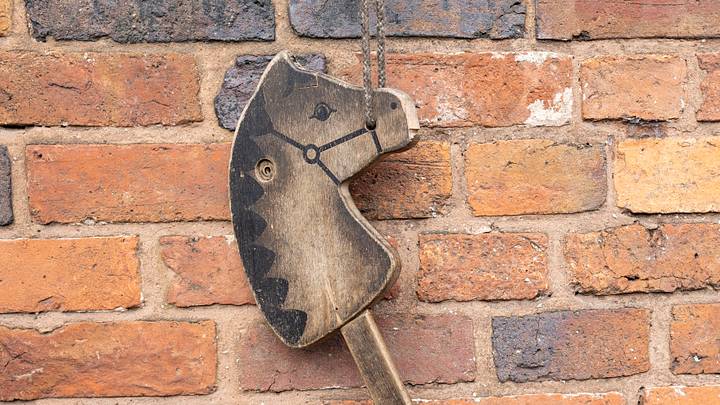
The Hobby Horse

What rich boys did with a stick comes down to one very good source. The Bodleian Library's Romance of Alexander, illuminated between 1338 and 1344 in Jehan de Grise's workshop, runs scenes of daily life along the bottom margins, and the boys in them ride hobby horses at tilting targets, shoot bows, work catapults, and stage puppet shows.
Writing in Speculum, Sarah McNamer argues the book was made for Lionel of Antwerp, Edward III's son, five or six when it was finished. Read it as what a court child had, not a village child.
The Bird With the Moving Tongue
Medieval toymakers built moving parts, and one surviving object proves it. A 14th-century pewter bird from London pivots on a horizontal bar, with a rod running up through the hollow body to emerge at the beak as a tongue—rock the bird and you get a tongue sliding in and out. Writing in 1998, the Museum of London argued it has a claim to be the earliest surviving post-Roman toy with moving parts. Seven centuries on, it is still a better gag than most.
The Buzz Bone
Somebody figured out that a pig's foot makes a noise. Buzz bones are pig metapodials drilled through the shaft, threaded onto a twisted cord and spun until they hum—Cotswold Archaeology records one from an excavation at Redcliffe in Bristol, and York Archaeology holds others. Archaeologists hedge on whether they were toys, musical instruments or hunting lures, which is a polite way of saying they were loud.
The Clay Whistle

Fired clay survives, so noisemakers survive with it. The Gibraltar National Museum holds a small clay whistle shaped like a fish, recovered from Grand Casemates Square in 1998 and dated to 14th-century Marinid and Nasrid Gibraltar, its scales incised and its fins moulded in relief. A kiln site at 17 Little Lane in Stanion, Northamptonshire produced three rare whistle pots of about the 15th century. The county record calls them whistles rather than toys, and it's right to.
Bone Ice Skates
Around 1173, the London clerk William FitzStephen described the city's young men crossing the frozen marsh at Moorfields on polished animal bones lashed to their feet. The skates were cattle or horse shin bones strapped under the shoe with leather, and a skater drove himself along with an iron-tipped pole; FitzStephen's comparison for the speed involved a crossbow bolt. The London Museum's surviving examples have bases worn flat. That is not a well-supervised afternoon.