%20%20--%3E%0A%3Csvg%20version%3D%221.1%22%20id%3D%22Layer_1%22%20xmlns%3D%22http%3A%2F%2Fwww.w3.org%2F2000%2Fsvg%22%20xmlns%3Axlink%3D%22http%3A%2F%2Fwww.w3.org%2F1999%2Fxlink%22%20x%3D%220px%22%20y%3D%220px%22%0A%09%20viewBox%3D%220%200%20684.6%2068.1%22%20style%3D%22enable-background%3Anew%200%200%20684.6%2068.1%3B%22%20xml%3Aspace%3D%22preserve%22%3E%0A%3Cg%3E%0A%09%3Cpath%20d%3D%22M444.1%2C29.3h-17.4v14.5h17.4V29.3z%20M36.4%2C68.1l29.3-50.8V0H50.4L32.9%2C36.8L15.5%2C0H0v68.1h16.7V45.8l12.4%2C22.3H36.4z%0A%09%09%20M49.1%2C68.1h16.6V23.4L49.1%2C52.1V68.1z%20M76.6%2C68.1h45V53.8H93.3V41.6h21V27.1h-21V14.8h28.3V0.1h-45V68.1z%20M175.6%2C68.1h17.3v-68%0A%09%09h-16.5v40.3L150%2C0.1h-17.6v68h16.7V27.7L175.6%2C68.1z%20M235.8%2C14.8h15.4V0.1h-47.4v14.7H219v53.2h16.8V14.8z%20M290.3%2C45.9h-17.1%0A%09%09l7.5-15.6h2L290.3%2C45.9z%20M298.7%2C68.1h18l-32.2-68h-5.7l-32%2C68h18l3.3-7.1h27.1L298.7%2C68.1z%20M325.2%2C68.1h46.2V53.8h-29.6V0.1h-16.7%0A%09%09V68.1z%20M423.7%2C14.8h27.2V0.1H407v68h16.7V14.8z%20M462%2C68.1h46.2V53.8h-29.6V0.1H462V68.1z%20M564.8%2C34.1c0%2C10.7-7.2%2C19.2-18.5%2C19.2%0A%09%09c-11.4%2C0-18.5-8.5-18.5-19.2s7.1-19.2%2C18.5-19.2C557.6%2C14.9%2C564.8%2C23.4%2C564.8%2C34.1%20M580.6%2C34.1c0-19-14.2-34-34.3-34%0A%09%09c-20.2%2C0-34.3%2C15-34.3%2C34c0%2C19%2C14.1%2C34%2C34.3%2C34C566.4%2C68.1%2C580.6%2C53.1%2C580.6%2C34.1%20M604.8%2C20.5c0-4.1%2C3.3-6.2%2C6.7-6.2%0A%09%09c4.4%2C0%2C6.6%2C3%2C6.6%2C6.6h14.7C631.8%2C9.1%2C625.1%2C0.1%2C611%2C0.1c-12%2C0-21.7%2C9.3-21.7%2C20.6c0%2C10.9%2C5.9%2C15.9%2C16.7%2C19.8%0A%09%09c5.2%2C1.8%2C11.5%2C3.2%2C11.5%2C8c0%2C3.3-2.4%2C5.5-6.4%2C5.5c-3.6%2C0-6.6-3-6.6-6.7h-15.2c0%2C11.5%2C7.9%2C20.8%2C21.8%2C20.8c12%2C0%2C21.6-9.3%2C21.6-20.6%0A%09%09c0-10-5.3-16.4-16.7-19.8C610.6%2C26.1%2C604.8%2C25.3%2C604.8%2C20.5%20M670%2C20.9h14.7C683.8%2C9.1%2C677.1%2C0.1%2C663%2C0.1c-12%2C0-21.7%2C9.3-21.7%2C20.6%0A%09%09c0%2C10.9%2C5.9%2C15.9%2C16.7%2C19.8c5.2%2C1.8%2C11.5%2C3.2%2C11.5%2C8c0%2C3.3-2.4%2C5.5-6.4%2C5.5c-3.6%2C0-6.6-3-6.6-6.7h-15.2c0%2C11.5%2C7.9%2C20.8%2C21.8%2C20.8%0A%09%09c12%2C0%2C21.6-9.3%2C21.6-20.6c0-10-5.3-16.4-16.7-19.8c-5.4-1.6-11.3-2.4-11.3-7.2c0-4.1%2C3.3-6.2%2C6.7-6.2C667.7%2C14.4%2C670%2C17.3%2C670%2C20.9%0A%09%09%22%2F%3E%0A%3C%2Fg%3E%0A%3C%2Fsvg%3E%0A)

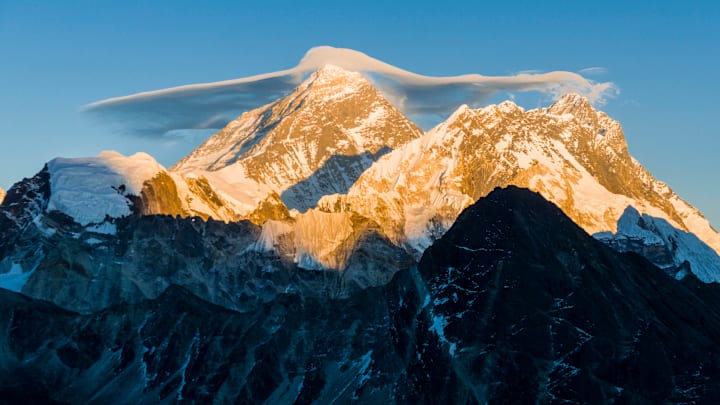
Mount Everest looms large both physically and figuratively in the lives and minds of mountaineers. The first confirmed successful ascent of the peak was achieved by Edmund Hillary and Tenzing Norgay in 1953, and since then, many people have followed in their footsteps—as of December 2024, 7,269 people to be exact. But the formidable mountain has also claimed the lives of more than 300 climbers.
Over the years, plenty of misconceptions have sprung up about Everest—which, by the way, was originally supposed to be pronounced “EVE-rest” (like Christmas Eve), after surveyor and geographer Sir George Everest, not “Ever-est” as it has come to be known. Here’s the truth behind five common misconceptions about the iconic mountain.
- Misconception: Everest is the tallest mountain in the world.
- Misconception: No animals live on Everest’s upper slopes.
- Misconception: Everest is the most difficult mountain to climb.
- Misconception: Climbers have to step over dead bodies to get to the top.
- Misconception: Everest is littered with garbage.
Misconception: Everest is the tallest mountain in the world.

By some metrics, Everest most certainly is the tallest mountain in the world—standing at an impressive 29,031.69 feet—but it depends on how you measure it. There are actually two other contenders for the title of Earth’s tallest mountain: Mauna Kea and Mount Chimborazo.
Mauna Kea is a dormant volcano in Hawaii that measures 33,497 feet from base to peak. So why isn’t it known as the world’s highest mountain? Well, the vast majority of that height is underwater. Only 13,802 feet of Mauna Kea is above sea level, whereas all 29,031 feet of Everest is on land. But if both mountains were plucked from the Earth and placed side-by-side, Mauna Kea would have the high ground.
Mount Chimborazo is a stratovolcano in Ecuador and is 20,548 feet high, which is clearly shorter than Everest. But if the title of tallest mountain goes to the peak that sticks out the farthest from the Earth’s center, then Chimborazo wins. Thanks to being so close to the equator, Chimborazo gets a big boost—around 20,000 feet—from the shape of the Earth, which isn’t perfectly spherical and bulges slightly around the latitude line.
Misconception: No animals live on Everest’s upper slopes.
The upper slopes of Everest aren’t a hospitable environment. The area above 26,000 feet is even known as the “death zone” because there isn’t enough oxygen to sustain human life, with climbers usually carrying oxygen bottles to make it to the summit. But there is one animal that isn’t bothered by the high altitude: a spider.
In 1924, explorer R.W.G. Hingston was climbing Everest and was surprised to see a small spider skittering across some rocks that had been blown clear of snow. He was at a height of 22,000 feet. “I cannot think on what it lives at such a height,” he wrote. “In these altitudes there is no other living thing nothing but rock and ice. This little spider is worthy of note as being the highest permanent inhabitant of the earth.”
In 1975, the noteworthy arachnid was officially named [PDF]: Euophrys omnisuperstes, which fittingly translates to “standing above all.” Colloquially, it’s known as the Himalayan jumping spider, and it’s thought to feed on tiny flies and springtails that are blown up Everest’s slopes by wind.
More Misconceptions:
Add Mental Floss as a preferred news source!
Misconception: Everest is the most difficult mountain to climb.

Reaching Everest’s summit is definitely not an easy task, but it’s not actually the hardest peak to climb, with a few other mountains actually having a higher death rate (the number of summits divided by the number of deaths). Not only do these peaks feature many of the same problems as Everest—freezing temperatures, unpredictable weather, hidden crevasses, and limited oxygen—but they also present a greater technical climbing challenge.
For instance, only highly-skilled climbers can attempt to summit K2—which is the second-tallest mountain in the world at 28,251 feet—because it’s an extremely technical climb almost the entire way up. In contrast, Everest is considered to be fairly accessible, with only two sections that are technically challenging (and there are ropes, ladders, and Sherpas for support): Khumbu Icefall and Hillary Step.
A few other mountains pose similarly daunting challenges. Climbers have to scale a formidable 1000-foot ice wall to summit Dhaulagiri I, while Annapurna I’s avalanche-prone slopes claim the lives of 1 out of every 4 climbers, making it the deadliest mountain in the world.
Misconception: Climbers have to step over dead bodies to get to the top.

Everest is often described as the world’s highest graveyard, with the bodies of more than 200 climbers who have died on the mountain being left there. Removing the bodies is often considered too dangerous for other climbers, and some of the deceased are in plain sight of those going up and down the mountain.
The most famous body is known as Green Boots—so-called due to wearing bright green hiking boots—who perished during the 1996 disaster and is thought to be either Tsewang Paljor or Dorje Morup. For many years, Green Boots served as a landmark along the Northeast Ridge route.
However, people don’t have to step over scores of bodies to reach the summit. Many of the deceased aren’t actually visible—being hidden from view after falling down steep cliff faces or deep crevasses. Even Green Boots isn’t as visible anymore, since a group of climbers moved him to a more private resting place in 2014.
Misconception: Everest is littered with garbage.

As well as being called the world’s highest graveyard, Everest is also sometimes described as the world’s highest garbage dump. However, the idea that Everest is covered in trash is false. Climbers used to leave much of their rubbish behind—including ripped tents, food wrappers, oxygen canisters, and human waste—but that hasn’t been the case for many years.
Not only do some Sherpas and specific companies, such as Asian Trekking’s Eco Everest Expeditions, work to remove the old garbage from Everest, but climbing teams typically take the vast majority of their rubbish away with them these days. Some trash is usually left at the higher camps—there are four camps between Base Camp and the summit—because of how difficult it is to remove, but not nearly enough to warrant the mountain being described as a garbage dump.