%20%20--%3E%0A%3Csvg%20version%3D%221.1%22%20id%3D%22Layer_1%22%20xmlns%3D%22http%3A%2F%2Fwww.w3.org%2F2000%2Fsvg%22%20xmlns%3Axlink%3D%22http%3A%2F%2Fwww.w3.org%2F1999%2Fxlink%22%20x%3D%220px%22%20y%3D%220px%22%0A%09%20viewBox%3D%220%200%20684.6%2068.1%22%20style%3D%22enable-background%3Anew%200%200%20684.6%2068.1%3B%22%20xml%3Aspace%3D%22preserve%22%3E%0A%3Cg%3E%0A%09%3Cpath%20d%3D%22M444.1%2C29.3h-17.4v14.5h17.4V29.3z%20M36.4%2C68.1l29.3-50.8V0H50.4L32.9%2C36.8L15.5%2C0H0v68.1h16.7V45.8l12.4%2C22.3H36.4z%0A%09%09%20M49.1%2C68.1h16.6V23.4L49.1%2C52.1V68.1z%20M76.6%2C68.1h45V53.8H93.3V41.6h21V27.1h-21V14.8h28.3V0.1h-45V68.1z%20M175.6%2C68.1h17.3v-68%0A%09%09h-16.5v40.3L150%2C0.1h-17.6v68h16.7V27.7L175.6%2C68.1z%20M235.8%2C14.8h15.4V0.1h-47.4v14.7H219v53.2h16.8V14.8z%20M290.3%2C45.9h-17.1%0A%09%09l7.5-15.6h2L290.3%2C45.9z%20M298.7%2C68.1h18l-32.2-68h-5.7l-32%2C68h18l3.3-7.1h27.1L298.7%2C68.1z%20M325.2%2C68.1h46.2V53.8h-29.6V0.1h-16.7%0A%09%09V68.1z%20M423.7%2C14.8h27.2V0.1H407v68h16.7V14.8z%20M462%2C68.1h46.2V53.8h-29.6V0.1H462V68.1z%20M564.8%2C34.1c0%2C10.7-7.2%2C19.2-18.5%2C19.2%0A%09%09c-11.4%2C0-18.5-8.5-18.5-19.2s7.1-19.2%2C18.5-19.2C557.6%2C14.9%2C564.8%2C23.4%2C564.8%2C34.1%20M580.6%2C34.1c0-19-14.2-34-34.3-34%0A%09%09c-20.2%2C0-34.3%2C15-34.3%2C34c0%2C19%2C14.1%2C34%2C34.3%2C34C566.4%2C68.1%2C580.6%2C53.1%2C580.6%2C34.1%20M604.8%2C20.5c0-4.1%2C3.3-6.2%2C6.7-6.2%0A%09%09c4.4%2C0%2C6.6%2C3%2C6.6%2C6.6h14.7C631.8%2C9.1%2C625.1%2C0.1%2C611%2C0.1c-12%2C0-21.7%2C9.3-21.7%2C20.6c0%2C10.9%2C5.9%2C15.9%2C16.7%2C19.8%0A%09%09c5.2%2C1.8%2C11.5%2C3.2%2C11.5%2C8c0%2C3.3-2.4%2C5.5-6.4%2C5.5c-3.6%2C0-6.6-3-6.6-6.7h-15.2c0%2C11.5%2C7.9%2C20.8%2C21.8%2C20.8c12%2C0%2C21.6-9.3%2C21.6-20.6%0A%09%09c0-10-5.3-16.4-16.7-19.8C610.6%2C26.1%2C604.8%2C25.3%2C604.8%2C20.5%20M670%2C20.9h14.7C683.8%2C9.1%2C677.1%2C0.1%2C663%2C0.1c-12%2C0-21.7%2C9.3-21.7%2C20.6%0A%09%09c0%2C10.9%2C5.9%2C15.9%2C16.7%2C19.8c5.2%2C1.8%2C11.5%2C3.2%2C11.5%2C8c0%2C3.3-2.4%2C5.5-6.4%2C5.5c-3.6%2C0-6.6-3-6.6-6.7h-15.2c0%2C11.5%2C7.9%2C20.8%2C21.8%2C20.8%0A%09%09c12%2C0%2C21.6-9.3%2C21.6-20.6c0-10-5.3-16.4-16.7-19.8c-5.4-1.6-11.3-2.4-11.3-7.2c0-4.1%2C3.3-6.2%2C6.7-6.2C667.7%2C14.4%2C670%2C17.3%2C670%2C20.9%0A%09%09%22%2F%3E%0A%3C%2Fg%3E%0A%3C%2Fsvg%3E%0A)

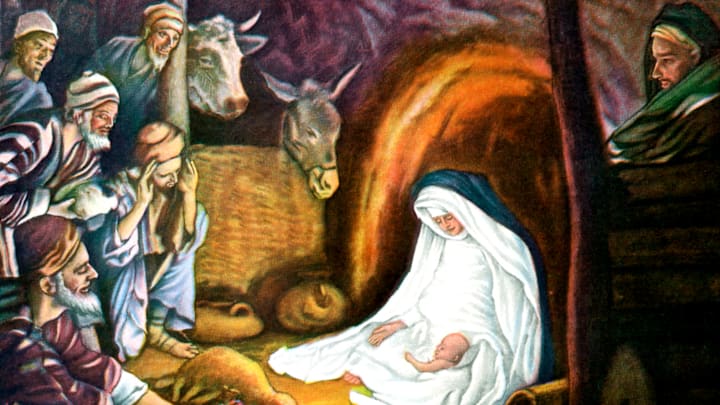
Thanks to the likes of decorative holiday manger scenes, Hollywood movies, and elementary school reenactments, the nativity story is now so ingrained in many of our minds that we could probably recite a fairly accurate version of it—including everything from the Three Wise Men to there being “no room at the inn.”
But given that this story now has a 2,000-year-old history behind it (and that it has been passed and translated from one language to another over the centuries, moreover), it’s only natural that some of the precise details of the birth of Jesus have become a little hazy, if not lost to the mists of time altogether. The truth behind five of these nativity myths and legends is explored here.
- It Took Place in Wintertime
- It Was in 0 BC
- The Star of Bethlehem Was a Star
- There Were Three Wise Men
- There Was No Room at the Inn (So Jesus Was Born in a Stable)
It Took Place in Wintertime

The Bible is oddly quiet when it comes to the precise details of the timing of Jesus’s birth (and it’s really nothing more than a coming together of ancient pagan traditions that has led to most of us celebrating it on the 25th day of December). But not only do we have no real clue as to the exact date of Jesus’s birth, but we can’t even be all that sure that it took place in the winter at all.
Some scholars and historians, for instance, have suggested that it would have been highly unlikely that the census that led to Mary and Joseph setting out on the road to Bethlehem at all (according to the Gospel of Luke, at least) would have been organized at a time of the year when inclement weather was all but guaranteed.
If it really were December in the Holy Land, moreover, it’s similarly unlikely that shepherds would have still been out in the fields “watching their flocks by night”; instead, they would have more likely have been sheltered in folds over the wintertime, making it more likely Jesus was born in either the spring or the fall.
It Was in 0 BC

There wasn’t actually a “year zero” to speak of, of course, and our longstanding BC vs. AD system of organizing our calendar wasn’t dreamt up until long after Jesus’s time in the mid-6th century.
But even still, based on the scant few details we know of the timing of Jesus’s birth, it seems more likely that he was born quite some time either before or after the BC–AD switch in our calendar that now bears reference to him—and even then, the details we have to go on the precise year of his birth are not only lacking, but contradictory.
At least one major detail of the nativity story, for instance, is the involvement of the king of Judea, Herod the Great. Born in 73 BC, Herod ruled as the Roman-appointed leader of Judea from 37 BC until his death in 4 BC, several years before our BC–AD system kicks in. Not only that, but the somewhat troublesome census mentioned in the Gospel of Luke was decreed by Quirinus, the Roman governor of Syria—yet he did not become governor until 6 AD, a decade after Herod’s death, making it impossible for Mary and Joseph to have journeyed to be counted in Quirinus’s census during the reign of King Herod.
All of this, ultimately, has led to suggestions that Luke must have got some of his facts surrounding the census relating to Jesus’s birth wrong (or at least confused with other censuses held in the decade before Quirinus came to power). Whatever the truth, though, it seems unlikely that Jesus was born at the time we have long since immortalized in our calendars.
The Star of Bethlehem Was a Star

Okay, so this one is more complicated, as it is at least possible that the Star of Bethlehem mentioned in the Gospel of Matthew was indeed nothing more than an especially bright star. But for decades now, scientists, astronomers, historians, and biblical scholars alike have all put forward various different theories as to precisely what else might have been going on in the nativity night sky that might explain such an extraordinarily noticeable light.
For instance, some voices claim that it was perhaps a rare alignment not of stars, but of planets. Adding fuel to the fire of the debate around the precise timing of Jesus’s birth, a so-called planetary conjunction of Venus and Jupiter is known to have occurred early in the summer of 2 BC.
Intriguingly, there was another of these so-called planetary conjunctions just a few years earlier than that, this time between Jupiter and Saturn, in 7 BC. Another theory, however, suggests that rather than a planet, the “star” may instead have been a comet—and likewise, we have evidence from ancient Chinese astronomers of what they called a “broom star” moving across the sky in 5 BC.
There Were Three Wise Men

The Wise Men are only mentioned in the second chapter of the Gospel of Matthew, and the few details he offers on their arrival in Bethlehem call into question an awful lot about what we have come to think about them.
For one, Matthew makes no specific reference to when the wise men arrive to see Jesus, and various interpretations of his words have led to notions that they may have arrived weeks, months, or even years after Jesus’s birth; in the original Greek text, for instance, Jesus is referred to as a paidion at the time of the wise men’s arrival, which was a word usually reserved for older children, rather than infants.
We might be used to nativity scenes showing the wise men sitting around the manger in an animal-filled stable, moreover, but Matthew’s gospel explicitly states that the wise men saw Jesus, Mary, and Joseph in a house.
Perhaps most curious of all, however, is the fact that Matthew makes no reference at all to there being three wise men—or, for that matter, a precise number of wise men at all. Instead, it seems our notion that there were three of them is based on nothing more than there being three gifts: gold, frankincense, and myrrh.
There Was No Room at the Inn (So Jesus Was Born in a Stable)

Two for the price of one here, as the original text of the scripture neither makes it clear whether or not Mary and Joseph sought room at an inn in Bethlehem, nor whether Jesus was born in a stable as a consequence.
In a 2010 study [PDF], Bible scholar Professor Stephen C Carlson made an intriguing case for interpreting the Greek scriptural word κατάλυμα (katalyma)—which we’re used to interpreting as an inn—in a far more general way, meaning simply “place to stay” or “lodging.” (The word itself, tellingly, derives from another Ancient Greek word meaning merely “to stay somewhere for one night.”)
Precisely what overnight lodging that word refers, ultimately, to is unclear, with some commentators suggesting the temporary home in question may well have been that of Joseph’s parents.
If that were the case, however, it’s highly unlikely that Joseph’s parents would have forced their son, daughter-in-law, and imminent grandson out to a freezing cold barn, of course—which would also call into question whether Jesus was truly born in a stable at all.
In fact, the only reason we’ve come to presume such a thing is that the Gospel of Luke makes specific reference to Jesus being laid in a manger (a kind of wooden feeding trough for livestock).
But as some Bible scholars have pointed out, homes in the Holy Land at the time of Jesus’s birth often featured a small hold for livestock attached to the main body of a house, where the homeowners’ animals could be kept overnight for safety and security.
Ultimately, although Jesus was placed in a manger, there’s no reason to presume that that manger in turn was placed in a barn or stable, far away from anywhere else. Instead, in the absence of any other suitably sized bed for such a newborn child, the manger might simply have provided a warm and comfortable makeshift crib, kept in a room adjoining Jesus’s grandparents’ house.
You May Also Like:
Add Mental Floss as a preferred news source!