%20%20--%3E%0A%3Csvg%20version%3D%221.1%22%20id%3D%22Layer_1%22%20xmlns%3D%22http%3A%2F%2Fwww.w3.org%2F2000%2Fsvg%22%20xmlns%3Axlink%3D%22http%3A%2F%2Fwww.w3.org%2F1999%2Fxlink%22%20x%3D%220px%22%20y%3D%220px%22%0A%09%20viewBox%3D%220%200%20684.6%2068.1%22%20style%3D%22enable-background%3Anew%200%200%20684.6%2068.1%3B%22%20xml%3Aspace%3D%22preserve%22%3E%0A%3Cg%3E%0A%09%3Cpath%20d%3D%22M444.1%2C29.3h-17.4v14.5h17.4V29.3z%20M36.4%2C68.1l29.3-50.8V0H50.4L32.9%2C36.8L15.5%2C0H0v68.1h16.7V45.8l12.4%2C22.3H36.4z%0A%09%09%20M49.1%2C68.1h16.6V23.4L49.1%2C52.1V68.1z%20M76.6%2C68.1h45V53.8H93.3V41.6h21V27.1h-21V14.8h28.3V0.1h-45V68.1z%20M175.6%2C68.1h17.3v-68%0A%09%09h-16.5v40.3L150%2C0.1h-17.6v68h16.7V27.7L175.6%2C68.1z%20M235.8%2C14.8h15.4V0.1h-47.4v14.7H219v53.2h16.8V14.8z%20M290.3%2C45.9h-17.1%0A%09%09l7.5-15.6h2L290.3%2C45.9z%20M298.7%2C68.1h18l-32.2-68h-5.7l-32%2C68h18l3.3-7.1h27.1L298.7%2C68.1z%20M325.2%2C68.1h46.2V53.8h-29.6V0.1h-16.7%0A%09%09V68.1z%20M423.7%2C14.8h27.2V0.1H407v68h16.7V14.8z%20M462%2C68.1h46.2V53.8h-29.6V0.1H462V68.1z%20M564.8%2C34.1c0%2C10.7-7.2%2C19.2-18.5%2C19.2%0A%09%09c-11.4%2C0-18.5-8.5-18.5-19.2s7.1-19.2%2C18.5-19.2C557.6%2C14.9%2C564.8%2C23.4%2C564.8%2C34.1%20M580.6%2C34.1c0-19-14.2-34-34.3-34%0A%09%09c-20.2%2C0-34.3%2C15-34.3%2C34c0%2C19%2C14.1%2C34%2C34.3%2C34C566.4%2C68.1%2C580.6%2C53.1%2C580.6%2C34.1%20M604.8%2C20.5c0-4.1%2C3.3-6.2%2C6.7-6.2%0A%09%09c4.4%2C0%2C6.6%2C3%2C6.6%2C6.6h14.7C631.8%2C9.1%2C625.1%2C0.1%2C611%2C0.1c-12%2C0-21.7%2C9.3-21.7%2C20.6c0%2C10.9%2C5.9%2C15.9%2C16.7%2C19.8%0A%09%09c5.2%2C1.8%2C11.5%2C3.2%2C11.5%2C8c0%2C3.3-2.4%2C5.5-6.4%2C5.5c-3.6%2C0-6.6-3-6.6-6.7h-15.2c0%2C11.5%2C7.9%2C20.8%2C21.8%2C20.8c12%2C0%2C21.6-9.3%2C21.6-20.6%0A%09%09c0-10-5.3-16.4-16.7-19.8C610.6%2C26.1%2C604.8%2C25.3%2C604.8%2C20.5%20M670%2C20.9h14.7C683.8%2C9.1%2C677.1%2C0.1%2C663%2C0.1c-12%2C0-21.7%2C9.3-21.7%2C20.6%0A%09%09c0%2C10.9%2C5.9%2C15.9%2C16.7%2C19.8c5.2%2C1.8%2C11.5%2C3.2%2C11.5%2C8c0%2C3.3-2.4%2C5.5-6.4%2C5.5c-3.6%2C0-6.6-3-6.6-6.7h-15.2c0%2C11.5%2C7.9%2C20.8%2C21.8%2C20.8%0A%09%09c12%2C0%2C21.6-9.3%2C21.6-20.6c0-10-5.3-16.4-16.7-19.8c-5.4-1.6-11.3-2.4-11.3-7.2c0-4.1%2C3.3-6.2%2C6.7-6.2C667.7%2C14.4%2C670%2C17.3%2C670%2C20.9%0A%09%09%22%2F%3E%0A%3C%2Fg%3E%0A%3C%2Fsvg%3E%0A)

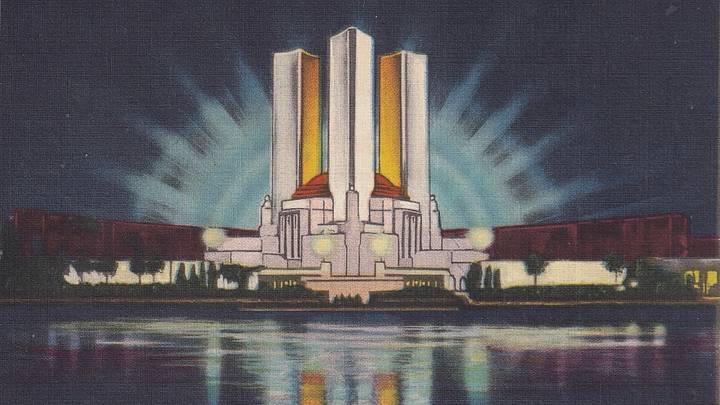
World’s Fairs were large global exhibitions where countries would come to showcase their latest innovations. These extravagant gatherings often lasted months at a time, drew massive crowds, and included exhibitions that could be awe-inspiring—or horrifying. Often, the sparkling surface of these events hid darker evils that festered within them and sometimes exploded.
World’s Fairs have their roots in early English national fairs and French industrial exhibitions. In 1851, Britain held the first World’s Fair—the Great Exhibition of the Works of Industry of All Nations—in Hyde Park. The event emerged thanks, in part, to the efforts and interest of Queen Victoria’s husband, Prince Albert.
The exhibition included a magnificent greenhouse-like building called the Crystal Palace, designed by Joseph Paxton. This building, and the many fascinating scientific and technological exhibitions within it, wowed attendees and sparked a global World’s Fair fever. Over 40 international exhibitions were held everywhere from Australia to Guatemala between 1880 and World War I, though perhaps the grandest World’s Fair of all was the World’s Columbian Exposition in Chicago in 1893.
While fairs held after World War I never quite reached the heights they once did, they remained popular in the 20th century, with many focusing on more specific topics such as sustainability, peace, or innovation. Ultimately, the World’s Fairs of yore remain examples of just how innovative, creative, and unfortunately, how evil people can sometimes be. Here are some of the wildest, strangest, and most disturbing things that happened during them.
- A Presidential Assassination
- H. H. Holmes’ "Murder Castle"
- Live Leeches Said to Predict Storms
- Air-Conditioned Houses
- Premature Babies
- The Ferris Wheel Vs. the Eiffel Tower
- Human Exhibitions
A Presidential Assassination

President William McKinley had just entered his second term in office when he made an appearance at the Pan-American Exhibition in Buffalo, New York in 1901. On September 5, he gave a speech to 116,000 people, and that night there was a fireworks display that culminated in pyrotechnics reading, “Welcome President McKinley, Chief of our Nation and Our Empire.”
The next day, McKinley held a meet-and-greet at a theater called the Temple of Music. Some of his staff were worried about a possible assassination and urged him to cancel it, but McKinley—who famously loved meeting the public—refused.
At around 4 P.M., a 28-year-old former steelworker named Leon Czolgosz shot McKinley twice with his revolver just as the president was extending his hand out towards him. “It was in my heart; there was no escape for me,” Czolgosz later said. “All those people seemed bowing to the great ruler. I made up my mind to kill that ruler.”
After the shots rang out, a great silence fell. Then another man waiting in line punched Czolgosz, stopping him from firing, while soldiers and detectives leaped on the assassin. “My wife,” McKinley told his secretary. “Be careful how you tell her—oh, be careful!”
He was quickly carried to the exhibition’s hospital, where the only capable doctor on site was a gynecological surgeon. Still, McKinley was rushed into surgery, where the doctors were able to stop his bleeding but were unable to find the bullet still inside him. He survived for several more days and appeared to be healing before succumbing to an infection, and died with his wife at his side.
H. H. Holmes’ "Murder Castle"

Evil lurked amid the glory and grandeur of the Chicago Columbian Exhibition. A doctor who became a con artist, H. H. Holmes moved to Chicago after being accused of fraud and murder in New York. Ahead of the 1893 World’s Fair, he purchased a building that would eventually be known as the “Murder Castle.”
Details of this building were likely later exaggerated by the press, which claimed it included secret passages, soundproof rooms, gas jets for asphyxiating victims, a torture chamber, and an oven to cremate remains. While the “Murder Castle” may not actually have been quite so lurid, Holmes was definitely a violent criminal. During the World’s Fair, Holmes allegedly murdered numerous young women through various methods. He later confessed to 27 murders, though he was legally convicted of one and was later executed. Because of his crimes, he is often labeled America’s first serial killer.
Live Leeches Said to Predict Storms

At London's Great Exhibition of 1851, one could lay eyes on everything from the Koh-i-Noor, the world’s largest diamond at the time, to an early prototype of a fax machine. But one of the stranger inventions available to see at this fair was certainly the tempest prognosticator, a peculiar weather device that relied on leeches to predict the weather. The contraption was invented by Dr. George Merryweather in 1850.
It featured 12 pint glass bottles, which each contained a single leech. These bottles stood around a bell and were encircled by 12 hammers that were attached to pieces of whalebone that rested in one bottle’s neck. The whole thing’s design was modeled after an Indian temple, with a few Egyptian flourishes. It was based on the theory that atmospheric electricity before storms would cause leeches to crawl towards the neck of the bottle, where they would eject the whalebones, thereby making the bell ring. The device understandably did not stand the test of time, but it remains one of the more unique inventions ever displayed at a World’s Fair.
Air-Conditioned Houses

Today, air conditioning is widely taken for granted, at least among Americans. Yet air conditioning did not become a widespread phenomenon in U.S. homes until around the 1960s, making George Fred Keck’s House of Tomorrow exhibition at the 1933 Chicago World’s Fair all the more impressive and prescient. This display envisioned what a futuristic home might be like, and actually included quite a few things that are staples of homes today. In addition to central air conditioning, it included a garage door that opened at the click of a button, the first General Electric dishwasher, and floor-to-ceiling windows that allowed for natural solar heating. It also included a hangar for a family’s theoretical plane, an aspirational vision which we haven’t quite caught up to yet.
Premature Babies

The 1939 World’s Fair in Flushing Meadows, Queens featured a lot of memorable attractions, from Salvador Dalí’s scandalous “Dream of Venus” funhouse to simulated rocket rides and talking robots. But perhaps one of the most unusual was a display of premature babies placed in incubators, which visitors paid 25 cents to come and see.
Overseen by a German man named Martin Couney, these so-called incubator shows were held regularly on the Coney Island boardwalk, but they found an even broader audience at the New York World’s Fair. This exhibit typically held 16 babies at a time, which were brought from nearby hospitals and cared for around the clock by nurses. Contrary to how strange the whole thing might sound, these exhibitions saved vulnerable infants’ lives and were often praised by parents whose vulnerable children they helped.
The idea to put incubator babies on display had previously been realized by a French physician named Pierre Budin. He had set up his own exhibition at the 1896 Berlin World’s Fair in order to raise support for incubators, which were widely considered frivolous and excessively expensive by doctors at the time. Couney allegedly happened to see the exhibition there, and was inspired to create his own in order to save lives and publicize the technology.
The Ferris Wheel Vs. the Eiffel Tower


The Eiffel Tower was originally intended to be a temporary attraction displayed at the 1889 Paris World’s Fair. Built by engineer Gustave Eiffel, it was the world’s tallest tower at the time, and it awed the millions of visitors who came to see it.
Not to be outdone, the committee in charge of the 1893 Chicago World’s Fair sought out something to rival it. The design they chose was not a higher tower, as Eiffel himself proposed, but a wheel that could carry people up and down in a circular motion. Designed by George Washington Gale Ferris Jr., it became the centerpiece of the exhibition and was considered a technological marvel. The so-called Ferris Wheel went on to spread around the world, becoming as much of a staple of amusement parks as the Eiffel Tower is in the Parisian skyline.
Human Exhibitions

World’s Fairs often reflected the colonialist and racist attitudes of the eras in which they occurred. Because of this, these events often included “ethnological exhibits,” which today are sometimes referred to as “human zoos.” There, human beings, including Native Americans and people from Africa, were put on display for white attendees’ entertainment. The largest of these exhibitions was the “Philippine Village” at the 1904 St. Louis World’s Fair. The U.S. paid $1.5 million for the exhibit and brought people from the Philippines, then under U.S. colonial rule following the Spanish-American War, to participate in it. They spent months living in a recreation of a Philippine town, and 17 people are estimated to have died during this time from illness, malnutrition, or suicide, per PBS.