%20%20--%3E%0A%3Csvg%20version%3D%221.1%22%20id%3D%22Layer_1%22%20xmlns%3D%22http%3A%2F%2Fwww.w3.org%2F2000%2Fsvg%22%20xmlns%3Axlink%3D%22http%3A%2F%2Fwww.w3.org%2F1999%2Fxlink%22%20x%3D%220px%22%20y%3D%220px%22%0A%09%20viewBox%3D%220%200%20684.6%2068.1%22%20style%3D%22enable-background%3Anew%200%200%20684.6%2068.1%3B%22%20xml%3Aspace%3D%22preserve%22%3E%0A%3Cg%3E%0A%09%3Cpath%20d%3D%22M444.1%2C29.3h-17.4v14.5h17.4V29.3z%20M36.4%2C68.1l29.3-50.8V0H50.4L32.9%2C36.8L15.5%2C0H0v68.1h16.7V45.8l12.4%2C22.3H36.4z%0A%09%09%20M49.1%2C68.1h16.6V23.4L49.1%2C52.1V68.1z%20M76.6%2C68.1h45V53.8H93.3V41.6h21V27.1h-21V14.8h28.3V0.1h-45V68.1z%20M175.6%2C68.1h17.3v-68%0A%09%09h-16.5v40.3L150%2C0.1h-17.6v68h16.7V27.7L175.6%2C68.1z%20M235.8%2C14.8h15.4V0.1h-47.4v14.7H219v53.2h16.8V14.8z%20M290.3%2C45.9h-17.1%0A%09%09l7.5-15.6h2L290.3%2C45.9z%20M298.7%2C68.1h18l-32.2-68h-5.7l-32%2C68h18l3.3-7.1h27.1L298.7%2C68.1z%20M325.2%2C68.1h46.2V53.8h-29.6V0.1h-16.7%0A%09%09V68.1z%20M423.7%2C14.8h27.2V0.1H407v68h16.7V14.8z%20M462%2C68.1h46.2V53.8h-29.6V0.1H462V68.1z%20M564.8%2C34.1c0%2C10.7-7.2%2C19.2-18.5%2C19.2%0A%09%09c-11.4%2C0-18.5-8.5-18.5-19.2s7.1-19.2%2C18.5-19.2C557.6%2C14.9%2C564.8%2C23.4%2C564.8%2C34.1%20M580.6%2C34.1c0-19-14.2-34-34.3-34%0A%09%09c-20.2%2C0-34.3%2C15-34.3%2C34c0%2C19%2C14.1%2C34%2C34.3%2C34C566.4%2C68.1%2C580.6%2C53.1%2C580.6%2C34.1%20M604.8%2C20.5c0-4.1%2C3.3-6.2%2C6.7-6.2%0A%09%09c4.4%2C0%2C6.6%2C3%2C6.6%2C6.6h14.7C631.8%2C9.1%2C625.1%2C0.1%2C611%2C0.1c-12%2C0-21.7%2C9.3-21.7%2C20.6c0%2C10.9%2C5.9%2C15.9%2C16.7%2C19.8%0A%09%09c5.2%2C1.8%2C11.5%2C3.2%2C11.5%2C8c0%2C3.3-2.4%2C5.5-6.4%2C5.5c-3.6%2C0-6.6-3-6.6-6.7h-15.2c0%2C11.5%2C7.9%2C20.8%2C21.8%2C20.8c12%2C0%2C21.6-9.3%2C21.6-20.6%0A%09%09c0-10-5.3-16.4-16.7-19.8C610.6%2C26.1%2C604.8%2C25.3%2C604.8%2C20.5%20M670%2C20.9h14.7C683.8%2C9.1%2C677.1%2C0.1%2C663%2C0.1c-12%2C0-21.7%2C9.3-21.7%2C20.6%0A%09%09c0%2C10.9%2C5.9%2C15.9%2C16.7%2C19.8c5.2%2C1.8%2C11.5%2C3.2%2C11.5%2C8c0%2C3.3-2.4%2C5.5-6.4%2C5.5c-3.6%2C0-6.6-3-6.6-6.7h-15.2c0%2C11.5%2C7.9%2C20.8%2C21.8%2C20.8%0A%09%09c12%2C0%2C21.6-9.3%2C21.6-20.6c0-10-5.3-16.4-16.7-19.8c-5.4-1.6-11.3-2.4-11.3-7.2c0-4.1%2C3.3-6.2%2C6.7-6.2C667.7%2C14.4%2C670%2C17.3%2C670%2C20.9%0A%09%09%22%2F%3E%0A%3C%2Fg%3E%0A%3C%2Fsvg%3E%0A)

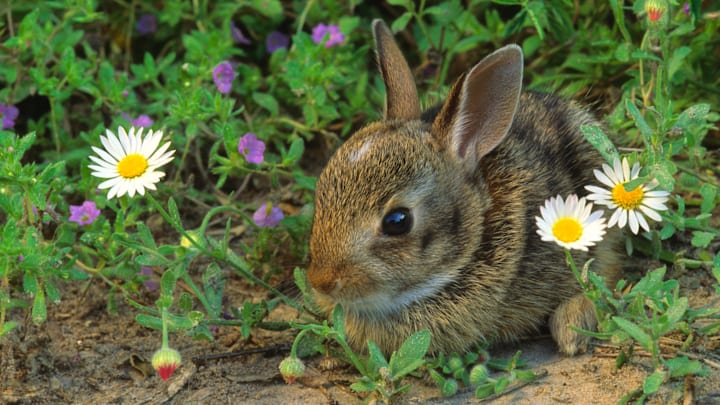
In parts of the world that have four distinct seasons, spring tends to bring new flowers and greenery, plenty of pollen, and tantalizing warmth. In the Northern Hemisphere, the spring equinox typically falls between March 19 and 21, and this time of year usually ushers in a rush of warmth and new life—and sometimes, a “fake spring” that makes everyone think it’s warming up only for a fresh frost to rush in.
Cultures all around the world have celebrated the spring equinox in different ways. In modern times, many people have adopted a holiday called Ostara, which has its roots in a goddess called Eostre—though it turns out that this goddess may or may not have actually been worshiped in ancient times. Learn more about what we know—and don't—about the origins of Eostre and Ostara ahead.
- The first recorded mention of Eostre appears in the writings of the English monk Bede
- Jacob Grimm helped popularize Eostre
- Another 19th-century book solidified Eostre’s association with hares
- The name “Eostre” derives from an ancient term meaning “dawn”
- Modern Wiccans celebrate a holiday called Ostara inspired by Eostre
The first recorded mention of Eostre appears in the writings of the English monk Bede

The first mention of Eostre known to history appears in the writings of the English Christian monk and scholar, the Venerable Bede. In his book De ratione temporum, which means The Reckoning of Time and was written around 725 CE, Bede discusses the origins of different months’ names in the Anglo-Saxon lunar calendar. Things get interesting when he reaches Eosturmonath—the month that roughly corresponds to the Roman month of April.
“Eosturmonath has a name which is now translated ‘Paschal month,’ and which was once called after a goddess of theirs named Eostre, in whose honour feasts were celebrated in that month,” he wrote, speaking of “olden” traditions practiced by the English. “Now they designate that Paschal season by her name, calling the joys of the new rite by the time-honoured name of the old observance.”
There is no record of a goddess named Eostre in pagan traditions prior to this passage’s publication. However, many of these practices were solely passed down orally, so whether Bede fabricated the association or was reporting the truth about a tradition that would later be lost to time remains unknown. Regardless, many writers, historians, and folklorists took Bede at his word.
Jacob Grimm helped popularize Eostre

In his 1835 book Deutsche Mythologie, folklorist Jacob Grimm theorized that the goddess named Eostre that Bede had mentioned must have been based on an older Germanic goddess, who he titled Ostara.
“Eostre seems therefore to have been the divinity of the radiant dawn, of upspringing light, a spectacle that brings joy and blessing, whose meaning could be easily adapted by the resurrection-day of the Christian's God,” he wrote. “This Ostara, like the [Anglo-Saxon] Eostre, must in heathen religion have denoted a higher being, whose worship was so firmly rooted, that the Christian teachers tolerated the name, and applied it to one of their own grandest anniversaries.”
There are no known sources that officially confirm a goddess named Ostara existed prior to the publication of Grimm’s book, but other scholars and historians ran with the idea.
Another 19th-century book solidified Eostre’s association with hares

In 1874, a writer named Adolf Holtzmann published another book called Deutsche Mythologie in which he theorized that the goddess Ostara may have been connected to hares. At the time in Germany, Christians already associated the holiday Easter with bunnies, so Holtzmann was spitballing about that association in his book. “The Easter Hare is inexplicable to to me, but probably the hare was the sacred animal of Ostara; just as there is a hare on the statue of [the Celtic goddess] Abnoba,” he wrote.
In 1884, a writer named H. Krebs built on this association in a note in the English journal Folk-Lore. “Some time ago the question was raised how it came that, according to South German still prevailing folk-lore, the Hare is believed by children to lay the Easter-eggs. I venture now to offer a probable answer to it,” he wrote. “Originally the hare seems to have been a bird which the ancient Teutonic goddess Ostara (the Anglo-Saxon Eàstre or Eostre, as Bede calls her) transformed into a quadruped. For this reason the Hare, in grateful recollection of its former quality as bird and swift messenger of the Spring-Goddess, is able to lay eggs on her festival at Easter-time.”
The same story was later repeated in an 1889 issue of American Notes and Queries, but folklorists have not identified a clear, written source for this legend that predates Krebs’ note.
The name “Eostre” derives from an ancient term meaning “dawn”

The name Eostre comes from the Proto-Germanic term “austrōn,” which means “dawn.” This is connected to the Proto-Indo-European root “h₂ews-,” which means “to shine” or “dawn.”
Modern Wiccans celebrate a holiday called Ostara inspired by Eostre

Today, traditions and legends surrounding Eostre and Ostara have been adapted by modern Wiccans and pagans into a holiday called Ostara. This holiday appears on the Wheel of the Year, an interpretation of pagan holidays that was primarily developed in the 20th century. In this framework, Ostara takes place on the spring equinox and celebrates spring, fertility, renewal, and rebirth. Many pagans honor this holiday with bonfires, feasting, and special rituals and practices that align with the season, like planting seeds and spending time outdoors.