%20%20--%3E%0A%3Csvg%20version%3D%221.1%22%20id%3D%22Layer_1%22%20xmlns%3D%22http%3A%2F%2Fwww.w3.org%2F2000%2Fsvg%22%20xmlns%3Axlink%3D%22http%3A%2F%2Fwww.w3.org%2F1999%2Fxlink%22%20x%3D%220px%22%20y%3D%220px%22%0A%09%20viewBox%3D%220%200%20684.6%2068.1%22%20style%3D%22enable-background%3Anew%200%200%20684.6%2068.1%3B%22%20xml%3Aspace%3D%22preserve%22%3E%0A%3Cg%3E%0A%09%3Cpath%20d%3D%22M444.1%2C29.3h-17.4v14.5h17.4V29.3z%20M36.4%2C68.1l29.3-50.8V0H50.4L32.9%2C36.8L15.5%2C0H0v68.1h16.7V45.8l12.4%2C22.3H36.4z%0A%09%09%20M49.1%2C68.1h16.6V23.4L49.1%2C52.1V68.1z%20M76.6%2C68.1h45V53.8H93.3V41.6h21V27.1h-21V14.8h28.3V0.1h-45V68.1z%20M175.6%2C68.1h17.3v-68%0A%09%09h-16.5v40.3L150%2C0.1h-17.6v68h16.7V27.7L175.6%2C68.1z%20M235.8%2C14.8h15.4V0.1h-47.4v14.7H219v53.2h16.8V14.8z%20M290.3%2C45.9h-17.1%0A%09%09l7.5-15.6h2L290.3%2C45.9z%20M298.7%2C68.1h18l-32.2-68h-5.7l-32%2C68h18l3.3-7.1h27.1L298.7%2C68.1z%20M325.2%2C68.1h46.2V53.8h-29.6V0.1h-16.7%0A%09%09V68.1z%20M423.7%2C14.8h27.2V0.1H407v68h16.7V14.8z%20M462%2C68.1h46.2V53.8h-29.6V0.1H462V68.1z%20M564.8%2C34.1c0%2C10.7-7.2%2C19.2-18.5%2C19.2%0A%09%09c-11.4%2C0-18.5-8.5-18.5-19.2s7.1-19.2%2C18.5-19.2C557.6%2C14.9%2C564.8%2C23.4%2C564.8%2C34.1%20M580.6%2C34.1c0-19-14.2-34-34.3-34%0A%09%09c-20.2%2C0-34.3%2C15-34.3%2C34c0%2C19%2C14.1%2C34%2C34.3%2C34C566.4%2C68.1%2C580.6%2C53.1%2C580.6%2C34.1%20M604.8%2C20.5c0-4.1%2C3.3-6.2%2C6.7-6.2%0A%09%09c4.4%2C0%2C6.6%2C3%2C6.6%2C6.6h14.7C631.8%2C9.1%2C625.1%2C0.1%2C611%2C0.1c-12%2C0-21.7%2C9.3-21.7%2C20.6c0%2C10.9%2C5.9%2C15.9%2C16.7%2C19.8%0A%09%09c5.2%2C1.8%2C11.5%2C3.2%2C11.5%2C8c0%2C3.3-2.4%2C5.5-6.4%2C5.5c-3.6%2C0-6.6-3-6.6-6.7h-15.2c0%2C11.5%2C7.9%2C20.8%2C21.8%2C20.8c12%2C0%2C21.6-9.3%2C21.6-20.6%0A%09%09c0-10-5.3-16.4-16.7-19.8C610.6%2C26.1%2C604.8%2C25.3%2C604.8%2C20.5%20M670%2C20.9h14.7C683.8%2C9.1%2C677.1%2C0.1%2C663%2C0.1c-12%2C0-21.7%2C9.3-21.7%2C20.6%0A%09%09c0%2C10.9%2C5.9%2C15.9%2C16.7%2C19.8c5.2%2C1.8%2C11.5%2C3.2%2C11.5%2C8c0%2C3.3-2.4%2C5.5-6.4%2C5.5c-3.6%2C0-6.6-3-6.6-6.7h-15.2c0%2C11.5%2C7.9%2C20.8%2C21.8%2C20.8%0A%09%09c12%2C0%2C21.6-9.3%2C21.6-20.6c0-10-5.3-16.4-16.7-19.8c-5.4-1.6-11.3-2.4-11.3-7.2c0-4.1%2C3.3-6.2%2C6.7-6.2C667.7%2C14.4%2C670%2C17.3%2C670%2C20.9%0A%09%09%22%2F%3E%0A%3C%2Fg%3E%0A%3C%2Fsvg%3E%0A)

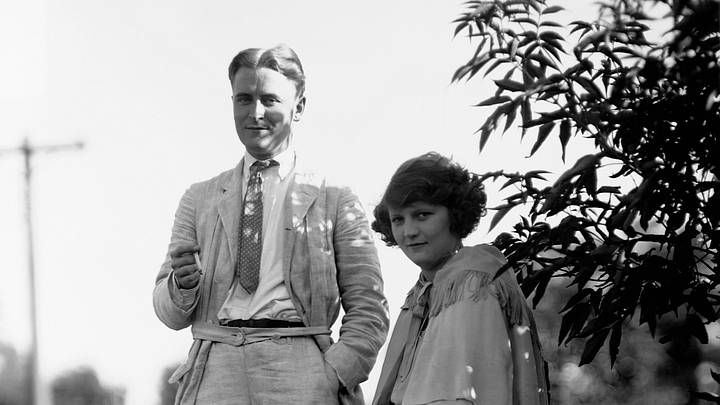
F. Scott Fitzgerald was born on September 24, 1896. He is now considered one of the greatest authors of 20th-century literature, though he achieved only moderate success in his lifetime. His writing explores wealth, class, morality, and the allure and flimsiness of the American dream, among other themes. His best-known work, The Great Gatsby, is widely considered the Great American Novel.
Fitzgerald’s life was rife with struggles and challenges that influenced his writing. His prose is also known for its descriptiveness, which invites the reader into a tactile world of sounds and sights and remains a time capsule of Jazz Age opulence and corruption. He often drew direct inspiration from the places he lived and visited, using them to paint vivid landscapes upon which he planted his glamorous and frequently doomed characters. Here are five places that shaped Fitzgerald’s life and work.
- St. Paul, Minnesota
- Lake Forest, Illinois
- Long Island’s Gold Coast
- The Valley of Ashes, Queens
- The French Riviera
- Hollywood
St. Paul, Minnesota

Fitzgerald was born in St. Paul, Minnesota, and came and went from there a number of times throughout his life. He was born at 481 Laurel Avenue in the Cathedral Hill neighborhood, a wealthy area that exposed Fitzgerald to privilege early on. Fitzgerald, whose mother came from money but whose parents were middle-class, would spend the rest of his life both fascinated and, at times, repulsed by the extreme wealth he grew up surrounded by. It became a major theme in his novels, which often glamorized the American upper classes while simultaneously lambasting them.
Fitzgerald spent around 16 formative years of his life in St. Paul, returning there to live with his parents while completing This Side of Paradise and later moving there with his wife, Zelda, for the birth of their first child. The author seemingly had mixed feelings about his hometown. A character in one of his books described St. Paul's Summit Avenue as “a mausoleum of American architectural monstrosities,” but still, Fitzgerald continuously drew inspiration from people and places there across his works, even though he never lived there again after the age of 26.
Lake Forest, Illinois

Despite Fitzgerald’s proximity to the nouveau riche in St. Paul, his first intimate exposure to true old money was a visit to the town of Lake Forest, Illinois. This was the home of his first love, Ginevra King, a fact that undoubtedly upped its allure in Fitzgerald’s mind.
The two met in Minnesota in 1915, and their relationship mostly consisted of letters. Fitzgerald did visit her in June 1915 and was clearly impacted by the elegant summer parties and golfing sessions he attended there, later describing Lake Forest as “immaculate.”
King is believed to be the inspiration for Daisy Buchanan in Gatsby, and her friend, fellow socialite and famous golfer Edith Cummings, is thought to have inspired Jordan Baker. King is also believed to be one of the inspirations behind Nicole Diver in Tender Is the Night; at one point, Nicole says, “We were in Lake Forest—that’s a summer place near Chicago where we have a place—and she was out all day playing golf or tennis with boys. And some of them pretty gone on her at that.”
Fitzgerald’s efforts to court King were shut down by her father, who told him, “Poor boys shouldn't think of marrying rich girls.” Undoubtedly, this event instilled in him at least part of the fascination with wealth that would pervade his novels and life.
Long Island’s Gold Coast

In 1922, 26-year-old Fitzgerald and his wife Zelda were flush with money from Fitzgerald’s first novels, and they moved to a house on Long Island, New York. They would live there for less than two years. Still, his time there shaped his iconic novel The Great Gatsby, with Great Neck forming the basis of the new money-flush West Egg and the neighborhood of Sands Point inspiring the old money-heavy East Egg.
The Fitzgeralds lived in a seven-bedroom Mediterranean-style house at 6 Gateway Drive in Great Neck. The house was an opulent dwelling, but it admittedly paled next to lavish mansions such as the nearby Beacon Towers, a towering estate said to be an inspiration for Jay Gatsby’s abode.
The Valley of Ashes, Queens
During his time living on Long Island, Fitzgerald often drove through what is now known as Flushing Meadows-Corona Park in Queens while on his way to Manhattan. Today, the place is a well-developed cultural hub, but in Fitzgerald’s time, it really did resemble the wasteland he labeled the “valley of ashes” in Gatsby.
At the time, the wetlands near Flushing Bay were used as a dumping ground for garbage and ash. “It was a really terrible sight, because you had the garbage dump north of Roosevelt Avenue, which is where Citi Field is today,” said Queens borough historian Jason Antos. “Then south of the railroad, south of Roosevelt, south of Northern, you have the ash dumps. And then slightly to the east of that, you had the Iron Triangle with all the automotive shops…The entire place was super industrial and really, really depressing.”
This area plays a key role in Gatsby, symbolizing the careless destruction and damage often done by those in possession of immense wealth and industry. Even the billboard featured on the original cover of Gatsby is believed to have been inspired by a real billboard advertising an optometrist that Fitzgerald likely saw there.
Plans for it to become a park were in place in the ‘20s and the area was further transformed for the 1939 World’s Fair. But certainly, it’s not hard to see how the yawning, ashen terrain that Fitzgerald had to drive through while traveling between Long Island’s mansions and Manhattan’s glitzy hotels made an impact on the author, who often faced periods of decay and despair in his own life in between moments of stunning success.
The French Riviera

The Fitzgeralds first visited the French Riviera in 1924 and quickly fell for the seaside destination. Thy first traveled there to visit Gerald and Sara Murphy, a couple who provided part of the inspiration for Dick and Nicole Diver, the troubled yet elegant protagonists of Tender Is the Night. (Of course, the Divers were ultimately more a reflection of Fitzgerald and Zelda than of anyone else.)
In August 1924, the Fitzgeralds set off to visit the Murphys, who were staying at the Hôtel du Cap in Antibes, a hotel that inspired the Hôtel des Étrangers in Tender Is the Night. Zelda and Scott took the train from Paris and spent time in the coastal town of Hyeres before moving to Saint-Raphaël, a locale that Fitzgerald called “a little red town built close to the sea, with gay red-roofed houses and an air of repressed carnival about it.”
In a rented house there, Fitzgerald hunkered down and wrote The Great Gatsby. His wife, meanwhile, embarked on a five-week affair with a French aviator that culminated in her demanding a divorce from Fitzgerald. The aviator subsequently broke things off with Zelda, and all of this led to a great deal of strife in the Fitzgeralds’ marriage and coincided with a sharp decline in Zelda’s mental health. Infidelity would become a major theme in Fitzgerald’s work, and some have even theorized that the aviator inspired Jay Gatsby.
Despite the turbulence that characterized their first visit to the Riviera, the Fitzgeralds visited it numerous times. “With our being back in a nice villa on my beloved Riviera (between Nice and Cannes),” Fitzgerald wrote in a letter to his friend Ernest Hemingway penned upon arriving at the Villa St Louis in Juan-les-Pins, “I’m happier than I’ve been for years. It’s one of those strange, precious and all too transitory moments when everything in one’s life seems to be going well.”
Hollywood

In 1937, a desperate and despondent Fitzgerald moved to Hollywood looking to recover his fortune. Broke, tormented by alcoholism, and with Zelda institutionalized and his daughter in a pricey boarding school, Fitzgerald took a day job in Hollywood’s studio system. He stayed at a hotel called the Garden of Allah on the Sunset Strip and rewrote screenplays, often indulging in amphetamines and other substances by night.
After his screenwriting contract with MGM ended, he began work on The Love of the Last Tycoon, a novel about a precocious young film producer navigating a large studio system. The novel was largely inspired by his own experiences in Hollywood and the characters he met there; in particular, its protagonist was inspired by “boy genius” MGM head Irving Thalberg, whom Fitzgerald worked under.
Unfortunately, the author died of a heart attack at 44 before he could finish the book, believing himself to be a failure at the time. Biographer Matthew Bruccoli, who reissued a version of the unfinished manuscript along with some of Fitzgerald’s notes and fragments in the 1990s, called Tycoon “the most promising — and the most disappointing — fragment in American fiction.”
