%20%20--%3E%0A%3Csvg%20version%3D%221.1%22%20id%3D%22Layer_1%22%20xmlns%3D%22http%3A%2F%2Fwww.w3.org%2F2000%2Fsvg%22%20xmlns%3Axlink%3D%22http%3A%2F%2Fwww.w3.org%2F1999%2Fxlink%22%20x%3D%220px%22%20y%3D%220px%22%0A%09%20viewBox%3D%220%200%20684.6%2068.1%22%20style%3D%22enable-background%3Anew%200%200%20684.6%2068.1%3B%22%20xml%3Aspace%3D%22preserve%22%3E%0A%3Cg%3E%0A%09%3Cpath%20d%3D%22M444.1%2C29.3h-17.4v14.5h17.4V29.3z%20M36.4%2C68.1l29.3-50.8V0H50.4L32.9%2C36.8L15.5%2C0H0v68.1h16.7V45.8l12.4%2C22.3H36.4z%0A%09%09%20M49.1%2C68.1h16.6V23.4L49.1%2C52.1V68.1z%20M76.6%2C68.1h45V53.8H93.3V41.6h21V27.1h-21V14.8h28.3V0.1h-45V68.1z%20M175.6%2C68.1h17.3v-68%0A%09%09h-16.5v40.3L150%2C0.1h-17.6v68h16.7V27.7L175.6%2C68.1z%20M235.8%2C14.8h15.4V0.1h-47.4v14.7H219v53.2h16.8V14.8z%20M290.3%2C45.9h-17.1%0A%09%09l7.5-15.6h2L290.3%2C45.9z%20M298.7%2C68.1h18l-32.2-68h-5.7l-32%2C68h18l3.3-7.1h27.1L298.7%2C68.1z%20M325.2%2C68.1h46.2V53.8h-29.6V0.1h-16.7%0A%09%09V68.1z%20M423.7%2C14.8h27.2V0.1H407v68h16.7V14.8z%20M462%2C68.1h46.2V53.8h-29.6V0.1H462V68.1z%20M564.8%2C34.1c0%2C10.7-7.2%2C19.2-18.5%2C19.2%0A%09%09c-11.4%2C0-18.5-8.5-18.5-19.2s7.1-19.2%2C18.5-19.2C557.6%2C14.9%2C564.8%2C23.4%2C564.8%2C34.1%20M580.6%2C34.1c0-19-14.2-34-34.3-34%0A%09%09c-20.2%2C0-34.3%2C15-34.3%2C34c0%2C19%2C14.1%2C34%2C34.3%2C34C566.4%2C68.1%2C580.6%2C53.1%2C580.6%2C34.1%20M604.8%2C20.5c0-4.1%2C3.3-6.2%2C6.7-6.2%0A%09%09c4.4%2C0%2C6.6%2C3%2C6.6%2C6.6h14.7C631.8%2C9.1%2C625.1%2C0.1%2C611%2C0.1c-12%2C0-21.7%2C9.3-21.7%2C20.6c0%2C10.9%2C5.9%2C15.9%2C16.7%2C19.8%0A%09%09c5.2%2C1.8%2C11.5%2C3.2%2C11.5%2C8c0%2C3.3-2.4%2C5.5-6.4%2C5.5c-3.6%2C0-6.6-3-6.6-6.7h-15.2c0%2C11.5%2C7.9%2C20.8%2C21.8%2C20.8c12%2C0%2C21.6-9.3%2C21.6-20.6%0A%09%09c0-10-5.3-16.4-16.7-19.8C610.6%2C26.1%2C604.8%2C25.3%2C604.8%2C20.5%20M670%2C20.9h14.7C683.8%2C9.1%2C677.1%2C0.1%2C663%2C0.1c-12%2C0-21.7%2C9.3-21.7%2C20.6%0A%09%09c0%2C10.9%2C5.9%2C15.9%2C16.7%2C19.8c5.2%2C1.8%2C11.5%2C3.2%2C11.5%2C8c0%2C3.3-2.4%2C5.5-6.4%2C5.5c-3.6%2C0-6.6-3-6.6-6.7h-15.2c0%2C11.5%2C7.9%2C20.8%2C21.8%2C20.8%0A%09%09c12%2C0%2C21.6-9.3%2C21.6-20.6c0-10-5.3-16.4-16.7-19.8c-5.4-1.6-11.3-2.4-11.3-7.2c0-4.1%2C3.3-6.2%2C6.7-6.2C667.7%2C14.4%2C670%2C17.3%2C670%2C20.9%0A%09%09%22%2F%3E%0A%3C%2Fg%3E%0A%3C%2Fsvg%3E%0A)

Book bans are nothing new. In 213 BCE, the Chinese emperor Shih Huang Ti is believed to have ordered 460 Confucian scholars to be buried alive as part of an effort to consolidate power and suppress dissent. In the year 8 CE, the poet Ovid was exiled from Rome—and some scholars believe this had something to do with his writing Ars Amatoria (The Art of Love), a poem that describes the art of romance and seduction; the book was later banned again in the United States in 1930. And in the year 35 CE, the Roman emperor Caligula is believed to have banned Homer’s The Odyssey because it expressed Greek ideas of freedom that he believed were dangerous.
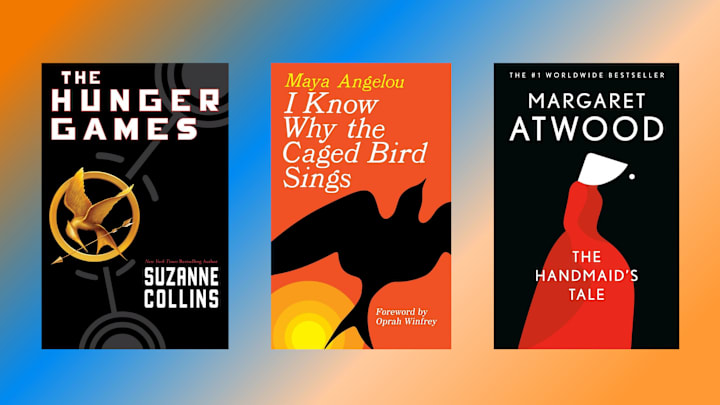
These are just a few examples of early book bans, but in more recent years, the United States has been the site of many more—and a large number of the books that have courted controversy in the U.S. in recent years have been written by women. If you’ve sat in a high school English class, you may have read Zora Neale Hurston's Their Eyes Were Watching God, Toni Morrison’s Beloved, Margaret Atwood's The Handmaid's Tale, and many more on this lis, and it may or may not come as a surprise to you that each of these books has been banned at one point or another.
Read on to discover 11 notable books written by women that have been banned over the years—and why.
- Beloved by Toni Morrison (1987)
- The Bluest Eye by Toni Morrison (1970)
- I Know Why the Caged Bird Sings by Maya Angelou (1969)
- Persepolis: The Story of a Childhood by Marjane Satrapi (2000)
- The House on Mango Street by Sandra Cisneros (1984)
- The Handmaid’s Tale by Margaret Atwood (1985)
- Their Eyes Were Watching God by Zora Neale Hurston (1937)
- Harry Potter and the Sorcerer's Stone by J. K. Rowling (1997)
- The Color Purple by Alice Walker (1982)
- The Hunger Games by Suzanne Collins (2008)
- Jane Eyre by Charlotte Brontë (1847)
Beloved by Toni Morrison (1987)

Toni Morrison’s Beloved is a lyrical, haunting novel that uses the presence of a furious ghost to explore the traumatic aftermath of slavery in America. It is inspired by the life of a real woman named Margaret Garner who escaped slavery and fled to Ohio in 1856, but killed one of her children when U.S. marshals broke into the cabin where she was hiding. The novel tells the story of a family whose home is haunted by a disruptive ghost who winds up being the spirit of a daughter that Sethe, the protagonist, killed in order to stop her from being enslaved again.
Beloved has also been challenged or banned in 12 states including Colorado, Florida, and Oregon. It has been criticized for featuring violence and sexual content, and in 2013, a woman named Laura Murphy even fought to have a so-called “Beloved bill” passed in Virginia that could allow parents to selectively opt out of their children reading books that included “sexually explicit content.” The bill was vetoed by then-governor Terry McAuliffe in 2016, but in 2021, his opponent Glenn Youngkin cited the veto in his campaign against McAuliffe, and won the race.
Proponents of the Pulitzer Prize-winning book, however, argue that it forces readers to grapple with the realities of violence and slavery in America. “Books like 'Beloved' really do force us to have real conversations about history,” Howard University professor Dana Williams said, per PBS.
The Bluest Eye by Toni Morrison (1970)

This is another Toni Morrison book that often appears on the American Library Association’s lists of frequently banned and challenged books. The novel tells the story of a young Black girl named Pecola who is frequently bullied for her looks and longs to look more white. It has been criticized for its depiction of childhood sexual abuse, and has even been banned in some prisons.
I Know Why the Caged Bird Sings by Maya Angelou (1969)

Maya Angelou’s famous autobiography tells the story of her childhood and details the abuse she suffered while growing up. Her unflinching depiction of what she went through has made the book controversial but is also part of why the book has been such a resonant read for many, as it also describes how she overcame the abuse and developed the courage to follow her dreams.
The book has been banned or challenged dozens of times. Parents have criticized its depiction of sexual violence, teen pregnancy, and LGBTQ+ content, among other themes, and school districts have also claimed that the book is “anti-white.” Over the years, it’s continued to top lists of most banned and challenged books.
Because of the level of backlash the book has received, Angelou has been called the most banned author in United States history. “I’m always sorry that people ban my books. Many times I’ve been called the most banned,” Angelou said in a 2009 interview. “Many times my books are banned by people who never read two sentences,” she added.
Though the book was criticized for its depiction of childhood sexual abuse, Angelou felt strongly that it was important that the book be taught in schools so it could inspire children to speak out about their experiences. “The unspeakable is far more dangerous when left unspoken,” she once said.
Persepolis: The Story of a Childhood by Marjane Satrapi (2000)

Marjane Satrapi’s Persepolis is a graphic novel that describes the author's experiences growing up in Iran before and after the 1979 Iranian revolution, and it focuses on the trauma Satrapi and her family endured during and after the war. The book has been banned for various reasons, including violence, some sexual content, and brief depictions of torture.
It was published in 2000, but controversy around the book began to swirl in 2013, when the book—which had been taught to seventh graders for years—was suddenly banned in Chicago public school classrooms for “graphic language and imagery,” sparking widespread backlash.
The book has since been challenged in numerous schools and universities, but its defenders cite the fact that students, particularly those living in Chicago public schools, are often exposed to violence in their day-to-day lives—and in history classes, especially when learning about subjects like the Holocaust or slavery. “History is violent, yes. And it’s disturbing, too,” wrote editor Jennifer Day in an op-ed about the ban in The Chicago Tribune. “What better place to learn about it than within the safe, educational framework of school?”
The House on Mango Street by Sandra Cisneros (1984)

Sandra Cisneros’s The House on Mango Street tells the story of a 12-year-old Mexican-American girl named Esperanza Cordero as she grows up in an impoverished Chicago neighborhood. The book has been challenged and banned a number of times, most famously in Arizona in 2010, when Arizona House Bill 2281 banned the book along with 80 other titles in an effort to target the Tucson Unified School District's Mexican-American Studies program, according to an article published by Lisa Rand for the American Library Association. It has since been subject to many bans and challenges due to its “raw and unflinching portrayal of difficult social issues,” according to the Nashville Public Library.
The Handmaid’s Tale by Margaret Atwood (1985)

Margaret Atwood’s The Handmaid’s Tale follows a woman named Offred thrust into slavery in an oppressive regime that overtakes the U.S. government during a period of widespread infertility. Offred is removed from her family and forced to act as a “handmaid,” essentially a breeding mare for wealthy families.
The book has been widely praised for its depiction of the dangers of censorship and extreme violence against women, but has also been challenged extensively. The book often appears on the American Library Association’s lists of most frequently challenged or banned books, and in 2024, the book was freshly banned in many schools across Florida, Texas, Oregon, and other states, reportedly due to reasons like “human sexuality,” “material that may discomfort students,” and “the discussion of feminism and extremism.”
Atwood herself responded to the bans by creating an “unburnable” version of the book in 2022. “Across the United States and around the world, books are being challenged, banned and even burned. So we created a special edition of a book that’s been challenged and banned for decades,” her publisher, Penguin Random House, said an announcement about the book. “Printed and bound using fireproof materials, this edition of Margaret Atwood’s The Handmaid’s Tale was made to be completely un-burnable. It is designed to protect this vital story and stand as a powerful symbol against censorship.”
Their Eyes Were Watching God by Zora Neale Hurston (1937)

Zora Neale Hurston’s Their Eyes Were Watching God is a coming-of-age story that follows a woman named Janie Crawford as she navigates being a Black woman in Florida in the early 20th century. The book explores Crawford’s marriages and her efforts to assert her independence in a male-dominated world, among other themes. According to the American Library Association, the book has also commonly been banned for reasons such as its depiction of “sexual explicitness and language.”
Interestingly, at the time of the book’s publication, Hurston was criticized for not taking an overtly political stance about the Black experience in America and instead focusing more on her main character’s inner world and romantic experiences.
Harry Potter and the Sorcerer's Stone by J. K. Rowling (1997)

J. K. Rowling’s Harry Potter series has also been challenged and banned many times, albeit not for the same exact reasons as many other books on this list. This series tells a fairly straightforward tale about a heroic young wizard triumphing over evil, but was banned and censored as early as 2001, largely for religious reasons and allegedly Satanic and occult subtext.
The books were still being banned as recently as 2020. That year, a pastor in Nashville said that year that the “books present magic as both good and evil, which is not true, but in fact a clever deception,” and added that “the curses and spells used in the books are actual curses and spells which when read by a human being risk conjuring evil spirits into the presence of the person reading the text.”
In an op-ed for the National Coalition Against Censorship, author Judy Blume warned against writing off the dangers of censorship. “The real danger is not in the books, but in laughing off those who would ban them,” she wrote. “The protests against Harry Potter follow a tradition that has been growing since the early 1980’s and often leaves school principals trembling with fear that is then passed down to teachers and librarians.”
The Color Purple by Alice Walker (1982)

Alice Walker’s The Color Purple tells the story of Celie, a Black woman living in rural Georgia, as she survives extensive bigotry during the first half of the 20th century. The Pulitzer Prize-winning book has also been turned into an award-winning musical and films, but it has also long been the subject of challenges and controversy. The book has been criticized for its depiction of race, sex, abuse, and profanity, among other themes, and one of the earliest high-profile efforts to ban it happened in 1984 in Oakland, California. The ban attempt was unsuccessful, and in an essay, Walker reflected on how all the controversy had caused sales to spike.
“I felt I had written the book as a gift to the people. All of them,” Walker added. “If they wanted it, let them fight to keep it, as I had to fight to deliver it.” Decades later, the controversy continues; in 2024, the Clay County Oversight Committee in Florida removed the book from all schools in the county.
The Hunger Games by Suzanne Collins (2008)

Suzanne Collins’s The Hunger Games tells the story of a society where 24 children from impoverished provinces are forced to fight to the death each year in a spectacle meant to entertain the inhabitants of the wealthy Capitol.
The book’s violence is the main reason it has been banned, but protestors have also cited “insensitivity, offensive language, anti-family, anti-ethic, and occult” themes as reasons for its censorship. However, critics of the bans have noted that the book is mostly focused around its protagonist Katniss’s efforts to protect her family, and contains very few messages surrounding religious or occult themes.
Jane Eyre by Charlotte Brontë (1847)

Charlotte Brontë’s Jane Eyre is a literary mainstay today, but it sparked a bit of a scandal when it came out. The book was criticized for its perceived feminist themes and was considered “coarse” and uncouth by Victorians at the time of its publication. One particular review, published in the Quarterly Review, accused Brontë—then writing under the male pseudonym of Currer Bell—of “moral Jacobinism,” or essentially trying to spark a revolution. At the time of the review's publication, rumors that Bell was a woman had begun to swirl, and the critic claimed that if this was the case, Bell had “forfeited the society of her own sex.”
The book was not actually formally banned in England, though it did face harsh criticism and attempts to censor it, particularly among young women. It was, however, censored by the Chinese Communist Party during the Cultural Revolution along with many other Western texts, when it was deemed to have the potential to influence and corrupt young people.