%20%20--%3E%0A%3Csvg%20version%3D%221.1%22%20id%3D%22Layer_1%22%20xmlns%3D%22http%3A%2F%2Fwww.w3.org%2F2000%2Fsvg%22%20xmlns%3Axlink%3D%22http%3A%2F%2Fwww.w3.org%2F1999%2Fxlink%22%20x%3D%220px%22%20y%3D%220px%22%0A%09%20viewBox%3D%220%200%20684.6%2068.1%22%20style%3D%22enable-background%3Anew%200%200%20684.6%2068.1%3B%22%20xml%3Aspace%3D%22preserve%22%3E%0A%3Cg%3E%0A%09%3Cpath%20d%3D%22M444.1%2C29.3h-17.4v14.5h17.4V29.3z%20M36.4%2C68.1l29.3-50.8V0H50.4L32.9%2C36.8L15.5%2C0H0v68.1h16.7V45.8l12.4%2C22.3H36.4z%0A%09%09%20M49.1%2C68.1h16.6V23.4L49.1%2C52.1V68.1z%20M76.6%2C68.1h45V53.8H93.3V41.6h21V27.1h-21V14.8h28.3V0.1h-45V68.1z%20M175.6%2C68.1h17.3v-68%0A%09%09h-16.5v40.3L150%2C0.1h-17.6v68h16.7V27.7L175.6%2C68.1z%20M235.8%2C14.8h15.4V0.1h-47.4v14.7H219v53.2h16.8V14.8z%20M290.3%2C45.9h-17.1%0A%09%09l7.5-15.6h2L290.3%2C45.9z%20M298.7%2C68.1h18l-32.2-68h-5.7l-32%2C68h18l3.3-7.1h27.1L298.7%2C68.1z%20M325.2%2C68.1h46.2V53.8h-29.6V0.1h-16.7%0A%09%09V68.1z%20M423.7%2C14.8h27.2V0.1H407v68h16.7V14.8z%20M462%2C68.1h46.2V53.8h-29.6V0.1H462V68.1z%20M564.8%2C34.1c0%2C10.7-7.2%2C19.2-18.5%2C19.2%0A%09%09c-11.4%2C0-18.5-8.5-18.5-19.2s7.1-19.2%2C18.5-19.2C557.6%2C14.9%2C564.8%2C23.4%2C564.8%2C34.1%20M580.6%2C34.1c0-19-14.2-34-34.3-34%0A%09%09c-20.2%2C0-34.3%2C15-34.3%2C34c0%2C19%2C14.1%2C34%2C34.3%2C34C566.4%2C68.1%2C580.6%2C53.1%2C580.6%2C34.1%20M604.8%2C20.5c0-4.1%2C3.3-6.2%2C6.7-6.2%0A%09%09c4.4%2C0%2C6.6%2C3%2C6.6%2C6.6h14.7C631.8%2C9.1%2C625.1%2C0.1%2C611%2C0.1c-12%2C0-21.7%2C9.3-21.7%2C20.6c0%2C10.9%2C5.9%2C15.9%2C16.7%2C19.8%0A%09%09c5.2%2C1.8%2C11.5%2C3.2%2C11.5%2C8c0%2C3.3-2.4%2C5.5-6.4%2C5.5c-3.6%2C0-6.6-3-6.6-6.7h-15.2c0%2C11.5%2C7.9%2C20.8%2C21.8%2C20.8c12%2C0%2C21.6-9.3%2C21.6-20.6%0A%09%09c0-10-5.3-16.4-16.7-19.8C610.6%2C26.1%2C604.8%2C25.3%2C604.8%2C20.5%20M670%2C20.9h14.7C683.8%2C9.1%2C677.1%2C0.1%2C663%2C0.1c-12%2C0-21.7%2C9.3-21.7%2C20.6%0A%09%09c0%2C10.9%2C5.9%2C15.9%2C16.7%2C19.8c5.2%2C1.8%2C11.5%2C3.2%2C11.5%2C8c0%2C3.3-2.4%2C5.5-6.4%2C5.5c-3.6%2C0-6.6-3-6.6-6.7h-15.2c0%2C11.5%2C7.9%2C20.8%2C21.8%2C20.8%0A%09%09c12%2C0%2C21.6-9.3%2C21.6-20.6c0-10-5.3-16.4-16.7-19.8c-5.4-1.6-11.3-2.4-11.3-7.2c0-4.1%2C3.3-6.2%2C6.7-6.2C667.7%2C14.4%2C670%2C17.3%2C670%2C20.9%0A%09%09%22%2F%3E%0A%3C%2Fg%3E%0A%3C%2Fsvg%3E%0A)

Horror novels are filled with spooky and sinister places—from Bly Manor in Henry James’s The Turn of the Screw (1898) to the entire town of Castle Rock, Maine, which is the setting for many of Stephen King’s stories. But while both Bly Manor and Castle Rock are entirely fictional, there are a few places from famous horror books that are actually real. If you want to experience some iconic literary horror locations for yourself, here are six scary places you can visit.
- Dracula’s Castle from Dracula (1897) // Scotland
- Sleepy Hollow from The Legend of Sleepy Hollow (1820) // New York
- The Overlook Hotel from The Shining (1977) // Colorado
- Hill House from The Haunting of Hill House (1959) // Vermont
- The Castle of Otranto from The Castle of Otranto (1764) // England
- The Amityville House from The Amityville Horror (1977) // New York
Dracula’s Castle from Dracula (1897) // Scotland

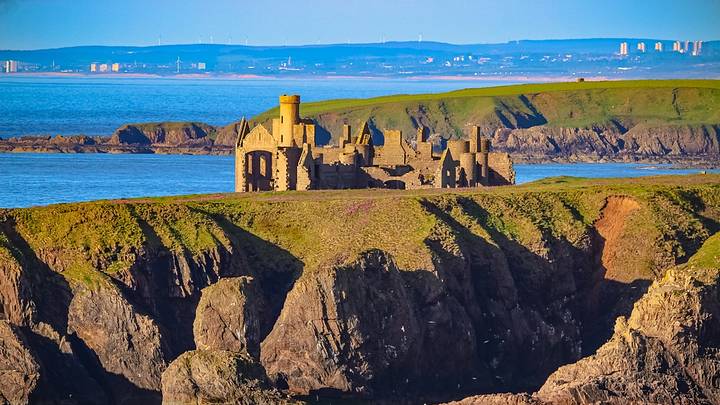
Bran Castle in Romania is often advertised as Dracula’s Castle, but there’s no evidence that Bram Stoker was even aware of the imposing fortress. While it is possible that the author was inspired by an illustration of Bran Castle in Charles Boner’s Transylvania: Its Product and Its People (1865), there is a far more likely option: Slains Castle in Scotland.
Stoker and his wife, Florence, regularly took month-long vacations to Aberdeenshire on the east coast of Scotland. In 1895, the couple stayed at the Kilmarnock Arms Hotel in Cruden Bay, where Stoker began writing Dracula. Florence later said that Stoker “seemed to get obsessed by the spirit of the thing” and “would sit for hours, like a great bat, perched on the rocks of the shore, or wander alone up and down the sand hills thinking it all out.”
Slains Castle sits on the coast that Stoker wandered along and is just a 15-minute walk from the Kilmarnock Arms. The now-ruined building definitely looks fit for a vampire’s lair, and Stoker’s description of Dracula’s Castle even replicates the distinctive octagonal room in Slains Castle.
Sleepy Hollow from The Legend of Sleepy Hollow (1820) // New York

Washington Irving’s The Legend of Sleepy Hollow is the most famous tale about a headless horseman, and it has been adapted numerous times—with the two best-known renditions being Disney’s animated The Adventures of Ichabod and Mr. Toad (1949) and Tim Burton’s live-action film Sleepy Hollow (1999).
The name Sleepy Hollow might sound like it was purposefully created for the creepy short story, but it’s actually a real place in New York’s Hudson Valley. Irving’s story put the small village on the map, and now around 100,000 tourists visit each October. Sadly, the iconic bridge that Ichabod Crane tries to escape across at the climax of the story has long since rotted away, but visitors can see other bridges around Sleepy Hollow—including at the suitably spooky cemetery.
The Overlook Hotel from The Shining (1977) // Colorado

In September 1974, Stephen King and his wife, Tabitha, checked into the Stanley Hotel in Estes Park, Colorado. “We were the only guests as it turned out; the following day they were going to close the place down for the winter,” the author wrote on his website. “Wandering through its corridors, I thought that it seemed the perfect—maybe the archetypical—setting for a ghost story.”
The eerily empty hotel caused King to have a nightmare that very night. “I dreamed of my three-year-old son running through the corridors, looking back over his shoulder, eyes wide, screaming. He was being chased by a fire-hose,” King continued. After waking up with a jerk, “I got up, lit a cigarette, sat in the chair looking out the window at the Rockies, and by the time the cigarette was done, I had the bones of the book firmly set in my mind.”
Not only did the Stanley Hotel become the Overlook Hotel in The Shining, but King’s nightmare and the room that he stayed in—Room 217, the Presidential Suite—also made into the story. Young Danny Torrance can sense that Room 217 is particularly haunted (just as it supposedly is in real life), and then he’s attacked by the fire-hose that is mounted outside the room.
Fans of Stephen King—known as Constant Readers—have flocked to the Stanley Hotel since the book was published in 1977, and Room 217 has even been renamed the Stephen King Suite.
Hill House from The Haunting of Hill House (1959) // Vermont
The inspiration for Hill House from Shirley Jackson’s classic haunted house novel has never been confirmed, but the staff and students of Bennington College, Vermont, are convinced that the Jennings Music Building was Jackson’s blueprint.
Jackson and her husband, Stanley Edgar Hyman, would have been familiar with the building because not only did they live nearby, but Hyman was a professor at the college. The ivy-covered stone building sits on a hill overlooking the campus, and it’s rumored to be haunted. “Lights go out when there’s no power outage and there’s always random cold patches,” explains music student Maeve Bustell. “I go to Jennings to practice music late at night when the building is empty and I hear footsteps that, I guess, could be a person—except I’m pretty sure there’s nobody else in the building.” And just like the creepy mansion in The Haunting of Hill House, Jennings is even home to a pair of stone lions.
But not everyone is convinced. Ruth Franklin, a Shirley Jackson biographer, thinks that Jennings isn’t grand enough to have been the basis of Hill House. Instead, she believes that Everett Mansion—which stands on the grounds of nearby Southern Vermont College and is also alleged to be haunted—is the more likely candidate.
The Castle of Otranto from The Castle of Otranto (1764) // England

The Castle of Otranto is one of the foundational Gothic stories, and it’s set in a haunted castle that was based on author Horace Walpole’s own home: a Gothic Revival castle called Strawberry Hill House. Located in Twickenham in South West London, Strawberry Hill House began to be built in 1749 and eventually inspired the setting and a few spooky scenes in Walpole’s best-known novel.
Walpole started writing The Castle of Otranto after having a nightmare about a “gigantic hand in armor…on the balustrade of the staircase.” In addition to the haunted armor, the scene in which a painting comes to life was also inspired by Walpole’s own art collection—likely a portrait of Henry Carey, Lord Falkland.
The Amityville House from The Amityville Horror (1977) // New York

When Jay Anson’s The Amityville Horror was first published in 1977, the front cover boldly claimed that it was a true story. The book details the alleged haunting of the Lutz family, who moved into 112 Ocean Avenue—a three-story Dutch Colonial Revival home—in Amityville, New York, in 1975. A little over a year earlier, the previous family who lived in the house had been brutally murdered by Ronald DeFeo Jr., the family’s 23-year-old eldest child.
Soon after moving in, the Lutzs claimed that they started experiencing paranormal phenomena. Green slime ran down the walls, they saw a horned demonic figure, and multiple family members were seen levitating above their beds. They fled the house in terror just 28 days later—even leaving their possessions behind. Although paranormal experts corroborated that the house was haunted—including Ed and Lorraine Warren—the whole thing was later revealed to be a hoax. In 1979, Ronald DeFeo Jr.’s lawyer, William Weber, admitted that he and George and Kathy Lutz “created this horror story over many bottles of wine.”
There was also no record of the family having called the police as claimed, or of any of the property damage that was supposedly done during the haunting. But although The Amityville Horror turned out to be fictional, plenty of horror fans still make the pilgrimage to see the famous house for themselves.