%20%20--%3E%0A%3Csvg%20version%3D%221.1%22%20id%3D%22Layer_1%22%20xmlns%3D%22http%3A%2F%2Fwww.w3.org%2F2000%2Fsvg%22%20xmlns%3Axlink%3D%22http%3A%2F%2Fwww.w3.org%2F1999%2Fxlink%22%20x%3D%220px%22%20y%3D%220px%22%0A%09%20viewBox%3D%220%200%20684.6%2068.1%22%20style%3D%22enable-background%3Anew%200%200%20684.6%2068.1%3B%22%20xml%3Aspace%3D%22preserve%22%3E%0A%3Cg%3E%0A%09%3Cpath%20d%3D%22M444.1%2C29.3h-17.4v14.5h17.4V29.3z%20M36.4%2C68.1l29.3-50.8V0H50.4L32.9%2C36.8L15.5%2C0H0v68.1h16.7V45.8l12.4%2C22.3H36.4z%0A%09%09%20M49.1%2C68.1h16.6V23.4L49.1%2C52.1V68.1z%20M76.6%2C68.1h45V53.8H93.3V41.6h21V27.1h-21V14.8h28.3V0.1h-45V68.1z%20M175.6%2C68.1h17.3v-68%0A%09%09h-16.5v40.3L150%2C0.1h-17.6v68h16.7V27.7L175.6%2C68.1z%20M235.8%2C14.8h15.4V0.1h-47.4v14.7H219v53.2h16.8V14.8z%20M290.3%2C45.9h-17.1%0A%09%09l7.5-15.6h2L290.3%2C45.9z%20M298.7%2C68.1h18l-32.2-68h-5.7l-32%2C68h18l3.3-7.1h27.1L298.7%2C68.1z%20M325.2%2C68.1h46.2V53.8h-29.6V0.1h-16.7%0A%09%09V68.1z%20M423.7%2C14.8h27.2V0.1H407v68h16.7V14.8z%20M462%2C68.1h46.2V53.8h-29.6V0.1H462V68.1z%20M564.8%2C34.1c0%2C10.7-7.2%2C19.2-18.5%2C19.2%0A%09%09c-11.4%2C0-18.5-8.5-18.5-19.2s7.1-19.2%2C18.5-19.2C557.6%2C14.9%2C564.8%2C23.4%2C564.8%2C34.1%20M580.6%2C34.1c0-19-14.2-34-34.3-34%0A%09%09c-20.2%2C0-34.3%2C15-34.3%2C34c0%2C19%2C14.1%2C34%2C34.3%2C34C566.4%2C68.1%2C580.6%2C53.1%2C580.6%2C34.1%20M604.8%2C20.5c0-4.1%2C3.3-6.2%2C6.7-6.2%0A%09%09c4.4%2C0%2C6.6%2C3%2C6.6%2C6.6h14.7C631.8%2C9.1%2C625.1%2C0.1%2C611%2C0.1c-12%2C0-21.7%2C9.3-21.7%2C20.6c0%2C10.9%2C5.9%2C15.9%2C16.7%2C19.8%0A%09%09c5.2%2C1.8%2C11.5%2C3.2%2C11.5%2C8c0%2C3.3-2.4%2C5.5-6.4%2C5.5c-3.6%2C0-6.6-3-6.6-6.7h-15.2c0%2C11.5%2C7.9%2C20.8%2C21.8%2C20.8c12%2C0%2C21.6-9.3%2C21.6-20.6%0A%09%09c0-10-5.3-16.4-16.7-19.8C610.6%2C26.1%2C604.8%2C25.3%2C604.8%2C20.5%20M670%2C20.9h14.7C683.8%2C9.1%2C677.1%2C0.1%2C663%2C0.1c-12%2C0-21.7%2C9.3-21.7%2C20.6%0A%09%09c0%2C10.9%2C5.9%2C15.9%2C16.7%2C19.8c5.2%2C1.8%2C11.5%2C3.2%2C11.5%2C8c0%2C3.3-2.4%2C5.5-6.4%2C5.5c-3.6%2C0-6.6-3-6.6-6.7h-15.2c0%2C11.5%2C7.9%2C20.8%2C21.8%2C20.8%0A%09%09c12%2C0%2C21.6-9.3%2C21.6-20.6c0-10-5.3-16.4-16.7-19.8c-5.4-1.6-11.3-2.4-11.3-7.2c0-4.1%2C3.3-6.2%2C6.7-6.2C667.7%2C14.4%2C670%2C17.3%2C670%2C20.9%0A%09%09%22%2F%3E%0A%3C%2Fg%3E%0A%3C%2Fsvg%3E%0A)

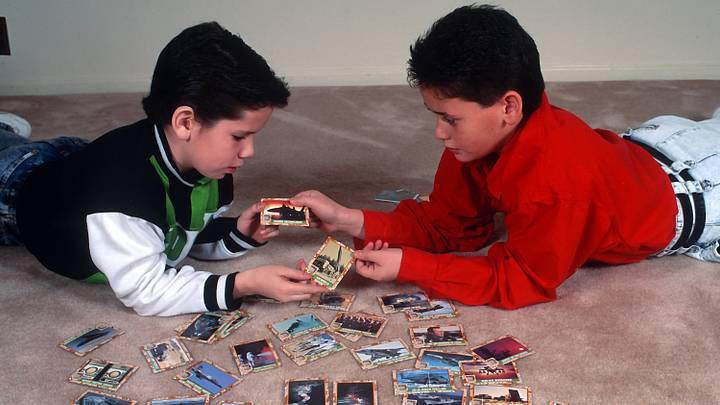
Back in the 1980s and 1990s, most rational consumers didn’t treat a jar of pennies, a pack of baseball cards, or the new issue of a magazine as an investment, which is why the best-kept examples are worth money now: most people spent, traded, folded, or tossed theirs. Mental Floss has already rounded up the ’90s toys and ’80s toys that can fetch a fortune, so this list sticks to the everyday stuff that lived in change jars, binders, backpacks, and magazine racks.
Every price below comes from real sales, not asking prices, and nearly every one comes with the same catch: the money is in the condition.
1984 Donruss Don Mattingly
Sports cards are a lot of people’s greatest regrets. (“I can’t believe my mom threw them all away!” many a would-be collector has lamented over the years.) The Yankees’ first baseman won the American League batting title with a .343 average in 1984 and the league’s MVP award a year later. While Don Mattingly never made the Hall of Fame, his cards still outsell those of plenty of players who did. Donruss printed its 1984 base cards by the millions, though the dark borders make perfect copies of his rookie hard to find: a PSA 10 sold for a record $9,455 at Heritage Auctions on July 10, 2026, almost triple what the same card brought a year earlier, while a PSA 9 sold for $380 around the same time, per Card Ladder data.
1986-87 Fleer Michael Jordan
Michael Jordan was the NBA’s Rookie of the Year with the Chicago Bulls in 1984-85, and in 1986-87 he averaged 37.1 points a game on his way to a record 10 scoring titles. His Fleer rookie card is notoriously tough to find in perfect shape, because the set had major centering problems and its red corners chip easily. In January 2021, two copies graded Gem Mint PSA 10 sold for $738,000 each at Goldin Auctions, and the card’s record price had jumped by more than $500,000 in less than a month.
1989 Upper Deck Ken Griffey Jr.
Ken Griffey Jr. reached the majors with the Seattle Mariners on Opening Day 1989, at 19, and hit 630 home runs and made the Hall of Fame in 2016. He appeared on card No. 1 in Upper Deck’s 1989 set, and Sports Collectors Digest credits it with pulling a whole generation into the hobby. During the pandemic boom of 2020 and 2021, top-graded copies sold at major auction houses for $10,000 to $15,000. They’ve cooled off since, with PSA 10s selling on eBay for around $3,000 in spring 2025, though signed PSA 10s still brought $18,853 and $20,130 in early 2025.
1989 Fleer Billy Ripken
Billy Ripken played second base for the Baltimore Orioles alongside his brother, shortstop Cal Ripken Jr., and their father, Cal Sr., became the first major league manager to manage two of his sons. Ripken’s 1989 Fleer card showed him holding a bat with everyone’s favorite four-letter word written on the knob, and collectors bought packs in massive quantities trying to pull one. He later explained that he’d written it on a batting-practice bat to tell it apart from his game bats and then grabbed the wrong one for the photo. Later printings covered the word up in several different ways, and the versions don’t sell alike: a PSA 10 of the original “FF Error” sold for $1,063 in a recent sale tracked by Card Ladder, while the much rarer “Scribbled Out in White” brought $4,915.
1990 Topps Frank Thomas “No Name on Front”
Frank Thomas, known as “the Big Hurt,” came up to the Chicago White Sox in August 1990 and won back-to-back American League MVP awards in 1993 and 1994 on his way to the Hall of Fame in 2014. The 1990 Topps set was a typically mundane, mass-produced issue, and a regular Frank Thomas rookie from it generally sells for well under $100. A production-sheet problem left some copies of the card without his name on the front, though, and the grading company CSG says high-grade copies of that error easily sell for thousands of dollars. By one count, PSA has graded only 437 of them, while more than 29,000 of the regular card have been graded.
1993 SP Derek Jeter
The Yankees took Derek Jeter with the sixth overall pick in the 1992 draft, and he won five World Series and collected 3,465 hits before making the Hall of Fame in 2020. Upper Deck printed its 1993 SP Jeter rookie on silver foil card stock, which is brutal on grades: PSA has graded more than 26,000 of them and given only 22 a Gem Mint 10. One of those 22 sold for $340,736 at Memory Lane Inc. in September 2025.
Batman Adventures No. 12
If sports cards are the first major missed investment opportunity of many an ’80s and ’90s kid, comic books are a close second. Batman Adventures was DC’s tie-in comic to Batman: The Animated Series, where Paul Dini had created a new henchwoman for the Joker in a 1992 episode called “Joker’s Favor.” Harley Quinn’s first appearance in a comic book was Batman Adventures No. 12, published by DC in September 1993, and by one estimate it had a print run of only 40,000 to 60,000 copies, small for a 1990s comic. Newsstand copies are the hardest to find, since newsstands handled only about 9 percent of comics distribution at the time. In early 2021, a newsstand copy graded CGC 9.8 sold on eBay for $3,450 after 27 bids.
The Amazing Spider-Man No. 300
Writer David Michelinie and artist Todd McFarlane marked the series’ 300th issue with a new villain who combined journalist Eddie Brock with a black alien substance. The May 1988 issue with the first full appearance of Venom was, as of 2018, the comic book CGC had graded more often than any other, ahead of New Mutants No. 98, Deadpool’s debut. A copy in a typical grade sells for several hundred dollars, but in 2018, three copies graded CGC 9.8 sold through Heritage Auctions for $1,920, $2,031, and $2,151, and in July 2022 a 9.8 signed by Todd McFarlane, Stan Lee, and three others brought $31,200.
A 1982-D Small Date Penny
Then there’s the change jar. Partway through 1982, the penny switched from bronze to copper-plated zinc, and the Denver Mint made a concerted effort to keep its Small Date cents off the old bronze blanks. One got through anyway: a Minnesota collector found a bronze 1982-D Small Date in 2016, and it sold for $18,800 at a Stack’s Bowers auction in August 2017. A second one surfaced in 2019, and that leaves billions of 1982-D Small Dates for the rest of us to check. The tell is the weight: bronze cents come in at around 3.1 grams and zinc ones around 2.5.
1992 Pennies With a “Close AM”
Flip a 1992 penny over and look at the word AMERICA. The Close AM design, with the “A” and “M” nearly touching, was meant to start in 1993, but a few of those dies saw a short run at the end of 1992, and fewer than 100 of the Denver version are known. A Michigan collector found one in a gas station’s take-a-penny tray in 2018, and Heritage Auctions has sold them for anywhere from $990 to $8,225 in 2017 and 2018, depending on condition.
The 1990 “No S” Proof Penny
In 1990, the San Francisco Mint ended up with a proof die that had no S mintmark, and it was caught only after several hundred coins had been struck. The Mint destroyed 145 of them, but more got out in proof sets: fewer than 200 are known, and the record price as of 2017 was $20,700, paid at a Bowers & Merena auction in 2007. They still turn up in sets nobody checked: a new collector spotted one at a coin show in a proof set the dealer sold her for $5.
1995 Doubled Die Pennies
Some 1995 pennies were struck from a doubled die, with the doubling clearest on the word TRUST, and the Philadelphia version can still occasionally be found in pocket change. The Denver version is many thousands of times rarer. In 2018, a newcomer to the hobby in Georgia found seven of them in rolls of uncirculated cents she’d bought online, and she sold two on eBay for $950 and $600.
Atari’s E.T. the Extra-Terrestrial
Outside of cards, comics, and currency, there’s a whole slew of other woulda-coulda-shoulda investments from kinda-olden-times. Atari released E.T. in 1982 after just 34 days of development, and ever since then, it has carried a reputation as pretty much history’s worst video game ever. After a documentary crew dug about 1,300 Atari cartridges out of a landfill in Alamogordo, New Mexico, the city sold 881 of them on eBay in April 2014 to buyers in 45 states and 14 countries for close to $108,000. One boxed copy of E.T. brought $1,537, and 23 more of the games went to museums, including the Smithsonian.
Swatch Watches
Swatch launched its plastic watches in Zurich on March 1, 1983, while Japanese quartz watches were battering the Swiss watch industry, and some 3.5 million had sold by the end of 1984. Only 140 Kiki Picasso Swatches were made, from a 1984 design by the French artist Christian Chapiron, and they were given away to well-known names in the art world. One sold at Sotheby’s in Milan in 1989 for $45,000, and Guinness still lists it as the most expensive Swatch ever sold at auction. Less exotic models have done fine too: at a 2001 Antiquorum auction, an Original Jelly Fish from 1983 sold for $1,157 and a 1986 Keith Haring “Serpent” went for $631.
A Ticket to Michael Jordan’s First NBA Game
Houston took Hakeem Olajuwon, and Portland took Sam Bowie with the first two picks of the 1984 NBA draft, which left Jordan to go third. Jordan made his NBA debut for the Chicago Bulls on Oct. 26, 1984, against the Washington Bullets at Chicago Stadium. In December 2021, the highest-graded ticket stub from that night sold for $264,000 at Huggins & Scott Auctions, the most ever paid for a collectible sports ticket at the time. The record lasted about two months: in February 2022, the only known full ticket, which its owner had kept in a manila envelope for 37 years, sold for $468,000 at Heritage Auctions.
A Sealed Nintendo Entertainment System
The NES Deluxe Set came with R.O.B. the robot, the Zapper light gun, and copies of Duck Hunt and Gyromite, and nearly every one of them got opened or lost along the way. A never-opened 1986 Deluxe Set, graded VGA 85 NM+, sold for $120,000 at Heritage Auctions in November 2023, the highest price ever paid at auction for a commercially released video game console. Mental Floss has already covered the sealed copy of Super Mario 64 that set the record for a single game.
Nintendo Power No. 1
Nintendo Power replaced a newsletter called Nintendo Fun Club News, and its first issue had a clay-modeled scene from Super Mario Bros. 2 on the cover. A copy graded CGC 9.4, still with all its inserts, sold for $24,000 at Heritage Auctions in November 2022. Five months later, the highest-graded copy, a CGC 9.8, brought $108,000 at Heritage, the most ever paid for a Nintendo magazine.
Nirvana’s Bleach on White Vinyl
Sub Pop released Nirvana’s debut album in 1989, and the first pressing of Bleach was just 1,000 copies on white vinyl, some of them with a poster. A copy sold for around $400 for many years, according to the collector-run Sub Pop discography Pette Discographies, before prices turned unpredictable: its author has seen at least three sell for more than $900.
The 1996 Sports Illustrated for Kids Tiger Woods Card
Tiger Woods won his third straight U.S. Amateur in August 1996, turned pro the following week, and won his first PGA Tour event, the Las Vegas Invitational, that October. The card came inside an issue of Sports Illustrated for Kids, so plenty of copies got thrown out with the magazine or folded by mail carriers, since Woods sat in the center of the sheet. Sports Illustrated even asked grading companies to stop grading it, arguing the cards were editorial content. In early 2001, a collector sold a gem-mint copy in an online auction for a record $125,000, and he regretted it as soon as Woods won the Masters that April.
A Signed Jurassic Park Galley Proof
OK, this one may be a bit of a stretch for a list of “everyday things…” Universal Pictures and Amblin Entertainment bought the movie rights to Michael Crichton’s Jurassic Park before Alfred A. Knopf even published it in 1990. Galley proofs, a publisher’s first in-house print of a book, are typically used for editing. This uncorrected one, from the first edition, carries a green dinosaur stamp and the author’s signature and inscription in blue felt-tip, dated Los Angeles, Aug. 16, 1992. It sold at RR Auction on Nov. 7, 2018, for $1,353.