%20%20--%3E%0A%3Csvg%20version%3D%221.1%22%20id%3D%22Layer_1%22%20xmlns%3D%22http%3A%2F%2Fwww.w3.org%2F2000%2Fsvg%22%20xmlns%3Axlink%3D%22http%3A%2F%2Fwww.w3.org%2F1999%2Fxlink%22%20x%3D%220px%22%20y%3D%220px%22%0A%09%20viewBox%3D%220%200%20684.6%2068.1%22%20style%3D%22enable-background%3Anew%200%200%20684.6%2068.1%3B%22%20xml%3Aspace%3D%22preserve%22%3E%0A%3Cg%3E%0A%09%3Cpath%20d%3D%22M444.1%2C29.3h-17.4v14.5h17.4V29.3z%20M36.4%2C68.1l29.3-50.8V0H50.4L32.9%2C36.8L15.5%2C0H0v68.1h16.7V45.8l12.4%2C22.3H36.4z%0A%09%09%20M49.1%2C68.1h16.6V23.4L49.1%2C52.1V68.1z%20M76.6%2C68.1h45V53.8H93.3V41.6h21V27.1h-21V14.8h28.3V0.1h-45V68.1z%20M175.6%2C68.1h17.3v-68%0A%09%09h-16.5v40.3L150%2C0.1h-17.6v68h16.7V27.7L175.6%2C68.1z%20M235.8%2C14.8h15.4V0.1h-47.4v14.7H219v53.2h16.8V14.8z%20M290.3%2C45.9h-17.1%0A%09%09l7.5-15.6h2L290.3%2C45.9z%20M298.7%2C68.1h18l-32.2-68h-5.7l-32%2C68h18l3.3-7.1h27.1L298.7%2C68.1z%20M325.2%2C68.1h46.2V53.8h-29.6V0.1h-16.7%0A%09%09V68.1z%20M423.7%2C14.8h27.2V0.1H407v68h16.7V14.8z%20M462%2C68.1h46.2V53.8h-29.6V0.1H462V68.1z%20M564.8%2C34.1c0%2C10.7-7.2%2C19.2-18.5%2C19.2%0A%09%09c-11.4%2C0-18.5-8.5-18.5-19.2s7.1-19.2%2C18.5-19.2C557.6%2C14.9%2C564.8%2C23.4%2C564.8%2C34.1%20M580.6%2C34.1c0-19-14.2-34-34.3-34%0A%09%09c-20.2%2C0-34.3%2C15-34.3%2C34c0%2C19%2C14.1%2C34%2C34.3%2C34C566.4%2C68.1%2C580.6%2C53.1%2C580.6%2C34.1%20M604.8%2C20.5c0-4.1%2C3.3-6.2%2C6.7-6.2%0A%09%09c4.4%2C0%2C6.6%2C3%2C6.6%2C6.6h14.7C631.8%2C9.1%2C625.1%2C0.1%2C611%2C0.1c-12%2C0-21.7%2C9.3-21.7%2C20.6c0%2C10.9%2C5.9%2C15.9%2C16.7%2C19.8%0A%09%09c5.2%2C1.8%2C11.5%2C3.2%2C11.5%2C8c0%2C3.3-2.4%2C5.5-6.4%2C5.5c-3.6%2C0-6.6-3-6.6-6.7h-15.2c0%2C11.5%2C7.9%2C20.8%2C21.8%2C20.8c12%2C0%2C21.6-9.3%2C21.6-20.6%0A%09%09c0-10-5.3-16.4-16.7-19.8C610.6%2C26.1%2C604.8%2C25.3%2C604.8%2C20.5%20M670%2C20.9h14.7C683.8%2C9.1%2C677.1%2C0.1%2C663%2C0.1c-12%2C0-21.7%2C9.3-21.7%2C20.6%0A%09%09c0%2C10.9%2C5.9%2C15.9%2C16.7%2C19.8c5.2%2C1.8%2C11.5%2C3.2%2C11.5%2C8c0%2C3.3-2.4%2C5.5-6.4%2C5.5c-3.6%2C0-6.6-3-6.6-6.7h-15.2c0%2C11.5%2C7.9%2C20.8%2C21.8%2C20.8%0A%09%09c12%2C0%2C21.6-9.3%2C21.6-20.6c0-10-5.3-16.4-16.7-19.8c-5.4-1.6-11.3-2.4-11.3-7.2c0-4.1%2C3.3-6.2%2C6.7-6.2C667.7%2C14.4%2C670%2C17.3%2C670%2C20.9%0A%09%09%22%2F%3E%0A%3C%2Fg%3E%0A%3C%2Fsvg%3E%0A)

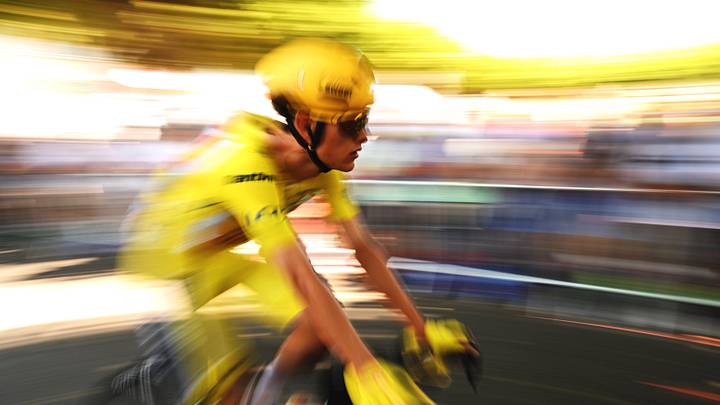
The annual Tour de France is the world’s most prestigious cycling race, attracting teams of riders from all around the world willing to take on its grueling roughly 2,000-mile course of open roads and high mountain routes.
As its name suggests, the competition typically takes place entirely in France, although routes sometimes stray into some of France’s neighboring nations, including Belgium, Germany, Italy, and Spain.
The Tour de France was first held in 1903, and over 120 years of competition, the Tour de France has established a number of customs and traditions, several of which have come to be adopted by other cycle races around the world as well. Perhaps chief among them is the longstanding custom of the lead cyclist—and the eventual winner—being given a yellow jersey to wear.
How the Yellow Jersey Works

Because of its immense length, the Tour de France is held over several stages typically spanning around three weeks of cycling. And at the end of each stage in that three-week period, the rider with the lowest cumulative time in the race so far (that is to say, the current fastest competitor across all the completed stages at that point) is given the yellow jersey, or maillot jaune, to wear in the following race.
At the beginning of each year’s competition, meanwhile, it is traditional for the returning winner of the previous year’s Tour de France, if they are present, to wear the jersey in the opening stage.
The Yellow Jersey’s Advertising Origins

So why yellow? Well, given the Tour de France’s long history, it’s perhaps not surprising that the tradition of wearing a yellow jersey has a long history behind it too. In fact, the yellow jersey is said to have been introduced way back in the 1910s, apparently by the race’s founder and first organizer, Henri Desgrange.
By that point, the race hadn’t actually been held for five years due to World War I. With the war over, Desgrange revived the Tour de France in 1919. According to the official story, it was at this point that Desgrange decided that the race’s current leader should be made more visible to spectators and to other riders.
In earlier races, the leader had been asked to wear an armband, but this had understandably not proved visible enough, and so Desgrange suggested that a brightly colored jersey should be used instead.
It just so happened that the sponsor of the race at that time, a French cycling newspaper named L’Auto (of which Desgrange was editor), was printed on pale yellow paper. Ultimately, he opted for a yellow jersey—both as a means of making the leader clearly visible on the road, and of subtly advertising his own newspaper.
Philippe Thys Offers a Different Story

There is, however, one more side to the story here. After his retirement from professional racing, the Belgian cyclist Philippe Thys—himself a three-time winner of the Tour de France in its early years—claimed that Desgrange’s idea of wearing a colored jersey in fact dates back to 1913, when Thys was at the height of his career.
Speaking in 1953, Thys claimed that Desgrange “dreamed of a golden-coloured jersey,” and asked him to wear it as the race leader that year. Although he initially wasn’t keen, his team, Peugeot, decided that it might be a good way of advertising their brand, and as a result Thys begrudgingly wore the brightly colored top (despite the spectators and fellow competitors calling him a “canary”).
Thys’ story, as compelling as it may be, has never been corroborated (or disproven, for that matter). Cycling historian Pierre Chany ultimately suggested that Desgrange perhaps had the idea of making the race’s leader more visible back in the race’s early years, and Thys was merely caught up in his early trials and experiments in 1913.
The outbreak of the war then interrupted his plans, so it was 1919 before Desgrange was at long last able to implement the change—both making the lead cyclist visible, and advertising his own newspaper, in the process.