%20%20--%3E%0A%3Csvg%20version%3D%221.1%22%20id%3D%22Layer_1%22%20xmlns%3D%22http%3A%2F%2Fwww.w3.org%2F2000%2Fsvg%22%20xmlns%3Axlink%3D%22http%3A%2F%2Fwww.w3.org%2F1999%2Fxlink%22%20x%3D%220px%22%20y%3D%220px%22%0A%09%20viewBox%3D%220%200%20684.6%2068.1%22%20style%3D%22enable-background%3Anew%200%200%20684.6%2068.1%3B%22%20xml%3Aspace%3D%22preserve%22%3E%0A%3Cg%3E%0A%09%3Cpath%20d%3D%22M444.1%2C29.3h-17.4v14.5h17.4V29.3z%20M36.4%2C68.1l29.3-50.8V0H50.4L32.9%2C36.8L15.5%2C0H0v68.1h16.7V45.8l12.4%2C22.3H36.4z%0A%09%09%20M49.1%2C68.1h16.6V23.4L49.1%2C52.1V68.1z%20M76.6%2C68.1h45V53.8H93.3V41.6h21V27.1h-21V14.8h28.3V0.1h-45V68.1z%20M175.6%2C68.1h17.3v-68%0A%09%09h-16.5v40.3L150%2C0.1h-17.6v68h16.7V27.7L175.6%2C68.1z%20M235.8%2C14.8h15.4V0.1h-47.4v14.7H219v53.2h16.8V14.8z%20M290.3%2C45.9h-17.1%0A%09%09l7.5-15.6h2L290.3%2C45.9z%20M298.7%2C68.1h18l-32.2-68h-5.7l-32%2C68h18l3.3-7.1h27.1L298.7%2C68.1z%20M325.2%2C68.1h46.2V53.8h-29.6V0.1h-16.7%0A%09%09V68.1z%20M423.7%2C14.8h27.2V0.1H407v68h16.7V14.8z%20M462%2C68.1h46.2V53.8h-29.6V0.1H462V68.1z%20M564.8%2C34.1c0%2C10.7-7.2%2C19.2-18.5%2C19.2%0A%09%09c-11.4%2C0-18.5-8.5-18.5-19.2s7.1-19.2%2C18.5-19.2C557.6%2C14.9%2C564.8%2C23.4%2C564.8%2C34.1%20M580.6%2C34.1c0-19-14.2-34-34.3-34%0A%09%09c-20.2%2C0-34.3%2C15-34.3%2C34c0%2C19%2C14.1%2C34%2C34.3%2C34C566.4%2C68.1%2C580.6%2C53.1%2C580.6%2C34.1%20M604.8%2C20.5c0-4.1%2C3.3-6.2%2C6.7-6.2%0A%09%09c4.4%2C0%2C6.6%2C3%2C6.6%2C6.6h14.7C631.8%2C9.1%2C625.1%2C0.1%2C611%2C0.1c-12%2C0-21.7%2C9.3-21.7%2C20.6c0%2C10.9%2C5.9%2C15.9%2C16.7%2C19.8%0A%09%09c5.2%2C1.8%2C11.5%2C3.2%2C11.5%2C8c0%2C3.3-2.4%2C5.5-6.4%2C5.5c-3.6%2C0-6.6-3-6.6-6.7h-15.2c0%2C11.5%2C7.9%2C20.8%2C21.8%2C20.8c12%2C0%2C21.6-9.3%2C21.6-20.6%0A%09%09c0-10-5.3-16.4-16.7-19.8C610.6%2C26.1%2C604.8%2C25.3%2C604.8%2C20.5%20M670%2C20.9h14.7C683.8%2C9.1%2C677.1%2C0.1%2C663%2C0.1c-12%2C0-21.7%2C9.3-21.7%2C20.6%0A%09%09c0%2C10.9%2C5.9%2C15.9%2C16.7%2C19.8c5.2%2C1.8%2C11.5%2C3.2%2C11.5%2C8c0%2C3.3-2.4%2C5.5-6.4%2C5.5c-3.6%2C0-6.6-3-6.6-6.7h-15.2c0%2C11.5%2C7.9%2C20.8%2C21.8%2C20.8%0A%09%09c12%2C0%2C21.6-9.3%2C21.6-20.6c0-10-5.3-16.4-16.7-19.8c-5.4-1.6-11.3-2.4-11.3-7.2c0-4.1%2C3.3-6.2%2C6.7-6.2C667.7%2C14.4%2C670%2C17.3%2C670%2C20.9%0A%09%09%22%2F%3E%0A%3C%2Fg%3E%0A%3C%2Fsvg%3E%0A)

Air travel is considered one of the safest forms of transportation, yet many airport runways still get passengers’ hearts pounding. A handful of airports scattered across the globe are built in locations where geography, weather, and technical limitations combine to create a nerve-wracking approach.
Some runways are carved into mountain valleys where pilots navigate steep descents, sharp turns, and cliff drops. Others sit on small islands surrounded only by the ocean, leaving little to no margin for error. Strong crosswinds, short runways, and dramatic elevation can make a typically routine part of a flight more challenging.
Even though these runways might look intimidating, commercial pilots receive thorough training for these environments, and all aircraft are required to meet strict safety standards before takeoff. What appears to be a horror scene from a cabin window is actually a carefully calculated procedure from the cockpit. Still, these worrisome runways have earned global recognition as some of the scariest airport landings on Earth.
Let's fly into 8 airports with landings so terrifying, passengers can't help but breathe a sigh of relief when they take their first step off the plane.
- Princess Juliana International Airport (St. Maarten)
- Hechi Jinchengjiang Airport, China
- Gibraltar International Airport, Gibraltar
- Toncontin International Airport, Tegucigalpa, Honduras
- Barra International Airport, Barra, Scotland
- Congonhas Airport, Sao Paulo, Brazil
- Madeira Airport, Santa Cruz, Madeira
- Tenzing-Hillary Airport, Nepal
Princess Juliana International Airport (St. Maarten)
Imagine falling asleep on the beach and being awoken by a giant plane that looks like it's coming right at you. That's the reality for beachgoers spending the day at Maho Beach in St. Maarten. The sand literally abuts Princess Juliana International Airport runway 10, creating the illusion that the aircraft might land on the beach. While the unusually short runway may be ideal for snapping a selfie, it poses safety concerns. The low altitude has been known to throw pilots off, the required turns are hard to handle, and jet blasts (responsible for a death in 2017) present a warning to beachgoers.
Hechi Jinchengjiang Airport, China
From sea-level airports to runways in the clouds, we travel 2,200 feet in the air to get to the next airport on the list, the Hechi Airport in China's southern Guangxi province. The shock factor of this runway isn't its length, but rather, what surrounds it, or should we say, what doesn't. One side of the runway is edged by a 1,000-foot drop. In other words, passengers can only hope the pilot has a steady hand. While the runway itself is over a mile long, it's very narrow and only sees three flights an hour.
Gibraltar International Airport, Gibraltar
For the longest time, bodies of water and massive rock formations weren't the only obstacles pilots had to navigate when landing at the Gibraltar International Airport in Gibraltar. Until 2023, there was a four-lane road that ran right through the runway! In fact, it is the busiest road on the peninsula, or at least it was until a tunnel was constructed in 2023 that directed traffic under the landing strip. With water on each side and rocks crowding its descent, it's no wonder only two airlines can access the 6,000-foot-long runway.
Toncontin International Airport, Tegucigalpa, Honduras
Runway 02 at the Toncontin International Airport in Honduras boasts the perfect conditions for one of the most terrifying plane landings on the planet. The runway is so short, one of the shortest in the entire world, that aircraft larger than Boeing 757s are not permitted to land. The landing strip was lengthened in 2009 after a pilot overshot the runway the previous year, resulting in the deaths of five passengers. Pilots must navigate tight turns to avoid the mountains, which are prone to forceful wind gusts.
Barra International Airport, Barra, Scotland
We've explored airport runways beside beaches, but what about airport runways directly on the sand? The Barra International Airport in Barra, Scotland, is the only airport in the world that doubles as a public beach. The runway is the sand itself, and the path changes depending on the tide. At certain points of the day, the runway is underwater. When the sand isn't acting as a landing strip, it's crowded with beachgoers flying kites and harvesting clams.
Congonhas Airport, Sao Paulo, Brazil
Flying into the Congonhas Airport in São Paulo, Brazil, offers a breathtaking view of the city’s skyline, and the landing itself certainly takes your breath away. As the plane descends, it can feel like you’re about to brush the tops of the skyscrapers, and reaching the runway presents yet another hurdle. In the past, the landing strips have been so slick that, in 2007, a TAM Airlines Airbus A320 skidded off the runway and crashed into a warehouse, resulting in the deaths of 187 passengers and several people on the ground. Since then, the airport has installed a drainage system to address the slippery runways and has imposed new restrictions on the weight of aircraft allowed to land.
Madeira Airport, Santa Cruz, Madeira
The Madeira Airport (also referred to as Funchal Airport), located on the Portuguese island of Madeira, features a runway so narrow that pilots must fly toward the mountains and execute a sharp turn to ensure a safe landing (which can appear quite alarming from inside the cabin). Navigating this approach can be a test for pilots of all experience levels. In 1977, a plane ran off the end of the runway and crashed, claiming 131 lives. Although the landing strip has since been expanded, it is still considered one of the most dangerous in the world.
Tenzing-Hillary Airport, Nepal
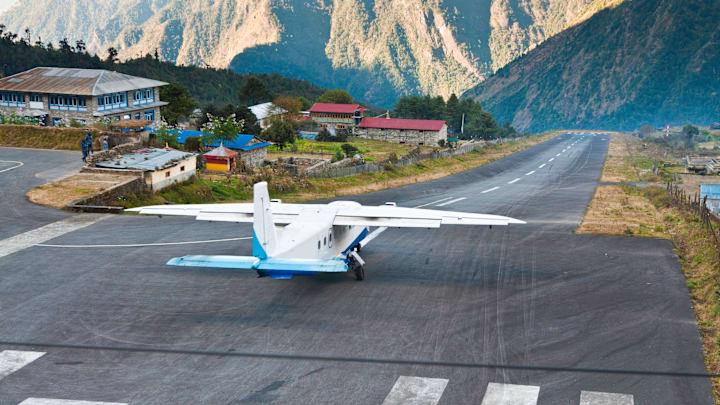
Named after the first climbers to reach the top of Mount Everest, Nepal’s Tenzing-Hillary Airport is far from ordinary. Anyone planning to climb Mount Everest must land at this airport to reach base camp. Better known as Lukla Airport, it is completely encircled by the Himalayas, making landings especially difficult. The approach is nerve-wracking due to the airport’s high altitude (over 9,000 feet), but takeoff is equally daunting. The runway is sloped, and, at its end, passengers catch sight of a sudden 2,000-foot drop into a river valley.