Matt Soniak
When Did Americans Lose Their British Accents?
by Matt Soniak - January 17, 2012 - 11:05 PM

Readers Nick and Riela have both written to ask how and when English colonists in America lost their British accents and how American accents came about.

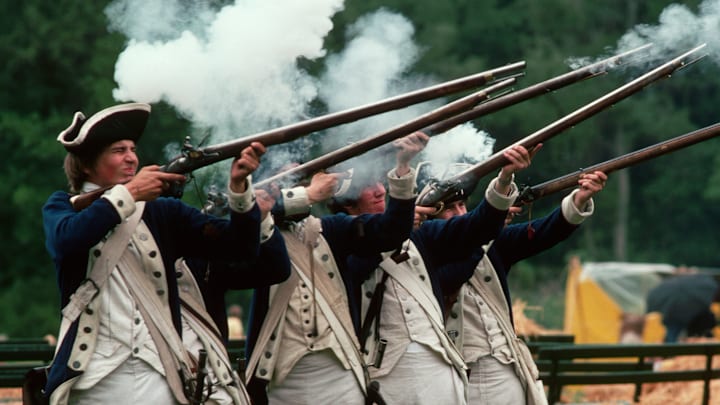
Revolutionary War Reenactment Image via Shutterstock

There are manymany evolving regional British and American accents, so the terms “British accent” and “American accent” are gross oversimplifications. What a lot of Americans think of as the typical “British accent” is what’s called standardized Received Pronunciation (RP), also known as Public School English or BBC English. What most people think of as an “American accent,” or most Americans think of as “no accent,” is the General American (GenAm) accent, sometimes called a ”newscaster accent” or “Network English.” Because this is a blog post and not a book, we’ll focus on these two general sounds for now and leave the regional accents for another time.

English colonists established their first permanent settlement in the New World at Jamestown, Virginia, in 1607, sounding very much like their countrymen back home. By the time we had recordings of both Americans and Brits some three centuries later (the first audio recording of a human voice was made in 1860), the sounds of English as spoken in the Old World and New World were very different. We’re looking at a silent gap of some 300 years, so we can’t say exactly when Americans first started to sound noticeably different from the British.

As for the “why,” though, one big factor in the divergence of the accents is rhotacism. The General American accent is rhotic and speakers pronounce the r in words such as hard. The BBC-type British accent is non-rhotic, and speakers don’t pronounce the r, leaving hard sounding more like hahd. Before and during the American Revolution, the English, both in England and in the colonies, mostly spoke with a rhotic accent. We don’t know much more about said accent, though. Various claims about the accents of the Appalachian Mountains, the Outer Banks, the Tidewater region and Virginia’s Tangier Island sounding like an uncorrupted Elizabethan-era English accent have been busted as myths by linguists. 

Talk This Way

Around the turn of the 18th 19th century, not long after the revolution, non-rhotic speech took off in southern England, especially among the upper and upper-middle classes. It was a signifier of class and status. This posh accent was standardized as Received Pronunciation and taught widely by pronunciation tutors to people who wanted to learn to speak fashionably. Because the Received Pronunciation accent was regionally “neutral” and easy to understand, it spread across England and the empire through the armed forces, the civil service and, later, the BBC.

Across the pond, many former colonists also adopted and imitated Received Pronunciation to show off their status. This happened especially in the port cities that still had close trading ties with England — Boston, Richmond, Charleston, and Savannah. From the Southeastern coast, the RP sound spread through much of the South along with plantation culture and wealth.

After industrialization and the Civil War and well into the 20th century, political and economic power largely passed from the port cities and cotton regions to the manufacturing hubs of the Mid Atlantic and Midwest — New York, Philadelphia, Pittsburgh, Cleveland, Chicago, Detroit, etc. The British elite had much less cultural and linguistic influence in these places, which were mostly populated by the Scots-Irish and other settlers from Northern Britain, and rhotic English was still spoken there. As industrialists in these cities became the self-made economic and political elites of the Industrial Era, Received Pronunciation lost its status and fizzled out in the U.S. The prevalent accent in the Rust Belt, though, got dubbed General American and spread across the states just as RP had in Britain. 

Of course, with the speed that language changes, a General American accent is now hard to find in much of this region, with New York, Philadelphia, Pittsburgh, and Chicago developing their own unique accents, and GenAm now considered generally confined to a small section of the Midwest.

As mentioned above, there are regional exceptions to both these general American and British sounds. Some of the accents of southeastern England, plus the accents of Scotland and Ireland, are rhotic. Some areas of the American Southeast, plus Boston, are non-rhotic.

More from mental_floss

The Great Gettysburg Reunion of 1913
*
September 11th and the Hospitable People of Gander, Newfoundland
*
Who Wrote the Pledge of Allegiance?
*
Dogs Welcoming Home Returning Soldiers
*
Andrew Jackson’s Big Block of Cheese
*
Glory Day: Lancaster’s Brief Stint as Our Nation’s Capital

twitterbanner.jpg

Click here to get a Risk-Free issue of mental_floss magazine
Comments (114)
  1. That is an awesome post! One of the most interesting parts of history is linguistic evolution. It’s interesting that Americans and our northern neighbors in Canada mostly sound alike, except for a few sounds. I think you know what I’m talking aboot.

  2. I love this post, it’s awesome!

  3. Great article! Although it did make my brain hurt a little bit.

    Good thing you didn’t touch on the crazy Canadian & Aussie accents. I think my head would’ve gone Scanners if you did.

  4. This IS a great post. Is there a book (since you mentioned it and got me thinking) that goes into further depth that you might recommend for those of us who want to know more?

  5. I’m suspicious of the notion that the non-rhotic accent developed because it was taught. I don’t think that’s how accents generally develop. Don’t they happen more often from natural sound changes over time? In any case, I’d like to see more evidence for that.

  6. I have taught Advanced Placement United States History for more than a decade, and I cannot begin to tell you how often I have been asked this question.

    My (admittedly superficial) research never turned up anything as simple yet authoritative as this. I’ll be using this post for years to come. Well done!

  7. I’m from California, and have generally held the belief that everywhere except here has accents, Boston, NY, The South, Texas, North Dakota. I wonder what I sound like…

  8. @Shiloh – Check out “The Cambridge History of the English Language: English in North America,” which I consulted for history here, and goes into much more depth than I did. For more on the characteristics of the American accent and a little history of the Scots-Irish accent, see the “Dialects of American English” page at Western Washington University (http://pandora.cii.wwu.edu/vajda/ling201/test3materials/AmericanDialects.htm).

    @Linda – What I said was that the non-rhotic sound did develop as a class accent and then SPREAD more readily because it was a desirable accent and was taught by orthoepists who saw a market they could fill. For more on these entrepreneurs, look into Thomas Sheridan and John Walker. Both taught pronunciation lessons and published pronunciation dictionaries, and Walker introduced the name “Received Pronunciation.”

  9. We really don’t say “aboot.” This misconception is becoming tiresome.

  10. I wonder whether the US rhotic accent is due to a sparse yet literate population.

    Lacking native, non-rhotic speakers to correct them, Americans may have relied increasingly on spelling pronunciation.

  11. Interesting that “General American” comes out of the midwest; I thought it was more of a “Hollywood” accent.

  12. I wonder if this has anything to do with going east to west, once you pass maybe Pittsburgh, soda becomes either Coke or Pop.

  13. @ Missy – I’m a lifelong Pennsylvanian, and to my ears, Californians generally sound more droney than East Coasters, with rounder vowel sounds (e.g. “awesome” sounds like “ossum.” Check out the work of Penelope Eckert, a Stanford researcher who studies what you guys sound like (http://www.stanford.edu/~eckert/)

  14. THere is a wonderful podcast about this very subject on the Colonial WIlliamsburg website — history.org. Look under Multimedia, then all 2011 podcasts. It is entitled “New World English” and well worth the listen!

  15. @Missy You have to spend a little time away and then come back to notice your region’s accent.
    I left Va Beach to attend Annapolis, where there were midshipman from all over the country. My ear became accustomed to no accent in particular. Fast-forward to my first Christmas vacation and I returned to Va Beach. I was at a local mall, shopping for presents for my 2 younger brothers. Every time I heard a young boy’s voice, I quickly turned around, afraid my brothers had somehow followed me and would see what I was buying. It was then that I realized that I was hearing the accent of what is referred to as the Tidewater area of Virginia.

  16. Great post. I think it could also be noted that studies have shown children pickup the accents of their contemporaries, not their parents. This explains how accents can be lost or changed in only one generation.

  17. @Jodi – You guys may not say “aboot” but you do pronounce about differently than we do (in California at least) sort of like “a boat”. Hard to explain.

  18. Awesome, thanks for answering my question!

  19. So what do we on the West Coast speak? The article says that GenAm is only in parts of the midwest today… I can’t imagine my accent being any different than standard “newscaster” English…

  20. When I talk to our canadian counterparts at work, I hear “aboot” quite clearly. (In the Halifax area, if that matters at all).

    I guess it’s all relative though. My ILs are from Lytham St- Anne and have lived here 40 years. I tease them about their English accents, then, when they go home to England they’re teased for their American accents. They can’t win!

  21. Recordings of FDR’s speeches, as well as dialogue from movies from the late 1930s (such as “The Thin Man” series) always strike me as sounding far closer to BBC English than General American. It seems to me that this style of formal speech went out of vogue in America during WWII. I wonder why.

    @wayne stevens: Re: soda becoming pop or coke once you get east of Pittsburgh, that’s not entirely true. It’s soda in southeastern Wisconsin, where I’m from, and it’s soda in the Rocky Mountain West, where I’ve lived for the past 15 years.

  22. @aj – Depends on where exactly you’re from. There’s the California accent (CA English), a generalized Pacific Northwest accent (Cascadian English) and a bunch of more specific regional accents. The Pacific NW accent is considered very “neutral sounding” and closely related to GenAm.

  23. The “aboot” Canadian Accent has roots in the maritimes, as well as the North (which has french commonly spoken so it’s muddled into a different accent altogether).

    Really, most Canadians in highly populated areas sound just like Americans aside from pronouncing some words a bit softer.

  24. @Matt: that’s odd — I am from So Cal, and moved to Portland Ore four years ago, and never noticed a change!

    Also, chiming in the on the Canada thing, I would say that “aboot” is a bit over-the-top, but there is a certain diphthong every so often. I hear it mostly in “garbage” which to my US ears comes across as “gyarbage.” It’s very slight and I only hear it sometimes. It’s probably regional. I know I hate it when all Americans are typified as having a broad Texan sort of accent.

  25. Canadians have just as many regional accents as Americans do. When it comes to our 2 countries the relative distance between any 2 points is a better indication of the difference in accent than which country or even which state/province you are in.

    For example, I defy anyone to notice a difference between a Toronto accent and a Buffalo accent, yet anyone can hear the difference in a Toronto accent and a Quebec accent, or a Quebec accent and a maritime accent.

  26. I am American, from the south, and most other southerners think I am from the north. Probably because I really enunciate my words. However, when I’m with my family, especially my grandparents, my southern accent comes out. My husband is British. And while he has lost his accent a bit (he is still very non-rhotic, and sounds REALLY British when talking to his family) I have actually started to sound slightly British myself. Some people think I’m British too if they are meeting me for the first time. It’s funny how it all works out…

  27. To mountainrev :

    FDR had the strong New England/Upper Class accent not often heard anymore. As for the English of the early 1930 movies, that has another reason. With the transition to talkies, movie producers were worried that there stars wouldn’t be understood either because they had a strong accent (Brooklyn, Southern, ext…) or that the audience wouldn’t understand them because ‘they’ had a strong accent. So a slightly formal, broad vowel use was encouraged. It wasn’t until James Cagney, Jean Harlow, and others with accents became popular that they realized that they were wrong. From the middle thirties on they stopped using the long-vowel form and pushed for a more ‘Midwest’ sound from then on. Southern accents were still frowned upon though, I’m not really sure why. Would Ava Gardner’s southern accent had made her less beautiful? That’s Hollywood, though…

  28. I am from Chicago and have a pretty good recollection of when my “accent” was pointed out to me as a teenager: by a bunch of kids with thick southern accents at that! Before that, I figured I had the “newscaster” accent.

    My cousin’s boyfriend was just visiting in from CA and said he can’t really detect our Chicago accents unless we talk excitedly. Apparently the faster and louder we talk, the more apparent it becomes!

    By the way, I’ve been trying to fight “pop” for awhile now. I much prefer to say “soda” but I cannot get it to catch on here. *sigh*

  29. ZZZzzz

  30. I heard or read somewhere, as you confirm here, that the English historically spoke with what is now called an American (rhotic) accent. Maybe the title of the piece should be “When Did the British Lose Their American Accents?”.

  31. I was bummed to hear my younger Australian cousins speek…they nearly have to “fake” their own accent…their “zeds” have turned to “zees” and this Yank cousin was getting the blame…at least western telly seems to be the culprit…still rather sad…

  32. The old Hollywood accent that was mentioned is probably what’s known as the “Trans-Atlantic” accent. Whereas British and American accents were difficult for their respective foreign audiences to understand, Trans-Atlantic speech was pleasing to both groups. Hollywood took it up for business reasons, and it provided a standard pronunciation for actors from many countries.

  33. “Around the turn of the 18th century, not long after the revolution…” Did you mean to say 19th century? :)

  34. I was just wondering this since my daughter is studying Colonial America.
    Interesting. From the sounds of this article it seems that both accents changed and developed over time, so I guess it wouldn’t really be that Americans “lost” their British accents, that both sides have deviated from the initial accent. I wonder what Elizabethans actually sounded like. Wasn’t there a lot of French influence on English linguistics at that time? Like the informal/formal tu/vous=thou/you in Shakespeare.

  35. @Katie Rose:

    I’m from Chicago and I say “soda.” Although I am a recent transplant from the east and I grew up in the west. I will NEVER succumb to saying “pop.” it just sounds wrong!

  36. @Mountain Rev
    I’m not sure where in the Rocky Mountain West you live but I live in Colorado and it’s Pop.
    Also, I have never really thought of people from Colorado or the West in general as having a specific accent.

  37. And on the Canadian note, I had a close friend who was from British Columbia. I particularly noticed the accent in words like “borrow” & “sorry” where the O sound was more pronounced like in “floor” not like the “ah” in “star” how I pronounced it in California.
    And she always corrected me for saying either/neither with a long e instead of a long i. (always assumed that was because of where she was from, but who knows)

  38. Maybe I’m misunderstanding something here, but if the British experienced a widespread change in their accent at the turn of the 18th century–as they began self-consciously to drop the rhotacistic pronunciation of the “r”–then shouldn’t the question be: When did the British lose their British Accents? From the description in this article it sounds like the Americans simply persisted with their rhotacism while the British moved onto the non-rhotacistic Received Pronunciation.

  39. @jgc3h – Both GenAm and RP are descended from an older, rhotic British accent, so you could you could say that either side lost that accent and phrase the question the way you did. The way we phrased it in the headline is just the way it was asked of us. I imagine your spin on it would get a lot of clicks, though.

  40. Nerak — yes, absolutely there was a lot of French influence, but it started well before Shakespeare; it started with the invasion of William the Conqueror, who was French (well, Norman) and made French the language of state. It wasn’t until Henry V that the state language became English again — and by then, English had changed so dramatically it would be difficult to recognize Old English. At this time, we have what is called Middle English, and you can read it in the works of Geoffrey Chaucer. It’s got a lot of French influence; in fact, the French influence is more obvious that it is in Modern English. Analysis of surviving poetic texts (which have the advantage of rhyme and meter to help decode ancient pronunciation) reveal that it probably was pronounced more like Romance languages such as French than modern English is; this is undoubtedly not coincidental, as English would increasingly establish itself as a legitimate language of power and learning after this point — it stopped borrowing so many new words from French and the pronunciation drifted.

    Shakespeare wrote in modern English, by the way, albeit an archaic dialect. By this time, the language was finally standardized, and it has not changed a great deal since then.

  41. Sarah Vowell briefly discussed this in her book, The Wordy Shipmates. She mentioned that the British accents back then were not the accents we know today. It’s a very interesting read about early settlers in America, if you’re interested in that sort of thing. I’m looking forward to reading more of her books.

  42. It’s hard to say that teaching a certain dialect was 100% responsible for its taking over, but in the mid-19th century, there were a lot of people in Britain who were trying to standardize the language. In the wake of the Industrial Revolution, there was at least some possible social mobility from lower to upper middle class, and people who wanted to appear more educated and refined were pushing for style manuals and textbooks that taught one how to speak like the upper middle class. Of course, this “proper” English was defined by the upper middle class and the upper classes, who were the primary population at the universities well into the 20th century, so even if you “talked genteel”, there were still plenty of social conventions that actually could keep you out of the upper classes (the point that Shaw was trying to make in _Pygmalion_ and Lerner and Loewe adapted into _My Fair Lady_). Find a good History of the English Language textbook (Millward, Baugh and Cable, Pyles and Algeo) for more on the topic.

  43. I’m a Coloradoan transplanted from Maryland. I have consciously changed one pronunciation, “horrible”. I used to say har-ible, like my Jersey neighbors. Now, I’ve hardened the ‘o’ and say whore-ible. Otherwise, I get stares.

    Brit and Mountain Rev, I honestly haven’t noticed what people say here for soft-drinks: pop or soda. It makes me think that it must be “soda” since that’s what I’m used to.

  44. I don’t have to read this to know that Americans don’t have British accents because they came from all over the world.

  45. @brit: I live in Colorado (in the mountains). In my nearly 16 years here, I’ve seldom if ever heard anyone call soft drinks “pop.” It’s nearly always “soda.” Colorado is a melting pot of dialects, so that might account for why I hear “soda” and you hear “pop.” I perhaps associate more with Coloradans originally from the East and the Upper Great Lakes than you do.

  46. @Mountainrev
    That explains it. Many of those I’ve met from the Mountain Towns are transplants. Most of the people near where I’m from are natives. I live in the southeast part of the state.

  47. I guess that just proves that there aren’t really hard an fast rules even in the same region.

  48. This is gonna blow your minds! :)

    http://www.thepoke.co.uk/2011/12/23/english-pronunciation/

    …also, I’m from Ontario and definitely do hear the “aboot” thing from some regions of Canada, not all. Most places I’ve traveled in Canada say pop, not soda, or cola. I’ve also never heard a Canadian say candy bar, to us they are chocolate bars. (Candy bar sounds gross, in that Big Turk kind of way.)

  49. I’m a 3rd generation native Californian, and as far as I can tell, the whole West Coast is very GenAm, with the exceptions of smaller regions within that area (Surf Talk, Valley Girl, etc.)

  50. I’m pretty sure this whole soda vs pop thing was covered in detail in a previous articles in mental floss. I remember seeing a map that showed the preferred term in any region and the percentage of people who used that term.

    Nerak: So you say “sorry” as “sah-ree”? Guess I never thought about that one but the way I say it probably is closer to “soh-ree”.

  51. This is very interesting. I think the prevailing thought is that Americans “lost” their British accents.

    However, the most important question I have is: would someone explain how a girl from Detroit turned megastar ends up sounding English? That is, Madonna.

  52. @Matt, in response to this quote: “the non-rhotic sound did develop as a class accent and then SPREAD more readily because it was a desirable accent and was taught by orthoepists who saw a market they could fill.”

    This is interesting, however, these could have been correlative and/or contributing events. There’s long been a notion that Castillian Spanish has that lisping ‘th’ sound because the King at one time talked that way and so demanded the rest of the population take up that way of talking as well. It ‘spread’ by way of decree. But from what I have read, linguists have debunked this. The theory you are advancing (that it ‘started’ intentionally and then spread fully with intention), sounds like a similar, ‘top down’ view of how languages change, so I am not sure it is totally correct. Influential perhaps, but greater, bottom up, natural drift, forces might have been at work.

  53. Another way to say ‘intentional, top down’ vs. ‘unintentional, bottom up’ might be unconscious or non-self-conscious change vs. conscious, self conscious change.

  54. Kate, I’m from Wisconsin, and I have always said “pop” when referring to soda, probably since very early childhood. It is amazing how much different a Wisconsin accent sounds from a Minnesota accent, and how an Upper Peninsula of Michigan, “Yoopers” if you will, accent, sounds so much different from the other two. My daughter does a great impression of both the Minnesota and “Yooper” accent, and there is a discernable difference. I’ve heard Minnesotans who get upset about the accents in the movie “Fargo”; hate to say it but it’s pretty much spot on, noit to disparage Minnesotans. I’ve always claimed I don’t have a Wisconsin accent; well, yes I do, and I’ve been told that.

  55. Very interesting topic! P.S. Thanks for teaching me an awesome new word: Rhotacism.

  56. I grew up in the DC Metro area. Perhaps some of you can help me, because I consider it much more GenAm than the Midwest. I cannot hear a trace of accent, as we all sound like newscasters, but I may not be hearing it.

    That being said, I can pick up accents extremely well. I went to college in Canada for a year. I can most definitely tell if you’re Canadian, and yes, many of my classmates did the whole “aboot” and “oot” thing. My roommate once said about the Colorado Avalanche, “Mike Ricci is on the fourth line. Figure that one oot!” Years after my Canada experience, I was on a bus in Florida with an older couple. After the first sentence, it was obvious to me that they were Canadian, which they confirmed. But it wasn’t just about pronunciation, it was also the rate of speech and intonation that is discernible.

    I lived in the Midwest for two years. I don’t know which part of the Midwest is considered GenAm, but where I was, there was a distinction. In general, it was a neutral accent, but when they said words like “car,” it was a dead giveaway.

    As for California, I have found West Coast to be quite neutral as well, but the manner of speaking, to me, is distinctive. There seems to be more of a slowness to the speech, like Phil Hartman when he spoke normally (RIP).

    I now live in the South, and what I find interesting is the differences in the Southern accent. Some sound gentlemanly, like James Coburn in the movie “Maverick.” Some sound rednecky, like Jeff Foxworthy. Some sound white-trashy, where every word’s syllables are exponentially multiplied, like “Ah luh-ove hee-im, y’ah-awll.” Many are more of a neutral Southern, which is hard to describe. It’s kind of like a drawl, but not too deep. Unfortunately, the by-product of living here is that my daughter is beginning to adopt some of the accent, even though my wife and I are GenAm (I think). “I think it’s up-stay-ers” she would often say.

    All in all, this is a fascinating article, topic, and discussion. Very well done!

  57. Hilarious book about Australian (“Strine”) accent:

    http://books.google.com.au/books?id=62Dx_o10mAoC&printsec=frontcover&dq=strine&hl=en&sa=X&ei=izAWT4DBJJGjiAeCjelD&ved=0CDMQ6AEwAA#v=onepage&q&f=false

  58. As a Canadian I just want to know why our accent is so different than both American and English. It’s not a boot but rather about…

  59. I recently visited the US and I was surprised that people had trouble identifying my fairly standard Australian accent; I was often asked if I was Canadian or South African. Yet to Australian ears Canadians sound very similar to Americans (excluding the non-standard accents from both countries.
    Oddly, and a little sadly, there is virtually no regional or geographic variation in Australian accents, it is much more education or class based.
    So be proud of your regional accents, long may they prosper!

  60. I live in Scotland to go to school. I’ve even studied linguistics here, funnily enough. I wouldn’t say that RP has really caught on anywhere except in a very specific part of the south of England (which was pointed out constantly by professors, as they said it was unfair that we had to study how to record pronunciation in an accent that barely anybody spoke as their true accent). Most accents throughout the UK are rhotic. I’m having a hard time coming up with any that aren’t.

    The trick is in the vowel sounds. At one point, it was fashionable to have shorter vowel sounds like Americans have (side note: this is why you’re supposed to refer to the queen as ma’am rhyming with ham, not “maahm” as a British person would probably say. The rule was created when the short vowels were fashionable.). Now and for a long time, longer vowel sounds have been preferred by the Brits. Lots of very open vowels, contrasting with American vowels, which are more closed.

  61. Anecdote: my family is from West Virginia, and most members have pronounced Appalachian accents. Except my father, who was a radio broadcaster early in his career. So within the same generation you have brothers, one with the GenAm accent (my father) and one with a “Southern” (WV ain’t the South but still) accent (my uncle).

    I have also worked in radio and am GenAm most of the time, except when back in WV or when around other accented people. It’s weird. It seems the radio thing really does train it out of you, for the most part.

  62. thank you! so honored :)

  63. It’s amusing to me when people say they have “no accent”. All accents are relative, so everyone has an accent when heard by someone who speaks differently.

  64. i find this topic endlessly fascinating for some reason. i’m a native Coloradan, and i think we’re pretty much right in the “middle” of most American accents. i have friends from NY, Boston, Portland and Cali, and the only accents i’ve ever “noticed” were those from the east coast. i think the “GenAm” accent becomes more common the farther west you go. i can’t tell if someone comes from Portland or California by their accent, but i can certainly tell if someone comes from the Boston area or New York/New Jersey. i have no idea why that is, but that’s what i’ve noticed. i also had a friend from Boston tell me that i had a slight drawl to my accent, but “not in a Southern way”. i’ve got no idea what she meant, but it’s still interesting to me.

    as for Recieved Pronunciation, “Downton Abbey” is a good example of that accent. i tend to describe it to people as “that sort of ‘proper’ English accent…that few people actually use anymore.” at the time that RP was hip, the aristocracy wanted a piece of anything that seemed posh, so it became common to learn to speak that way because it was “the thing to do”. i’ve had several British friends over the years, and only one of them actually spoke like that (and even then, just barely.) far more common were the Liverpool, Manchester and “Geordie”-type accents, which makes sense when you look back and discover that most of those places weren’t really places many aristocrats lived (and thus didn’t bother with RP.)

  65. Joaquin, I suppose you would be familiar with ‘Kiwese’ (the NZ version of Strine)

    http://books.google.com.au/books?id=CedZAAAAMAAJ&q=kiwese&dq=kiwese&hl=en&sa=X&ei=rrAWT7vvMcWOmQXQv4HTAw&ved=0CDsQ6AEwAA

  66. any book recommendations to follow up? I love the concept of accents, especially the derivation of regional accents in the US (Boston, New England) (New York, New Jersey)

  67. Thank you!! I’ve been curious about this forever!! Well, figuratively. Aaah, satisfaction!

  68. I have heard that some US accents are a lot closer to the Cornish dialect than many other modern english accents. Having only been to Florida it certainly seems the southern accents have a lot in common with the South West English accents!
    My other abiding question is why the heck Americans seem to think we come from Australia when they hear us speak?

  69. I’m honestly shocked that your article did not point out the fact that it was Noah Webster who is primarily responsible for our changes in pronunciation and spelling. Completing his first dictionary in 1828, he deliberately changed both pronunciation and spellings of many common words because he felt that Americans needed a language that was disctinctly their own in order to unify the nation.

  70. I’ve always wondered why on Southpark most of the characters speak with what I consider a Canadian accent (my accent) and the Canadians on the show speak with a heavy British accent.

    The only one I consider having an authentic Colorado midwest accent is Mr. Garrison.

  71. I have become fascinated by all of the variations in American dialect and how accents in general have formed. I think a lot of this has to do with my own identity. I was born in Rochester, NY which has a very strong great lakes accent (think Michigan, Chicago, Wisconsin). But we moved south to North Carolina when I was only 6 years old (I’m 23 now). I thought that my relatives up in Rochester sounded “normal” or “without an accent” up until I was probably in my early teens, and thought I sounded the same as them. As time has passed I noticed how nasally my northern relatives sounded and started to hear it in myself as well….yet I also heard myself sounding more southern (I have gradually come to leave the “i” out of “oil” and swap it out with the “o” in “you”…resulting in ‘ole” and “yeew”. Yet I still say “Come aaahn” and ” you gueeeys!

    Down south, my friends and neighbors who are natives tell me I sound northern. When we visit family up north, they tell me I sound southern!

  72. MadCityMac:
    “I’ve heard Minnesotans who get upset about the accents in the movie “Fargo”; hate to say it but it’s pretty much spot on, noit to disparage Minnesotans. I’ve always claimed I don’t have a Wisconsin accent; well, yes I do, and I’ve been told that.”

    I’m a Minnesotan; yeah, we really do talk like that. :-D It depends, though — there isn’t actually a monolithic Minnesotan accent, and the accent around the border between our two states is pretty much all the same. I’m in the Twin Cities, of course, and this is a region dominated by the Twin Cities, even into a portion of Wisconsin. Get into the area dominated by Milwaukee and it’s different — I suspect it’s more the metro areas (the practical groupings of people socializing together) than the states (the official, arbitrary lines) that drive a difference in accent.

    The “Fargo” accent definitely gets stronger the further north and west you go. It tends to be milder in the Twin Cities, but lilts strongly as you get towards St Cloud, Alexandria, and then of course the Fargo-Moorhead area. Go north (Duluth, the North Shore, the Iron Range) and you get a variant which sounds like a cross between Fargo and the stereotypical Canadian accent — get close enough to the international border and they pretty much sound like Red Green. (That show originates in Toronto, but the actor affects a thicker accent to suit the character’s gruff voice and comically stereotypical redneck lifestyle.)

  73. Is the “Cavandish Drawl”, as popularized by Georgiana, Dutchess of Devonshire, a reason for the popularity of non-rhotic speech among the British upper classes?

  74. I grew up in Tidewater and lived in Appalachia when in college. I also lived on the Outer Banks when I worked for the Fish and Wildlife Service. The Tidewater accent is hard to nail as there are few true Tidewater locals due to the high military presence.Vowels are generally softer Norfolk is pronouned Nah-fuck or Nor-Fuck and on occassion Naw-Fick. Appalachia has a deep pronounced vowel drawl and sounds nothing related to the Queens English, of which my British stepdad speaks.

  75. i come from the midwest and we’re often copared to canadians,people tell me ive got a midwest accent whenever i travel, so im guessing what i speak isnt ‘GenAm’. butcha gahtta love wiz-can-sin, yeah hey?

  76. I’d like to point out that Maryland has almost no accent. If you go too far North in PA, you can start hearing one. Also, if you go too far south in VA, you’ll hear one too. MD has the classic “Televised American English” accent.

  77. Very nice article ! I’ve heard several times that “British” accents back then sounded like a modern American accent. I’m not sure the credibility of this, but it’s worth mentioning. Any ideas on this?

  78. Because my family moved around (DC/MD, NYC, Long Island, Cincinnati, Indianapolis) a lot when I was growing up I was subjected to a number of accents. I was born in DC and MD/DC is home. I was educated in Boston, DC and Miami. Talk about differences. I’ve been living in NM for the past 16 years and never noticed an accent in MD/DC/VA until being in NM for a while. People in MD certainly have accents that vary widely. Those in Western MD sound similar to “southern” accent of WV. Those living or working in Baltimore have a distinct accent (think Balmore). It’s a slightly softer accent than the Philly accent.

    You can actually track accents going up the Eastern seaboard. If you’re family is not from the South, a DC accent is generally neutral. Mine tends to be neutral in that no one can say explicitly where I’m from apart from colloquial sayings, etc. Baltimore cuts off some consonants which are cut off even more in Philly. South Jersey sounds more like Philly while North Jersey is more like New Yaak. Long Island has the obnoxious NY accent that many associate with a typical NYC accent. Connecticut from Hartford down is more NY whereas above Hartford, the accent sounds more “Boston-like”. People in RI seem to have a stronger accent than those in Boston. And so it goes up the coast into Maine.

    I love accents and love to pick out where people are from. It’s usually harder to tell if the people have moved around like myself. I usually listen for colloquialism to in order to figure them out.

  79. This is a perfect example of why I think Mental Floss is awesome. When I read the question it made me say out loud, “Huh, what an awesome question.” So a good question, a good answer, and something that is interesting to know. Kudos.

  80. I think there is one flaw in the argument. Accents often show some hint of the parentage and thus as an ethnic group moves into an area then they learn to speak English (or whatever language) with remnants of their native tongue. eg “th” sound is not in all languages and some people struggle to pronounce it when they start to learn english. The children of these migrants will be bilingual and will introduce some ways of pronunciation into the way they speak english.
    So for those who say they are from Wisconsin there are likely to be some “patterns of speech” eg tone as well as accent that comes from Scandanavian languages. The Miami accent is affected by the Cuban migrants. New York is affected by the Irish migration.

  81. Differences between the two dialects have been discussed since the 18th century. Look at the differences between Johnson and Webster’s dictionaries. There is much debate amongst the linguist community as to whether the differences espoused in each dictionary simply reflected the regional differences or if they actually lead to language change by being taught in schools.

    Different translations of the Bible have also affected dialectical differences.

    (btw, I’m a trained linguist and an English teacher)

  82. Re Steve Hernadez:

    There is an accent in Maryland, it just varies a bit across the state.

    The Eastern Shore has a very coastal, Virginia-esque accent. The western portion of the state varies between that of Pennsylvania, Ohio, and Northern Virginia, and Baltimore…Well, Baltimore has its own accent (“Bawl-a-more” for Baltimore, “oreos” for orioles, etc)

    Actually, despite what most people think, EVERY single person on the planet speaks their language with a dialect (an accent). Sometimes our accents are reflective of where we live. Sometimes reflective of where our parents are from or the language they speak. And, sometimes we have mish-mash accents. I grew up in the Deep South and do have a drawl, but my entire extended family is from south Florida and the Midwest, so I have some Midwesternisms (to me PEN and PIN are pronounced the same).

    There is no such thing as Standard English. It is a artificial, invented, supposedly superior dialect that we used to expect from newscasters and movie stars. There was (is?) even a school in Missouri that taught future newscasters to speak with it. But, I notice increasing numbers of newscasters who keep true to their natural dialects. Diane Sawyer is a good example of one who keeps her accent. Dan Rather is one example of one who doesn’t.

  83. On accent drifts:
    In our family my late aunt refered to her shoes as ‘Gun Boats’ (a probable corruption of ‘Gun Boots’ or ‘Gum [Rubber]Boots’.
    ‘Burr Dock’ became ‘Bird Ock’.
    (Area: St.George Twp, Benton County, Minnesota, USA.)

  84. I’m from Michigan, and of course I consider the accent here to be GenAm (in cities, at least… I have noticed a bit of a Yooper-like accent in the northern or rural parts of the state. And also sometimes people who live in the country have what sounds to me like a southern accent but which is probably actually different from a true southern accent, so I’ve decided that there’s such a thing as a “country accent” where rural people sound kind of “southern” even in the north.), but Wisconsin has apparently got a serious accent going on. This I base on the time I was at the beach and listening to Wisconsin radio stations that reach across Lake Michigan, and was shocked by how all the radio announcers had these rather strong, what I’d previously thought of as stereotypical, Wisconsin accents. I mean, if even the radio personalities and newscasters have the accent it must be pretty pervasive.

  85. I find it humorous when people try to guess where I’m from by listening to my accent. I was born in the midwest (think the Great Plains) but we moved a lot during my childhood. Before I was 14, we’d lived in CA, TX, KS, VA, and FL. Everyone has to ask where I’m from because they can’t identify my accent. Of course, it’s even better now since I married someone from the Appalacians whose family has very strongly accented speech which further influences mine, and we live in the South now due to my husband’s job. LOL.

  86. I grew up in Northern Minnesota, right near the Canadian border, and back in the 1960′s-70′s, they DID say “aboot”. It may have changed now, but I remember that very well.In fact, any “ou” sound was prounonced “oot”. For example, “I am going oot”, “I am going oot and aboot”.

  87. Wisconsin still has a serious accent going on. I hear it right away. Very hard “r”s. Witness the speech of Edie McClurg in Trains, Planes, and Automobiles – classic Wisconsin accent!

  88. Actually, Matt, you can pinpoint the time Britons ceased to rhotacise a little more accurately than just sometime between Jamestown and recorded sound.

    The fact Australians and New Zealanders don’t rhotacise suggests that Brits lost their hard R between 1600 and 1800.

  89. I think what we need to remember is that WE ALL have an accent. Yes, those on the west coast, California and all. What we consider General American speaking English is a made up or “faked” accent. And what we really need to remember is that the Brits were there FIRST (or the Saxons or however far back you want to go). They had the language and the “accent” first. Yes, it’s changed and varied over the centuries but we (Americans) came much, much later. So all of us Americans, Canadians, Australians, all have accents.

  90. I attended DLI, a language school run by the US Department of Defense. Students from all parts of the country and territories gathered together to learn many different foreign languages. I became adept at pinpointing a person’s origin from their speech. I also learned about my own accent, St. Louis, from other students and instructors. I believe I damn near drove gospodin Bockstein nuts with my flat vowels and closed-mouth speech. Russians love their round vowels!

  91. Here’s some fine research on the distribution of the various regionalisms for the soft drinks in the US:

    http://popvssoda.com/

  92. The western USA “accent” is known as the broadcaster accent, with those east of the Mississippi seeming to us who live west, a having some sort of accent, either southern, NY, Bostonian, upper midwest with the hard vowels that almost sounds like the Canadian accents.

  93. This topic is endlessly fascinating to me! My experience with accents:

    - Grew up in NW Indiana (considers itself a suburb of Chicago) and the Chicago burbs and I am always told I have a regional accent. Sometimes even friends who I’ve known for years will comment on a particular word.

    - Relative that also grew up in the same general areas have moved to central/southern Indiana and have developed pretty pronounced southern-type drawls. Not sure if this is because they all moved to very small towns or what, but it’s very strange – kind of slow and twangy, very country-sounding.

    - Other family members are from Pittsburgh and that accent is so discernible to me! I can instantly tell if a person is from that area, I think it’s the way the “O” is pronounced. For example, my brother is Scott – we pronounce it like “Scahht” while they pronounce it like “Skwat.” Weird.

    - After watching The Wire, I started researching the Baltimore (Bawldimore) accent as well – the one that uses “tew” and “dew” instead of “too” and “do.”

    Tres interesante! Gracias Mental Floss :)

  94. @MickMark So glad you commented! I’m from STL and have just recently returned after being stationed at Lackland for 4 yrs. When I first got to Texas no one could understand what the heck I was saying! I had to ask myself ‘Do I speak English?!’ Its incredibly insulting when someone from Texas can’t even understand you. I really think St. Louis has a very strong dialect that differs from the rest of the midwest cities. We don’t enunciate like most do, I was told by my friend that my top lip didn’t move alot when I spoke (is it suppose to move?!). Now that I’m back in St. Louis, all of my family says I sound like I’m from the south. They have taken to calling me, ‘Mrs. Scarlett O’hara’

  95. I have lived in South-east England ove(r) 60 yea(r)s. I have never heard any fellow southeaste(r)ne(r) pronounce “r” at the end of a wo(r)d. Nevvah.

  96. I married a Canadian, and I’m very familiar with their thick Canadian accents… It’s true the whole “aboot” thing is not real, an exaggeration… It’s more like abeut instead of about. It’s a slight accent, but not as brutal as some make it out to be.

  97. Linguistic distortions are natural consequence of linguistic in-capabilities and main source of confusion in understanding of documentations and misunderstanding.

  98. I’m in Iowa. What’s interesting here is that people in the northern part of the state sound Minnesotan and people in the southern part sound Missourian/Southern. Myself at least, I tend to pick up whatever accent I’m hearing and use it back to whoever I’m speaking with.

    As someone earlier pointed out being a melting pot probably has a lot to do with the way America’s regional dialects developed. People from the same countries tended to group together as they spread out so it seems natural they’d develop a shorthand English.

    I would really love to read something as well that delves into this further. Not just Brits/Americans but also Canada, South Africa, Australia, NZ, etc. For all being former colonies of the same place, they all developed English with vastly different, instantly recognizable sounds.

  99. I am English and moved to the US 22 years ago with no real concept of which area had which accent other than the much maligned southern ‘you-awls’ – as seen in the movies.
    I would say I have a middle-of-the-road London accent which to my surprise nobody seemed to understand. Possibly terminology had somethng to do with it -supermarket trolleys are called carts in the US!
    I lived the first 10 years in MN, and the MN/WI accents are very distinctive (ref. Ms M. Bachmann.) Also, sentences end on an up-note as if asking a question. I would think the WI ‘aboot’ has drifted down from Canada’s Scottish immigrants. ‘Aboot’ is definitely a Scottish pronunciation.
    A had a friend, native of Carolina, who accent was very close to a W. Country (Cornwall/Devon) English accent. Not surprising, the Mayflower left from Plymouth, Devon.
    Therefore we could assume that accents derive somewhat from the original settlers of that region.
    Where does the New York accent come from – everywhere?
    The Australian accent is a derivation of the London ‘Cockney’ accent spoken by the then poor of east London, who constituted the majority of criminals shipped to the British colony of Australia in the 18th/19th Century. ‘Criminals’ constituted anyone from a starving child stealing a loaf of bread to a mass murderer.
    I find American history particularly interesting as it is relatively recent. However, I am surprised that many people here have no interest in their ancestry – and even less in the rest of the world which could be part of it.
    FYI: Soda pop: In England, pop refers to Coke, etc. Soda would refer only to Club soda.

  100. Since British actors can do American Southern accents so well I’ve always been of the opinion that a Southern accent was just a degenerate British accent.

  101. Jo, British actors who are not good at accents usually end up (unwittingly) doing a Southern accent! I think it’s the easiest accent to do.

    I’m British and I think most British actors do terrible U.S. accents — except a few like Hugh Laurie (he used to play upper class Englishmen!)

    U.S. actors’ British accents have improved enormously – some are perfect now. They used to do a strange mix between Cockney and Upper class English.

  102. The non-rhotic pronunciation is not limited to Boston. Here in Maine and the other states generally referred to as New England, the old ways are still much in evidence. How much longer it lasts is questionable. Television has proved to be a language leveller. Particularly curious is the habit of teenagers affecting “valley girl” (California as portrayed on TV) and occasionally urban black accents. The efforts of actors to attempt a New England accent are a particular travesty. But that’s how we tell the locals from the flatland posers.

  103. My grandparents were born in the twenties in Mississippi and they all had the most charming non-rhotic accents I have ever heard. I asked my grandmother when Southerners started pronouncing their r’s and she said it first started in WW2 when Southerners were first exposed to people from different parts of the country and then of course television in the fifties. The Northeastern states probably are the last to carry on the non-rhotic pronunciations but even their accents are not as pretty as they used to be. John Kennedy’s Boston accent and Humphrey Bogart’s New York accent really don’t exist anymore. I think the early non-rhotic accents were the prettiest but most of them are gone thanks to television.

  104. @Missy- Everyone has an accent. I have lived in California and I’ve found that the California accent is more crisp than the general American or “neutral” American accent.

  105. Great post. I do english language at school, so this is a fascinating subject topic for me. One detail that you may like to have included is that now-a-days in the UK only 3% of then population speak RP.

  106. As a Brit spending much of my life in the US, I have always had a certain conviction. You got your accent from the Irish. They flooded across the Atlantic during their 19th Century famine. When I sit listening to chatter in a bar here , or across a dinner table, I could almost be in Dublin – same emphases, use of vowels. The accent has swerved a bit – but not much.

  107. So THAT’S why people keep telling me my Boston accent sounds English. I think I’m pronouncing my Rs but I suppose I don’t pronounce them as hard as other Americans. I just don’t realize I’m doing it. Still, I laugh a little whenever I hear a true Bostonian accent, because I notice when some one says “please close the doh-a” (door.) I don’t do that, but somehow I still have a strong accent.

  108. We talk about “the Queen’s English”, but even Her Britannic Majesty’s accent has changed considerably since she was a young woman. Listen especially to her As. Nowadays they sound a lot more “pat” than “pet”.

    One is looking forward to one’s Diamond Jubilee this year.

  109. Something else I’ve wondered that goes along with the original question is, using the example in the article, what is the phonetic spelling of the word “hard” in a British dictionary? Does the phonetic spelling use the “r” or not, as in “hahd”? Can any Brits here answer that?

    If a British dictionary includes the letter “r” in the phonetic spelling, then that to me means that “hahd” is an incorrect way of saying that word. Same would go for American dialects that don’t pronounce the r.

  110. For further reading I can recommend Mother Tongue by Bill Bryson. He discusses the development and dialects of English around the world, in a very entertaining way. It’s a nice read.

  111. ” Canadians do not, probably never did, and probably never will say aboot!”

    http://dialectblog.com/2011/03/20/canadian-raising-nobody-says-aboot/

  112. Interesting piece and an excellent acknowledgement of the fact that there’s no generic “British” accent as there are very strong regional differences, making English, Scottish, Welsh and Irish accents absolutely distinct from one another. I shall make sure all my Canadian and American friends see this next time they say “I love your British accent!”

  113. Thanks Miguel, that was very interesting, particularly listening to Rob Ford talk. Do we really sound like that? Almost like “aboat”. I thought maybe we just didn’t drag the “ow” sound out as long as the Americans “abowwwwt”, but I didn’t think it was that noticable.

  114. They lost their English accent roughly the same time they lost the ability to spell Proper English!!!

Comment

commenting policy