%20%20--%3E%0A%3Csvg%20version%3D%221.1%22%20id%3D%22Layer_1%22%20xmlns%3D%22http%3A%2F%2Fwww.w3.org%2F2000%2Fsvg%22%20xmlns%3Axlink%3D%22http%3A%2F%2Fwww.w3.org%2F1999%2Fxlink%22%20x%3D%220px%22%20y%3D%220px%22%0A%09%20viewBox%3D%220%200%20684.6%2068.1%22%20style%3D%22enable-background%3Anew%200%200%20684.6%2068.1%3B%22%20xml%3Aspace%3D%22preserve%22%3E%0A%3Cg%3E%0A%09%3Cpath%20d%3D%22M444.1%2C29.3h-17.4v14.5h17.4V29.3z%20M36.4%2C68.1l29.3-50.8V0H50.4L32.9%2C36.8L15.5%2C0H0v68.1h16.7V45.8l12.4%2C22.3H36.4z%0A%09%09%20M49.1%2C68.1h16.6V23.4L49.1%2C52.1V68.1z%20M76.6%2C68.1h45V53.8H93.3V41.6h21V27.1h-21V14.8h28.3V0.1h-45V68.1z%20M175.6%2C68.1h17.3v-68%0A%09%09h-16.5v40.3L150%2C0.1h-17.6v68h16.7V27.7L175.6%2C68.1z%20M235.8%2C14.8h15.4V0.1h-47.4v14.7H219v53.2h16.8V14.8z%20M290.3%2C45.9h-17.1%0A%09%09l7.5-15.6h2L290.3%2C45.9z%20M298.7%2C68.1h18l-32.2-68h-5.7l-32%2C68h18l3.3-7.1h27.1L298.7%2C68.1z%20M325.2%2C68.1h46.2V53.8h-29.6V0.1h-16.7%0A%09%09V68.1z%20M423.7%2C14.8h27.2V0.1H407v68h16.7V14.8z%20M462%2C68.1h46.2V53.8h-29.6V0.1H462V68.1z%20M564.8%2C34.1c0%2C10.7-7.2%2C19.2-18.5%2C19.2%0A%09%09c-11.4%2C0-18.5-8.5-18.5-19.2s7.1-19.2%2C18.5-19.2C557.6%2C14.9%2C564.8%2C23.4%2C564.8%2C34.1%20M580.6%2C34.1c0-19-14.2-34-34.3-34%0A%09%09c-20.2%2C0-34.3%2C15-34.3%2C34c0%2C19%2C14.1%2C34%2C34.3%2C34C566.4%2C68.1%2C580.6%2C53.1%2C580.6%2C34.1%20M604.8%2C20.5c0-4.1%2C3.3-6.2%2C6.7-6.2%0A%09%09c4.4%2C0%2C6.6%2C3%2C6.6%2C6.6h14.7C631.8%2C9.1%2C625.1%2C0.1%2C611%2C0.1c-12%2C0-21.7%2C9.3-21.7%2C20.6c0%2C10.9%2C5.9%2C15.9%2C16.7%2C19.8%0A%09%09c5.2%2C1.8%2C11.5%2C3.2%2C11.5%2C8c0%2C3.3-2.4%2C5.5-6.4%2C5.5c-3.6%2C0-6.6-3-6.6-6.7h-15.2c0%2C11.5%2C7.9%2C20.8%2C21.8%2C20.8c12%2C0%2C21.6-9.3%2C21.6-20.6%0A%09%09c0-10-5.3-16.4-16.7-19.8C610.6%2C26.1%2C604.8%2C25.3%2C604.8%2C20.5%20M670%2C20.9h14.7C683.8%2C9.1%2C677.1%2C0.1%2C663%2C0.1c-12%2C0-21.7%2C9.3-21.7%2C20.6%0A%09%09c0%2C10.9%2C5.9%2C15.9%2C16.7%2C19.8c5.2%2C1.8%2C11.5%2C3.2%2C11.5%2C8c0%2C3.3-2.4%2C5.5-6.4%2C5.5c-3.6%2C0-6.6-3-6.6-6.7h-15.2c0%2C11.5%2C7.9%2C20.8%2C21.8%2C20.8%0A%09%09c12%2C0%2C21.6-9.3%2C21.6-20.6c0-10-5.3-16.4-16.7-19.8c-5.4-1.6-11.3-2.4-11.3-7.2c0-4.1%2C3.3-6.2%2C6.7-6.2C667.7%2C14.4%2C670%2C17.3%2C670%2C20.9%0A%09%09%22%2F%3E%0A%3C%2Fg%3E%0A%3C%2Fsvg%3E%0A)

Breaking and kayak cross are two sports making their Olympic debut at the 2024 Summer Games in Paris, while karate, baseball, and softball are out this year. They’re not alone in being cut from the roster: The International Olympic Committee has slashed a number of sports over the years, not all of which have gotten a second chance at gold medal glory. Here are 10 of them.
Tug of War
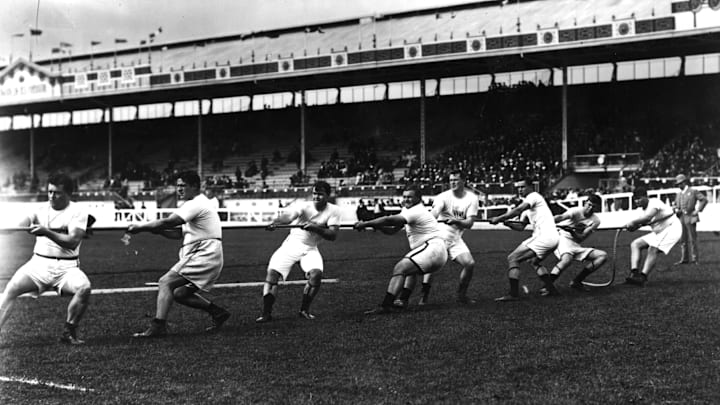
Unlike some of other discontinued Olympic sports, tug of war had a fair amount of staying power; it made the program for every Olympics between 1900 and 1920. The sport was played in pretty much the same way you remember it from your grade-school field days, but it was also a magnet for Olympic controversies.
The 1904 gold medal-winning American squad was ostensibly representing the Milwaukee Athletic Club, which was fine until further research established that the team was actually composed of ringers recruited from Chicago. Scandal struck again at the 1908 Games when the American squad protested that the police boots worn by the British pullers from the Liverpool Police team were equipped with illegal cleats for extra traction. When the protest failed, the American pullers left the Games in a huff. All told, the British teams grabbed a total of five medals to the Americans’ three before the sport fell off the program following the 1920 Games.
Cricket
Cricket began and ended its Olympic run at the second modern Games, held in 1900 in Paris. (Organizers originally wanted to have a cricket tournament at the 1896 Games, but the event didn’t draw enough entries.) Things got off to a rough start when the Belgian and Dutch teams withdrew from the field prior to the start of play, leaving just a British touring team, the Devon and Somerset Wanderers, to take on the French Athletic Club Union’s squad. The teams apparently weren’t even aware they were playing in the Olympics; they thought the two-day match was just a part of the World’s Fair Paris was hosting at the time.
According to one contemporary report, the teams squared off in a cycling arena fit for 20,000 spectators but had only a dozen soldiers as an audience. The English side won the match and received silver medals and miniature Eiffel Towers for their trouble; the French team got bronze medals.
Everyone returned home without knowing they had been Olympians, and it wasn’t until the IOC sat down to make a comprehensive record of the Games in 1912 that the two squads received official recognition as gold and silver medalists in cricket. The sport has never returned to the Games.
Basque Pelota
The Paris Games of 1900 saw more than one sport make its sole Olympic appearance (at least officially). The ancient sport of Basque pelota, in which teams of two players use a curved basket to fling a ball against a wall in a racquetball-like game, made the Olympic program for Paris.
Unfortunately, like cricket, participation was a bit low; only two teams showed up. The duo from Spain, where the sport enjoys great popularity, beat a French pair in the sole Olympic Basque pelota match to claim the gold medals. The final score of the match is lost to history.
Croquet

Like cricket and Basque pelota, croquet saw action only at the 1900 Paris Games, where sports apparently went to die. The French hosts made the most of the opportunity, though; they claimed all seven medals awarded in the sport. Records are sketchy, but it would seem that across the three events, nine of the 10 competitors were French, which probably facilitated their dominance.
Roque
Give yourself 50 bonus points if you know what roque is. The sport is a croquet variant played with short mallets on a hard rolled-sand court with a wall, off which players can bank the balls. The sport’s official rules tout it as “the most scientific outdoor sport in existence,” but it didn’t hold up so well at the Olympics. Roque debuted at the 1904 Games in St. Louis. Americans swept the medals, and the sport promptly disappeared.
Jeu de Paume
Jeu de paume, or “real tennis,” is a tennis precursor that was originally played without racquets—players hit the ball with their hands. By the 1908 Games in London, the sport had evolved to the point where small racquets played a key role, but the largely indoor variant remained separate from what we think of as tennis, which was also played at the Games under the name lawn tennis.
American railroad scion Jay Gould II claimed the gold, and Charles Sands, who won the gold in golf in 1900, competed but lost in the first round. “Real tennis” made a brief reappearance as a demonstration sport at the 1924 Games before fading away.
Lacrosse

Despite lacrosse’s popularity in the English-speaking world, it never really caught on as an Olympic sport. It made the program in the 1904 and 1908 Games, and since only five teams combined entered the event over the two Games, every team that played won a medal. Canada won both golds and a bronze (they sent two teams in 1904), while American and British teams claimed the two silvers, respectively. Lacrosse was a demonstration sport at the 1928, 1932, and 1948 Games, but it never regained its medal status.
Rackets
If you haven’t noticed a pattern yet, it’s worth pointing out that if you hosted an early set of Games, you could pretty much railroad whatever sport you wanted to onto the program to help your countrymen get medals. The rackets competition at the 1908 Games in London was no exception; every single entrant was British. The sport itself is very similar to squash, which originated as an offshoot of rackets in the 19th century, and remains popular in the UK. The seven-man all-British field included John Jacob Astor V of the famed Astor family; he won a gold in doubles and a bronze in singles competition.
Polo
Apparently the Olympics could never quite figure out how to handle polo. It popped on and off the program throughout the first 40 years of the modern Games. Polo was a medal sport at five different Games, with competitions appearing in 1900, 1908, 1920, 1924, and 1936. Only the British team competed in all of these Games and won a total of six medals, including three golds.
Water Motorsports
Motorboat racing first appeared as a demonstration sport at the 1900 Games, and in 1908 it received full medal status. Captains in three classes were set to race five laps around an eight-nautical-mile course in the only Olympic event to involve motors. However, the English weather didn’t feel like complying and whipped up a ferocious gale. Two boats entered each class, but due to the terrible weather, boats started to fill with water, ran aground, suffered engine problems, and had to quit. As a result, only one boat finished each race, meaning that the only Olympic water motorsports medals ever handed out were gold. The British boat Gyrinus won two of the races.
Read More About Olympics History:
A version of this story was published in 2009; it has been updated for 2024.