Where Knowledge Junkies Get Their Fix
McAfee Secure sites help keep you safe from identity theft, credit card fraud, spyware, spam, viruses and online scams
Floss books
The History of Utensils (Spork Included)
by Floss books - December 5, 2008 - 7:45 AM

Before utensils, everything was finger food. Here’s how some of our common eating tools wound up on our placemats.

Chopsticks

chopsticks.jpgChopsticks evolved in China during the Chou Dynasty (1122–255 BCE), not due to fashion but mostly because of the nation’s poverty at the time. While starvation was a big problem, the land did have plenty of water for rice farming, so the country’s forests were cleared in favor of agriculture. As a result, firewood became a luxury item, and culinary trends reflected the need for shorter cooking times. For example, instead of boiling or baking large items, cooks chopped them into small pieces that could be stir-fried quickly.

No wood for fires also meant no wood for tables, so in order to eat, people had to be able to hold their food bowl while eating with the other hand. An expert chopsticks user could pick up small bits of meat, vegetables, and rice without ever touching the utensils to his or her lips—making the chopsticks more sanitary and pleasing to even the most fastidious of diners.

While eating in a Chinese restaurant, you may have received wooden chopsticks from time to time, which appears to break the no-wood pattern the Chinese were aiming for. But there’s a simple explanation for this seeming anachronism: during the Chou Dynasty, chopsticks were traditionally made of non-wooden materials like bamboo, ivory, or bone.

Spoons

Strangely enough, spoons are the utensil most found in nature and therefore predate their rival, the fork. From sea shells to gourds, to sections of bamboo and wood, spoons appeared in many forms in every region. The shapes ranged from mini-bowls in seacoast areas to flat, paddle-like objects used by American Indians in the Pacific Northwest.

The word for spoon in both Greek and Latin is cochlea, which means a spiral-shaped snail shell, suggesting that shells were the spoon of choice in Southern Europe. Judging by the Anglo-Saxon word spon, which means a chip or splinter of wood, Northern Europeans were using other materials for the same purpose.

Despite the difference of materials, it’s highly probable that the Anglo spoon was influenced by the Southern European version. The Romans designed two spoons in the first century CE: (1) a ligula, which sported a pointed oval bowl and decorative handle, for soups and soft foods and (2) a cochleare, a small spoon with a round bowl and pointed handle, for shellfish and eggs. When the Romans occupied Britain (43 CE to 410 CE), they likely brought their cutlery, inspiring the English design.

Forks

Sure, forks are handy, but they were once counted as the most scandalous of utensils. One legend tells that the fork got its start in Europe during the superstitious Middle Ages. In the 11th century, a Byzantium princess flouted her delicate, two-tined golden fork at her wedding to Domenico Selvo, son of the Venetian Doge. The Venetian clergy had clearly stated their position on the subject: God provided humans with natural forks (i.e., fingers) and it was an insult to his design to use a metal version. Moreover, fork use represented “excessive delicacy,” which was apparently very bad. When the princess died shortly after her wedding, people didn’t look to natural causes (or even fork injury). They assumed the death must be divine punishment.

Somehow, fork use still spread through Europe over the next 500 years, and despite the wishes of the clergy, it was considered an Italian affectation in Northern Europe. Part of the bad rap came from, again, the prissy factor. Although the fork’s functional value is similar to a spoon nowadays, the first forks originally evolved from the knife. Aristocrats would use one knife to cut the food and a second to spear and eat it. The two- and four-pronged knife substitutes must have looked as overwrought as a double-layer dinner fork would seem to us today.

Knives

Back in the Middle Ages in Europe, the rule was to carry your own knife, usually in a sheath at your belt. Seems natural enough—archaeological evidence shows that humans had been using knives since prehistoric times as weapons and eating utensils, and they were a most useful tool. So, who went Emily Postal and domesticated the knife for the dinner table?

Well, Louis XIV for one. Until Louis’ time, the knives used to cut and eat dinner were sharply pointed—after all, they had to spear food as well as cut it. But no one forgot that they also doubled as weapons. This meant that dining experiences could be a little uncomfortable, as the dining utensil represented a threat of danger at any moment, even under seemingly friendly circumstances.

When that darn fork gained popularity in Europe, the need for a pointed knife at the table lessened, and that’s where Louis comes in. In 1669, the French king ruled all pointed knives at the dinner tables to be illegal. As such, the utensils were ground down to prevent violence. The blunt and wider knives became popular in America, too, though the fork was rarely imported there. As a result, European and American dining customs evolved somewhat differently.

Sporks

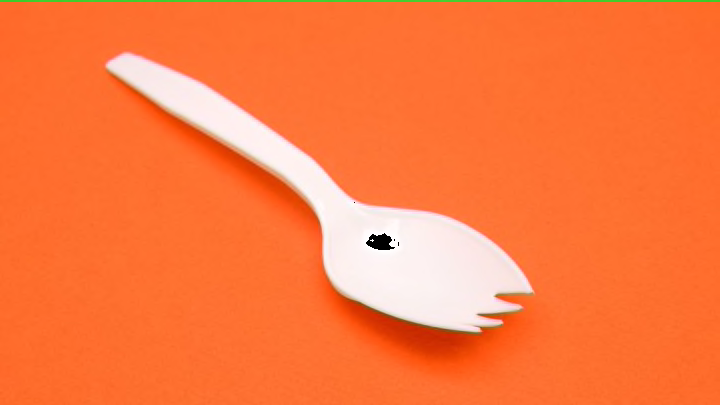
spork.jpg

Ah, the spork. Our favorite utensil—perfect for scooping up ice cream and spearing pie without dirtying extra cutlery. As its name indicates, the spork is half-spoon, half-fork, and while America was clearly behind on the other cutlery trends, the spork is a true American eating utensil. First mentioned by name in a 1909 supply catalogue, the spork achieved notoriety through another American original—Kentucky Fried Chicken. Back in 1970, KFC started including plastic sporks with their meals as a cheap convenience, and the Van Brode Milling Company of Massachusetts patented the invention for their “combination plastic spoon, fork, and knife” the same year. Due to its handy nature, the spork eventually became a common dessert and travel utensil, available in silver and other metals.

One More: The Splade

Americans aren’t the only ones who appreciate multipurpose utensils. In Australia, the splade, originally trademarked as Splayd, started as a combination spoon/blade. A darling of wedding gift ideas in Australia, the splade gained massive popularity in the 1950s and 1960s.

This article was written by Liz Hunt and excerpted from the mental_floss book In the Beginning: The Origins of Everything. You can pick up a copy in our store.

staticcatalog.jpg

Comments (32)
  1. The spork is also called a runcible spoon a la Lear’s Owl and the Pussycat.

  2. What I would like to know is why Americans and Europeans hold their utensils differently when eating. Both hold the knife in our right hand when cutting food and the fork in the left. But then Americans drop the knife and transfer the fork to the right hand to transfer food to the mouth. Europeans eat with the fork always in the left hand. Why is that?

  3. KJ, what are you talking about ? Is this anecdotal or has this actually been studied ? As an American, I can tell you that your post makes you sound ridiculous.

  4. KJ- I don’t have the answer but I remember when I was a kid, my parents considered it the height of rude to eat the “European way”. It just had the fewest steps in the process of uniting food and mouth.

  5. KJ– As an American I’ve heard this, but never so much witnessed it. It may be one of those miss manners ‘in theory’ things. (Another example: when you’re done with your meal, you’re supposed to place your fork across your plate upside down. But the majority of people I know don’t do this — and likely haven’t heard about it.)

    I’ve always kept my fork it the left hand. ‘The transfer’ seems like an unnecessary movement for the sake of ceremony. But who knows, maybe some people around here think me a no-mannered clod because I eat ‘European’. I can live with that.

  6. Well, this American grew up in a household that used utensils the ‘European way.’ And we were just common folk out of Appalachia.

    (This is the kind of article I come to Mental Floss for.)

  7. Wouldn’t it be odd to eat using your non-dominant hand? I eat with my left hand because I’m left-handed (usually). Wouldn’t a righty have a bit of trouble with a fork in the left hand?

    I would love to see a post about table manners and where they came from and why. Some things that are considered the height of rudeness seem really baffling to me.

  8. I think I switch back and forth between the two styles of utensil use. As long as i get the food in my mouth it’s all good. If anybody gives you trouble about using the wrong hand, just use your new flossy knowledge. Tell them that forks are an affront to god and you are misusing it on purpose so you wont be smited.

  9. I also grew up in a very rural community, but my mother was brought up in a traditionally Southern (US) fashion – prim and proper, manners and etiquette; these were non-negotiable.

    Fortunately, it “took” with me (the eldest son) although my father and brother held fast to their “redneck” upbringing (in my mother’s opinion).

    I always understood that the “European” method of handling cutlery was more than efficiency – it limited the awkward transitions of utensils from hand-to-hand and the potential CLANG of such and the startled distractions away from the “proper” topic being discussed at the moment.

  10. I can see that the ‘European Style’ of cutlery use would be less awkward. However, as a severely right-handed person, I’m sure the mess I would make would be more awkward than utensil switching.

  11. Rachel: I cut with my dominant hand (my right) because it’s safer. If I cut with my left hand it’s just dangerous for all those around me. I can at least get the food to my mouth with my left hand.

  12. KJ, An easy work-around to this, is to learn to use your knife with your left hand and keep your fork in the right hand. It takes some practice, but once you get used to it, it’s much easier.

  13. Does the splade look dangerous to anyone else? I’m seeing a lot of cuts to the corners of the lips. Ouch!

    As for the European/American utensil use discussion, I go with both. When cutting meat, I use the fork in my left hand that has already speared the meat to transfer it to my mouth. When moving over to the mashed potatoes, for instance, the fork gets transferred to the right hand.

    reCaptcha: buffet Mabel

  14. @Dee – how rude. Just because YOU haven’t heard of it, someone else sound ridiculous? I’m wondering, in viewing posts subsequent to yours, who sounds ridiculous now? I believe an apology is in order.

    I have seen various places where people taking etiquette classes are taught the European way of dining, i.e., you do not switch your fork to your dominate hand. Additionally, you do not turn your fork over, you simply bring it up to your mouth. I agree that researching the origins of these types of etiquette “rules” would make an interesting post.

  15. The “European Way” has been said to take less elbow room. If eats with the fork in the left hand tines down and knife in right, she can move the fork to her mouth keeping her elbows tucked.

    I’d suggest one looks at the difference between how English and rest of Europe behave. Apparently during the War of Independance Americans rejected English customs for French.

    Just reciting from some old junk in the back of my brain. Can’t cite a word of it.

  16. I’ve heard two theories about why Americans use their forks differently.

    The first is that early American colonists arrived here prior to the adoption of the fork in Europe. The transfering of hands was possibly done because all they had was spoons, and its easier to control a spoon with the dominant hand. The custom stuck even after Americans eventually adopted knives.

    The other theory is that it was a deliberate choice made during and after the Revolutionary war. Eating in the European style was seen as too British. Not sure how much stock I would put in this theory.

  17. I’m an American that eats with his knife in his left hand and fork in his right hand. I don’t swap utensils. I typically hang my spoon from my nose…

  18. I must correct JBrailer about his wrongheaded assertion about the “runcible spoon” from the Owl and the Pussycat! A spork is a spork – it has tines and a bowl. A runcible spoon is a spoon with serrated edges, NOT tines, such as a grapefruit spoon. Check your wikipedia before stating “facts”.

    Lear: “… and plenty of quince, which they ate with a runcible spoon”

    Quince is a fruit – the serrations on the runcible spoon allow the fruit to be teased out of the peel, just like grapefruit spoons mean you don’t have to precut your halved fruit.

    Also – I have seen other runcible spoons used for sugar, butter, and as decorative serving spoons, done with a scalloped edge. Again, scallops or serrations, not tines.

  19. “went Emily Postal” – very good! Did you make that up or did I miss a Seinfeld?

  20. Count me as an American that eat with fork in left hand. When I need a knife, I hold it with my left hand, and swap the fork to the right. I do this because I am left handed. If I cut with my right hand, I might injure myself or others. Stabbing someone seems far less courteous than switching the knife to my left hand.

  21. As the child of an American and a European, I’ve definitely noticed different etiquette at the dining table. Dee’s comment irritated me to no end. “As an American…” Ugh. Anyway, food was passed in opposite directions. The salad was served at different times of the meal. People held their knives and forks differently. The French people I’ve known don’t seem to care if you have your elbows on the table. Many Americans do. So, whatevs… Just saying that there are cultural differences in something as mundane as table manners.

  22. The “European Way” [sic] you all keep referring to is actually called continental style. It is well known to be a more efficient way of eating, as one only needs to put their utensils down in order to drink a beverage (usually with mouth full of food) or partake of more victules (without ascertaining if others would like more first).

    As you can see, I have a preference.

  23. Interesting, I never knew there was a “European/Continental” versus “American” way of holding utensils. I have always held the knife in my right-hand and then switched to a fork to eat. Because I am right-handed, this just makes sense to me. I don’t mind the extra step of switching, it only takes a second and I find it better than eating awkwardly with my retarded left hand.
    Also, it just seems to me that putting the knife down to pick up a fork would be more presentable than eating with the opposite hand and still continuing to hold a knife while you eat.

  24. I think we should invent more utensils to use while eating. Why stop with fork/spoon and fork/knife combinations?

    I would like to make a fork with multiple prongs on it, like a miniature garden rake, to use when eating green peas or similar items. One simply rakes the peas into a spoon to eat. We could call it a Flake…

  25. i have to agree with bzzzx2- Dee, your comment was obnoxiously rude, and it shows you obviously didn’t read the post as it mentioned how American and European styles of dining differ.


    what a great post, though!

  26. I am right-handed, however I hold the fork in my right hand and slice with my left hand.

    I caught on to the whole fork and knife thing late because my Mum’s Filipino and they tend to use a fork and spoon instead. Or hands. That’s always fun.

    I have never heard of a splade and I’m pretty sure I’ve never seen one either but they sounds like fun. Does it make me unAustralian to have NEVER heard of a splade until five minutes ago? I’m thinking it’s kitschy and nobody ever brings them up.

  27. I’ve always found it easier to cut my food with my right(dominate) hand (maybe because we had a lot of cheap, tough cuts of meat to deal with while I was growing up) and so I hold my fork in my left hand.

    Sporks are useless, in my opinion. The food does not stay on the pointy end long enough to get it to you mouth, and the bowl is too shallow. Takes forever to eat anything using one.

  28. Marion,
    I think you need to check your wikipedia.

    A scalloped spoon, when small in size is called a sugar shell and not a runcible spoon as it resembles a sea shell.

  29. Also check out Knork, a brand of cutlery that was originally just a fork with sharper edges in the curve. Now they have a fabulous full line of tableware.

  30. FOOD FIGHT!!!

    —————-

    I’m just glad I have food to eat.

    On the rare occasion that I’m in a fancy eatin’ situation I observe how the other people are using the utensils. At home I’m a pig.

    …and I learned to not drink from the finger bowl. (j/k)

  31. Dee,

    An excerpt from cuisinenet dot com might not answer KJ’s question to his/her satisfaction, but may well fill a gap in YOUR education:

    “The Zig Zag Method
    By American custom, which was brought about partly by the late introduction of the fork into the culture, all three utensils are intended for use primarily with the right hand, which is the more capable hand for most people. This leads to some complicated maneuvering when foods, such as meat, require the use of knife and fork to obtain a bite of manageable size. When this is the case, the fork is held in the left hand, turned so that the tines point downward, the better to hold the meat in place while the right hand operates the knife. After a bite-sized piece has been cut, the diner sets the knife down on the plate and transfers the fork to the right hand, so that it can be used to carry the newly cut morsel to the mouth. Emily Post calls this the “zig-zag” style.

    European Style
    The European, or “Continental,” style of using knife and fork is somewhat more efficient, and its practice is also common in the United States, where left-handed children are no longer forced to learn to wield a fork with their right hands. According to this method, the fork is held continuously in the left hand and used for eating. When food must be cut, the fork is used exactly as in the American style, except that once the bite has been separated from the whole, it is conveyed directly to the mouth on the downward-facing fork. Regardless of which style is used to operate fork and knife, it is important never to cut more than one or two bites at one time.”

  32. First off, I agree with Lindsey. If I’m cutting somthing like a steak, a pork chop, a chicken breast, etc; I’m going to use my right hand to cut. I’m right handed, and lefty-knife would just feel awkward. Then I will pick up the meat with the fork, held in my left hand (which feels awkward, but switching is just too dadblasted inefficient). However, if I’m not cutting the food or I’m cutting it with the fork; say I’m eating broccoli or a salad; I will keep the fork in my right hand.

    I did take some etiquette classes, but I don’t think that I should be counted among the “etiquette educated” because I spent a lot of time in that class throwing packets of jam across the table at my friends…and spinning the lazy susan. Lunchtime roulette.

    However, I love me a good spork. I want to open a restaraunt named Spork that only serves food that can be eaten with sporks. Chicken and dumplings and beef stew anyone?

Comment

commenting policy