%20%20--%3E%0A%3Csvg%20version%3D%221.1%22%20id%3D%22Layer_1%22%20xmlns%3D%22http%3A%2F%2Fwww.w3.org%2F2000%2Fsvg%22%20xmlns%3Axlink%3D%22http%3A%2F%2Fwww.w3.org%2F1999%2Fxlink%22%20x%3D%220px%22%20y%3D%220px%22%0A%09%20viewBox%3D%220%200%20684.6%2068.1%22%20style%3D%22enable-background%3Anew%200%200%20684.6%2068.1%3B%22%20xml%3Aspace%3D%22preserve%22%3E%0A%3Cg%3E%0A%09%3Cpath%20d%3D%22M444.1%2C29.3h-17.4v14.5h17.4V29.3z%20M36.4%2C68.1l29.3-50.8V0H50.4L32.9%2C36.8L15.5%2C0H0v68.1h16.7V45.8l12.4%2C22.3H36.4z%0A%09%09%20M49.1%2C68.1h16.6V23.4L49.1%2C52.1V68.1z%20M76.6%2C68.1h45V53.8H93.3V41.6h21V27.1h-21V14.8h28.3V0.1h-45V68.1z%20M175.6%2C68.1h17.3v-68%0A%09%09h-16.5v40.3L150%2C0.1h-17.6v68h16.7V27.7L175.6%2C68.1z%20M235.8%2C14.8h15.4V0.1h-47.4v14.7H219v53.2h16.8V14.8z%20M290.3%2C45.9h-17.1%0A%09%09l7.5-15.6h2L290.3%2C45.9z%20M298.7%2C68.1h18l-32.2-68h-5.7l-32%2C68h18l3.3-7.1h27.1L298.7%2C68.1z%20M325.2%2C68.1h46.2V53.8h-29.6V0.1h-16.7%0A%09%09V68.1z%20M423.7%2C14.8h27.2V0.1H407v68h16.7V14.8z%20M462%2C68.1h46.2V53.8h-29.6V0.1H462V68.1z%20M564.8%2C34.1c0%2C10.7-7.2%2C19.2-18.5%2C19.2%0A%09%09c-11.4%2C0-18.5-8.5-18.5-19.2s7.1-19.2%2C18.5-19.2C557.6%2C14.9%2C564.8%2C23.4%2C564.8%2C34.1%20M580.6%2C34.1c0-19-14.2-34-34.3-34%0A%09%09c-20.2%2C0-34.3%2C15-34.3%2C34c0%2C19%2C14.1%2C34%2C34.3%2C34C566.4%2C68.1%2C580.6%2C53.1%2C580.6%2C34.1%20M604.8%2C20.5c0-4.1%2C3.3-6.2%2C6.7-6.2%0A%09%09c4.4%2C0%2C6.6%2C3%2C6.6%2C6.6h14.7C631.8%2C9.1%2C625.1%2C0.1%2C611%2C0.1c-12%2C0-21.7%2C9.3-21.7%2C20.6c0%2C10.9%2C5.9%2C15.9%2C16.7%2C19.8%0A%09%09c5.2%2C1.8%2C11.5%2C3.2%2C11.5%2C8c0%2C3.3-2.4%2C5.5-6.4%2C5.5c-3.6%2C0-6.6-3-6.6-6.7h-15.2c0%2C11.5%2C7.9%2C20.8%2C21.8%2C20.8c12%2C0%2C21.6-9.3%2C21.6-20.6%0A%09%09c0-10-5.3-16.4-16.7-19.8C610.6%2C26.1%2C604.8%2C25.3%2C604.8%2C20.5%20M670%2C20.9h14.7C683.8%2C9.1%2C677.1%2C0.1%2C663%2C0.1c-12%2C0-21.7%2C9.3-21.7%2C20.6%0A%09%09c0%2C10.9%2C5.9%2C15.9%2C16.7%2C19.8c5.2%2C1.8%2C11.5%2C3.2%2C11.5%2C8c0%2C3.3-2.4%2C5.5-6.4%2C5.5c-3.6%2C0-6.6-3-6.6-6.7h-15.2c0%2C11.5%2C7.9%2C20.8%2C21.8%2C20.8%0A%09%09c12%2C0%2C21.6-9.3%2C21.6-20.6c0-10-5.3-16.4-16.7-19.8c-5.4-1.6-11.3-2.4-11.3-7.2c0-4.1%2C3.3-6.2%2C6.7-6.2C667.7%2C14.4%2C670%2C17.3%2C670%2C20.9%0A%09%09%22%2F%3E%0A%3C%2Fg%3E%0A%3C%2Fsvg%3E%0A)

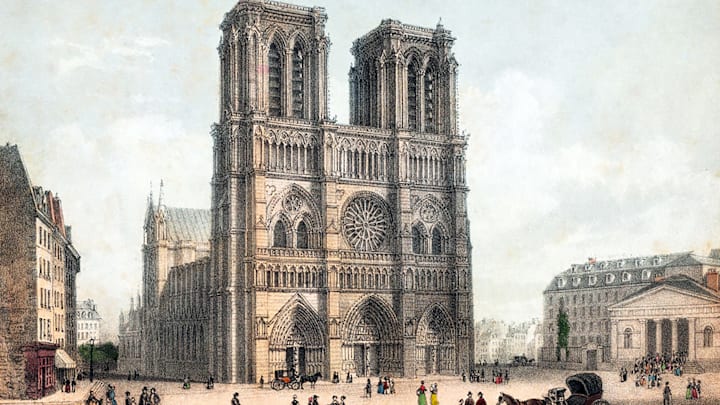
Constructed between the 12th and 14th centuries, Notre-Dame de Paris has centuries of French history built into its stone. The Gothic cathedral reflects the prominent role of Paris as an economic and spiritual center in the 12th century, and its scars from the French Revolution are reminders of its long connection with the monarchy—a connection that almost resulted in its demolition. Thousands of tourists entered its doors each day to photograph its rose windows and flying buttresses.
On April 15, 2019, a devastating fire broke out in the building. Its masonry was severely damaged and its wooden roof beams, iron spire, and other components were destroyed. Hundreds of firefighters worked to control the flames. While the embers were still hot, President Emmanuel Macron promised it would be rebuilt, even more beautifully, in five years.
Now, with restoration of the structure nearly complete, reopening day scheduled for December 2024, and tourists gathering in Paris for the Summer Olympics, let’s dive into 13 lesser-known facts about Notre-Dame de Paris.
- A pagan city lies below the cathedral.
- Notre-Dame’s façade features some recycled architecture.
- Notre-Dame had a “forest” in its roof.
- Its flying buttresses were Gothic trendsetters.
- 28 of its kings lost their heads in the French Revolution.
- The towers are not twins.
- Its bells were once melted down for artillery.
- Napoleon and Victor Hugo saved Notre-Dame from ruin.
- Its monsters are modern, not medieval.
- Its spire was a saintly lightning rod.
- Its organ is thought to be the largest in France.
- All roads lead to Notre-Dame de Paris.
- Bees still live on its roof.
A pagan city lies below the cathedral.
The Île-de-la-Cité on which Notre-Dame de Paris now stands was once a Gallo-Roman city known as Lutetia. The cathedral may have been built right over remnants of a temple: Around 1710, pieces of a sculpted altar dedicated to Jupiter and other deities were discovered during an excavation under the choir (although it remains unclear if this is evidence of an ancient temple, or if the pieces were recycled there from another location). Additional architectural ruins found in the 1960s and ’70s, many dating back to this ancient era, lie in the archaeological crypt located beneath the square just in front of Notre-Dame.
Notre-Dame’s façade features some recycled architecture.


There are three portals on the western façade of Notre-Dame, each laden with sculpted saints and sacred scenes. One doesn’t seem to fit, however—the Portal Sainte-Anne features a much earlier style than the rest. Its figures, such as the central Virgin and Child, look stiffer in their poses and less natural in their features compared to the other statues. That’s because this tympanum, or semi-circular area of decoration, was recycled from a previous Romanesque church. A close examination in 1969 revealed that it was not originally made for this space, and had been adapted to fit the Gothic structure.
Notre-Dame had a “forest” in its roof.
Before the fire, the cathedral contained one of the oldest surviving wood-timber frames in Paris, involving around 52 acres of trees that were cut down in the 12th century. Each beam was made from an individual tree. For this reason, the lattice of historic woodwork was nicknamed “the forest.”
Its flying buttresses were Gothic trendsetters.

The cathedral was one of the earliest structures built with exterior flying buttresses. They were constructed around its nave in the 12th century to lend support to the thin walls, after the need for more light in the incredibly tall church required larger windows, and thus greater supports. The exposed flying buttresses became an iconic aspect of Gothic design, and although there’s some debate over whether Notre-Dame was the first church to have them, they certainly set the trend in sacred architecture.
28 of its kings lost their heads in the French Revolution.
In 1793, in the midst of the French Revolution, 28 statues of biblical kings in the cathedral were pulled down with ropes and decapitated by a mob. (King Louis XVI was guillotined earlier that year, and any iconography tied to the monarchy was under attack.) The mutilated stones were eventually tossed in a trash heap, which the interior minister dealt with by ordering the material be repurposed for construction. It wasn’t until 1977 that the heads of 21 of these kings were rediscovered during work on the basement of the French Bank of Foreign Trade. Now they’re at the nearby Musée de Cluny.
The towers are not twins.

At first glance, Notre-Dame’s two towers appear like identical twins. Closer examination reveals that the north tower is in fact a bit bigger than the south. As with all the elements of the cathedral, they were built over time, and reflect how the cathedral is more of a collage of architectural trends and leadership than the culmination of one person’s vision.
Its bells were once melted down for artillery.
The kings weren’t the only part of Notre-Dame destroyed during the French Revolution. The cathedral, like other churches around France, was transformed in the late 18th century from a Christian space and rededicated to the new Cult of Reason. All 20 of its bells—except the colossal 1681 bourdon called Emmanuel—were removed and melted down to make cannons.
While the bells at Notre-Dame were replaced in the 19th century, the new instruments were not as finely made as the older versions, and made a more dissonant noise when clanging. Finally, in 2013, a new ensemble of bells restored the cathedral to its 17th-century sound, with the deeply resonant Emmanuel still joining in the toll on special occasions.
Napoleon and Victor Hugo saved Notre-Dame from ruin.
When Napoleon Bonaparte decided to have his 1804 coronation as emperor in Notre-Dame, the building was in bad shape. Centuries of decay as the city developed and changed around it, as well as the vandalism of the French Revolution, had left it on the verge of demolition. For years it had been used as little more than a warehouse. So when Napoleon declared its return to church use, and hosted his grand ceremony within his walls—an event in which he famously crowned himself—it brought Notre-Dame to new prominence.
Nevertheless, the coronation didn’t fix its structural deterioration. Then author Victor Hugo used the building as a personification of France itself in his 1831 novel Notre-Dame de Paris. (The book’s name is often translated as The Hunchback of Notre Dame, yet the bell ringer Quasimodo is not the main character; the central figure is Notre-Dame.) And Hugo vividly evoked its decrepit 19th-century state:
“But noble as it has remained while growing old, one cannot but regret, cannot but feel indignant at the innumerable degradations and mutilations inflicted on the venerable pile, both by the action of time and the hand of man, regardless alike of Charlemagne, who laid the first stone, and Philip Augustus, who laid the last. On the face of this ancient queen of our cathedrals, beside each wrinkle one invariably finds a scar. 'Tempus edax, homo edacior,' which I would be inclined to translate: 'Time is blind, but man is senseless.'”
The book was a success, and the momentum led to a major restoration overseen by architects Jean-Baptiste-Antoine Lassus and Eugène Viollet-le-Duc.
Its monsters are modern, not medieval.

Some of the most popular images of Notre-Dame are from the perspective of its gargoyles or chimera (the carved monsters that don’t act as waterspouts). Few visitors would guess that the fantastic creatures now on the cathedral weren’t there until the 19th century; they were added between 1843 and 1864 during the radical restoration overseen by Eugène-Emmanuel Viollet-le-Duc.
Hugo had described gargoyles extensively in Notre-Dame de Paris, and Viollet-le-Duc was reportedly inspired by this romantic vision of the past. A daguerreotype from before this overhaul shows a building more stark than the one we know today, with no beasts perched on its towers, its medieval gargoyles having long been removed. Before the fire, many of the 19th-century gargoyles were decaying; PVC pipes had taken the place of those that had been taken down for safety.
The gargoyles were far from the only fanciful addition by the architect Viollet-le-Duc. Among the 12 apostles he had installed around his new spire, he included himself as the face of Saint Thomas.
Its spire was a saintly lightning rod.
Photos of the cathedral before the fire show a rooster on top of the spire. This rooster was not a purely decorative bird. In 1935, three tiny relics—an alleged piece of the Crown of Thorns and some bits of Saint Denis and Saint Genevieve (the city's patron saints)—were secured inside the metal bird’s body. The idea, the story went, was to create a sort of spiritual lightning rod to protect the parishioners within.
Its organ is thought to be the largest in France.
The Notre-Dame organ involves almost 8000 pipes (some dating back to the 18th century) played with five keyboards, making it the biggest pipe organ in France (although some claim that Saint-Eustache has a larger one). The instrument was restored in 2013 to mark the 850th anniversary of the cathedral, and fortunately, it survived the 2019 fire with only water damage from the firefighters’ hoses. It is still being cleaned and decontaminated.
All roads lead to Notre-Dame de Paris.

Mostly overlooked beneath the crowds of tourists milling around outside Notre-Dame is a diminutive circular marker with an eight-pointed bronze star embedded in the cobblestones. It’s engraved with the words Point zéro des routes de France, and is the point from which distances are measured from Paris to other cities in France. It was placed there in 1924, although it had to be temporarily dislodged in the 1960s during the excavations for what was intended to be an underground parking garage. Those construction plans were thwarted when workers turned up architectural ruins—now kept in the archaeological crypt.
Bees still live on its roof.
On the Notre-Dame sacristy, adjacent to the cathedral, a small beehive was installed in 2013. The hive was home to Buckfast bees, a strain developed by a monk named Brother Adam and known for its gentleness. Their honey is made from the flowering plants in nearby gardens, including the Square Jean XXIII just behind the cathedral, and was given away to the poor.
Miraculously, the 180,000 bees survived the devastating fire. They wouldn’t abandon their queens, and so hunkered down inside their hives and survived on honey. A year after the blaze, they were pollinating flowers and producing the sweet stuff as usual.
Read More About Famous Buildings:
A version of this story was published in 2018; it has been updated for 2024.