%20%20--%3E%0A%3Csvg%20version%3D%221.1%22%20id%3D%22Layer_1%22%20xmlns%3D%22http%3A%2F%2Fwww.w3.org%2F2000%2Fsvg%22%20xmlns%3Axlink%3D%22http%3A%2F%2Fwww.w3.org%2F1999%2Fxlink%22%20x%3D%220px%22%20y%3D%220px%22%0A%09%20viewBox%3D%220%200%20684.6%2068.1%22%20style%3D%22enable-background%3Anew%200%200%20684.6%2068.1%3B%22%20xml%3Aspace%3D%22preserve%22%3E%0A%3Cg%3E%0A%09%3Cpath%20d%3D%22M444.1%2C29.3h-17.4v14.5h17.4V29.3z%20M36.4%2C68.1l29.3-50.8V0H50.4L32.9%2C36.8L15.5%2C0H0v68.1h16.7V45.8l12.4%2C22.3H36.4z%0A%09%09%20M49.1%2C68.1h16.6V23.4L49.1%2C52.1V68.1z%20M76.6%2C68.1h45V53.8H93.3V41.6h21V27.1h-21V14.8h28.3V0.1h-45V68.1z%20M175.6%2C68.1h17.3v-68%0A%09%09h-16.5v40.3L150%2C0.1h-17.6v68h16.7V27.7L175.6%2C68.1z%20M235.8%2C14.8h15.4V0.1h-47.4v14.7H219v53.2h16.8V14.8z%20M290.3%2C45.9h-17.1%0A%09%09l7.5-15.6h2L290.3%2C45.9z%20M298.7%2C68.1h18l-32.2-68h-5.7l-32%2C68h18l3.3-7.1h27.1L298.7%2C68.1z%20M325.2%2C68.1h46.2V53.8h-29.6V0.1h-16.7%0A%09%09V68.1z%20M423.7%2C14.8h27.2V0.1H407v68h16.7V14.8z%20M462%2C68.1h46.2V53.8h-29.6V0.1H462V68.1z%20M564.8%2C34.1c0%2C10.7-7.2%2C19.2-18.5%2C19.2%0A%09%09c-11.4%2C0-18.5-8.5-18.5-19.2s7.1-19.2%2C18.5-19.2C557.6%2C14.9%2C564.8%2C23.4%2C564.8%2C34.1%20M580.6%2C34.1c0-19-14.2-34-34.3-34%0A%09%09c-20.2%2C0-34.3%2C15-34.3%2C34c0%2C19%2C14.1%2C34%2C34.3%2C34C566.4%2C68.1%2C580.6%2C53.1%2C580.6%2C34.1%20M604.8%2C20.5c0-4.1%2C3.3-6.2%2C6.7-6.2%0A%09%09c4.4%2C0%2C6.6%2C3%2C6.6%2C6.6h14.7C631.8%2C9.1%2C625.1%2C0.1%2C611%2C0.1c-12%2C0-21.7%2C9.3-21.7%2C20.6c0%2C10.9%2C5.9%2C15.9%2C16.7%2C19.8%0A%09%09c5.2%2C1.8%2C11.5%2C3.2%2C11.5%2C8c0%2C3.3-2.4%2C5.5-6.4%2C5.5c-3.6%2C0-6.6-3-6.6-6.7h-15.2c0%2C11.5%2C7.9%2C20.8%2C21.8%2C20.8c12%2C0%2C21.6-9.3%2C21.6-20.6%0A%09%09c0-10-5.3-16.4-16.7-19.8C610.6%2C26.1%2C604.8%2C25.3%2C604.8%2C20.5%20M670%2C20.9h14.7C683.8%2C9.1%2C677.1%2C0.1%2C663%2C0.1c-12%2C0-21.7%2C9.3-21.7%2C20.6%0A%09%09c0%2C10.9%2C5.9%2C15.9%2C16.7%2C19.8c5.2%2C1.8%2C11.5%2C3.2%2C11.5%2C8c0%2C3.3-2.4%2C5.5-6.4%2C5.5c-3.6%2C0-6.6-3-6.6-6.7h-15.2c0%2C11.5%2C7.9%2C20.8%2C21.8%2C20.8%0A%09%09c12%2C0%2C21.6-9.3%2C21.6-20.6c0-10-5.3-16.4-16.7-19.8c-5.4-1.6-11.3-2.4-11.3-7.2c0-4.1%2C3.3-6.2%2C6.7-6.2C667.7%2C14.4%2C670%2C17.3%2C670%2C20.9%0A%09%09%22%2F%3E%0A%3C%2Fg%3E%0A%3C%2Fsvg%3E%0A)

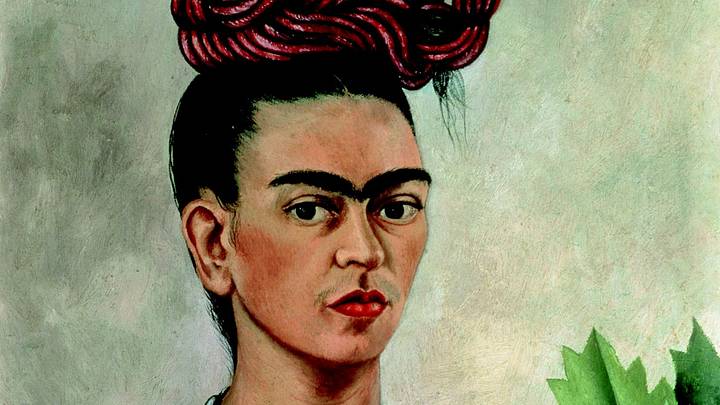
Frida Kahlo's life and work continue to captivate the world decades after her death.
Kahlo was best known for her enigmatic and powerful self-portraits, which blend Mexican culture and folklore, rich symbolism, and uncompromising imagery in deep, bold colors.
Her personal life has also received a great deal of attention over the years. Kahlo suffered from polio as a child and was in a horrific bus accident at the age of 18, leaving her bedridden and in pain for much of her life. Following this accident, she began painting seriously, and she would chronicle both her suffering and her dreams for herself and her nation for the rest of her life.
The artist died at the age of 47 in the year 1954, and ever since, her legacy has grown into a myth in itself. Unsurprisingly, all the mythologizing and reverence that have come to surround this artist have obscured some of the specific realities of her life.
- Misconception: Frida Kahlo was born in 1910
- Misconception: She was a surrealist
- Misconception: She was unknown during her lifetime
- Misconception: Frida Kahlo only painted self-portraits
Misconception: Frida Kahlo was born in 1910

This misconception was actually seeded by Kahlo herself. The artist often told people she was born in 1910, the year the Mexican Revolution began. However, she was actually born three years prior, on July 6, 1907.
Her decision to align her birth year with the start of the revolution was a symbolic act signifying her alignment with Mexico and its cultural and political rebirth following the overthrow of dictator Porfirio Díaz.
Misconception: She was a surrealist

Kahlo’s work has often been classified as surrealist, and her work was characterized as such by Surrealism founder André Breton, who featured her art in the 1940 International Exhibition of Surrealism in Mexico City.
However, the artist outright rejected this label. “They thought I was a Surrealist but I wasn’t. I never painted dreams. I painted my own reality,” she once said. Kahlo apparently found the 1940 exhibition disorganized, and also understandably took issue with her work being featured in a section labeled “Mexican knick-knacks.”
“I never knew I was a Surrealist ’til André Breton came to Mexico and told me I was,” she later reflected.
Kahlo further elaborated on her distaste for the French Surrealists in a letter to her lover, photographer Nicholas Muray. “They sit for hours in the ‘cafés’ warming their precious behinds, and talk without stopping about ‘culture,’ ‘art,’ revolution,’ and so on and so forth, thinking themselves the gods of the world, dreaming the most fantastic nonsense, and poisoning the air with theories and theories that never come true…” she wrote. “Sh*t and only sh*t is what they are.”
While Kahlo’s work does share some associations with Surrealism, she mostly depicted images from her own life as well as Mexican folklore, politics, and the natural world. Rather than focus on dreamscapes and other realities, Kahlo’s work delves deeply into the strangeness, pain, and beauty of this world and her own experience.
Misconception: She was unknown during her lifetime

Kahlo is sometimes spoken about as if she were an unknown artist during her lifetime, vastly overshadowed by her husband Diego Rivera. It is true that his artistic renown eclipsed hers during their lifetimes, only for Kahlo’s to vastly outshine him—and most other artists who have ever lived, in truth—posthumously.
Yet though Kahlo’s work did not break into the mainstream during her lifetime, she did receive significant recognition among artistic circles. In 1939, the Louvre purchased her painting “The Frame,” making her the first Mexican artist of the 20th century whose work was acquired by a major museum.
Misconception: Frida Kahlo only painted self-portraits

Retrospectives and popular perceptions of Kahlo’s work tend to focus largely on her own selfhood, her personal life, and her struggles with fertility and pain.
However, Kahlo was anything but myopic and disconnected. She was not reclusive or entirely bedridden, though she did spend much of her time at home dealing with pain. She loved entertaining, and also worked as a teacher and mentor to many young artists, supporting many of them up until her death.
She was also deeply politically engaged. A dedicated communist and anti-imperialist throughout her life, she also wove these themes into her art. Even her choice to wear traditional Mexican clothing was rooted in a desire to express solidarity with Mexican nationalism and her Indigenous heritage, as well as to create a carefully curated persona and to hide her physical disabilities.
And while about a third of the roughly 143 paintings she completed in her lifetime were self-portraits, her paintings often focused on political issues and cultural themes, and many did not include her own face at all. For example, the 1933 painting “My Dress Hangs There,” which Kahlo painted while in New York City, shows a Mexican Tehuana dress hanging in the middle of city streets, alongside a burning building, an overflowing trash can, and the Statue of Liberty.
The 2027 Mental Floss Amazing Facts Calendar is now on sale! Order yours today.