%20%20--%3E%0A%3Csvg%20version%3D%221.1%22%20id%3D%22Layer_1%22%20xmlns%3D%22http%3A%2F%2Fwww.w3.org%2F2000%2Fsvg%22%20xmlns%3Axlink%3D%22http%3A%2F%2Fwww.w3.org%2F1999%2Fxlink%22%20x%3D%220px%22%20y%3D%220px%22%0A%09%20viewBox%3D%220%200%20684.6%2068.1%22%20style%3D%22enable-background%3Anew%200%200%20684.6%2068.1%3B%22%20xml%3Aspace%3D%22preserve%22%3E%0A%3Cg%3E%0A%09%3Cpath%20d%3D%22M444.1%2C29.3h-17.4v14.5h17.4V29.3z%20M36.4%2C68.1l29.3-50.8V0H50.4L32.9%2C36.8L15.5%2C0H0v68.1h16.7V45.8l12.4%2C22.3H36.4z%0A%09%09%20M49.1%2C68.1h16.6V23.4L49.1%2C52.1V68.1z%20M76.6%2C68.1h45V53.8H93.3V41.6h21V27.1h-21V14.8h28.3V0.1h-45V68.1z%20M175.6%2C68.1h17.3v-68%0A%09%09h-16.5v40.3L150%2C0.1h-17.6v68h16.7V27.7L175.6%2C68.1z%20M235.8%2C14.8h15.4V0.1h-47.4v14.7H219v53.2h16.8V14.8z%20M290.3%2C45.9h-17.1%0A%09%09l7.5-15.6h2L290.3%2C45.9z%20M298.7%2C68.1h18l-32.2-68h-5.7l-32%2C68h18l3.3-7.1h27.1L298.7%2C68.1z%20M325.2%2C68.1h46.2V53.8h-29.6V0.1h-16.7%0A%09%09V68.1z%20M423.7%2C14.8h27.2V0.1H407v68h16.7V14.8z%20M462%2C68.1h46.2V53.8h-29.6V0.1H462V68.1z%20M564.8%2C34.1c0%2C10.7-7.2%2C19.2-18.5%2C19.2%0A%09%09c-11.4%2C0-18.5-8.5-18.5-19.2s7.1-19.2%2C18.5-19.2C557.6%2C14.9%2C564.8%2C23.4%2C564.8%2C34.1%20M580.6%2C34.1c0-19-14.2-34-34.3-34%0A%09%09c-20.2%2C0-34.3%2C15-34.3%2C34c0%2C19%2C14.1%2C34%2C34.3%2C34C566.4%2C68.1%2C580.6%2C53.1%2C580.6%2C34.1%20M604.8%2C20.5c0-4.1%2C3.3-6.2%2C6.7-6.2%0A%09%09c4.4%2C0%2C6.6%2C3%2C6.6%2C6.6h14.7C631.8%2C9.1%2C625.1%2C0.1%2C611%2C0.1c-12%2C0-21.7%2C9.3-21.7%2C20.6c0%2C10.9%2C5.9%2C15.9%2C16.7%2C19.8%0A%09%09c5.2%2C1.8%2C11.5%2C3.2%2C11.5%2C8c0%2C3.3-2.4%2C5.5-6.4%2C5.5c-3.6%2C0-6.6-3-6.6-6.7h-15.2c0%2C11.5%2C7.9%2C20.8%2C21.8%2C20.8c12%2C0%2C21.6-9.3%2C21.6-20.6%0A%09%09c0-10-5.3-16.4-16.7-19.8C610.6%2C26.1%2C604.8%2C25.3%2C604.8%2C20.5%20M670%2C20.9h14.7C683.8%2C9.1%2C677.1%2C0.1%2C663%2C0.1c-12%2C0-21.7%2C9.3-21.7%2C20.6%0A%09%09c0%2C10.9%2C5.9%2C15.9%2C16.7%2C19.8c5.2%2C1.8%2C11.5%2C3.2%2C11.5%2C8c0%2C3.3-2.4%2C5.5-6.4%2C5.5c-3.6%2C0-6.6-3-6.6-6.7h-15.2c0%2C11.5%2C7.9%2C20.8%2C21.8%2C20.8%0A%09%09c12%2C0%2C21.6-9.3%2C21.6-20.6c0-10-5.3-16.4-16.7-19.8c-5.4-1.6-11.3-2.4-11.3-7.2c0-4.1%2C3.3-6.2%2C6.7-6.2C667.7%2C14.4%2C670%2C17.3%2C670%2C20.9%0A%09%09%22%2F%3E%0A%3C%2Fg%3E%0A%3C%2Fsvg%3E%0A)

Hail to Thee, great Muses of art and history!
As storytellers have for thousands of years,
I seek Thy aid.
Be Ye one or three or nine,
Grant me inspiration, that I may convey Thy glory.
Those who read classical literature are probably quite familiar with the kind of invocation displayed above. Many epics began with a formal request for aid from the Muses, and the writer or singer often continued to praise the goddesses throughout the rest of their story. While there aren't as many tales about the Muses as there are about other mythological figures, they are referenced frequently by artists and scholars.
It's hard to know how many of these invocations were genuine appeals for aid and how many were done to imitate the style of famous works like The Odyssey. However, we can safely say that the idea of the Muses persisted into the modern day. While some artists designate a person in their life as their muse, others invoke them more figuratively to describe the presence—or lack—of creative inspiration.
But who were the original Muses? Classical texts disagree on the number, names, and backstories of these mythical figures, making them hard to pin down. As time went on, however, disparate traditions combined into a standard understanding of nine official Muses, who are broken down below along with a more general description of their role in classical mythology.

Who were the Muses?
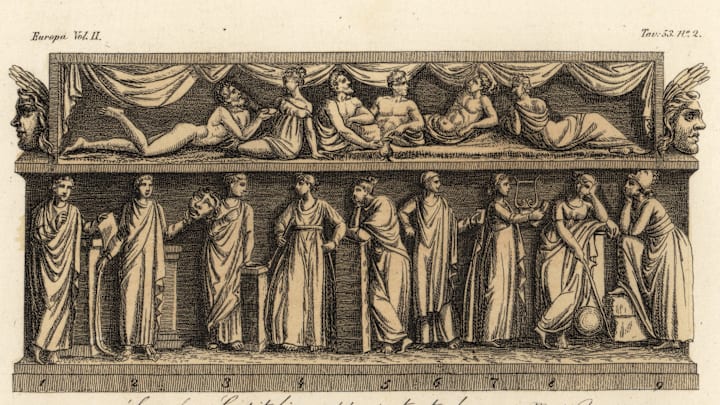
Much of what we know about the Muses refers to them all as a group, so it's important to start there. In most writings, the nine Muses are the children of Zeus and Mnemosyne, the Goddess of Memory. Per Pseudo-Apollodorus, the Muses (from eldest to youngest) include Calliope, Clio, Melpomene, Euterpe, Erato, Terpsichore, Urania, Thalia, and Polyhymnia.
The nine lived and worked together, often appearing at significant events to sing as a choir. Per a fragment from Simonides, the Muses "are always dancing, and the goddesses love to busy themselves with songs and strings." Instrumentally, the Muses are most strongly connected with the lyre and the flute.
In addition to being performers, the Muses were commonly depicted as teachers. They were considered the patrons of Athenian education and were invoked when discussing prophecy, medicine, philosophy, and mathematics. As the daughters of Memory, they could inspire truth in their acolytes, which allowed Greeks to learn their history and make new discoveries.
While the Muses are side-characters in the Greek mythological cycle, that doesn't make them irrelevant. They were frequently shown as companions for Apollo, the God of Music, and Dionysus, the God of Theatre. In addition, they were major figures in a series of music contests.
When Marsyas challenged Apollo, the Muses served as the judges. However, they were also competitors against the Sirens, whom they punished by stealing their feathers; Thamyris, whom they punished by stealing his voice, musical talent, and memory; and the daughters of Pieros, whom they transformed into birds. Like in so many tales, it was a very bad idea to challenge a god in their own domain.

Calliope
Calliope is the oldest and "the Chiefest" of the Muses (Hesiod, Theogony 1), which meant that she was invoked more frequently than most of her sisters. Her domain is epic poetry, though she was also credited with inspiring eloquence in political speech. In some versions of the conflict between the Muses and the daughters of Pieros, Calliope served as their champion, winning the competition by singing an epic tale about the abduction of Persephone.
In addition to leading the Muses, Calliope is prominently known as the mother of Orpheus, whose songs granted him entrance to the Underworld. When he died, Zeus allowed Calliope to honor his memory by putting his lyre into the sky via a constellation, suggesting that she was a favored child of his.

Clio
Clio is the muse of history, a position which was strongly associated with her mother's domain of memory. She was believed to know and remember all things, and thus was called on to help mortals learn about their past and to enshrine recent events in history. Due to this second role, Clio was believed to have power over legacy. Those she favored would be remembered by history, while those she didn't were forgotten.

Melpomene
While Melpomene's name is associated with melodies, her official domain was tragedy, which led to one of the darkest depictions amongst the Muses. She was often included in funeral scenes, where she would perform mournful songs about heroes and poets who died. Melpomene's official iconography included both the tragic theatrical mask and a sword or dagger, which contributed to the idea that she might inspire violence or even murder.
While she is less well known by modern mythology lovers, her daughters, the Sirens, are prominent figures. They used the beautiful voices they inherited from their mother to lure sailors and heroes to their deaths. It's unclear how Melpomene responded to being challenged by the Sirens in a musical contest, but it seems likely that their violent deeds gave her ample material for her songs and poetry.

Euterpe
Euterpe is officially known as the muse of lyrical poetry, though her domain is less distinct than some of her sisters. She was typically associated with flutes and other wind instruments, and her name roughly meant "bringer of delight." Because of this, we can assume that she was primarily invoked when seeking inspiration for positive poems and songs, despite her limited presence in historical records, making it difficult to be certain.

Erato
As her name suggests, Erato has a prominent connection with desire and its god, Eros. In addition to being the muse of erotic poetry, Erato was credited with the ability to charm the eyes. But while Eros could force desire on undeserving mortals, Diodorus Siculus claimed that Erato "makes those who are instructed by her men who are desired and worthy to be loved." Thus, she prompted men to do better, rather than giving them the affection of women without effort on their part.
This fits with her stories, as Erato seems to have been in a committed relationship with Malos, despite it being an arranged marriage. She is not depicted as having multiple lovers, like most other desire-based deities, and her lineage is fairly consistent, as it has been traced down to her great-grandson Asklepios, the God of Medicine.

Terpsichore
Terpsichore, in both name and domain, is a lover of dance who inspires dancers and revels in the works of great musicians. This aligned her with the Charities, goddesses of dance who lived near the Muses. While she is occasionally mentioned as a possible mother of heroes, there are fewer surviving references to her than to her sisters, since her domain has limited written materials.

Urania
Urania has perhaps the most interesting story behind her name because she is the muse of astronomy. While this is easy to remember in the modern day, the planet Uranus was not discovered until 1781, so it could not have influenced the Greeks when choosing her name. Instead, she was named after her grandfather Uranus, the god of the sky. This is important because the Greeks had a far broader understanding of astronomy than we do today.
While Urania was known for her knowledge of celestial bodies, which might be honored by scholars, she was also heavily associated with prophecy and philosophy. She was believed to be able to tell the future from the position of the stars, which created a stronger connection between herself and Apollo. Philosophers also invoked her name because they believed she could inspire thought that surpassed the "grounded" perspectives of those stuck on Earth.

Thalia
Thalia is often depicted as the opposite of her sister Melpomene, as the muse of comedy and pastoral poetry. Where Melpomene was associated with death, Thalia was associated with life and growth. This worked in both a literal sense, where she was connected with nature and plant life, and in the more figurative sense that the people she sang about would thrive. Thanks to this connection, she was often depicted with both a theatrical comedy mask and a shepherd's staff.

Polyhymnia
As could be guessed by her name, Polyhymnia is the muse of hymns and sacred poetry, though she might more accurately be described as the muse of praise. While the sacred element of her domain led to her being known as the goddess of meditation, she was also capable of bringing mortals into the sacred realm. Like her sister Clio, if Polyhymnia sang a praise of someone, it would guarantee their legacy would be remembered.