%20%20--%3E%0A%3Csvg%20version%3D%221.1%22%20id%3D%22Layer_1%22%20xmlns%3D%22http%3A%2F%2Fwww.w3.org%2F2000%2Fsvg%22%20xmlns%3Axlink%3D%22http%3A%2F%2Fwww.w3.org%2F1999%2Fxlink%22%20x%3D%220px%22%20y%3D%220px%22%0A%09%20viewBox%3D%220%200%20684.6%2068.1%22%20style%3D%22enable-background%3Anew%200%200%20684.6%2068.1%3B%22%20xml%3Aspace%3D%22preserve%22%3E%0A%3Cg%3E%0A%09%3Cpath%20d%3D%22M444.1%2C29.3h-17.4v14.5h17.4V29.3z%20M36.4%2C68.1l29.3-50.8V0H50.4L32.9%2C36.8L15.5%2C0H0v68.1h16.7V45.8l12.4%2C22.3H36.4z%0A%09%09%20M49.1%2C68.1h16.6V23.4L49.1%2C52.1V68.1z%20M76.6%2C68.1h45V53.8H93.3V41.6h21V27.1h-21V14.8h28.3V0.1h-45V68.1z%20M175.6%2C68.1h17.3v-68%0A%09%09h-16.5v40.3L150%2C0.1h-17.6v68h16.7V27.7L175.6%2C68.1z%20M235.8%2C14.8h15.4V0.1h-47.4v14.7H219v53.2h16.8V14.8z%20M290.3%2C45.9h-17.1%0A%09%09l7.5-15.6h2L290.3%2C45.9z%20M298.7%2C68.1h18l-32.2-68h-5.7l-32%2C68h18l3.3-7.1h27.1L298.7%2C68.1z%20M325.2%2C68.1h46.2V53.8h-29.6V0.1h-16.7%0A%09%09V68.1z%20M423.7%2C14.8h27.2V0.1H407v68h16.7V14.8z%20M462%2C68.1h46.2V53.8h-29.6V0.1H462V68.1z%20M564.8%2C34.1c0%2C10.7-7.2%2C19.2-18.5%2C19.2%0A%09%09c-11.4%2C0-18.5-8.5-18.5-19.2s7.1-19.2%2C18.5-19.2C557.6%2C14.9%2C564.8%2C23.4%2C564.8%2C34.1%20M580.6%2C34.1c0-19-14.2-34-34.3-34%0A%09%09c-20.2%2C0-34.3%2C15-34.3%2C34c0%2C19%2C14.1%2C34%2C34.3%2C34C566.4%2C68.1%2C580.6%2C53.1%2C580.6%2C34.1%20M604.8%2C20.5c0-4.1%2C3.3-6.2%2C6.7-6.2%0A%09%09c4.4%2C0%2C6.6%2C3%2C6.6%2C6.6h14.7C631.8%2C9.1%2C625.1%2C0.1%2C611%2C0.1c-12%2C0-21.7%2C9.3-21.7%2C20.6c0%2C10.9%2C5.9%2C15.9%2C16.7%2C19.8%0A%09%09c5.2%2C1.8%2C11.5%2C3.2%2C11.5%2C8c0%2C3.3-2.4%2C5.5-6.4%2C5.5c-3.6%2C0-6.6-3-6.6-6.7h-15.2c0%2C11.5%2C7.9%2C20.8%2C21.8%2C20.8c12%2C0%2C21.6-9.3%2C21.6-20.6%0A%09%09c0-10-5.3-16.4-16.7-19.8C610.6%2C26.1%2C604.8%2C25.3%2C604.8%2C20.5%20M670%2C20.9h14.7C683.8%2C9.1%2C677.1%2C0.1%2C663%2C0.1c-12%2C0-21.7%2C9.3-21.7%2C20.6%0A%09%09c0%2C10.9%2C5.9%2C15.9%2C16.7%2C19.8c5.2%2C1.8%2C11.5%2C3.2%2C11.5%2C8c0%2C3.3-2.4%2C5.5-6.4%2C5.5c-3.6%2C0-6.6-3-6.6-6.7h-15.2c0%2C11.5%2C7.9%2C20.8%2C21.8%2C20.8%0A%09%09c12%2C0%2C21.6-9.3%2C21.6-20.6c0-10-5.3-16.4-16.7-19.8c-5.4-1.6-11.3-2.4-11.3-7.2c0-4.1%2C3.3-6.2%2C6.7-6.2C667.7%2C14.4%2C670%2C17.3%2C670%2C20.9%0A%09%09%22%2F%3E%0A%3C%2Fg%3E%0A%3C%2Fsvg%3E%0A)

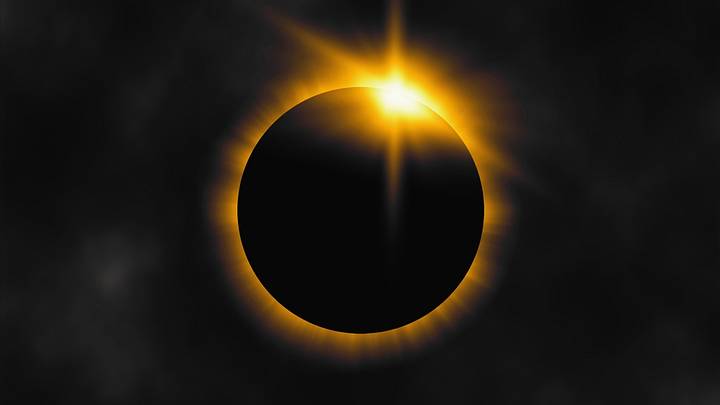
Solar eclipses occur when the moon blocks the sun from the Earth’s perspective in a celestial alignment that occurs two to five times per year. During a total solar eclipse, the sky goes completely dark, an experience that has understandably awed, thrilled, and terrified people for millennia.
It’s a surreal and striking thing to see the sky go black in the middle of the day—one of those natural wonders that lays bare the mathematical order underlying the universe, and that is easy to ascribe great significance to. And indeed, people have been assigning various spiritual meanings to eclipses for a very long time.
In many traditions, they are omens. In more modern spiritual paradigms, these celestial events are often associated with illumination, new beginnings, the bringing of inner truths into light, and embracing both darkness and light sides of life.
Eclipses in Folklore and Mythology: Eating the Sun

Cultures from all over the world have different stories and legends that explain what causes solar eclipses. A large number of traditional stories say that these phenomena are the result of a creature or deity eating the sun.
Vietnamese legend holds that solar eclipses are created when a frog swallows the sun. In Andean cosmology, solar eclipses occur when a puma devours the sun, and the puma must be scared away by children’s screams and animal sounds in order to prevent it from darkening the sun forever.
Choctaw legend says solar eclipses are the result of black squirrels eating the sun, whereas in Chinese folklore, the offending party is a massive dragon. Apapocúva-Guaraní people, meanwhile, blamed the sun’s disappearance on a hungry bat.
In Javanese mythology, the being making a meal of the sun is the god of darkness, Batara Kala, who must be appeased by drumming and sacrificial offerings. In Norse cosmology, the eater of the sun is a celestial wolf named Sköll who is said to constantly be chasing the sun goddess, Sol, alongside the wolf Hati, who is always chasing the moon god, Mani. A solar eclipse indicated that the wolves had nearly caught their prey. It was believed that when they finally did so, the end of the world, or Ragnarök, would occur.
Omens and Portents

In many ancient cultures, eclipses were seen as omens of violence, destruction, and ill fortune. For the ancient Greeks, eclipses were signs that the gods were displeased with humans and that the sun was considering abdicating from its role as the illuminator of the Earth. The ancient Greek word for eclipse actually translates to “abandonment.”
Similarly, in Transylvanian folklore, eclipses were signs that the sun had turned away from Earth in disappointment at its inhabitants’ actions. For the Inca, eclipses were indicative of the sun god Inti’s anger.
Meanwhile, some Christians associate solar eclipses with the second coming of Christ and the arrival of Judgment Day. In Hindu traditions, the solar eclipse is sometimes also considered an omen, and extra fasting, prayer, and cleansing practices are encouraged. Jewish tradition also sees solar eclipses as an omen. Islamic traditions, meanwhile, view these astrological moments as signs of divine power, and advise extra prayer and trust when they occur.
Some cultures have viewed eclipses as signs of the sun’s weakness or clumsiness rather than anger. To the Aymara of the Peruvian Andes, eclipses indicate that the sun is sick, and people traditionally light fires to make up for its lack of light. In a story from the Nuxalk people of the Pacific Northwest, eclipses result when a clumsy sun loses hold of his torch for a moment.
The Chippewa people would sometimes shoot flaming arrows at the sun in an effort to rekindle its power. One ancient Persian legend, meanwhile, holds that eclipses resulted from pranks by fairy-like spirits called peri who would sometimes block out the sun for entertainment.
Some cultures, like the Maya, were successfully able to predict the dates of both solar and lunar eclipses, carefully recording their every detail in a collection of astronomical writings called the Dresden Codex. These works also explained the Maya belief that eclipses were manifestations of the sun god Kinich Ahau’s anger, and, of course, also noted their belief that they resulted from ants trying to devour the sun.
Relationship and Renewal

Some cultures saw solar eclipses as signs of tension between various celestial bodies. For the Batammaliba of northern Togo, eclipses resulted from fighting between the sun and moon, and people would often try to resolve their own conflicts in order to persuade these luminous orbs in the sky to do the same.
In other stories, the solar eclipse results from love. The West African Benin people have a story that the sun and the moon are lovers who turn off the light when they unite. Tahitian mythology, meanwhile, says that the eclipse results when the sun and moon are joined in union and forget, for a moment, about their duties to light up the skies.
Navajo cosmology associates eclipses with renewal, viewing them as evidence of inherent cosmic design and order. People were encouraged to sit in reflection at this time, but were advised not to look at the sun. Diné tradition sees the sun as a father figure, and views the sun’s disappearance as a time to reflect, rest, and connect with the sacred.
Some practitioners of Vedic astrology also suggest resting and reflecting during eclipses and allowing the energy to settle before making any major decisions, while staying open to the inner transformations this event might catalyze.
The Modern Spiritual Meaning of Solar Eclipses

Today, some eclipse-related fears still persist among people around the world, and many people still consider eclipses to be excellent times to stay home.
Modern New Age spirituality has drawn from many of these diverse traditions, while putting a new spin on eclipses for contemporary times. We may now have scientific explanations as to why and how the sun, moon, and Earth perfectly align on occasion, but still, many people divine spiritual significance from this cosmic event.
According to tarot card reader Maggie Gonzales, eclipses are portals that can be used to usher in new chapters of life while also bringing hidden insights to the fore. “Because we're all very capable of getting stuck in our shadows from time to time, eclipses…[have] the ability to illuminate our unconscious mind, helping us become aware of the truths within ourselves that are almost hidden from our conscious mind,” she told Vermont Public.
Ultimately, she said, eclipses can open our eyes to things we did not previously see. “Life gets to be so much cooler than we think. And a lot of time, we're just really narrowed in and just stuck in the details and missing that bigger picture,” she continued. “And when we can get out of our own ways, much as the energy shifts, like an eclipse, it's like, ‘Wow, I didn't even realize I was just so stuck in this loop, and I had the blinders on, and now I see the full picture.’”
For Reiki Institute of Vermont founder Annette Gingras, solar eclipses are ideal times to look inward. “It's this balancing of the dualities of shadow and light, you know, and one literally eclipsing the other so that you have an opportunity to really look at what's going on internally, and then bring what is happening internally into the light,” she said.
In modern schools of spiritual thought, eclipses can serve as reminders of how shifts in perspective and new worldviews can change everything. They can also be reminders that although darkness and shadows may come, this is part of life, and we can alchemize them into fuel for transformation by embracing them.
Today, solar eclipses are often linked to new beginnings, transformation, balance, and seeing things clearly. These celestial events can be times to break old patterns, embrace uncomfortable realizations, and begin connecting with who, what, and where we’re meant to be. All this can set us on a path towards a life where we are most aligned with our inner truth.
This intense inner work can also require a lot of energy, making eclipses a great time to rest and reflect, just like many ancient religions advise.