%20%20--%3E%0A%3Csvg%20version%3D%221.1%22%20id%3D%22Layer_1%22%20xmlns%3D%22http%3A%2F%2Fwww.w3.org%2F2000%2Fsvg%22%20xmlns%3Axlink%3D%22http%3A%2F%2Fwww.w3.org%2F1999%2Fxlink%22%20x%3D%220px%22%20y%3D%220px%22%0A%09%20viewBox%3D%220%200%20684.6%2068.1%22%20style%3D%22enable-background%3Anew%200%200%20684.6%2068.1%3B%22%20xml%3Aspace%3D%22preserve%22%3E%0A%3Cg%3E%0A%09%3Cpath%20d%3D%22M444.1%2C29.3h-17.4v14.5h17.4V29.3z%20M36.4%2C68.1l29.3-50.8V0H50.4L32.9%2C36.8L15.5%2C0H0v68.1h16.7V45.8l12.4%2C22.3H36.4z%0A%09%09%20M49.1%2C68.1h16.6V23.4L49.1%2C52.1V68.1z%20M76.6%2C68.1h45V53.8H93.3V41.6h21V27.1h-21V14.8h28.3V0.1h-45V68.1z%20M175.6%2C68.1h17.3v-68%0A%09%09h-16.5v40.3L150%2C0.1h-17.6v68h16.7V27.7L175.6%2C68.1z%20M235.8%2C14.8h15.4V0.1h-47.4v14.7H219v53.2h16.8V14.8z%20M290.3%2C45.9h-17.1%0A%09%09l7.5-15.6h2L290.3%2C45.9z%20M298.7%2C68.1h18l-32.2-68h-5.7l-32%2C68h18l3.3-7.1h27.1L298.7%2C68.1z%20M325.2%2C68.1h46.2V53.8h-29.6V0.1h-16.7%0A%09%09V68.1z%20M423.7%2C14.8h27.2V0.1H407v68h16.7V14.8z%20M462%2C68.1h46.2V53.8h-29.6V0.1H462V68.1z%20M564.8%2C34.1c0%2C10.7-7.2%2C19.2-18.5%2C19.2%0A%09%09c-11.4%2C0-18.5-8.5-18.5-19.2s7.1-19.2%2C18.5-19.2C557.6%2C14.9%2C564.8%2C23.4%2C564.8%2C34.1%20M580.6%2C34.1c0-19-14.2-34-34.3-34%0A%09%09c-20.2%2C0-34.3%2C15-34.3%2C34c0%2C19%2C14.1%2C34%2C34.3%2C34C566.4%2C68.1%2C580.6%2C53.1%2C580.6%2C34.1%20M604.8%2C20.5c0-4.1%2C3.3-6.2%2C6.7-6.2%0A%09%09c4.4%2C0%2C6.6%2C3%2C6.6%2C6.6h14.7C631.8%2C9.1%2C625.1%2C0.1%2C611%2C0.1c-12%2C0-21.7%2C9.3-21.7%2C20.6c0%2C10.9%2C5.9%2C15.9%2C16.7%2C19.8%0A%09%09c5.2%2C1.8%2C11.5%2C3.2%2C11.5%2C8c0%2C3.3-2.4%2C5.5-6.4%2C5.5c-3.6%2C0-6.6-3-6.6-6.7h-15.2c0%2C11.5%2C7.9%2C20.8%2C21.8%2C20.8c12%2C0%2C21.6-9.3%2C21.6-20.6%0A%09%09c0-10-5.3-16.4-16.7-19.8C610.6%2C26.1%2C604.8%2C25.3%2C604.8%2C20.5%20M670%2C20.9h14.7C683.8%2C9.1%2C677.1%2C0.1%2C663%2C0.1c-12%2C0-21.7%2C9.3-21.7%2C20.6%0A%09%09c0%2C10.9%2C5.9%2C15.9%2C16.7%2C19.8c5.2%2C1.8%2C11.5%2C3.2%2C11.5%2C8c0%2C3.3-2.4%2C5.5-6.4%2C5.5c-3.6%2C0-6.6-3-6.6-6.7h-15.2c0%2C11.5%2C7.9%2C20.8%2C21.8%2C20.8%0A%09%09c12%2C0%2C21.6-9.3%2C21.6-20.6c0-10-5.3-16.4-16.7-19.8c-5.4-1.6-11.3-2.4-11.3-7.2c0-4.1%2C3.3-6.2%2C6.7-6.2C667.7%2C14.4%2C670%2C17.3%2C670%2C20.9%0A%09%09%22%2F%3E%0A%3C%2Fg%3E%0A%3C%2Fsvg%3E%0A)

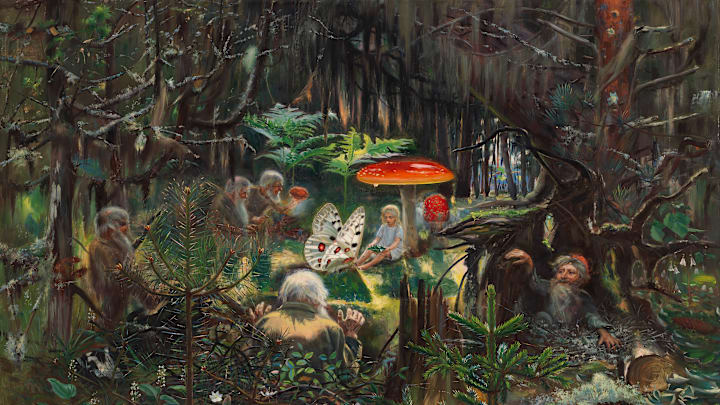
Fairies were not always viewed as the sparkly, winged beings that they are in many popular contemporary children’s stories. Across time and cultures, they have long been seen as capricious and powerful creatures that sometimes require extensive caution and reverence when it comes to engaging with them and appeasing them.
Fairy-like beings appear in various forms across time and traditions, from the Arabic djinn to the gandharva, celestial musicians that appear across Indian traditions and are seen as messengers between mortals and divine realms. The actual term fairy itself first appeared in the Middle Ages, when fairies were often believed to steal children or play tricks on humans, often with extreme consequences.
While there are countless different kinds of fairies and fairy stories, these creatures are often viewed as bridges between the realm of humans and a more divine or ethereal realm. They are also often linked to nature and music. And across the board, they are believed to require some knowledge and care when it comes to maintaining harmonious relations with them.
Ahead, learn about fairy-related superstitions rooted in Celtic and European folklore…which might come in handy in case you ever find yourself wandering the dark woods and feeling strangely summoned by the haunting sound of a violin humming in the distance.
- Don’t disrupt fairy forts.
- Don’t step into a fairy ring.
- Protective charms like St. John’s Wort and four-leaf clovers can help.
- Don’t follow the will-o'-the-wisp.
- Don’t chop down fairy trees.
- Give offerings to the fairies, and be kind and generous.
- Don’t give clothes to brownies.
- Don’t go into Fairyland, and if you do, don’t eat anything.
- Treat the natural world well.
Don’t disrupt fairy forts.

“Fairy forts” are circular stone formations scattered across the Irish landscape. According to Irish folklore, these were created by fairies, and woe—sometimes seven years of it—would befall anyone who dared disturb one. Archaeological evidence has proven that these structures were created by humans, not the fair folk, but still, Irish history overflows with tales of misfortune that has befallen people who dared disturb one of these.
Don’t step into a fairy ring.

If you’ve ever stumbled upon a circle of mushrooms growing in the woods, then you'll probably understand why these striking phenomena have generated countless myths and legends. However, there is a logical explanation for their existence. Research has revealed that circles of mushrooms appear because a fungus’s mycelium has been sending nutrients outward in a circular shape, leading the center of the circle to die off and resulting in a living ring.
Still, these formations have long been the subject of speculation and fear. In German and French, they have been called “witches’ rings” and “witches’ circles,” and in English, Celtic, and Scandinavian folklore, these rings are often said to be the result of late-night fairy dances. Entering these rings was sometimes believed to allow humans to see the fairies, but this could also result in the human being spirited away into fairyland, which could have severe and sometimes dangerous consequences. Many stories strongly advise against going anywhere near fairy rings, and some go as far as to say that even collecting droplets of dew from a fairy ring could lead to bad luck.
Protective charms like St. John’s Wort and four-leaf clovers can help.

Various folkloric traditions have blamed fairies for everything from famine and blights to strong winds, which is why many of these traditions also offer different ways to protect against fairies. In some European and North American stories, bread and salt could deter fairies, while other stories say that fairies will accept these as offerings, which could appease them and inspire them not to create disruption in the human realm.
Other stories hold that fairies dislike iron, and sometimes parents would place iron shears next to their children’s beds to prevent them from being swept off to fairyland. Many people would also hang horseshoes on their doors for this reason, though this practice dates back to ancient times and its origins may not exactly be connected to fairies.
Additionally, herbs like St. John’s wort were sometimes believed to repel fairies in European folk magic, and four-leaf clovers—another ancient symbol of luck—were thought to help people see through fairy disguises, or glamours.
Don’t follow the will-o'-the-wisp.

Will-o’-the-wisps are faint, glowing blue lights that, per scientific research, are created when decaying plants in marshlands and other dense, damp areas release gases. Still, it’s not hard to see why these tantalizingly luminous orbs have long been associated with fairies or other spectral activity—and why late-night wanderers have always been heavily discouraged from walking towards them.
Don’t chop down fairy trees.

In Irish folklore, hawthorn trees were seen as portals to the Otherworld. Cutting one down was said to bring terrible luck, though having one of these trees on one’s land could also bring great fortune.
Give offerings to the fairies, and be kind and generous.

Fairies are often said to appreciate offerings and gifts ranging from cream and butter to blackberries, herbs, and even jewelry or crystals. Additionally, they are often said to appreciate big-heartedness and selflessness—at least across various stories and legends, which of course, more often than not, contain moral lessons within their fanciful trimmings.
In many fairy stories and folktales, from the Brothers Grimm’s Frau Holle to over 900 variants documented by folklorist Warren Everett Roberts in the 1950s, a character who is kind and generous is rewarded by some kind of magical creature or fairy, while her unkind counterpart is cursed and condemned.
Don’t give clothes to brownies.

According to certain tales, brownies—said to be fairies that look after houses and household items—should not be given clothing, otherwise they might abandon your house.
Tales of similar household spirits exist around the world, from the Russian domovoi to the Japanese zashiki-warashi, and each culture has its own superstitions surrounding exactly how these house spirits should be treated. Ultimately, though, it seems like it’s always a good idea to treat them with respect, but to avoid treating them too much like employees or charity cases, otherwise they might be offended and could flee, leaving you with stove problems or an animal infestation—or at least, something to conveniently blame for one.
Don’t go into Fairyland, and if you do, don’t eat anything.

While giving fairies gifts may earn their favor, many Celtic stories strongly discourage accepting gifts from fairies—particularly food. Fairy food, or anything eaten in the realm of faerie, is often believed to be imbued with magical qualities that can warp time, so a few hours spent in the Otherworld can be decades in the human world. Fairy food is also sometimes said to erase memories, and fairy gifts are also often said to come with hidden contracts that bind the receiver to the land of the fae.
Treat the natural world well.

Fairies are often associated with various natural elements, from common stories of river and water spirits to tales of gnomes said to live in the rocks and mountains. In many stories, they are protectors of the earth and are inextricably intertwined with nature’s power. The natural world has always been a threshold between the realm of humans and the realm of the divine, and for many people and cultures across time, nature has symbolized an entryway to the Otherworld and the land of the fey.
Therefore, disrupting or destroying natural elements has long been said to be a surefire way to provoke the ire of fairies. On the other hand, connecting with the earth and tuning into nature’s cycles and power is often said to bring humans closer to the realm of the fae.