%20%20--%3E%0A%3Csvg%20version%3D%221.1%22%20id%3D%22Layer_1%22%20xmlns%3D%22http%3A%2F%2Fwww.w3.org%2F2000%2Fsvg%22%20xmlns%3Axlink%3D%22http%3A%2F%2Fwww.w3.org%2F1999%2Fxlink%22%20x%3D%220px%22%20y%3D%220px%22%0A%09%20viewBox%3D%220%200%20684.6%2068.1%22%20style%3D%22enable-background%3Anew%200%200%20684.6%2068.1%3B%22%20xml%3Aspace%3D%22preserve%22%3E%0A%3Cg%3E%0A%09%3Cpath%20d%3D%22M444.1%2C29.3h-17.4v14.5h17.4V29.3z%20M36.4%2C68.1l29.3-50.8V0H50.4L32.9%2C36.8L15.5%2C0H0v68.1h16.7V45.8l12.4%2C22.3H36.4z%0A%09%09%20M49.1%2C68.1h16.6V23.4L49.1%2C52.1V68.1z%20M76.6%2C68.1h45V53.8H93.3V41.6h21V27.1h-21V14.8h28.3V0.1h-45V68.1z%20M175.6%2C68.1h17.3v-68%0A%09%09h-16.5v40.3L150%2C0.1h-17.6v68h16.7V27.7L175.6%2C68.1z%20M235.8%2C14.8h15.4V0.1h-47.4v14.7H219v53.2h16.8V14.8z%20M290.3%2C45.9h-17.1%0A%09%09l7.5-15.6h2L290.3%2C45.9z%20M298.7%2C68.1h18l-32.2-68h-5.7l-32%2C68h18l3.3-7.1h27.1L298.7%2C68.1z%20M325.2%2C68.1h46.2V53.8h-29.6V0.1h-16.7%0A%09%09V68.1z%20M423.7%2C14.8h27.2V0.1H407v68h16.7V14.8z%20M462%2C68.1h46.2V53.8h-29.6V0.1H462V68.1z%20M564.8%2C34.1c0%2C10.7-7.2%2C19.2-18.5%2C19.2%0A%09%09c-11.4%2C0-18.5-8.5-18.5-19.2s7.1-19.2%2C18.5-19.2C557.6%2C14.9%2C564.8%2C23.4%2C564.8%2C34.1%20M580.6%2C34.1c0-19-14.2-34-34.3-34%0A%09%09c-20.2%2C0-34.3%2C15-34.3%2C34c0%2C19%2C14.1%2C34%2C34.3%2C34C566.4%2C68.1%2C580.6%2C53.1%2C580.6%2C34.1%20M604.8%2C20.5c0-4.1%2C3.3-6.2%2C6.7-6.2%0A%09%09c4.4%2C0%2C6.6%2C3%2C6.6%2C6.6h14.7C631.8%2C9.1%2C625.1%2C0.1%2C611%2C0.1c-12%2C0-21.7%2C9.3-21.7%2C20.6c0%2C10.9%2C5.9%2C15.9%2C16.7%2C19.8%0A%09%09c5.2%2C1.8%2C11.5%2C3.2%2C11.5%2C8c0%2C3.3-2.4%2C5.5-6.4%2C5.5c-3.6%2C0-6.6-3-6.6-6.7h-15.2c0%2C11.5%2C7.9%2C20.8%2C21.8%2C20.8c12%2C0%2C21.6-9.3%2C21.6-20.6%0A%09%09c0-10-5.3-16.4-16.7-19.8C610.6%2C26.1%2C604.8%2C25.3%2C604.8%2C20.5%20M670%2C20.9h14.7C683.8%2C9.1%2C677.1%2C0.1%2C663%2C0.1c-12%2C0-21.7%2C9.3-21.7%2C20.6%0A%09%09c0%2C10.9%2C5.9%2C15.9%2C16.7%2C19.8c5.2%2C1.8%2C11.5%2C3.2%2C11.5%2C8c0%2C3.3-2.4%2C5.5-6.4%2C5.5c-3.6%2C0-6.6-3-6.6-6.7h-15.2c0%2C11.5%2C7.9%2C20.8%2C21.8%2C20.8%0A%09%09c12%2C0%2C21.6-9.3%2C21.6-20.6c0-10-5.3-16.4-16.7-19.8c-5.4-1.6-11.3-2.4-11.3-7.2c0-4.1%2C3.3-6.2%2C6.7-6.2C667.7%2C14.4%2C670%2C17.3%2C670%2C20.9%0A%09%09%22%2F%3E%0A%3C%2Fg%3E%0A%3C%2Fsvg%3E%0A)

The past was full of misery. Workers were stuck doing things that no one realized would kill them all, and when people did realize it, few of them really cared.
But let’s turn away from the most obviously wretched jobs at the worker-smashing factory and shift our thoughts to more whimsical occupations, the kind you’d more enjoy picturing in an idealized view of the past. Perhaps these workplaces were a rare exception and would make for a fun setting in that period romance novel you’re writing?
Perhaps not. Many offered their own deadly and utterly unique dangers.
Flower Maker
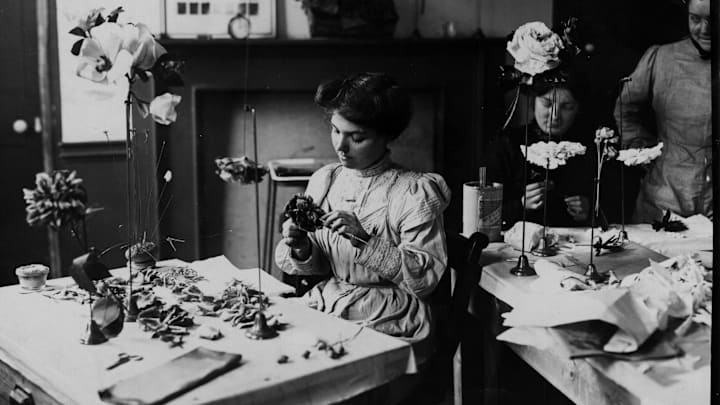
Victorian England had a large industry devoted to making artificial flowers. The process involved sewing fabric together for 12 or 18 hours a day, and perhaps you won’t be surprised that these factories operated like sweatshops. But the process also offered a special threat in the form of the dye used to color the artificial leaves green.
This dye was named Scheele’s Green, after its creator Carl Wilhelm Scheele. He stumbled on the process for creating it by accident, as happens with so many pigments, and it involved mixing sodium carbonate, arsenious oxide, and copper sulfate. The resulting dye contained arsenic. Many people who touched the final products, such as people whose homes used green wallpaper, became poisoned, while the most severe poisoning hit the women who used Scheele’s Green daily to color artificial leaves.
One account tells of a flower maker killed in 1861 with arsenic in her liver and lungs. The whites of her eyes had turned green, and she said everything looked green to her. It was a terrible way to dye.
Soda Jerk

You probably know soda jerks from movies or shows set in the 1950s, where a smiling employee would operate a soda fountain, serving customers ice cream sodas or glasses of Coke. The job of operating soda fountains went back a bit further than that, however. Go back to the 1870s, for example, and soda fountains were still around, and every establishment with one had a team of workers in the basement manufacturing the soda.
Manufacturing soda meant mixing sulfuric acid with calcium carbonate in a chamber lined with lead. The calcium carbonate came in the form of powdered marble, perhaps trucked in as construction waste. The mixed chemicals produced carbon dioxide, and a worker would then have to manually shake a tank for half an hour to blend the gas with water. The real problem here, though, came not from the labor involved but from the tendency of high-pressure gas to explode out of its container.
A pressure gauge could help with this, but soda fountains did not have pressure gauges. Sometimes workers used a system called Ben's Thumb, named after former slave Ben Austen, who originated it. A man would place his thumb at an opening in the pipe, and if the gas pushed the thumb off, that suggested the pressure was just right. To clarify: Employing a human pressure gauge wasn’t the dangerous job. This was the safer and more responsible alternative to how the job normally operated.
Baker
Making cakes sounds like a dream job, and there was a time recently when every character in rom-coms sought to open their own cupcake store. If we go back to Victorian days, however, a baker’s workday started every day at 11 p.m. They’d work all night kneading dough, perhaps with their feet. A baker in the 1870s rarely lived past the age of 42.
Besides the long hours in windowless cellars and the pain of carrying 300-pound flour sacks, the big threat to bakers was the powder they inhaled. You know how inhaling coal dust is bad for the lungs? It’s not bad because the dust is black or dirty, but simply because it’s dust, and flour dust had a similar effect. Most bakers suffered from lung disease, along with skin diseases and bleeding throats.
They also inhaled other types of dust, including coal dust, since coal fueled the ovens. They also inhaled chalk dust, since one way of increasing profits was to adulterate the dough by replacing 10 percent of the flour with chalk.
Matchmaker

Matchmaking — meaning the manufacture of matchsticks, not arranging marriages — was actually not such a bad job, for quite a while. Though it involved handling chemicals in a factory, it was light work compared with what other laborers did, so it was mostly carried out by women.
Then came 1830 and the invention of a new match that used white phosphorous. You might know white phosphorus for its use in banned chemical weapons. Though exposure to phosphorus vapor in a factory is not the same as being bombarded with white phosphorus munitions, it did lead to severe health effects in factory workers. The result was necrosis of the jaw bones, a condition dubbed “phossy jaw.”
One medical account from 1857 describes how a doctor treated the decaying jaw of a 16-year-old matchgirl named Cornelia. First, he sawed away half her jaw without anesthesia. The saw broke. He removed the remaining half with forceps, and then, when the other half became infected, he removed that as well. For pain relief afterward, he prescribed a lead and opium wash and also four ounces of wine daily.
White phosphorous matches were eventually phased out, thanks in part to laws enacted in response to the matchmakers' strike.
Glassmaker
Having read this far, and knowing you’re about to read about glassmakers, you’re probably already imagining the many dangers that came with handling a material that could slice your skin open. However, we’re going to talk about making glass in 13th-century Venice, a job that was, for the most part, quite pleasant. Venice held glassmakers in high esteem, granting them a status above that of other artisans and allowing them to marry into noble families.
Making glass was not especially dangerous. People did say that the glassworks posed a risk of catching fire, but the real risk was to the buildings, not to their occupants, who could easily flee into the canals. To prevent fires from spreading, glassworks were confined to one island, Murano.
However, that was just the official reason the glassworks were all in that one spot. The real reason was to confine the workers, to keep them from divulging the secrets of how Venetian glass was made. Right up until the 18th century, if a glassmaker was caught telling these secrets to a foreigner, or even leaving Murano without permission, the penalty was death.
We just mentioned that canals made escape easy in the event of a fire. But if a glassmaker fled the island when they weren’t supposed to, the city dispatched an assassin to hunt him down. The assassin would find him, kill him, and dump his body into a canal. People would say, “He was eaten by a salamander,” and never speak of him again.