%20%20--%3E%0A%3Csvg%20version%3D%221.1%22%20id%3D%22Layer_1%22%20xmlns%3D%22http%3A%2F%2Fwww.w3.org%2F2000%2Fsvg%22%20xmlns%3Axlink%3D%22http%3A%2F%2Fwww.w3.org%2F1999%2Fxlink%22%20x%3D%220px%22%20y%3D%220px%22%0A%09%20viewBox%3D%220%200%20684.6%2068.1%22%20style%3D%22enable-background%3Anew%200%200%20684.6%2068.1%3B%22%20xml%3Aspace%3D%22preserve%22%3E%0A%3Cg%3E%0A%09%3Cpath%20d%3D%22M444.1%2C29.3h-17.4v14.5h17.4V29.3z%20M36.4%2C68.1l29.3-50.8V0H50.4L32.9%2C36.8L15.5%2C0H0v68.1h16.7V45.8l12.4%2C22.3H36.4z%0A%09%09%20M49.1%2C68.1h16.6V23.4L49.1%2C52.1V68.1z%20M76.6%2C68.1h45V53.8H93.3V41.6h21V27.1h-21V14.8h28.3V0.1h-45V68.1z%20M175.6%2C68.1h17.3v-68%0A%09%09h-16.5v40.3L150%2C0.1h-17.6v68h16.7V27.7L175.6%2C68.1z%20M235.8%2C14.8h15.4V0.1h-47.4v14.7H219v53.2h16.8V14.8z%20M290.3%2C45.9h-17.1%0A%09%09l7.5-15.6h2L290.3%2C45.9z%20M298.7%2C68.1h18l-32.2-68h-5.7l-32%2C68h18l3.3-7.1h27.1L298.7%2C68.1z%20M325.2%2C68.1h46.2V53.8h-29.6V0.1h-16.7%0A%09%09V68.1z%20M423.7%2C14.8h27.2V0.1H407v68h16.7V14.8z%20M462%2C68.1h46.2V53.8h-29.6V0.1H462V68.1z%20M564.8%2C34.1c0%2C10.7-7.2%2C19.2-18.5%2C19.2%0A%09%09c-11.4%2C0-18.5-8.5-18.5-19.2s7.1-19.2%2C18.5-19.2C557.6%2C14.9%2C564.8%2C23.4%2C564.8%2C34.1%20M580.6%2C34.1c0-19-14.2-34-34.3-34%0A%09%09c-20.2%2C0-34.3%2C15-34.3%2C34c0%2C19%2C14.1%2C34%2C34.3%2C34C566.4%2C68.1%2C580.6%2C53.1%2C580.6%2C34.1%20M604.8%2C20.5c0-4.1%2C3.3-6.2%2C6.7-6.2%0A%09%09c4.4%2C0%2C6.6%2C3%2C6.6%2C6.6h14.7C631.8%2C9.1%2C625.1%2C0.1%2C611%2C0.1c-12%2C0-21.7%2C9.3-21.7%2C20.6c0%2C10.9%2C5.9%2C15.9%2C16.7%2C19.8%0A%09%09c5.2%2C1.8%2C11.5%2C3.2%2C11.5%2C8c0%2C3.3-2.4%2C5.5-6.4%2C5.5c-3.6%2C0-6.6-3-6.6-6.7h-15.2c0%2C11.5%2C7.9%2C20.8%2C21.8%2C20.8c12%2C0%2C21.6-9.3%2C21.6-20.6%0A%09%09c0-10-5.3-16.4-16.7-19.8C610.6%2C26.1%2C604.8%2C25.3%2C604.8%2C20.5%20M670%2C20.9h14.7C683.8%2C9.1%2C677.1%2C0.1%2C663%2C0.1c-12%2C0-21.7%2C9.3-21.7%2C20.6%0A%09%09c0%2C10.9%2C5.9%2C15.9%2C16.7%2C19.8c5.2%2C1.8%2C11.5%2C3.2%2C11.5%2C8c0%2C3.3-2.4%2C5.5-6.4%2C5.5c-3.6%2C0-6.6-3-6.6-6.7h-15.2c0%2C11.5%2C7.9%2C20.8%2C21.8%2C20.8%0A%09%09c12%2C0%2C21.6-9.3%2C21.6-20.6c0-10-5.3-16.4-16.7-19.8c-5.4-1.6-11.3-2.4-11.3-7.2c0-4.1%2C3.3-6.2%2C6.7-6.2C667.7%2C14.4%2C670%2C17.3%2C670%2C20.9%0A%09%09%22%2F%3E%0A%3C%2Fg%3E%0A%3C%2Fsvg%3E%0A)

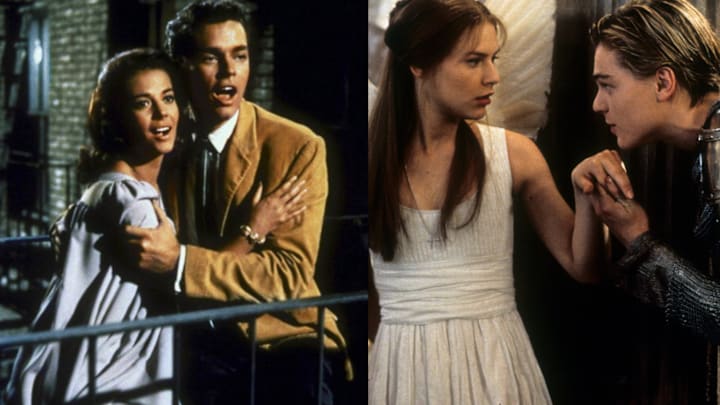
Shakespeare’s Romeo and Juliet is perhaps his most adapted play (with some cinema scholars going so far as to call it the most-filmed play of all time). As a result, dozens of adaptations and re-imaginings of all shapes and sizes have made their way to the big screen over the last century or so, with the very first dating back to 1908.
Precisely what constitutes the best of these is understandably debatable—but so too is precisely what counts as an adaptation of Romeo and Juliet at all. Should straightforward productions be considered alongside movies that merely build on the play’s star-crossed-lovers setup, or do the likes of Gnomeo and Juliet deserve their own list? Well, in this instance, we’re keeping things general. Any movie that counts as an adaptation of Romeo and Juliet is fair game here, as are straightforward adaptations of the Shakespeare text. As for metrics, we’re taking everything into consideration: the critics, the awards, the box office numbers, and audience ratings from the likes of IMDB, Letterboxd, and Rotten Tomatoes. Numbers crunched, then, here’s how all the major big-screen Romeo and Juliet films match up.
- Tromeo & Juliet (1996)
- Romeo & Juliet (2013)
- Beneath the 12-Mile Reef (1953)
- Gnomeo and Juliet (2011)
- Valley Girl (1983)
- Warm Bodies (2013)
- Romeo and Juliet (1936)
- West Side Story (2021)
- Romeo + Juliet (1996)
- Romeo and Juliet (1968)
- West Side Story (1961)
Tromeo & Juliet (1996)
Countless filmmakers have used only the bones of Shakespeare’s Romeo and Juliet as the basis for their films over the years, often adding surprising and unconventional elements that take their versions in new and intriguing directions (as this list will no doubt show). This crass 1996 adaptation by infamous US independent Troma Entertainment, though, perhaps takes things a few too many steps too far. It might have been co-adapted for the big screen by future Guardians of the Galaxy director James Gunn (no, really), but Tromeo and Juliet is so chock-full of gratuitous and unpleasant additions that even the eventual reveal that the title characters are engaged in an incestuous relationships, having been brother and sister all along, barely scratches the surface of how mindboggling this film is, and how far from the source material it strays. Troma fans loved it, of course, but other critics understandably weren’t quite so convinced.
Romeo & Juliet (2013)
One of the more recent attempts at a straightforward big-screen Romeo and Juliet, Carlo Carlei’s 2013 adaptation had a considerable pedigree behind it, with Oscar-nominee Hailee Steinfeld as Juliet (opposite Douglas Booth as Romeo), Oscar-winner Julian Fellowes adapting the script (hot off the heels of creating Downton Abbey), and a weighty supporting cast including Damian Lewis, Leslie Manville, Paul Giamatti and Stellan Skarsgård. Unfortunately, barely any of it worked—with the action and dialogue diluted to “Shakespeare lite,” and only the most seasoned theatrical pros among the cast managing to work magic with a scattershot and “dumbed down” script.
Beneath the 12-Mile Reef (1953)
Rival families in Verona are replaced by river sponge-fishermen in this bizarre yet beautiful 1953 interpretation of Shakespeare’s classic romance, starring Robert Wagner and Terry Moore. Partly conceived of as a vehicle for the new widescreen technology of CinemaScope (this was only the third CinemaScope movie in history), director Robert D Webb made full use of the cameras at his disposal during the film’s extraordinary underwater scenes, but alas, the action above the waves here isn’t quite as arresting or convincing. Nevertheless, Beneath the 12-Mile Reef was a box-office success and earned an Oscar nomination for its remarkable underwater cinematography.
Gnomeo and Juliet (2011)
Perhaps showing more than any other film on this list just how flexible Shakespeare can be, this 2011 animation swapped Verona for the bottom of a garden in rural England (Shakespeare’s birthplace, Stratford, no less), and swapped the warring families for two neighbors who despise one another, Miss Montague and Mr. Capulet (voiced by British acting royalty, Dame Julie Walters and Richard Wilson). The pair of star-crossed lovers, meanwhile, are lawn ornament gnomes in the neighbors’ two gardens, voiced by James McAvoy and Emily Blunt—while the supporting cast around them includes everyone from Shakespearean heavy-hitters Dame Maggie Smith and Sir Patrick Stewart, to Jason Statham, Hulk Hogan, Dolly Parton, and Ozzy Osbourne (who voices an ornamental deer, naturally).
The fact that this setup works at all is remarkable, but the fact that Gnomeo and Juliet grossed ten times its budget, earned a smattering of positive reviews and a Golden Globe nomination, and comes out the other end as a perfectly charming and fun family-friendly tale is downright miraculous.
Valley Girl (1983)
Martha Coolidge’s 1983 romcom Valley Girl swapped Verona for California, and Romeo and Juliet for inner-city punk Randy (played by Nicolas Cage) and 80s Valley Girl Julie (played by scream queen Deborah Foreman)—all set against a hit best-selling soundtrack by a slew of 80s New Wave legends. A hit with critics and audiences alike, Valley Girl grossed five times its budget and remains something of an overlooked gem among all big-screen Shakespearean re-imaginings. A less well-received remake followed in 2020.
Warm Bodies (2013)
An adaptation of Isaac Marion’s 2010 novel of the same name, 2013’s Warm Bodies stars Nicholas Hoult as “R,” and Teresa Palmer as “Julie.” The mismatched pair understandably fall for one another, with just one catch—“R” is a zombie. That particular detail in this ingenious reimagining of the classic tale proved a step too far for some critics, but others raved about it, and Warm Bodies has become something of a cult classic among teens, movie fans, and Shakespearean cinema completists alike.
Romeo and Juliet (1936)
The first major Shakespearean adaptation of Romeo and Juliet in cinema history, George Cukor’s 1936 version mostly stayed true to the original text, resulting in an accomplished, if somewhat heavy-handed and stagy, production. Costing a staggering $2 million (a record for an MGM sound picture at the time), the film’s cast included a number of Hollywood names and theatrical heavyweights, among them Leslie Howard as Romeo and Norma Shearer as Juliet, plus John Barrymore, Basil Rathbone, and future Westerns legend Andy Devine. Despite the cast’s obvious talent and big-screen experience, one of the film’s biggest criticisms was its casting: both were supposedly playing lovestruck teenagers, yet Shearer was 34, and Howard was 43.
West Side Story (2021)
Remakes and re-imaginings have been big business in the 21st century, but Robert Wise’s 1961 adaptation of the Romeo and Juliet-inspired musical West Side Story was so firmly established as the definitive version that even the great Steven Spielberg couldn’t escape the “but why though?” accusations when his remake was first mooted in 2018. The film failed to shake off those accusations when it at long last arrived in theaters three years later, but with the aftereffects of the pandemic still being felt, Spielberg’s longtime passion project faltered at the box office and ended up losing millions.
For the most part, though, critics and cinema audiences alike loved it, with Spielberg’s trademark ingenious camerawork bringing an energy to the music that simply wasn’t possible with the heavyweight cameras of the 1960s. The film went on to be nominated for seven Oscars, with Ariana DeBose winning Best Supporting Actress for her performance as Anita.
Romeo + Juliet (1996)
Baz Luhrmann’s frenetic music-video-esque Romeo + Juliet somewhat divided the critics back in 1996, but audiences loved it, and it has since stood the test of time to emerge as one of the most courageous, intriguing, and downright exhilarating big-screen adaptations of any of his plays. Using the original text, but relocating the action to a hyper-stylized present-day Verona Beach, the film stars a pre-Titanic Leonardo DiCaprio and a post-My So Called Life Claire Danes, both of whom bring the same star quality that would see them go on to become two of the most lauded actors of the 21st century to their title roles.
Not to be missed alongside them, though, are a heady and varied supporting cast of legendary British heavyweights (Pete Postlethwaite, Miriam Margolyes) and classic American character actors and comics (Paul Rudd, John Leguizamo, Jamie Kennedy, Paul Sorvino). The movie picked up just one Oscar nod but fared better at the BAFTAs, where Luhrmann beat off stiff competition from James Cameron (Titanic) and Curtis Hanson (LA Confidential) to win Best Director. The film’s big-name pop soundtrack became an international bestseller too, while the movie itself went a long way towards making Shakespeare cool again for countless 90s kids.
Romeo and Juliet (1968)
It’s a close-run thing between all the straightforward movie adaptations of Shakespeare’s text, but Franco Zeferelli’s 1968 version—“the most exciting film of Shakespeare ever made,” according to the legendary Roger Ebert—just edges out the rest. The film rightly won praise at the time for its cinematography and costumes (both of which picked up Oscars), while Zeffirelli’s determination to cast actors as close as possible to Romeo and Juliet’s age in the play (Leonard Whiting and Olivia Hussey) was likewise lauded by audiences and critics alike. (Lucky for us, Zeffirelli reneged on his rumored original plan to cast either Paul McCartney or Phil Collins as the romantic lead.)
One of the biggest films of the year (it grossed over forty times its relatively meagre $850,000 budget), incredibly, the 1968 adaptation of Romeo and Juliet was the last straightforward Shakespeare adaptation to pick up a Best Picture nod—and the last Shakespearean movie of any kind to do so until Spielberg’s West Side Story in 2021.
West Side Story (1961)
It might be a bitter bill to swallow for literary scholars and thespians alike, but it’s hard to argue that cinema’s greatest ever Romeo and Juliet isn’t actually Shakespeare’s Romeo and Juliet at all. Leonard Bernstein and Stephen Sondheim first collaborated on their stage production of West Side Story way back in 1957, with the original Broadway and West End productions taking the theatre world by storm, and picking up a clutch of awards (including two Tonys). It wasn’t long before word of a big-screen adaptation began to emerge, with Robert Wise—at that time coming off a string of successes with the likes of Somebody Up There Likes Me (1956) and Run Silent, Run Deep (1958)—promptly signed on to direct.
The result was a movie that broke box-office records, became the highest-grossing movie musical of all time (until Wise broke his own record with The Sound of Music four years later), and picked up 10 Oscars from 11 nominations. Widely touted as not only one of the greatest musicals and greatest Shakespearean adaptations of all time, West Side Story is today heralded as one of the greatest movies of all time—and until someone comes up with a straightforward Romeo and Juliet to rival its place at the top of this list, even the great Bard himself will have to make do with second place.