%20%20--%3E%0A%3Csvg%20version%3D%221.1%22%20id%3D%22Layer_1%22%20xmlns%3D%22http%3A%2F%2Fwww.w3.org%2F2000%2Fsvg%22%20xmlns%3Axlink%3D%22http%3A%2F%2Fwww.w3.org%2F1999%2Fxlink%22%20x%3D%220px%22%20y%3D%220px%22%0A%09%20viewBox%3D%220%200%20684.6%2068.1%22%20style%3D%22enable-background%3Anew%200%200%20684.6%2068.1%3B%22%20xml%3Aspace%3D%22preserve%22%3E%0A%3Cg%3E%0A%09%3Cpath%20d%3D%22M444.1%2C29.3h-17.4v14.5h17.4V29.3z%20M36.4%2C68.1l29.3-50.8V0H50.4L32.9%2C36.8L15.5%2C0H0v68.1h16.7V45.8l12.4%2C22.3H36.4z%0A%09%09%20M49.1%2C68.1h16.6V23.4L49.1%2C52.1V68.1z%20M76.6%2C68.1h45V53.8H93.3V41.6h21V27.1h-21V14.8h28.3V0.1h-45V68.1z%20M175.6%2C68.1h17.3v-68%0A%09%09h-16.5v40.3L150%2C0.1h-17.6v68h16.7V27.7L175.6%2C68.1z%20M235.8%2C14.8h15.4V0.1h-47.4v14.7H219v53.2h16.8V14.8z%20M290.3%2C45.9h-17.1%0A%09%09l7.5-15.6h2L290.3%2C45.9z%20M298.7%2C68.1h18l-32.2-68h-5.7l-32%2C68h18l3.3-7.1h27.1L298.7%2C68.1z%20M325.2%2C68.1h46.2V53.8h-29.6V0.1h-16.7%0A%09%09V68.1z%20M423.7%2C14.8h27.2V0.1H407v68h16.7V14.8z%20M462%2C68.1h46.2V53.8h-29.6V0.1H462V68.1z%20M564.8%2C34.1c0%2C10.7-7.2%2C19.2-18.5%2C19.2%0A%09%09c-11.4%2C0-18.5-8.5-18.5-19.2s7.1-19.2%2C18.5-19.2C557.6%2C14.9%2C564.8%2C23.4%2C564.8%2C34.1%20M580.6%2C34.1c0-19-14.2-34-34.3-34%0A%09%09c-20.2%2C0-34.3%2C15-34.3%2C34c0%2C19%2C14.1%2C34%2C34.3%2C34C566.4%2C68.1%2C580.6%2C53.1%2C580.6%2C34.1%20M604.8%2C20.5c0-4.1%2C3.3-6.2%2C6.7-6.2%0A%09%09c4.4%2C0%2C6.6%2C3%2C6.6%2C6.6h14.7C631.8%2C9.1%2C625.1%2C0.1%2C611%2C0.1c-12%2C0-21.7%2C9.3-21.7%2C20.6c0%2C10.9%2C5.9%2C15.9%2C16.7%2C19.8%0A%09%09c5.2%2C1.8%2C11.5%2C3.2%2C11.5%2C8c0%2C3.3-2.4%2C5.5-6.4%2C5.5c-3.6%2C0-6.6-3-6.6-6.7h-15.2c0%2C11.5%2C7.9%2C20.8%2C21.8%2C20.8c12%2C0%2C21.6-9.3%2C21.6-20.6%0A%09%09c0-10-5.3-16.4-16.7-19.8C610.6%2C26.1%2C604.8%2C25.3%2C604.8%2C20.5%20M670%2C20.9h14.7C683.8%2C9.1%2C677.1%2C0.1%2C663%2C0.1c-12%2C0-21.7%2C9.3-21.7%2C20.6%0A%09%09c0%2C10.9%2C5.9%2C15.9%2C16.7%2C19.8c5.2%2C1.8%2C11.5%2C3.2%2C11.5%2C8c0%2C3.3-2.4%2C5.5-6.4%2C5.5c-3.6%2C0-6.6-3-6.6-6.7h-15.2c0%2C11.5%2C7.9%2C20.8%2C21.8%2C20.8%0A%09%09c12%2C0%2C21.6-9.3%2C21.6-20.6c0-10-5.3-16.4-16.7-19.8c-5.4-1.6-11.3-2.4-11.3-7.2c0-4.1%2C3.3-6.2%2C6.7-6.2C667.7%2C14.4%2C670%2C17.3%2C670%2C20.9%0A%09%09%22%2F%3E%0A%3C%2Fg%3E%0A%3C%2Fsvg%3E%0A)

On the surface, the Academy Awards can seem a permanent record, a yearly inscription of the films that mattered in any particular year.
But the award show is less of a final record and more of a snapshot of taste in a single moment in time. What the Academy recognizes often reflects who its members were at the time, which genres they took seriously, and which performances fit their prevailing idea of what “good acting” looked like. Anything that falls outside of those boundaries is often snubbed and left behind for film buffs and cinephiles alike to litigate and curse the sky over for the rest of their lives.
As the years go by, more and more snubs get added to the already massive list, serving as a reminder that sometimes the Oscars do a better job at capturing consensus than anticipating legacy. These performances are not obscure outliers that exist on the fringe of arthouse cinema that people rarely ever see or talk about; these are performances that are central to some of the most memorable films ever made, and it is time (not trophies) that often clarifies significance.
Some snubs are so baked into the fabric of our cultural consciousness that they fall outside the realm of this list. Charlie Chaplin’s Little Tramp is considered a monumental achievement and foundational in the history of film acting. Still, it was a character that was refined over several decades and over 70 films, and that makes it hard to place alongside singular performances.
This list focuses more on singularity and performance only. Studio politics and controversies outside of their omission are not taken into consideration. These 10 performances were either overlooked or undervalued in their time by Academy members, but time and distance have since given them undeniable cultural significance.
10. Audrey Tautou: Amélie

When Amélie took the world by storm, its whimsical charm and visual tone took center stage, but it is Audrey Tautou’s performance as the playful and curious Amélie that makes this beautiful French comedy endure. It’s a controlled performance built on micro-expressions and physical restraint, which allows the interior life of the character to emerge without overt exposition. You could watch it without subtitles or any understanding of French, and still be captivated by the film because of her work in it.
Despite the film’s popularity and nomination for Best Foreign Language Film, Tautou’s work wasn’t nominated for Best Actress, a recurring blind spot that the Academy has for international performances
9. Amy Adams: Arrival

Amy Adams’s subtle performance as a linguistics professor hired by the US Government to communicate with extraterrestrials was overlooked by the Academy despite the film securing eight nominations, including Best Picture.
Her performance was understated compared to performances that The Academy traditionally recognizes. She portrayed grief as something cumulative and internal, which allowed the character’s emotional arc to unfold gradually, and challenged the audience to piece together the meaning of the film through nuance and expression.
It is this quiet devastation of her performance and Denis Villeneuve’s direction that makes Arrival endure as a masterpiece of modern speculative fiction.
8. Adam Sandler: Uncut Gems

Adam Sandler’s role in the Safdie Brothers’ Uncut Gems is not only one of the most dramatic shifts of his career, but it is one of the most uncomfortable, claustrophobic performances in modern film.
Sandler delivers a relentless portrayal of a compulsive gambling addict that is not only anxiety-inducing but stunningly accurate in its depiction of self-destruction. Sandler’s ability to really get into the character even scared the Safdie Brothers with his intensity, and it was this commitment to the character throughout that contributed to the in-your-face realism Sandler delivers.
The result led to a genius performance that may have been too chaotic for Academy voters to embrace. Uncut Gems was not nominated for any Oscars, though Sandler did win the Independent Spirit Award for Best Male Lead, along with other accolades.
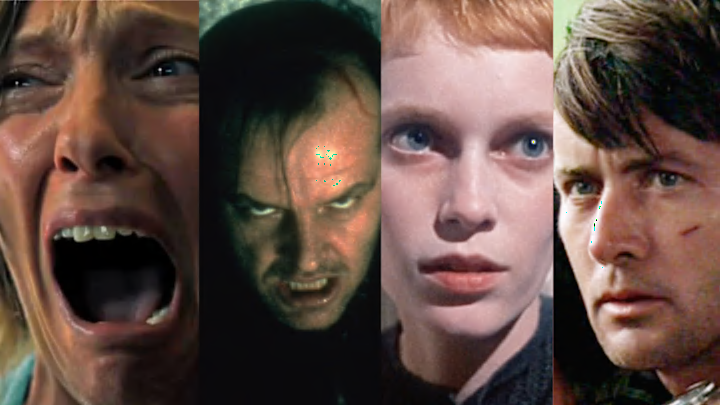
7. Mia Farrow: Rosemary’s Baby

Amy Adams may have learned a thing or two from Mia Farrow because this performance is also defined by its restraint. She didn’t play Rosemary’s terror openly; she allowed fear and isolation to accumulate gradually, which created a feeling of insidious dread that we walk away from Rosemary’s Baby feeling.
Director Roman Polanski showed subtlety and restraint by holding onto Farrow for long takes, forcing the performance to do most of the heavy lifting by carrying the emotional weight without ever really relieving it. Its influence on the horror genre is enormous, and is yet another example of how the Academy often misses, especially with horror.
6. Paul Giamatti: Sideways

In 2005, Sideways was the small-budget little engine that could film that began on the festival circuit and culminated in five Academy Award nominations, making the absence of its leading man all the more glaring.
Paul Giamatti’s take on Miles Raymond does a masterful job at depicting what middle-aged male loneliness looked like in the new millennium: prickly, insecure, and painfully self-aware. It was a character defined by not-so-quiet desperation rather than charm.
Not only does his performance resonate with film buffs today, but Giamatti’s delivery of one hilarious line, slamming merlot, still has ripple effects on the wine industry.
5. Robert Shaw: Jaws

Jaws is a masterpiece. The first true summer Hollywood blockbuster and staple of our pop culture still holds up 50 years after its release, and a big reason why is Robert Shaw’s portrayal of Quint, a New England fisherman with many demons from his past who is hired to pilot the vessel used to kill the shark terrorizing Amity Island.
His USS Indianapolis monologue serves as one of the great pieces of dialogue ever written for the screen. Shaw, who was also a novelist, helped write that speech himself. But his performance extends far beyond that moment. Quint is the physical manifestation of obsession and fatalism that gives a movie about a monster shark its depth.
None of the performances were nominated, but Shaw as Quint is the most egregious, reinforcing the idea that early blockbusters, while often are awarded for their technical achievements, are overlooked for the performances by their actors. Jaws won three Academy Awards: Best Sound, Best Film Editing, and Best Music, Original Dramatic Score.
4. James Stewart:Vertigo

Alfred Hitchcock deliberately cast James Stewart against type in this masterpiece about obsession and moral decay.
It was this choice to use his wholesome, familiar image to heighten the character’s collapse, and it’s an incredible example of an actor stepping outside of his comfort zone and absolutely knocking it out of the park. The Academy didn’t acknowledge the performance at the time, despite the movie receiving two nominations, but its elevation into canon is placed solely at the feet of Stewart’s performance and Hitchcock's choice to cast him.
3. Toni Collette: Hereditary

These are the types of performances that are the reason lists like these exist.
Toni Collette delivers arguably the most emotionally devastating performances of the 21st century in Ari Aster’s Hereditary. As usual, with the Academy’s typical omission of horror films, it missed the mark with one of our great actresses in their prime, pulling out all the stops and swinging like a heavyweight, grounding the film’s horror in agonizing human pain. Even though it’s been less than 10 years, it already feels indefensible.
Hereditary was snubbed by the Oscars altogether, though Collette was nominated for a Film Independent Spirit Award, among others.
2. Jack Nicholson: The Shining

Now, has Jack Nicholson been accused of overacting? Yes. Is he guilty of overacting? Also, yes. But movies wouldn’t be movies today without him.
It is hard to feel too bad for Nicholson, considering he is the most-nominated male actor of all time, but surely you would think one of those nominations would have included his take on Jack Torrance spiraling into madness in The Shining. You would be wrong.
The lack of recognition doesn’t fall solely on the Academy’s oversight. The film was widely panned in its time, but that just proves that sometimes the audience's memory of a piece of art can outlive the negativity surrounding it in the moment.
1. Martin Sheen: Apocalypse Now

Martin Sheen’s performance as Captain Willard is without question the most catastrophic snub in the near-century history of The Academy of Motion Pictures Arts and Sciences.
Sheen’s character is introduced mid-breakdown as a soldier whose humanity is so lost that he is incompatible with civilian life, leaving war as the only place that feels like home. The film’s psychological force flows directly from his disintegration and search for the vile Col. Kurtz. Sheen carried this performance through cold voiceover, physical exhaustion, and portrayal of moral ambiguity, taking us along for the ride in one of the truest depictions of the psychological toll the realities of violence can take on a person.
The Academy rightfully embraced Apocalypse Now in its time—with multiple nominations and two wins—and history remembers it as one of the greatest films ever made. Yet the failure to recognize Sheen’s harrowing, internalized portrayal of moral ruin remains a defining failure of the award show’s history.
You May Also Like:
Add Mental Floss as a preferred news source!