%20%20--%3E%0A%3Csvg%20version%3D%221.1%22%20id%3D%22Layer_1%22%20xmlns%3D%22http%3A%2F%2Fwww.w3.org%2F2000%2Fsvg%22%20xmlns%3Axlink%3D%22http%3A%2F%2Fwww.w3.org%2F1999%2Fxlink%22%20x%3D%220px%22%20y%3D%220px%22%0A%09%20viewBox%3D%220%200%20684.6%2068.1%22%20style%3D%22enable-background%3Anew%200%200%20684.6%2068.1%3B%22%20xml%3Aspace%3D%22preserve%22%3E%0A%3Cg%3E%0A%09%3Cpath%20d%3D%22M444.1%2C29.3h-17.4v14.5h17.4V29.3z%20M36.4%2C68.1l29.3-50.8V0H50.4L32.9%2C36.8L15.5%2C0H0v68.1h16.7V45.8l12.4%2C22.3H36.4z%0A%09%09%20M49.1%2C68.1h16.6V23.4L49.1%2C52.1V68.1z%20M76.6%2C68.1h45V53.8H93.3V41.6h21V27.1h-21V14.8h28.3V0.1h-45V68.1z%20M175.6%2C68.1h17.3v-68%0A%09%09h-16.5v40.3L150%2C0.1h-17.6v68h16.7V27.7L175.6%2C68.1z%20M235.8%2C14.8h15.4V0.1h-47.4v14.7H219v53.2h16.8V14.8z%20M290.3%2C45.9h-17.1%0A%09%09l7.5-15.6h2L290.3%2C45.9z%20M298.7%2C68.1h18l-32.2-68h-5.7l-32%2C68h18l3.3-7.1h27.1L298.7%2C68.1z%20M325.2%2C68.1h46.2V53.8h-29.6V0.1h-16.7%0A%09%09V68.1z%20M423.7%2C14.8h27.2V0.1H407v68h16.7V14.8z%20M462%2C68.1h46.2V53.8h-29.6V0.1H462V68.1z%20M564.8%2C34.1c0%2C10.7-7.2%2C19.2-18.5%2C19.2%0A%09%09c-11.4%2C0-18.5-8.5-18.5-19.2s7.1-19.2%2C18.5-19.2C557.6%2C14.9%2C564.8%2C23.4%2C564.8%2C34.1%20M580.6%2C34.1c0-19-14.2-34-34.3-34%0A%09%09c-20.2%2C0-34.3%2C15-34.3%2C34c0%2C19%2C14.1%2C34%2C34.3%2C34C566.4%2C68.1%2C580.6%2C53.1%2C580.6%2C34.1%20M604.8%2C20.5c0-4.1%2C3.3-6.2%2C6.7-6.2%0A%09%09c4.4%2C0%2C6.6%2C3%2C6.6%2C6.6h14.7C631.8%2C9.1%2C625.1%2C0.1%2C611%2C0.1c-12%2C0-21.7%2C9.3-21.7%2C20.6c0%2C10.9%2C5.9%2C15.9%2C16.7%2C19.8%0A%09%09c5.2%2C1.8%2C11.5%2C3.2%2C11.5%2C8c0%2C3.3-2.4%2C5.5-6.4%2C5.5c-3.6%2C0-6.6-3-6.6-6.7h-15.2c0%2C11.5%2C7.9%2C20.8%2C21.8%2C20.8c12%2C0%2C21.6-9.3%2C21.6-20.6%0A%09%09c0-10-5.3-16.4-16.7-19.8C610.6%2C26.1%2C604.8%2C25.3%2C604.8%2C20.5%20M670%2C20.9h14.7C683.8%2C9.1%2C677.1%2C0.1%2C663%2C0.1c-12%2C0-21.7%2C9.3-21.7%2C20.6%0A%09%09c0%2C10.9%2C5.9%2C15.9%2C16.7%2C19.8c5.2%2C1.8%2C11.5%2C3.2%2C11.5%2C8c0%2C3.3-2.4%2C5.5-6.4%2C5.5c-3.6%2C0-6.6-3-6.6-6.7h-15.2c0%2C11.5%2C7.9%2C20.8%2C21.8%2C20.8%0A%09%09c12%2C0%2C21.6-9.3%2C21.6-20.6c0-10-5.3-16.4-16.7-19.8c-5.4-1.6-11.3-2.4-11.3-7.2c0-4.1%2C3.3-6.2%2C6.7-6.2C667.7%2C14.4%2C670%2C17.3%2C670%2C20.9%0A%09%09%22%2F%3E%0A%3C%2Fg%3E%0A%3C%2Fsvg%3E%0A)

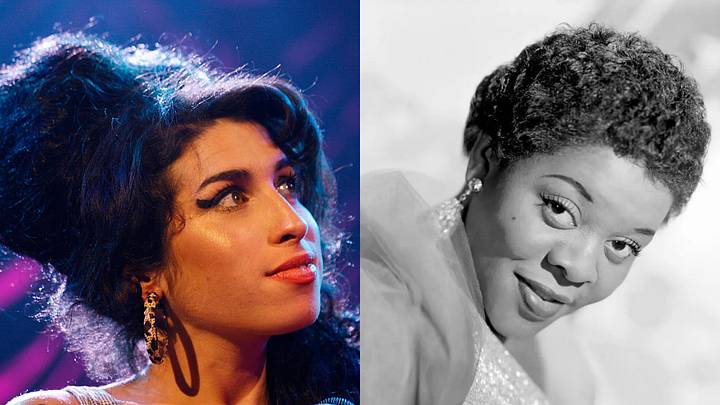
Considering her originality and inimitability as a performer, it should come as no surprise that Amy Winehouse was selective about the musical influences that shaped her short but hugely successful career. Of course, some of these influences were stronger than others.
The musicians who shaped Amy Winehouse
Born in Enfield, London, England in 1983, Winehouse was first introduced to music via her family, including her father, brother, and grandmother.
Her grandmother Cynthia had been an accomplished jazz singer in her own right, performing at Ronnie Scott’s Jazz Club in London and brushing shoulders with the likes of Ella Fitzgerald and Matt Monro, known as the “British Sinatra.”
Winehouse liked Fitzgerald up to a point, stating in an interview that—though she “knew how to carry a tune”—to her she was “just like a lot of other people. You can hear her and go: that’s Ella Fitzgerald, but it’s not like she stood out.”
She also liked Monro, as well as Frank Sinatra himself. In fact, her admiration for “The Voice” was so great that she named her 2003 debut album after his first name. According to Winehouse’s father, “Fly Me To the Moon” was her favorite song as a child, and as a singer she adopted his conversational delivery, rhythmic cadence, and raw emotion.
Speaking of raw emotion, Winehouse’s brother introduced her to alternative rock bands like Sonic Youth, Pearl Jam, and Therapy—“I-want-to-die” music, in her own words. She also listened to hip-hop—especially Salt-n-Pepa—and gospel, a genre she found extremely beautiful even though she herself was not religious.
Ultimately, however, no genre moved her quite like jazz did. She recalled entering her brother’s room while he was listening to Ray Charles, whose music she went on to play “exclusively” for the next three months. Later she discovered Sarah Vaughan‚ whose voice she described as “a reed instrument,” and Thelonious Monk, one of the fathers of modern jazz and bebop.
Dinah Washington’s influence on Amy Winehouse
With the possible exception of Monk, none had a bigger influence on Winehouse’s own music than Dinah Washington. In a 2006 interview with the BBC, Winehouse said that Washington, known in her time as the “Queen of Blues,” helped her find her voice:
“I learned to sing from Dinah Washington,” she said. “It wasn’t just the vocal jazz—I learned from everything, really.”
Washington was an American singer who was one of the biggest Black female artists of the 1950s. Known for her versatility and vocal control, she often performed at jazz festivals and also was called “Queen of the Blues.” Winehouse was such an admirer of the singer that she refused to cover any of her songs. "I don't do Dinah songs because she made them her own,” she once said.
Like Washington, Winehouse drew inspiration from many different sounds and sources, taking elements from jazz, soul, R&B, and more, and combining them into a performance that remains entirely her own, even all these years after her tragic death in 2011.