%20%20--%3E%0A%3Csvg%20version%3D%221.1%22%20id%3D%22Layer_1%22%20xmlns%3D%22http%3A%2F%2Fwww.w3.org%2F2000%2Fsvg%22%20xmlns%3Axlink%3D%22http%3A%2F%2Fwww.w3.org%2F1999%2Fxlink%22%20x%3D%220px%22%20y%3D%220px%22%0A%09%20viewBox%3D%220%200%20684.6%2068.1%22%20style%3D%22enable-background%3Anew%200%200%20684.6%2068.1%3B%22%20xml%3Aspace%3D%22preserve%22%3E%0A%3Cg%3E%0A%09%3Cpath%20d%3D%22M444.1%2C29.3h-17.4v14.5h17.4V29.3z%20M36.4%2C68.1l29.3-50.8V0H50.4L32.9%2C36.8L15.5%2C0H0v68.1h16.7V45.8l12.4%2C22.3H36.4z%0A%09%09%20M49.1%2C68.1h16.6V23.4L49.1%2C52.1V68.1z%20M76.6%2C68.1h45V53.8H93.3V41.6h21V27.1h-21V14.8h28.3V0.1h-45V68.1z%20M175.6%2C68.1h17.3v-68%0A%09%09h-16.5v40.3L150%2C0.1h-17.6v68h16.7V27.7L175.6%2C68.1z%20M235.8%2C14.8h15.4V0.1h-47.4v14.7H219v53.2h16.8V14.8z%20M290.3%2C45.9h-17.1%0A%09%09l7.5-15.6h2L290.3%2C45.9z%20M298.7%2C68.1h18l-32.2-68h-5.7l-32%2C68h18l3.3-7.1h27.1L298.7%2C68.1z%20M325.2%2C68.1h46.2V53.8h-29.6V0.1h-16.7%0A%09%09V68.1z%20M423.7%2C14.8h27.2V0.1H407v68h16.7V14.8z%20M462%2C68.1h46.2V53.8h-29.6V0.1H462V68.1z%20M564.8%2C34.1c0%2C10.7-7.2%2C19.2-18.5%2C19.2%0A%09%09c-11.4%2C0-18.5-8.5-18.5-19.2s7.1-19.2%2C18.5-19.2C557.6%2C14.9%2C564.8%2C23.4%2C564.8%2C34.1%20M580.6%2C34.1c0-19-14.2-34-34.3-34%0A%09%09c-20.2%2C0-34.3%2C15-34.3%2C34c0%2C19%2C14.1%2C34%2C34.3%2C34C566.4%2C68.1%2C580.6%2C53.1%2C580.6%2C34.1%20M604.8%2C20.5c0-4.1%2C3.3-6.2%2C6.7-6.2%0A%09%09c4.4%2C0%2C6.6%2C3%2C6.6%2C6.6h14.7C631.8%2C9.1%2C625.1%2C0.1%2C611%2C0.1c-12%2C0-21.7%2C9.3-21.7%2C20.6c0%2C10.9%2C5.9%2C15.9%2C16.7%2C19.8%0A%09%09c5.2%2C1.8%2C11.5%2C3.2%2C11.5%2C8c0%2C3.3-2.4%2C5.5-6.4%2C5.5c-3.6%2C0-6.6-3-6.6-6.7h-15.2c0%2C11.5%2C7.9%2C20.8%2C21.8%2C20.8c12%2C0%2C21.6-9.3%2C21.6-20.6%0A%09%09c0-10-5.3-16.4-16.7-19.8C610.6%2C26.1%2C604.8%2C25.3%2C604.8%2C20.5%20M670%2C20.9h14.7C683.8%2C9.1%2C677.1%2C0.1%2C663%2C0.1c-12%2C0-21.7%2C9.3-21.7%2C20.6%0A%09%09c0%2C10.9%2C5.9%2C15.9%2C16.7%2C19.8c5.2%2C1.8%2C11.5%2C3.2%2C11.5%2C8c0%2C3.3-2.4%2C5.5-6.4%2C5.5c-3.6%2C0-6.6-3-6.6-6.7h-15.2c0%2C11.5%2C7.9%2C20.8%2C21.8%2C20.8%0A%09%09c12%2C0%2C21.6-9.3%2C21.6-20.6c0-10-5.3-16.4-16.7-19.8c-5.4-1.6-11.3-2.4-11.3-7.2c0-4.1%2C3.3-6.2%2C6.7-6.2C667.7%2C14.4%2C670%2C17.3%2C670%2C20.9%0A%09%09%22%2F%3E%0A%3C%2Fg%3E%0A%3C%2Fsvg%3E%0A)

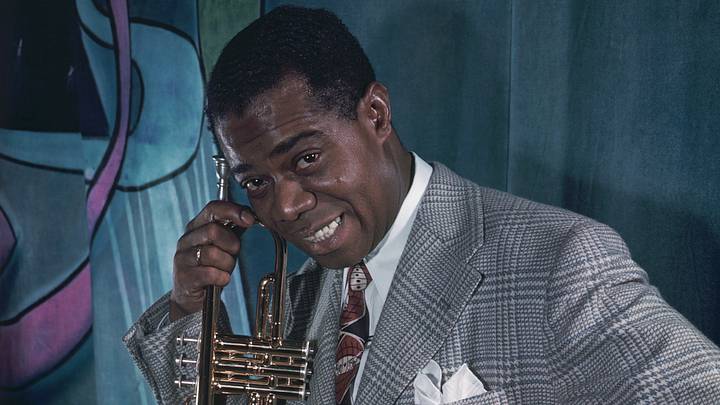
The great Louis Armstrong holds a unique place in the history of popular culture. As a cultural ambassador, he spread his infectious love of music across the globe. His innovations in the field of jazz opened up new opportunities for musical expression, and his instantly recognizable voice was a source of joy to many.
Following his passing, many thousands of photos have been preserved from Armstrong's own personal archive.
Louis and Lucille in Egypt at the Sphinx

Armstrong had always been a great ambassador for jazz and for goodwill, but, in November 1955, he received an offer to become a literal ambassador, when the US government announced its first ever officially sponsored jazz tour. Writing in the New York Times, journalist Felix Belair noted that: “America’s secret weapon is a blue note in a minor key . . .”
The trumpeter's trip to Egypt occurred six years later, at the end of another State Department tour of Africa, in January 1961. It was during a reception at the American Embassy in Cairo that Armstrong was introduced to Egyptian archaeologist Kamel el-Mallakh – the man who became an unofficial tour guide for Louis and his wife, Lucille. This stunning picture of Louis playing for Lucille in front of the Sphinx with a pyramid in the background remains as wondrous as ever.
Louis Armstrong and His Hot Five Publicity Photo

The band Armstrong titled "Louis Armstrong and His Hot Five" were responsible for some of the greatest and most influential jazz ever recorded. The group originated in 1925, when Armstrong returned to Chicago from New York, and began recording new material for the Okeh label. The Hot Five consisted of renowned clarinetist Johnny Dodds, pioneering banjo player Johnny St. Cyr, groundbreaking trombonist Kid Ory, and the exquisite piano of Lil Armstrong (Louis' then-wife). Together, they revolutionized jazz music, with greater importance placed on soloing, vocal 'scat' techniques, and scintillating arrangements.
Louis Armstrong wax figure at Madame Tussaud's

You know you're at the top tier of fame when Madame Tussauds makes a waxwork of you. This wonderful 2004 photograph shows one of Louis' models in all its glory. In 2019, the prestigious establishment announced a new venue in Nashville, Tennessee, the first of its branches to focus specifically on music. Three legendary jazz figures provided the highlight - Ella Fitzgerald, Billie Holiday and Louis Armstrong. That Armstrong sits comfortably alongside waxworks of Taylor Swift, Stevie Wonder, and Beyoncé is testament to his importance in the history of popular music.
Louis and the All Stars on CKWX

During the 1940s, the number of big bands dwindled dramatically. Changing musical tastes of the public meant that touring with large groups was no longer profitable. This, plus a resurgence of interest in the 1920s Dixieland style, gave Armstrong the chance to return to small group playing. His newly created All-Stars band became the go-to format that sustained the remainder of his career, touring with him the world over. Group personnel changed over the years, but the quality never dropped. Pictured here alongside Louis are All-Star members, trombonist, singer, and bandleader, Jack Teagarden, legendary pianist Earl Hines, and the great singer, Velma Middleton.
Hello, Dolly! - Black and white photograph of Louis

The spectacularly successful musical, Hello, Dolly! first opened in Detroit in 1963, and has over the years established itself as a much-beloved Broadway hit. Composer Jerry Herman wrote the music and lyrics, based on a novel by Michael Stewart, which was itself based on a 1938 book by Thornton Wilder. The 1969 film version of Hello, Dolly!, directed by Gene Kelly and starring Barbra Streisand and Walther Matthau, won three Academy Awards.
Back in the musical's opening year, Louis Armstrong's manager convinced him to make a recording of the show's title track as part of a promotional push for radio. When Hello, Dolly! hit Broadway in 1964, Armstrong's recording was released commercially and rocketed to number one on the Billboard Hot 100 chart (toppling no less than The Beatles from the summit).
Louis singing onstage

As skilled as he was on the trumpet, Armstrong was equally influential as a vocalist. Although his emergence as a lead singer didn't begin until relatively late in his career, during the 1930s, his deep, rich tones became recognisable the world over. New microphone technology developed during that decade helped capture Armstrong's unique gravelly voice and innate ability to convey emotion. He enjoyed numerous hits as a singer, and his recording of the song "Melancholy Blues" was even chosen to be included on the Golden Record, which accompanied the Voyager probe on its journey into deep space.