%20%20--%3E%0A%3Csvg%20version%3D%221.1%22%20id%3D%22Layer_1%22%20xmlns%3D%22http%3A%2F%2Fwww.w3.org%2F2000%2Fsvg%22%20xmlns%3Axlink%3D%22http%3A%2F%2Fwww.w3.org%2F1999%2Fxlink%22%20x%3D%220px%22%20y%3D%220px%22%0A%09%20viewBox%3D%220%200%20684.6%2068.1%22%20style%3D%22enable-background%3Anew%200%200%20684.6%2068.1%3B%22%20xml%3Aspace%3D%22preserve%22%3E%0A%3Cg%3E%0A%09%3Cpath%20d%3D%22M444.1%2C29.3h-17.4v14.5h17.4V29.3z%20M36.4%2C68.1l29.3-50.8V0H50.4L32.9%2C36.8L15.5%2C0H0v68.1h16.7V45.8l12.4%2C22.3H36.4z%0A%09%09%20M49.1%2C68.1h16.6V23.4L49.1%2C52.1V68.1z%20M76.6%2C68.1h45V53.8H93.3V41.6h21V27.1h-21V14.8h28.3V0.1h-45V68.1z%20M175.6%2C68.1h17.3v-68%0A%09%09h-16.5v40.3L150%2C0.1h-17.6v68h16.7V27.7L175.6%2C68.1z%20M235.8%2C14.8h15.4V0.1h-47.4v14.7H219v53.2h16.8V14.8z%20M290.3%2C45.9h-17.1%0A%09%09l7.5-15.6h2L290.3%2C45.9z%20M298.7%2C68.1h18l-32.2-68h-5.7l-32%2C68h18l3.3-7.1h27.1L298.7%2C68.1z%20M325.2%2C68.1h46.2V53.8h-29.6V0.1h-16.7%0A%09%09V68.1z%20M423.7%2C14.8h27.2V0.1H407v68h16.7V14.8z%20M462%2C68.1h46.2V53.8h-29.6V0.1H462V68.1z%20M564.8%2C34.1c0%2C10.7-7.2%2C19.2-18.5%2C19.2%0A%09%09c-11.4%2C0-18.5-8.5-18.5-19.2s7.1-19.2%2C18.5-19.2C557.6%2C14.9%2C564.8%2C23.4%2C564.8%2C34.1%20M580.6%2C34.1c0-19-14.2-34-34.3-34%0A%09%09c-20.2%2C0-34.3%2C15-34.3%2C34c0%2C19%2C14.1%2C34%2C34.3%2C34C566.4%2C68.1%2C580.6%2C53.1%2C580.6%2C34.1%20M604.8%2C20.5c0-4.1%2C3.3-6.2%2C6.7-6.2%0A%09%09c4.4%2C0%2C6.6%2C3%2C6.6%2C6.6h14.7C631.8%2C9.1%2C625.1%2C0.1%2C611%2C0.1c-12%2C0-21.7%2C9.3-21.7%2C20.6c0%2C10.9%2C5.9%2C15.9%2C16.7%2C19.8%0A%09%09c5.2%2C1.8%2C11.5%2C3.2%2C11.5%2C8c0%2C3.3-2.4%2C5.5-6.4%2C5.5c-3.6%2C0-6.6-3-6.6-6.7h-15.2c0%2C11.5%2C7.9%2C20.8%2C21.8%2C20.8c12%2C0%2C21.6-9.3%2C21.6-20.6%0A%09%09c0-10-5.3-16.4-16.7-19.8C610.6%2C26.1%2C604.8%2C25.3%2C604.8%2C20.5%20M670%2C20.9h14.7C683.8%2C9.1%2C677.1%2C0.1%2C663%2C0.1c-12%2C0-21.7%2C9.3-21.7%2C20.6%0A%09%09c0%2C10.9%2C5.9%2C15.9%2C16.7%2C19.8c5.2%2C1.8%2C11.5%2C3.2%2C11.5%2C8c0%2C3.3-2.4%2C5.5-6.4%2C5.5c-3.6%2C0-6.6-3-6.6-6.7h-15.2c0%2C11.5%2C7.9%2C20.8%2C21.8%2C20.8%0A%09%09c12%2C0%2C21.6-9.3%2C21.6-20.6c0-10-5.3-16.4-16.7-19.8c-5.4-1.6-11.3-2.4-11.3-7.2c0-4.1%2C3.3-6.2%2C6.7-6.2C667.7%2C14.4%2C670%2C17.3%2C670%2C20.9%0A%09%09%22%2F%3E%0A%3C%2Fg%3E%0A%3C%2Fsvg%3E%0A)

Sometimes, creative magic happens when you’re not taking yourself so seriously. That was the case for the writers of these songs, each of which began as a joke in one way or another—and wound up becoming a major hit. Here's the story of how these surprisingly successful anthems came to be.
- “I Am the Walrus” // The Beatles
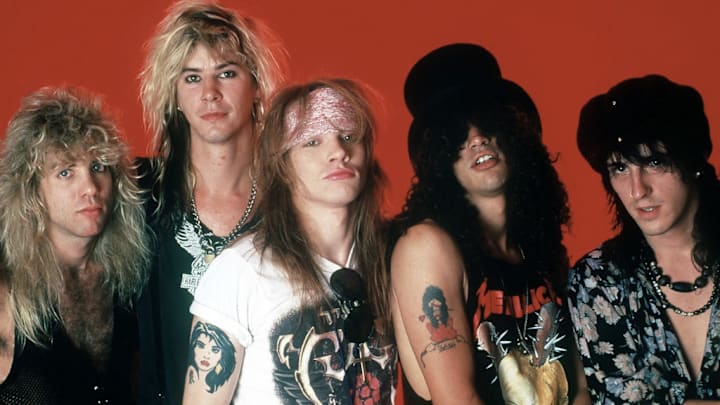
- “Sweet Child O’ Mine” // Guns N’ Roses
- “Heart of Glass” // Blondie
- “Song 2” // Blur
- “Karma Police” // Radiohead
- “Loser” // Beck
“I Am the Walrus” // The Beatles
The Beatles’ “I Am the Walrus” is well-known for its absurdist, highly abstract lyrics. Apparently, John Lennon actually wrote it with the intention of confusing Beatles scholars and fans, who the band knew would obsessively try to analyze whatever they wrote. The seed for the song was planted when Lennon received a letter from a student at his former secondary school who said his teacher was having them interpret Beatles music.
In a 1980 Playboy interview, Lennon discussed the song’s kaleidoscopic collage of influences. “The first line was written on one acid trip one weekend. The second line was written on the next acid trip the next weekend, and it was filled in after I met Yoko,” he said. “Part of it was putting down Hare Krishna. All these people were going on about Hare Krishna, Allen Ginsberg in particular. The reference to 'Element'ry penguin' is the elementary, naive attitude of going around chanting, 'Hare Krishna,' or putting all your faith in any one idol. I was writing obscurely, a la Dylan, in those days.”
He also explained that the image of the walrus came from the poem “The Walrus and the Carpenter” from the Lewis Carroll book Through the Looking Glass, which is the sequel to Alice in Wonderland. However, Lennon hadn’t realized the implications of selecting the image of the walrus for the song.
“It never dawned on me that Lewis Carroll was commenting on the capitalist and social system. I never went into that bit about what he really meant, like people are doing with the Beatles' work,” Lennon said. “Later, I went back and looked at it and realized that the walrus was the bad guy in the story and the carpenter was the good guy. I thought, Oh, s**t, I picked the wrong guy. I should have said, 'I am the carpenter.' But that wouldn't have been the same, would it?”
“Sweet Child O’ Mine” // Guns N’ Roses
The riff at the start of Guns N’ Roses’ “Sweet Child O’ Mine” is so iconic that it often triggers immediate excitement among listeners, no matter the crowd. However, when guitarist Slash originally composed it, he didn’t take it seriously, and even called it a “stupid little riff.”
“Initially it was just a cool, neat riff that I’d come up with,” Slash later said. “It was an interesting pattern, and it was really melodic, but I don’t think I would have presented it to the band and said, ‘Hey, I’ve got this idea!’ because I just happened to come up with it while we were all hanging around together.”
But when the rest of the band heard it, magic was made. “Next thing you know, it was turning into something,” Slash continued. “I really just thought of it as a joke, but lo and behold, Axl [Rose]...heard it.”
Rose always believed in the song’s potential, but bassist Duff McKagan wasn’t so sure. “It was like a joke,” he said. “We thought, 'What is this song? It’s gonna be nothing.'”
What emerged, though, was the band’s sole No. 1 single in the United States. For a long time, the song ground Slash’s gears. “I hated it for years,” he said. “But it would cause such a reaction—just playing the first stupid notes used to evoke this hysteria—so I've finally gotten to appreciate it.”
“Heart of Glass” // Blondie
In 1979, the band Blondie already had a cult following. Yet the song “Heart of Glass” launched the group into the stratosphere with its infectious beat.
As it turns out, the song came together when the band completely stopped trying to conform to external pressures and trends. “When we did ‘Heart of Glass,’ it wasn’t cool in our social set to play disco,” singer Debbie Harry said. “We did it because we wanted to be uncool.”
No one could have imagined what happened next. “We didn’t expect the original to get that big,” said guitarist Chris Stein. “We only did it as a novelty to put more diversity into the album.” Yet the song resonated with some listeners where the band’s previous grittier efforts hadn’t.
After its release, the band found themselves in a liminal space between disco-pop and rock and roll. “We did a disco TV show and we were total outcasts," Harry recalled. “Some other group tried to steal our guitars, they wouldn't give us a dressing room. So we might end up being total outcasts; from the rock 'n' roll crowd and the disco crowd. The rock crowd thinks we sold out and the disco crowd thinks we're punks.”
“Song 2” // Blur
Blur’s “Song 2” was originally created as a joke meant to ruffle the feathers of the band’s label representatives—a joke that completely backfired, as the song became a huge hit.
It began with a catchy melody, but the band then added an aggressive beat, cloaked the basslines with distortion, and turned up the gain on the guitars. The whole thing came together organically. “We didn’t think about it at all,” bassist Alex James told Q Magazine, per Far Out.
Guitarist Graham Coxon recalled the band’s decision to prank their label with what emerged. “Let’s tell the record label that we want to release it a single. Sort of scare them to death,” Coxon told Produce Like a Pro. “They’ll hate it. That’s what they did. They came in, and we played it to them giggling, and they were like, ‘wow this is excellent.’” Soon enough, a song that had originated as a parody of grunge became a massively successful contribution to the genre.
“Karma Police” // Radiohead
Radiohead’s 1997 album OK Computer is a highly prescient blend of paranoia about the future, political corruption, and social alienation. Yet one of its most famous songs started as an inside joke among band members.
“It was a band catchphrase for a while on tour—whenever someone was behaving in a particular s***ty way, we’d say, ‘The karma police will catch up with him sooner or later,’” guitarist Jonny Greenwood told Melody Maker. “You have to rely on something like that, even though we’re probably just kidding ourselves. But it’s not a revenge thing, just about being happy with your own behavior.”
Eventually, the band’s other guitarist Ed O’Brien suggested that they turn the phrase “karma police” into a song. Singer Thom Yorke ran with that seed of an idea, turning it into a chilling and melancholic lament about surveillance and consequences.
“Karma is important,” Yorke later told Humo of the song’s deeper meaning. “The idea that something like karma exists makes me happy. It makes me smile. ‘Karma Police’ is dedicated to everyone who works for a big firm. It’s a song against bosses.”
“Loser” // Beck
Beck’s mega-hit “Loser” originated both from a self-deprecating joke and some real-life struggles. At the time the song came out, Beck was couch surfing and working odd jobs. “I was living in a shed behind a house with a bunch of rats, next to an alley downtown,” he told Rolling Stone. “I had zero money and zero possibilities.”
But a single session with producer Carl Stephenson in Los Angeles changed everything. Stephenson recorded Beck playing a guitar slide and looped it over a beat, and Beck started rapping over it in the style of Chuck D. Stephenson was not impressed, and neither was Beck when he listened back.
The recording made Beck feel like “the worst rapper in the world” and basically “a loser,” he recalled. That feeling inspired the sarcastic line, “I’m a loser baby, so why don’t you kill me?”
The song came together in around six hours, and wound up becoming a massive success. Most of the vocals in it are first takes, Beck added, saying that if he’d known that it would become so famous, he might have “put something a little more substantial” into the recording. Still, fans of the song will probably agree that the song’s overall low-effort vibe is what makes it such a perfect track.