%20%20--%3E%0A%3Csvg%20version%3D%221.1%22%20id%3D%22Layer_1%22%20xmlns%3D%22http%3A%2F%2Fwww.w3.org%2F2000%2Fsvg%22%20xmlns%3Axlink%3D%22http%3A%2F%2Fwww.w3.org%2F1999%2Fxlink%22%20x%3D%220px%22%20y%3D%220px%22%0A%09%20viewBox%3D%220%200%20684.6%2068.1%22%20style%3D%22enable-background%3Anew%200%200%20684.6%2068.1%3B%22%20xml%3Aspace%3D%22preserve%22%3E%0A%3Cg%3E%0A%09%3Cpath%20d%3D%22M444.1%2C29.3h-17.4v14.5h17.4V29.3z%20M36.4%2C68.1l29.3-50.8V0H50.4L32.9%2C36.8L15.5%2C0H0v68.1h16.7V45.8l12.4%2C22.3H36.4z%0A%09%09%20M49.1%2C68.1h16.6V23.4L49.1%2C52.1V68.1z%20M76.6%2C68.1h45V53.8H93.3V41.6h21V27.1h-21V14.8h28.3V0.1h-45V68.1z%20M175.6%2C68.1h17.3v-68%0A%09%09h-16.5v40.3L150%2C0.1h-17.6v68h16.7V27.7L175.6%2C68.1z%20M235.8%2C14.8h15.4V0.1h-47.4v14.7H219v53.2h16.8V14.8z%20M290.3%2C45.9h-17.1%0A%09%09l7.5-15.6h2L290.3%2C45.9z%20M298.7%2C68.1h18l-32.2-68h-5.7l-32%2C68h18l3.3-7.1h27.1L298.7%2C68.1z%20M325.2%2C68.1h46.2V53.8h-29.6V0.1h-16.7%0A%09%09V68.1z%20M423.7%2C14.8h27.2V0.1H407v68h16.7V14.8z%20M462%2C68.1h46.2V53.8h-29.6V0.1H462V68.1z%20M564.8%2C34.1c0%2C10.7-7.2%2C19.2-18.5%2C19.2%0A%09%09c-11.4%2C0-18.5-8.5-18.5-19.2s7.1-19.2%2C18.5-19.2C557.6%2C14.9%2C564.8%2C23.4%2C564.8%2C34.1%20M580.6%2C34.1c0-19-14.2-34-34.3-34%0A%09%09c-20.2%2C0-34.3%2C15-34.3%2C34c0%2C19%2C14.1%2C34%2C34.3%2C34C566.4%2C68.1%2C580.6%2C53.1%2C580.6%2C34.1%20M604.8%2C20.5c0-4.1%2C3.3-6.2%2C6.7-6.2%0A%09%09c4.4%2C0%2C6.6%2C3%2C6.6%2C6.6h14.7C631.8%2C9.1%2C625.1%2C0.1%2C611%2C0.1c-12%2C0-21.7%2C9.3-21.7%2C20.6c0%2C10.9%2C5.9%2C15.9%2C16.7%2C19.8%0A%09%09c5.2%2C1.8%2C11.5%2C3.2%2C11.5%2C8c0%2C3.3-2.4%2C5.5-6.4%2C5.5c-3.6%2C0-6.6-3-6.6-6.7h-15.2c0%2C11.5%2C7.9%2C20.8%2C21.8%2C20.8c12%2C0%2C21.6-9.3%2C21.6-20.6%0A%09%09c0-10-5.3-16.4-16.7-19.8C610.6%2C26.1%2C604.8%2C25.3%2C604.8%2C20.5%20M670%2C20.9h14.7C683.8%2C9.1%2C677.1%2C0.1%2C663%2C0.1c-12%2C0-21.7%2C9.3-21.7%2C20.6%0A%09%09c0%2C10.9%2C5.9%2C15.9%2C16.7%2C19.8c5.2%2C1.8%2C11.5%2C3.2%2C11.5%2C8c0%2C3.3-2.4%2C5.5-6.4%2C5.5c-3.6%2C0-6.6-3-6.6-6.7h-15.2c0%2C11.5%2C7.9%2C20.8%2C21.8%2C20.8%0A%09%09c12%2C0%2C21.6-9.3%2C21.6-20.6c0-10-5.3-16.4-16.7-19.8c-5.4-1.6-11.3-2.4-11.3-7.2c0-4.1%2C3.3-6.2%2C6.7-6.2C667.7%2C14.4%2C670%2C17.3%2C670%2C20.9%0A%09%09%22%2F%3E%0A%3C%2Fg%3E%0A%3C%2Fsvg%3E%0A)

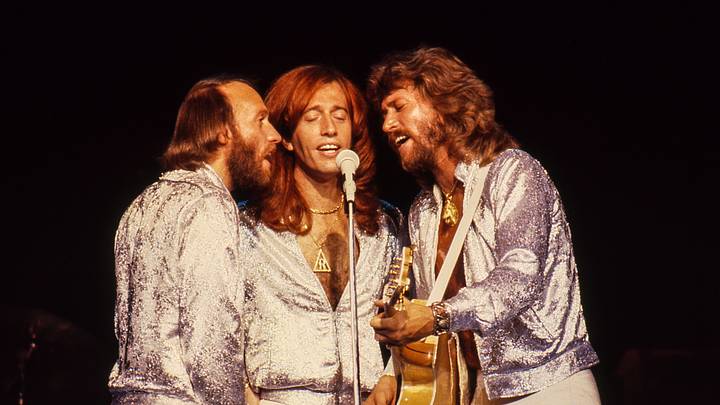
Known as the “Disco Kings” of the 1970s, the Bee Gees are one of the most successful pop-rock groups ever. Together, brothers Barry, Robin, and Maurice Gibb produced glittering hits like “Stayin’ Alive” and “How Deep Is Your Love” that remain signature songs of the eras in which they emerged.
The brothers wrote all their own songs, and together they hold the distinction of being the only songwriters to ever have five hits in the U.S. top 10 at the same time.
Yet they also lent their songwriting talents to some of the other biggest artists of their day. Read on to discover seven unforgettable songs the Bee Gees wrote for other iconic artists.
- "Islands In The Stream"// Kenny Rogers and Dolly Parton
- "Immortality" // Céline Dion
- "Woman in Love" // Barbra Streisand
- "Heartbreaker" // Dionne Warwick
- "Grease" // Frankie Valli
- “Emotion” // Samantha Sang
- "Chain Reaction" // Diana Ross
"Islands In The Stream"// Kenny Rogers and Dolly Parton
Dolly Parton has written a lot of beloved songs for other artists, but in the case of her duet “Islands In The Stream,” she borrowed a song for once. “Islands In The Stream” was recorded by Parton and country icon Kenny Rogers. It was released in 1983 and went on to reach No. 1 on the Billboard Hot 100 chart.
Members of the band have said that the song was originally written with Marvin Gaye and Diana Ross in mind. Named after an Ernest Hemingway novel of the same name, the tune is a sweet love song that helped catapult country-pop to the top of the charts. The Bee Gees also contributed vocals ot the duet, and the group recorded their own version in 2001.
"Immortality" // Céline Dion
Céline Dion and the Bee Gees shared a close friendship in the ‘90s, and the band even penned the song “Immortality” especially for her. The song emerged suddenly after a long, frustrating session they’d spent working on a different project.
According to John Marchant, the band’s engineer, the group finally decided to leave the stagnating song behind, and Barry suggested taking a look at one final idea. That concept almost immediately became “Immortality,” which was initially intended for the Saturday Night Fever musical and was also written with the group’s pal Dion in mind.
“Maurice listened, and played the first chord, and then three and a half minutes later, they wrote the song—in real-time, in just one pass,” Marchant recalled of the track's creation. “I get goosebumps telling that story. It was unbelievable. Barry would change chords, and Maurice would be there immediately, like he knew where Barry was going. They locked in together in a way, both timing-wise and intonation-wise, that only someone who knows what the other person is thinking before they think it could do.”
He also added that Dion’s version is incredibly faithful to what the band came up with that night. “The way you hear Céline Dion perform ['Immortality'] now is exactly how they did it [that night],” he added.
The song appeared on Dion’s 1997 album Let’s Talk About Love, and the Bee Gees lent their backing vocals to the tune. She also performed the track at a 2017 Bee Gees tribute at the Grammys, and thanked the band for the tune during her performance. “Twenty years ago, they gave me the gift of this song. Tonight, I sing it with love for Barry, as well as for Robin, Maurice, and Andy,” she said.
"Woman in Love" // Barbra Streisand
“Woman in Love” is one of Barbra Streisand’s greatest hits; the 1980 song reached No. 1 in 22 countries. The tune was co-written by Barry and Robin Gibb.
Initially, though, Barry was hesitant to work with Streisand. “That’s got to intimidate anyone,” he said of her star power and influence. “I didn’t want to do it at first, but my wife told me to do it, or she’d divorce me! I even called Neil Diamond to ask what it was like to work with her. He had nothing but glowing reports, so I felt a little less scared.”
“Woman in Love” actually drew on another one of the Bee Gees’ most noteworthy hits—the song “Night Fever” from Saturday Night Fever. Barry, engineer Albhy Galuten, and Karl Richardson used a drum loop from “Night Fever”—which had also been reused for “Stayin’ Alive” and “More Than a Woman”—to shape the tune's rhythm section.
Barry either wrote or co-wrote all nine songs on Streisand’s album Guilty, and he was featured on the title track. “Woman in Love” became the album’s breakout hit., and an emotional demo that Barry recorded was released in 2006.
"Heartbreaker" // Dionne Warwick
All three Gibb brothers joined forces to write Dionne Warwick’s “Heartbreaker,” which became a huge hit for the star. Initially, Warwick wasn’t sure about the tune, and strangely enough, the Bee Gees had to persuade her that the song would be successful.
Maurice Gibb, however, definitely loved the track immediately—and even thought the Bee Gees should have kept it for themselves. “I cried my eyes out after we wrote it. I drove home and thought, ‘We should be doing this one,’ and when she did it, it was brilliant,” he said. “Barry sang on it, and it became a duet between Barry and Dionne Warwick.”
The song was the title track on Warwick’s fifth album with Arista Records. Most of the tunes on it were written by Barry, who also played on the album.
"Grease" // Frankie Valli
The Bee Gees might be best known for contributing many of the defining songs to the soundtrack of Saturday Night Fever. But they also contributed a major song to another movie musical: Grease.
The stage musical version of Grease came out in 1972, but by the end of the decade, the story was ready to be adapted for the big screen. After Bee Gees’ manager Robert Stigwood joined the film as a producer, he immediately asked the band to write a new theme song for it.
The song that emerged drew on the Bee Gees’ classic disco style, but Stigwood wanted the tune to maintain its own autonomy. So he tapped Frankie Valli, who, like Barry, was notorious for his soaring falsetto, but hadn’t had a solo hit for a while.
“Barry Gibb called and said, 'I wrote a song. I think it's for you. It's going to be the title song for this motion picture,” Valli told Billboard. “My manager at the time was Allan Carr, who was partners in Grease with Robert Stigwood. He called and said, 'What do you want to do? Do you want to be in the movie? Or sing the title song?’ Well, I had already heard the title song, and I loved it. I called [famed arranger] Don Costa up and told him to come over right away and hear this song. He said, 'If you don't record this song, you're crazy,’” he continued.
“So I said, 'What's the song if I want to be in the movie?' And they said ‘Beauty School Dropout.’” But Valli turned down the opportunity to play the “Teen Angel” in the film, choosing to sing the theme song instead.
“It was done by Frankie Avalon. It never became a hit, but he made a lot of money from it being on the soundtrack,” Valli said. “But ‘Grease’ was one of the biggest records I ever had in my career.”
“Emotion” // Samantha Sang
The Bee Gees originally wrote the song “Emotion” for the Saturday Night Fever soundtrack. It was recorded by Samantha Sang in 1977, but was cut from the film and used in the 1978 film The Stud instead.
The Bee Gees released their own version of the track in 1994. In 2001, Destiny’s Child released their own version of the tune, which made it a massive hit.
"Chain Reaction" // Diana Ross
The Bee Gees' career faltered at the start of the 1980s due to backlash against disco, but they channeled their energies into songwriting during this time—and that decision paid off greatly. Following success writing for Barbra Streisand and Dionne Warwick, they next turned their attention to Diana Ross. Together, the band wrote and produced her entire 1985 album Eaten Alive.
One of the most memorable songs they wrote for the legendary artist was “Chain Reaction”—but the song almost didn’t exist. “‘Chain Reaction' was never originally meant to be on the album. It was the last song we cut,” Barry said in 1000 UK #1 Hits by Jon Kutner and Spencer Leigh.
“We'd done the whole album and Diana said, 'Well, we still need one more song from somewhere.' We had 'Chain Reaction' all along but didn't have the nerve to play it to her because it was so Motown-ish that we were scared she wouldn't go back there,” he continued. “Robin Gibb persuaded her by saying, ‘We think it's time you did something that you would have done with The Supremes and not just Diana Ross.' Once Diana had recorded it, she sat down and heard the playback and realized it was a credible tribute to the past.”