%20%20--%3E%0A%3Csvg%20version%3D%221.1%22%20id%3D%22Layer_1%22%20xmlns%3D%22http%3A%2F%2Fwww.w3.org%2F2000%2Fsvg%22%20xmlns%3Axlink%3D%22http%3A%2F%2Fwww.w3.org%2F1999%2Fxlink%22%20x%3D%220px%22%20y%3D%220px%22%0A%09%20viewBox%3D%220%200%20684.6%2068.1%22%20style%3D%22enable-background%3Anew%200%200%20684.6%2068.1%3B%22%20xml%3Aspace%3D%22preserve%22%3E%0A%3Cg%3E%0A%09%3Cpath%20d%3D%22M444.1%2C29.3h-17.4v14.5h17.4V29.3z%20M36.4%2C68.1l29.3-50.8V0H50.4L32.9%2C36.8L15.5%2C0H0v68.1h16.7V45.8l12.4%2C22.3H36.4z%0A%09%09%20M49.1%2C68.1h16.6V23.4L49.1%2C52.1V68.1z%20M76.6%2C68.1h45V53.8H93.3V41.6h21V27.1h-21V14.8h28.3V0.1h-45V68.1z%20M175.6%2C68.1h17.3v-68%0A%09%09h-16.5v40.3L150%2C0.1h-17.6v68h16.7V27.7L175.6%2C68.1z%20M235.8%2C14.8h15.4V0.1h-47.4v14.7H219v53.2h16.8V14.8z%20M290.3%2C45.9h-17.1%0A%09%09l7.5-15.6h2L290.3%2C45.9z%20M298.7%2C68.1h18l-32.2-68h-5.7l-32%2C68h18l3.3-7.1h27.1L298.7%2C68.1z%20M325.2%2C68.1h46.2V53.8h-29.6V0.1h-16.7%0A%09%09V68.1z%20M423.7%2C14.8h27.2V0.1H407v68h16.7V14.8z%20M462%2C68.1h46.2V53.8h-29.6V0.1H462V68.1z%20M564.8%2C34.1c0%2C10.7-7.2%2C19.2-18.5%2C19.2%0A%09%09c-11.4%2C0-18.5-8.5-18.5-19.2s7.1-19.2%2C18.5-19.2C557.6%2C14.9%2C564.8%2C23.4%2C564.8%2C34.1%20M580.6%2C34.1c0-19-14.2-34-34.3-34%0A%09%09c-20.2%2C0-34.3%2C15-34.3%2C34c0%2C19%2C14.1%2C34%2C34.3%2C34C566.4%2C68.1%2C580.6%2C53.1%2C580.6%2C34.1%20M604.8%2C20.5c0-4.1%2C3.3-6.2%2C6.7-6.2%0A%09%09c4.4%2C0%2C6.6%2C3%2C6.6%2C6.6h14.7C631.8%2C9.1%2C625.1%2C0.1%2C611%2C0.1c-12%2C0-21.7%2C9.3-21.7%2C20.6c0%2C10.9%2C5.9%2C15.9%2C16.7%2C19.8%0A%09%09c5.2%2C1.8%2C11.5%2C3.2%2C11.5%2C8c0%2C3.3-2.4%2C5.5-6.4%2C5.5c-3.6%2C0-6.6-3-6.6-6.7h-15.2c0%2C11.5%2C7.9%2C20.8%2C21.8%2C20.8c12%2C0%2C21.6-9.3%2C21.6-20.6%0A%09%09c0-10-5.3-16.4-16.7-19.8C610.6%2C26.1%2C604.8%2C25.3%2C604.8%2C20.5%20M670%2C20.9h14.7C683.8%2C9.1%2C677.1%2C0.1%2C663%2C0.1c-12%2C0-21.7%2C9.3-21.7%2C20.6%0A%09%09c0%2C10.9%2C5.9%2C15.9%2C16.7%2C19.8c5.2%2C1.8%2C11.5%2C3.2%2C11.5%2C8c0%2C3.3-2.4%2C5.5-6.4%2C5.5c-3.6%2C0-6.6-3-6.6-6.7h-15.2c0%2C11.5%2C7.9%2C20.8%2C21.8%2C20.8%0A%09%09c12%2C0%2C21.6-9.3%2C21.6-20.6c0-10-5.3-16.4-16.7-19.8c-5.4-1.6-11.3-2.4-11.3-7.2c0-4.1%2C3.3-6.2%2C6.7-6.2C667.7%2C14.4%2C670%2C17.3%2C670%2C20.9%0A%09%09%22%2F%3E%0A%3C%2Fg%3E%0A%3C%2Fsvg%3E%0A)

Grab your bell bottoms and tie-dye, because it’s time to go back to the ‘70s! This decade was characterized by highly recognizable fashions, cultural icons, and, of course, many a song and sound that remain beloved today.
Some of the biggest hits of this decade might genuinely surprise you, and many of them break a lot of the rules people tend to associate with chart hits. Please enjoy this list of the biggest hits from each year in the ‘70s, according to Billboard magazine’s end-of-year Top Hot 100 song rankings.
- 1970 - “Bridge Over Troubled Water” // Simon & Garfunkel
- 1971 - “Joy to the World” // Three Dog Night
- 1972 - “The First Time Ever I Saw Your Face” // Roberta Flack
- 1973 - “Tie a Yellow Ribbon Round the Ole Oak Tree” // Tony Orlando and Dawn
- 1974 - “The Way We Were” // Barbra Streisand
- 1975 - “Love Will Keep Us Together” // Captain & Tennille
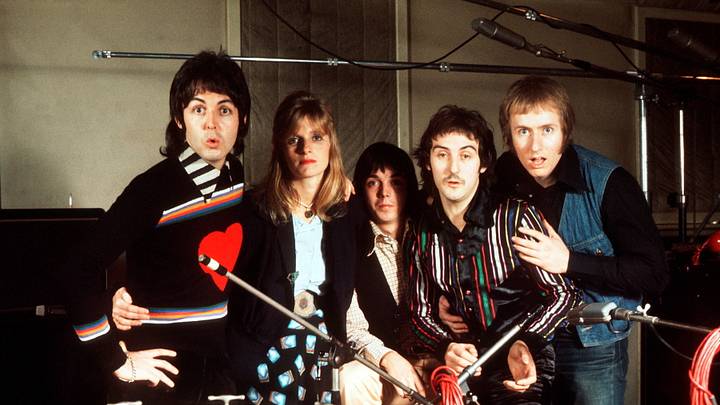
- 1976 - “Silly Love Songs” // Wings
- 1977 - “Tonight's the Night (Gonna Be Alright)” // Rod Stewart
- 1978 - “Shadow Dancing” // Andy Gibb
- 1979 - “My Sharona” // The Knack
1970 - “Bridge Over Troubled Water” // Simon & Garfunkel
In 1969, the Vietnam War was raging, Bobby Kennedy and Martin Luther King, Jr. had been assassinated, and the world was undergoing turbulence and transformation. Paul Simon found himself staring at New York’s East River, seeking solace and listening to the Swan Silvertones’ “Oh Mary Don’t You Weep” on repeat.
Inspired by a line in the song, Simon penned “Bridge over Troubled Water,” which became the second single and title track from Simon and Art Garfunkel’s fifth and final album. He then shared it with Garfunkel, whom he wanted to sing it. Garfunkel apparently demurred at first, an event that later became the subject of rumors about tensions between the two artists.
“Now, the famous story is that he took offense and that became a thorn between us, as if I was rejecting the song,” Garfunkel told Louder. “That’s nonsense. I don’t remember him having a hard time with my grace. He said: ‘No, I wrote it for you.’ I said: ‘Thank you, man,’ and got into singing it.”
When they recorded the song at CBS Studio in Hollywood, the need for a third verse became apparent. By the time the song was done, it was five minutes long and built up to a soaring, orchestral conclusion. The track became a classic, sweeping the 1971 Grammys and gaining new life thanks to memorable covers by Aretha Franklin, Elvis Presley, and other artists.
Garfunkel has often expressed great gratitude for the opportunity to deliver the song’s powerful message to so many audiences. “I’ve sung it 6,400 times,” he added. “And every time, I get a little visitation of the power of a great song. To say: ‘Whoever you are, if you need some solace, I will try to be a moment of sweetness for you,’ this kills me. To be the lucky one to express that, it moves me every damned time.”
The song also, unfortunately, became the subject of tensions between Simon and Garfunkel. “Many times on stage, when I’d be sitting off to the side…and Artie would be singing it, people would stomp and cheer when it was over, and I would think: ‘That’s my song, man. Thank you very much. I wrote that,’” Simon reflected. “In the earlier days, when things were smoother, I never would have thought that, but towards the end when things were strained, I did.”
1971 - “Joy to the World” // Three Dog Night
This song is sometimes better known by its rip-rollicking first lyric, “Jeremiah was a bullfrog.” It tells a rather nonsensical story of a wine-drinking amphibian and then launches into an exuberant chorus that gets straight to the song’s point: joy for everyone, animal and human alike. “It was a carefree, fun song, and those lines, ‘Joy to the world, all the boys and girls,’...I mean, joy to everybody, even the fishes,” band member Chuck Negron told Forbes in 2022. “That sentiment hit all the demographics, the core of America.”
Three Dog Night passed on the song twice before finally accepting it at Negron’s behest. The tune was written by country singer Hoyt Axton, who originally penned it for a children’s show that was supposed to feature—you guessed it—a bullfrog. Axton had songwriting in his blood; his mother, Mae Axton, co-wrote Elvis Presley’s “Heartbreak Hotel.”
Axton had initially intended to replace the bullfrog lyric with something a bit more serious for Three Dog Night’s version, but Negron immediately knew that the lyric would make for a powerful hook. In the band’s hands, the song became an inescapable and infectious radio hit.
1972 - “The First Time Ever I Saw Your Face” // Roberta Flack
Songwriter Ewan MacColl originally wrote this song for his lover, Peggy Seeger. The tune was later covered by the likes of Elvis Presley and Johnny Cash, but MacColl reportedly remained displeased by all of the versions.
Then a music teacher named Roberta Flack began teaching the song to students in her high school glee club and performing it during her residency at a local nightclub. She was soon picked up by Atlantic Records, and released a version of the song. It didn’t become a hit until Clint Eastwood used her recording in a key scene from the film Play Misty For Me, which turned Flack into a megastar. The song also became a classic that remains inextricable from Flack’s warbling, emotive vocals.
1973 - “Tie a Yellow Ribbon Round the Ole Oak Tree” // Tony Orlando and Dawn
This song tells the story of a man returning from three years as a prisoner of war, searching for a sign that the woman he loves remembers him. Songwriters Irwin Levine and L. Russell Brown wrote it based on a story Brown encountered in an issue of Reader’s Digest.
“It was one of those human interest things. It was a half-page. It was by Pete Hamill and it started off by saying, ‘Here’s a story I heard in a Greenwich Village pub that’s been handed down through the ages about a soldier coming home from the Andersonville Prison during the Civil War,’” Brown said in an interview.
The story followed the returning prisoner as he searches for a handkerchief that he asked the girl he loved to tie around a tree if she wanted to see him again. “When they got in front of the tree, it was all filled with handkerchiefs,’ Brown continued. “That story put a chill up my neck so the next morning I drove up to my partner’s house and asked if I could tell him the story…I told it fast and he said, ‘Larry, I just got a chill up my neck and my arm. A rush. Tell it again.’ So, I told it again and he said ‘I love that story, but handkerchiefs, they have snot in them. Disgusting.’ I said well, what can we do about that? He said ‘Let’s change handkerchiefs to ribbons. That’s prettier.’” The song materialized quickly after that and soon became a hit.
Columnist Pete Hamill later sued the songwriters, but the suit was dropped when evidence of similar stories dating back to the 1950s was found. Some people have since claimed that the song is inspired by an ancient tradition of tying a yellow ribbon around a tree in honor of someone you’re waiting for. However, it’s actually widely believed that this song was largely responsible for creating that tradition in the first place.
1974 - “The Way We Were” // Barbra Streisand
Barbra Streisand starred alongside Robert Redford in the 1973 romantic drama The Way We Were, and also sang its lead single. For songwriter Marvin Hamlisch, it was all a dream come true.
Hamlisch was a piano prodigy who, as a 20-year-old student, often prayed, “Please, God, let Barbra Streisand sing one of my songs.” His first job was playing keys for Streisand during Funny Girl rehearsals, but at the time, none of his compositions caught her attention.
But years later, his prayers were answered when he was enlisted to write a song for the film The Way We Were starring Streisand. He set about composing a song that encapsulated the film’s entire story and also catered to Streisand’s vocals.
“No matter what I was doing, I could hear Barbra’s voice in my head and recall how wonderful she sounds when she holds certain notes,” he said. “I wanted to let her soar! I was determined not to write something drippingly sentimental.” Eventually, he struck gold. “I’d been trying minor key melodies but thought they might have told you too much in advance that Streisand and Redford were never going to get together,” he said. “So I wrote a major key melody that was sad but also had a great deal of hope in it.”
The lyrics were written by Alan and Marilyn Bergman, who showed the song to Streisand. She was initially a bit put off by its sentimentality, but agreed to record it. The song became a key part of the film and turned into Streisand’s first No. 1 hit as well as the biggest song of 1974.
1975 - “Love Will Keep Us Together” // Captain & Tennille
This peppy, romantic tune was inescapable in 1975. It was written by songwriting duo Neil Sedaka and Howard Greenfield, who penned the track after Greenfield decided to move to California. Yes, this tune was about love keeping a creative partnership intact despite distance, not a romantic relationship! It was released by married duo Captain & Tennille and spent a total of 23 weeks on the Billboard chart in 1975.
1976 - “Silly Love Songs” // Wings
Paul and Linda McCartney’s band Wings had a megahit with “Silly Love Songs,” which was written by McCartney and released as the lead single from the band’s fifth studio album, Wings At the Speed of Sound. McCartney penned the track in part as a response to a slight by his former Beatles bandmate, John Lennon.
“There were accusations in the mid-1970s—including one from John—that I was just writing ‘silly love songs.’ I suppose the idea was that I should be a bit tougher, a bit more worldly,” McCartney said. “But then I suddenly realized that’s exactly what love is—it’s worldly. ‘Some people want to fill the world/With silly love songs.’ I’d been given that reputation, and I had to stand up for it. Instead of abandoning songs about love, just get on with it, get into it and don’t be embarrassed, because even though you might say this is a soppy subject, it’s actually the opposite: this thing people can feel for each other that makes life better. I think that’s the crux of it, and if you want to be cynical, it’s easy, you can. ‘Love doesn’t come in a minute/Sometimes it doesn’t come at all.’ I think a lot of people who are cynical about love haven’t been lucky enough to feel it.” He wrote the song while vacationing in Hawaii, and the rest was history.
1977 - “Tonight's the Night (Gonna Be Alright)” // Rod Stewart
This song's rather lewd lyrics resulted in a temporary radio ban in the UK, but their scandalous nature also helped make it into a hit.
"This came to me in the middle of the night, as songs often do. I always keep a notepad and cassette recorder by my bed, among other things," Rod Stewart later recalled of the tune's conception. "Steve Cropper and I worked out the arrangement on Friday morning and it was in the can by Friday night, lyrics being finished by the following evening. We spent more time working on the somewhat complicated intro than the song itself. It was banned by many radio stations because of its lyrical content, but, nevertheless, a little scandal never did anyone any harm."
The tune features some French vocals from Stewart's girlfriend at the time, Swedish actress Britt Ekland. "I was going out with Britt Ekland. I'd just moved here. So that's 20 years ago," he said. "I remember I got her drunk, pissed as a fart to sing that old French bollocks on the end, because she didn't want to do it." When asked if he'd paid her royalties, he replied, "Bollocks! I bought her a nice frock."
1978 - “Shadow Dancing” // Andy Gibb
The Bee Gees were everywhere in the ‘70s, and 1978 was perhaps their biggest year of all thanks to the release of “How Deep Is Your Love,” “Stayin’ Alive,” and “Saturday Night Fever.” But it was a track by their little brother Andy Gibb that topped the Billboard charts that year.
The song was written by Andy and his older brothers, Barry, Maurice, and Robin, who penned the chorus’s melody in just 10 minutes during a trip to Los Angeles. “One night, while we were relaxing, we sat down, and we had to start getting tracks together for the album,” Andy recalled. “So we literally sat down, and in ten minutes, we had a group going, [singing] the chorus part. As it says underneath the song, we all wrote it, the four of us.”
1979 - “My Sharona” // The Knack
“My Sharona” is an upbeat tune that was also the Knack's biggest hit. The band never had another major success and broke up three years after its release. Its lyrics also shocked countless listeners.
25-year-old frontman Doug Fieger wrote the song about a 17-year-old girl named Sharona Alperin, who he fell for after meeting her in a clothing store where she worked. He went on to write a number of songs about Alperin, and pursued her for over a year until the pair started dating. During that time, she occasionally came to the band’s rehearsals and shows and even heard the band play an early version of “My Sharona” in her honor.
“I was about 16 or 17 at the time,” Alperin said to NPR following Fieger’s death. “He was nine years older than me. And within a month or two later, he told me that, ‘I’m in love with you, you’re my soulmate, you’re my other half, we’re going to be together one day.’” They were together for four years and remained friends until Fieger’s death.
“My Sharona” became a radio hit before the pair even started dating. It contains lyrics that detail attraction to “the younger kind” in rather vulgar terms, leading to many parents forbidding their children from listening to the song. The track also helped inspire the harder rock that characterized the ‘80s—and also contributed to some of the backlash against it.