%20%20--%3E%0A%3Csvg%20version%3D%221.1%22%20id%3D%22Layer_1%22%20xmlns%3D%22http%3A%2F%2Fwww.w3.org%2F2000%2Fsvg%22%20xmlns%3Axlink%3D%22http%3A%2F%2Fwww.w3.org%2F1999%2Fxlink%22%20x%3D%220px%22%20y%3D%220px%22%0A%09%20viewBox%3D%220%200%20684.6%2068.1%22%20style%3D%22enable-background%3Anew%200%200%20684.6%2068.1%3B%22%20xml%3Aspace%3D%22preserve%22%3E%0A%3Cg%3E%0A%09%3Cpath%20d%3D%22M444.1%2C29.3h-17.4v14.5h17.4V29.3z%20M36.4%2C68.1l29.3-50.8V0H50.4L32.9%2C36.8L15.5%2C0H0v68.1h16.7V45.8l12.4%2C22.3H36.4z%0A%09%09%20M49.1%2C68.1h16.6V23.4L49.1%2C52.1V68.1z%20M76.6%2C68.1h45V53.8H93.3V41.6h21V27.1h-21V14.8h28.3V0.1h-45V68.1z%20M175.6%2C68.1h17.3v-68%0A%09%09h-16.5v40.3L150%2C0.1h-17.6v68h16.7V27.7L175.6%2C68.1z%20M235.8%2C14.8h15.4V0.1h-47.4v14.7H219v53.2h16.8V14.8z%20M290.3%2C45.9h-17.1%0A%09%09l7.5-15.6h2L290.3%2C45.9z%20M298.7%2C68.1h18l-32.2-68h-5.7l-32%2C68h18l3.3-7.1h27.1L298.7%2C68.1z%20M325.2%2C68.1h46.2V53.8h-29.6V0.1h-16.7%0A%09%09V68.1z%20M423.7%2C14.8h27.2V0.1H407v68h16.7V14.8z%20M462%2C68.1h46.2V53.8h-29.6V0.1H462V68.1z%20M564.8%2C34.1c0%2C10.7-7.2%2C19.2-18.5%2C19.2%0A%09%09c-11.4%2C0-18.5-8.5-18.5-19.2s7.1-19.2%2C18.5-19.2C557.6%2C14.9%2C564.8%2C23.4%2C564.8%2C34.1%20M580.6%2C34.1c0-19-14.2-34-34.3-34%0A%09%09c-20.2%2C0-34.3%2C15-34.3%2C34c0%2C19%2C14.1%2C34%2C34.3%2C34C566.4%2C68.1%2C580.6%2C53.1%2C580.6%2C34.1%20M604.8%2C20.5c0-4.1%2C3.3-6.2%2C6.7-6.2%0A%09%09c4.4%2C0%2C6.6%2C3%2C6.6%2C6.6h14.7C631.8%2C9.1%2C625.1%2C0.1%2C611%2C0.1c-12%2C0-21.7%2C9.3-21.7%2C20.6c0%2C10.9%2C5.9%2C15.9%2C16.7%2C19.8%0A%09%09c5.2%2C1.8%2C11.5%2C3.2%2C11.5%2C8c0%2C3.3-2.4%2C5.5-6.4%2C5.5c-3.6%2C0-6.6-3-6.6-6.7h-15.2c0%2C11.5%2C7.9%2C20.8%2C21.8%2C20.8c12%2C0%2C21.6-9.3%2C21.6-20.6%0A%09%09c0-10-5.3-16.4-16.7-19.8C610.6%2C26.1%2C604.8%2C25.3%2C604.8%2C20.5%20M670%2C20.9h14.7C683.8%2C9.1%2C677.1%2C0.1%2C663%2C0.1c-12%2C0-21.7%2C9.3-21.7%2C20.6%0A%09%09c0%2C10.9%2C5.9%2C15.9%2C16.7%2C19.8c5.2%2C1.8%2C11.5%2C3.2%2C11.5%2C8c0%2C3.3-2.4%2C5.5-6.4%2C5.5c-3.6%2C0-6.6-3-6.6-6.7h-15.2c0%2C11.5%2C7.9%2C20.8%2C21.8%2C20.8%0A%09%09c12%2C0%2C21.6-9.3%2C21.6-20.6c0-10-5.3-16.4-16.7-19.8c-5.4-1.6-11.3-2.4-11.3-7.2c0-4.1%2C3.3-6.2%2C6.7-6.2C667.7%2C14.4%2C670%2C17.3%2C670%2C20.9%0A%09%09%22%2F%3E%0A%3C%2Fg%3E%0A%3C%2Fsvg%3E%0A)

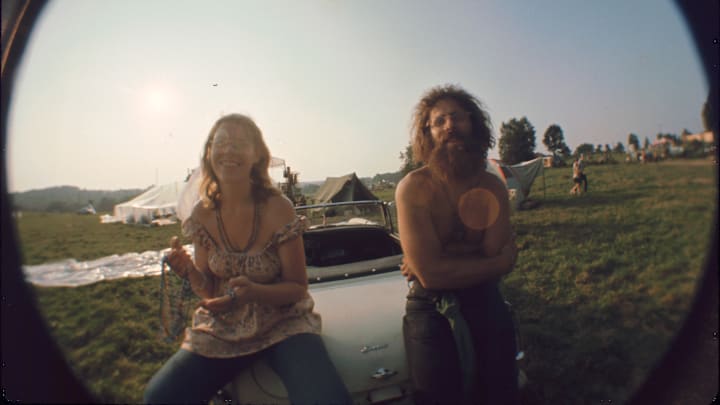
Woodstock was a festival that defined a generation. Even all these decades later, those three legendary days of peace, love, and music continue to reverberate across culture and music. Key moments, such as Jimi Hendrix’s epic performance of "The Star-Spangled Banner," also continue to go viral today, and in terms of ephemera and fun facts, the festival is a gift that keeps on giving. From acid-spiked ice to iconic photos of sunglass-sporting hippies, Woodstock will forever be the pinnacle of the 1960s counterculture movement and all that came with it.
Unsurprisingly, with great legendariness comes great quantities of misinformation. Woodstock has reached a near-fanciful level of mythologization, and unfortunately, some tales about this festival are taller than others.
- Misconception: Woodstock Took Place in the Town of Woodstock
- Misconception: Jimi Hendrix Played For a Huge Crowd
- Misconception: Woodstock Was All Peace and Love
- Misconception: Woodstock Was a Free Festival
- Misconception: Joni Mitchell Was There
Misconception: Woodstock Took Place in the Town of Woodstock

I wasn’t anywhere near born when Woodstock occurred, but the festival still has a hold on me as a teen—so much so that I took my first solo road trip to the town of Woodstock at the age of 17. Unfortunately, I had not done much research, and upon my arrival, I was surprised to learn that the actual festival had occurred about an hour-and-a-half-long drive away. Still, it was an unforgettable trip, and the town has more than enough nostalgic Woodstock-themed memorabilia to placate anyone suffering from similar confusion.
It’s true, though: Woodstock didn’t take place in Woodstock. Instead, it was held in Bethel, New York, on a 600-acre dairy farm owned by a man named Max Yasgur. The festival’s organizers actually had originally planned to hold the event in the town of Woodstock, which was already a famous bohemian retreat for various famous artists at the time. But locals objected, citing the crowds the festival might attract—a suspicion that turned out to be more than correct.
The festival was then moved to the town of Wallkill, but residents objected again due to the same concerns. Just a month before the festival, its organizers paid Yasgur a reported $50,000 to use his farm, which was located 70 miles away from the town of Woodstock. Still, it was too late to change the name, and history—and ongoing confusion—was made.
Misconception: Jimi Hendrix Played For a Huge Crowd
Jimi Hendrix’s cover of “The Star-Spangled Banner” has become one of the musical centerpieces of the entire counterculture movement. Hendrix’s raw, ragged, and deeply emotive performance is emblematic of how even a nation’s national anthem can become an electrifying protest anthem in the hands of the right artist.
Yet in actuality, Hendrix’s set didn’t reach the vast majority of the hundreds of thousands of people who attended Woodstock. The festival’s lineup was plagued by such dramatic delays due to technical issues and weather that Hendrix, a headliner, wound up playing at around nine in the morning on Monday, August 18—to only about 30 or 40,000 people, as opposed to the 400 or 500,000 who attended the festival at its peak.
Many people had left by that morning, some for work and school. Undoubtedly, a fair number were grumbling about how the “man” was pulling them away from history as they trudged off the festival grounds. At least we have the YouTube recording.
Misconception: Woodstock Was All Peace and Love

Woodstock has a reputation for embodying the idealistic spirit of the 1960s counterculture movement to its fullest. In popular imagination, it is diametrically opposed to the disastrous Altamont, a music festival that occurred later that year and cast a sheen of doom and nihilism over the whole era, and of course its legacy couldn't be more different from that of the famously chaotic Woodstock ‘99.
However, the original Woodstock certainly wasn’t entirely the paradise that Joni Mitchell sang about in her song “Woodstock” (more on that later). The event was plagued by ridiculous traffic jams that caused people to leave their cars in the middle of the road. The weather was often extremely poor as well, which resulted in a muddy, wet experience for many.
Along the way, nefarious figures handed out bad acid, there was garbage everywhere, there weren’t nearly enough medical tents, and there was reportedly one porta-potty per every 833 people. Two people died at the festival—one from an overdose and another from an accident. Initially, there was such an extreme lack of food available that nearby residents arranged for a U.S. Army helicopter to air-drop over 10,000 sandwiches and other goods to wary, hungry festival-goers.
Still, for many, it all seemed to add to the atmosphere. “I was at Woodstock (66 yrs old now), and there was no dark side for me,” one Reddit user wrote. “I had an amazing time, with amazing music, and almost a million people there feeling the same way. It did rain, and the mud had a really strange and unpleasant smell, and the portable toilets were beyond what you can imagine, but I can't really call that any of that a dark side. It was a great time to be young. We were filled with optimism. We thought we were creating a new world. Maybe we gave it a little good direction for a time.”
Misconception: Woodstock Was a Free Festival

Woodstock has a reputation for being a free concert, which certainly adds to its utopian image. However, the concert wasn’t supposed to be free at all! Tickets cost $18 total in advance and $24 at the door, which translates to about $120 and $160 today—not bad for a three-day festival in today’s economy, but definitely a far cry from free.
However, when the festival kicked off on Friday night, ticketless attendees quickly began intruding through gaps in the fences surrounding the farm where Woodstock took place. Overwhelmed and unable to stop the flood of intruders, the festival’s organizers soon made the decision to just let everyone in for free. They wound up near-bankrupt after the festival, but recouped their losses with a 1970 documentary—and may have helped secure their festival’s idealistic legacy in the process.
Misconception: Joni Mitchell Was There
Ironically, the person who wrote the most popular song about Woodstock wasn’t even at the festival. Joni Mitchell’s track “Woodstock” is a beautiful ballad about meeting a bohemian wanderer on their way to Woodstock, and it is full of sparkling dreams about creating a new and better world through love, community, and music. Yet Mitchell was actually holed up in a hotel room in New York City when the festival occurred.
The young folk singer was originally slated to perform at Woodstock on Sunday, but her manager pulled her out at the last minute so she could make her live television debut on the Dick Cavett Show in New York City that Monday. She wound up watching footage of the festival on television.
Ultimately, though, the whole experience allowed her to access parts of her imagination she wouldn’t have been able to if she had actually attended. “I was the deprived kid who couldn’t go,” Mitchell said in an interview with CBC. “I wrote [the song 'Woodstock'] from the point of view of a kid going there. If I’d been there in the backroom with all the cutthroat, egomaniacal crap that goes on backstage, I would not have had that perspective.”