%20%20--%3E%0A%3Csvg%20version%3D%221.1%22%20id%3D%22Layer_1%22%20xmlns%3D%22http%3A%2F%2Fwww.w3.org%2F2000%2Fsvg%22%20xmlns%3Axlink%3D%22http%3A%2F%2Fwww.w3.org%2F1999%2Fxlink%22%20x%3D%220px%22%20y%3D%220px%22%0A%09%20viewBox%3D%220%200%20684.6%2068.1%22%20style%3D%22enable-background%3Anew%200%200%20684.6%2068.1%3B%22%20xml%3Aspace%3D%22preserve%22%3E%0A%3Cg%3E%0A%09%3Cpath%20d%3D%22M444.1%2C29.3h-17.4v14.5h17.4V29.3z%20M36.4%2C68.1l29.3-50.8V0H50.4L32.9%2C36.8L15.5%2C0H0v68.1h16.7V45.8l12.4%2C22.3H36.4z%0A%09%09%20M49.1%2C68.1h16.6V23.4L49.1%2C52.1V68.1z%20M76.6%2C68.1h45V53.8H93.3V41.6h21V27.1h-21V14.8h28.3V0.1h-45V68.1z%20M175.6%2C68.1h17.3v-68%0A%09%09h-16.5v40.3L150%2C0.1h-17.6v68h16.7V27.7L175.6%2C68.1z%20M235.8%2C14.8h15.4V0.1h-47.4v14.7H219v53.2h16.8V14.8z%20M290.3%2C45.9h-17.1%0A%09%09l7.5-15.6h2L290.3%2C45.9z%20M298.7%2C68.1h18l-32.2-68h-5.7l-32%2C68h18l3.3-7.1h27.1L298.7%2C68.1z%20M325.2%2C68.1h46.2V53.8h-29.6V0.1h-16.7%0A%09%09V68.1z%20M423.7%2C14.8h27.2V0.1H407v68h16.7V14.8z%20M462%2C68.1h46.2V53.8h-29.6V0.1H462V68.1z%20M564.8%2C34.1c0%2C10.7-7.2%2C19.2-18.5%2C19.2%0A%09%09c-11.4%2C0-18.5-8.5-18.5-19.2s7.1-19.2%2C18.5-19.2C557.6%2C14.9%2C564.8%2C23.4%2C564.8%2C34.1%20M580.6%2C34.1c0-19-14.2-34-34.3-34%0A%09%09c-20.2%2C0-34.3%2C15-34.3%2C34c0%2C19%2C14.1%2C34%2C34.3%2C34C566.4%2C68.1%2C580.6%2C53.1%2C580.6%2C34.1%20M604.8%2C20.5c0-4.1%2C3.3-6.2%2C6.7-6.2%0A%09%09c4.4%2C0%2C6.6%2C3%2C6.6%2C6.6h14.7C631.8%2C9.1%2C625.1%2C0.1%2C611%2C0.1c-12%2C0-21.7%2C9.3-21.7%2C20.6c0%2C10.9%2C5.9%2C15.9%2C16.7%2C19.8%0A%09%09c5.2%2C1.8%2C11.5%2C3.2%2C11.5%2C8c0%2C3.3-2.4%2C5.5-6.4%2C5.5c-3.6%2C0-6.6-3-6.6-6.7h-15.2c0%2C11.5%2C7.9%2C20.8%2C21.8%2C20.8c12%2C0%2C21.6-9.3%2C21.6-20.6%0A%09%09c0-10-5.3-16.4-16.7-19.8C610.6%2C26.1%2C604.8%2C25.3%2C604.8%2C20.5%20M670%2C20.9h14.7C683.8%2C9.1%2C677.1%2C0.1%2C663%2C0.1c-12%2C0-21.7%2C9.3-21.7%2C20.6%0A%09%09c0%2C10.9%2C5.9%2C15.9%2C16.7%2C19.8c5.2%2C1.8%2C11.5%2C3.2%2C11.5%2C8c0%2C3.3-2.4%2C5.5-6.4%2C5.5c-3.6%2C0-6.6-3-6.6-6.7h-15.2c0%2C11.5%2C7.9%2C20.8%2C21.8%2C20.8%0A%09%09c12%2C0%2C21.6-9.3%2C21.6-20.6c0-10-5.3-16.4-16.7-19.8c-5.4-1.6-11.3-2.4-11.3-7.2c0-4.1%2C3.3-6.2%2C6.7-6.2C667.7%2C14.4%2C670%2C17.3%2C670%2C20.9%0A%09%09%22%2F%3E%0A%3C%2Fg%3E%0A%3C%2Fsvg%3E%0A)

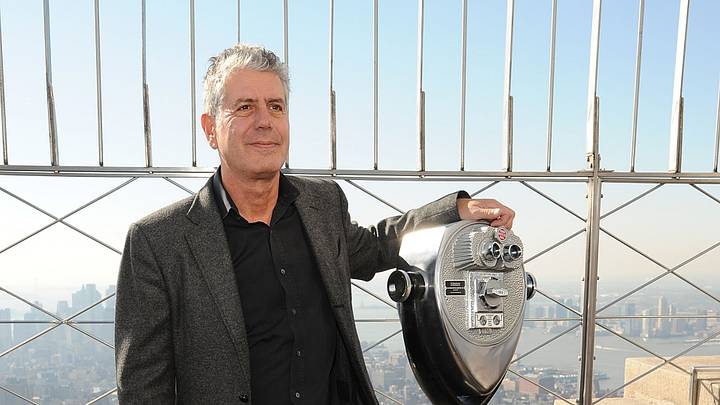
Anthony Bourdain traveled widely, ate adventurously, and shared it all with the world. He showed the masses a different type of travel experience, one that made it possible to truly connect with places and people in all their contradictions and truth.
Throughout Bourdain’s travels, he consistently engaged deeply with the people and energy of diverse locations through authentic relationships and incisive looks at history and culture. You’d find him dining with everyone from presidents to anonymous local elders, often at ramshackle roadside establishments where Bourdain had a knack for finding the best meals in town.
As a longtime traveler with a pretty similar ethos to Bourdain, it always surprises me that I didn’t begin to really engage with Bourdain’s work and legacy until after his death. But the more I read of his work and reflections, the more I connect to his way of seeing places in all their fullness and complexity.
Prior to his 2018 suicide, Bourdain was a restless soul who spent up to 250 days per year on the road. Across that time, he broke bread in many places across the world. But some places truly won his heart, and he often returned to them many times for episodes of his TV shows, Anthony Bourdain: No Reservations and Parts Unknown.
Here are some of the places that Bourdain had a special connection with, and some of my own reflections on them.
Hanoi, Vietnam

Perhaps no image is more associated with Bourdain’s legacy than the scene of him sitting with then-President Barack Obama, eating a $6 dish of bún chả on plastic stools. This iconic moment took place in Hanoi, Vietnam, at a restaurant called Bún Chả Hương Liên.
Located in the north of the country, Hanoi is Vietnam’s capital. Known for its storied architecture and mix of Vietnamese, French, and Chinese influences, it also boasts a thriving food and coffee scene as well as a number of historic sites.
Bourdain had a long love affair with Hanoi and Vietnam. He filmed eight episodes in Vietnam across his television career, and his work there inspired a new generation of travelers to visit the country.
Ironically, the first time I really began to feel drawn to Bourdain’s work was during lunch with a fellow backpacker I met in Ho Chi Minh City. “Bourdain loved this place,” he said as we perched on a rickety bench, going on to tell me a bit about the chef’s struggles and life’s work.
I can’t remember the name of it, but I do remember the way he spoke about Bourdain with reverence and real sadness about his death. There amid the bustle of the small restaurant, I started understanding how Bourdain became something of a pied piper, calling other travelers to follow in his footsteps and inspiring them to truly—and sometimes literally—“suck the marrow out of life,” as Henry David Thoreau once wrote.
Bourdain often spoke about his love for the country. “Vietnam: it grabs you and doesn’t let you go,” he once said of the country. “Once you love it, you love it forever. I’ve been coming here since 2000, the first time I’d been in this part of the world, and it’s held a special place in my heart and my imagination since. I keep coming back; I have to.”
Vietnam made an impact on Bourdain from the very first time he set foot there. “Going to Vietnam the first time was life-changing for sure; maybe because it was all so new and different to my life before and the world I grew up in,” he told Conde Nast Traveler. “The food, culture, landscape and smell; they’re all inseparable. It just seemed like another planet; a delicious one that sort of sucked me in and never let go.” From the hospitality and resilience of its people to its street food culture, Vietnam clearly won Bourdain over and kept him coming back.
During my time in Vietnam, I constantly found myself swept away both the country’s natural beauty and the electric energy of its cities, with their endless streams of motorbikes whizzing by elaborate cafes serving the most delicious coffee I have ever had.
At the same time, the more I learned of the Vietnamese perspective on the Vietnam War, the more I realized how much of a gap there is in my own understanding of this unfathomable tragedy. In the American education system and in the culture at large, after all—at least in my experience—we tend to hear more about the fate of GIs but almost nothing about the experiences of the actual Vietnamese.
Listening to the sound of gunshots ricocheting through a shooting range near the Củ Chi tunnels in the jungles outside of Ho Chi Minh City, I couldn’t help but feel disturbed by the fact that we were all a bunch of tourists, shooting guns for fun in a place so marred by real blood. Yet that night I found myself on the back of a motorbike, seeking out the best banh mi in the city with my Bourdain-loving friend.
These are the contradictions that can emerge whenever you truly engage with the world, in all its violent shadows and flavorful diversions—something Bourdain knew well, and often grappled with, not in an effort to find the answer but rather to share in the discomfort of the questions.
Tokyo, Japan

Bourdain’s love for Tokyo may have exceeded his affection for all other cities across the world. He once told National Geographic that if there’s one city that “had it all,” it would be Tokyo.
“I mean, if I had to die mid-meal anywhere, it would be Tokyo,” he said. “If you were to ask most chefs if they had to have house arrest for the rest of their life in one city and eat all of their meals there, just about everyone I know would pick Tokyo.” When asked if he had to choose one particular meal to die in the midst of, he immediately said that his place of choice would be Sukiyabashi Jiro, a 10-counter restaurant located in the basement of a building in Ginza helmed by the master chef Jiro Ono.
I would have to say that after visiting, I felt the same. On my first night there, hobbling on a knee injury after a fall from a bus in China a few days prior, I found myself eating the best sushi I have ever had at a Shinjuku hole-in-the-wall shown to me by a local friend. It was a tiny place and we ate standing up, but roll after roll kept coming out and transporting me to different dimensions of flavor. Needless to say the knee pain, for at least some time, was gone.
Bourdain loved Tokyo’s food culture and frequently expounded on its magic, calling it “the most amazing food city in the world, with a nearly unimaginable variety of places stacked one on top of the other, tucked away on every level on densely packed streets.” From tiny sushi bars serving up the most excellent fish you’ll ever eat to matcha-flavored everything, from elegant temples and steaming onsens to high-speed trains and sprawling intersections, Tokyo certainly offers quite a seductive experience.
As is typical of Bourdain, he took in the full spectrum of Tokyo’s culture when he visited and shared that with the world. In Parts Unknown, he reflected on the culture of overwork and loneliness that pervades Tokyo while also praising the complexity and contrast that define its nightlife and broader culture.
“What do you need to know about Tokyo? Deep, deep waters,” he reflected. “The first time I came here, it was a transformative experience. It was a powerful and violent experience. It was just like taking acid for the first time—meaning, what do I do now? I see the whole world in a different way.”
With just a few days in the city, I knew I had merely scratched its surface and also knew I needed to come back. The city was astoundingly clean and organized overall, everything was laid out in perfect order. Yet beneath it all was the infinite complexity Bourdain touched on.
On my last night, dining with a new local friend who ordered things I never could have even known to try, we compared notes about mental health and manifestation, realizing that despite growing up in different lands we were the same in countless ways. She was a private chef who dreamed of one day holding retreats where she shared local, medicinal food and told its stories. I promised I’d be back one day to try it, and meant it. In the onsen with a bunch of elderly Japanese ladies the next day, for a moment I imagined never leaving.
Granada, Spain

“Any reasonable, sentient person who looks at Spain, comes to Spain, eats in Spain, drinks in Spain, they’re going to fall in love,” Bourdain once said. “Otherwise, there’s something deeply wrong with you.”
The chef had a particular love for the city of Granada. This historic locale is located in Spain’s Andalusian region among the Sierra Nevada mountains. Rich in medieval architecture, it is also home to the sprawling Alhambra, a vast palace and fortress rich in Islamic art and stunning gardens.
“Granada is one of the oldest, most complex, magically surreal places in Spain, and one of the most beautiful,” Bourdain said in Parts Unknown. For Bourdain, who seemed perpetually incapable of finding stillness, Granada seemed to represent a kind of elusive, imagined peace. “This is the dream of all the world. The dream is to live in Granada,” he continued. “Work in the morning, have a one-hour nap in the afternoon and go out at night. Go out and see your friends, eat tapas, drink red wine, and be in a beautiful place.”
I would have to agree. Spain was my very first solo travel destination, and it gave me a bug that I still have—an endless love for going to a place and exploring its literature, its back alleys, and its crumbling ruins, ideally in solitude, so I can follow little signs and private interests. My fascination with the poet Federico García Lorca led me to Granada, where I visited the house in which he used to live and scribbled poetry on my phone as we moved through its silent rooms.
Granada, with its cobblestone streets and little dimly lit bars, also felt like a place I could stay perhaps for a very long time. Though of course I couldn't stay, not in that dream-place; for then it would become real, and the little indignities of day-to-day life would start to come in. Better to keep Granada as a vision of tapas and cobblestones, poetry and memory.
Bourdain enjoyed many places in Spain over the years, and particularly favored Barcelona’s food culture. “You’d have a hard time finding anything better than Barcelona for food, as far as being a hub,” he once said of the city, which is known for its Antoni Gaudí landmarks, its fine museums, and of course, its flavors.
In Barcelona, immediately after arriving, I drank absinthe and ate paella and potatoes bravas at a roadside cafe on an empty stomach, then ran into the sea. It remains one of my favorite dining experiences of all time, one of those hard-to-replicate moments. I can still taste the liquor and potatoes.
Rome, Italy

Bourdain loved Rome and recommended a number of places there. “I love this place. I want to die here already—and I might yet,” he said while enjoying a solo meal of artichokes and prosciutto at Osteria dal 1931 during Parts Unknown’s season eight finale.
For Bourdain, Rome was a place “where you find the most extraordinary pleasures in the most ordinary things,” as he once said. In many ways, Rome needs no introduction. It is world-famous for architectural wonders like the Colosseum, Vatican City, and Trevi Fountain, and of course is also beloved for its cuisine, ranging from iconic pastas like cacio e pepe to endless thin-crust scrocchiarella pizzas.
Immediately upon arriving in Rome, I had a perfect slice of pizza, which I ordered at three in the morning from a little restaurant and ate in the middle of the street, cheese dripping through my fingertips.
My experience in the following days was admittedly a bit tinted by the fact that I explored the city with a man I’d met at the hostel who was from Rome, and absolutely loathed the city; he had nothing but criticism and disdain for its food, its coffee, and even its gelato.
However, we did share a delicious bottle of warm, dark wine in the middle of a town square to the sound of echoing music from a nearby restaurant. At one point he privately, drunkenly confessed his undying love for the musical The Greatest Showman, though, and I saw the heart behind the gelato-hate.
Paris, France

Bourdain had a deep personal connection to France. His father’s parents were French, and his early love for food blossomed during a family vacation to the country. This occurred after two foundational events: he tasted cold vichyssoise while on the transatlantic boat ride there, and realized that children could have cigarettes on Sundays and wine at dinner. Then there was the raw oyster he devoured on a beach in France. Offered to him by a local fisherman one summer, it sparked the young Bourdain’s love of adventurous eating.
France was in Bourdain’s blood, literally and figuratively. He visited the country many times over the years, but Paris held a special place for him. He also frequently advised travelers not to try to pack their itineraries with sights, but rather to “stop, find someplace inviting, and slip comfortably into the Parisian pace of life,” as he once said.
There’s a lot I could say about my own memories of Paris, with its poetic museums and vibrant palaces and gardens and crowded streets and crepes, but I’ll simply share my favorite memory of the country. Directly after my ex and I broke up over the phone, my friends and I sat by the Seine eating cheese and strawberries with honey from a local boulangerie. If one must be heartbroken, I thought, that was the way to do it—there on those ghost-soaked banks of the city of light.
New York City, USA

New York was perhaps not exactly Bourdain’s favorite place, per se, and neither was it a travel destination. It was home, or as much of a home as the ever-traveling Bourdain had, and it was the city he always kept coming back to. I feel similarly; after all my travels, I somehow always end up back in my longtime home of NYC.
The thing about New York City is that it’s the archetypal melting pot. Every cuisine in the world is here, so it’s less of one culture than many woven into one. You can travel the world just by walking from one street to the next and see billionaires next to beggars everywhere you look. It’s a dizzying environment. Its intensity and complexity are inextricable from Bourdain’s own.
One of Bourdain’s main go-to NYC dishes was yakitori, or Japanese chicken skewers. He also favored deli spots like Katz’s Delicatessen and Russ & Daughters, and relished everything from local Italian spots in Sheepshead Bay to hot dogs from Papaya King.
He loved the city’s gritty spirit and often railed against gentrification, calling the Upper East Side a “wasteland for food” and labeling the Bronx “magical.” He also once identified the ramshackle Midtown haunt Siberia as his “favorite bar on Earth.”
“You never know who's going to be draped over couches or listening to live bands in the dungeon-like cellar–rock-and-rollers, off-duty cops, drunken journos, cast and crew from 'Saturday Night Live,' slumming fashionistas, post-work chefs, kinky politicos, out-of-work bone breakers, or nodding strippers,” he said of the joint. “It's heaven.”
And I agree—when you look at NYC right, when you love it for its infinite complexity, its wild and anxious soul, and its endless arrays of food options cooked by people all over the world, all come to look for a better life in the city of dreams and skyscrapers—it can be a sort of slanted heaven. Maybe Bourdain’s spirit still floats in Siberia right now, basking in his own personal heaven, at the center of the human experience with all its bittersweet contradictions.
Beirut, Lebanon

Bourdain filmed three television episodes in Beirut: a 2006 episode of No Reservations that occurred amid the Israel-Hezbollah war, a 2010 episode that saw him return to the country, and a 2015 Parts Unknown episode. The 2006 episode, which occurred while the U.S. was bombing the country, forced Bourdain to consider how he could not separate his travel journalism from sociopolitical issues.
“Our Beirut experience did not give me delusions of being a journalist. I just saw that there were realities beyond what was on my plate, and those realities almost inevitably informed what was—or was not—for dinner. To ignore them had come to seem monstrous,” he said.
The city opened both his mind and his heart and altered the trajectory of his career. “I’d already fallen in love with Beirut,” Bourdain shared of his first experience in the country. “We all had—everyone on my crew. As soon as we’d landed, headed into town, there was a reaction I can only describe as pheromonic: The place just smelled good. Like a place we were going to love. You learn to trust these kinds of feelings after years on the road,” he wrote, going on to praise the “lovely people” and “fantastic food” while not shying away from the city’s problems and contradictions.
“It’s a beautiful city, with layers of scars the locals have ceased to even notice. It’s a place with tremendous heart…That is an egregious oversimplification. But it’s also my way of telling you you should go there. It defies logic. It defies expectations. It is amazing,” he concluded.
Beirut is a place I have not yet been, but it remains on my list. The ongoing violence there tells its own kind of story and would have horrified Bourdain. But at least Bourdain was able to visit and share the reality and wonder of the place with so many.
Travel is a privilege, and to be able to sit in a place and eat food grown and made there by people who live there is a gift; Bourdain knew and honored it well. I may not be able to ever share a meal with Bourdain, and I can't even say I desperately want to; we didn't know each other, after all, and it's far too easy to idealize him, just like it's far too easy to idealize and oversimplify far-off lands. But all that aside, I do hope to someday visit Beirut.
And I hope all people of the world will one day be able to sit at each other’s tables and break bread without violence. To me, this was what Bourdain's work was really about, as much as he would probably have disdained such starry-eyed dreaming. He embodied it, though, with his open-hearted willingness to sit with anyone, to share a meal, and to listen.