%20%20--%3E%0A%3Csvg%20version%3D%221.1%22%20id%3D%22Layer_1%22%20xmlns%3D%22http%3A%2F%2Fwww.w3.org%2F2000%2Fsvg%22%20xmlns%3Axlink%3D%22http%3A%2F%2Fwww.w3.org%2F1999%2Fxlink%22%20x%3D%220px%22%20y%3D%220px%22%0A%09%20viewBox%3D%220%200%20684.6%2068.1%22%20style%3D%22enable-background%3Anew%200%200%20684.6%2068.1%3B%22%20xml%3Aspace%3D%22preserve%22%3E%0A%3Cg%3E%0A%09%3Cpath%20d%3D%22M444.1%2C29.3h-17.4v14.5h17.4V29.3z%20M36.4%2C68.1l29.3-50.8V0H50.4L32.9%2C36.8L15.5%2C0H0v68.1h16.7V45.8l12.4%2C22.3H36.4z%0A%09%09%20M49.1%2C68.1h16.6V23.4L49.1%2C52.1V68.1z%20M76.6%2C68.1h45V53.8H93.3V41.6h21V27.1h-21V14.8h28.3V0.1h-45V68.1z%20M175.6%2C68.1h17.3v-68%0A%09%09h-16.5v40.3L150%2C0.1h-17.6v68h16.7V27.7L175.6%2C68.1z%20M235.8%2C14.8h15.4V0.1h-47.4v14.7H219v53.2h16.8V14.8z%20M290.3%2C45.9h-17.1%0A%09%09l7.5-15.6h2L290.3%2C45.9z%20M298.7%2C68.1h18l-32.2-68h-5.7l-32%2C68h18l3.3-7.1h27.1L298.7%2C68.1z%20M325.2%2C68.1h46.2V53.8h-29.6V0.1h-16.7%0A%09%09V68.1z%20M423.7%2C14.8h27.2V0.1H407v68h16.7V14.8z%20M462%2C68.1h46.2V53.8h-29.6V0.1H462V68.1z%20M564.8%2C34.1c0%2C10.7-7.2%2C19.2-18.5%2C19.2%0A%09%09c-11.4%2C0-18.5-8.5-18.5-19.2s7.1-19.2%2C18.5-19.2C557.6%2C14.9%2C564.8%2C23.4%2C564.8%2C34.1%20M580.6%2C34.1c0-19-14.2-34-34.3-34%0A%09%09c-20.2%2C0-34.3%2C15-34.3%2C34c0%2C19%2C14.1%2C34%2C34.3%2C34C566.4%2C68.1%2C580.6%2C53.1%2C580.6%2C34.1%20M604.8%2C20.5c0-4.1%2C3.3-6.2%2C6.7-6.2%0A%09%09c4.4%2C0%2C6.6%2C3%2C6.6%2C6.6h14.7C631.8%2C9.1%2C625.1%2C0.1%2C611%2C0.1c-12%2C0-21.7%2C9.3-21.7%2C20.6c0%2C10.9%2C5.9%2C15.9%2C16.7%2C19.8%0A%09%09c5.2%2C1.8%2C11.5%2C3.2%2C11.5%2C8c0%2C3.3-2.4%2C5.5-6.4%2C5.5c-3.6%2C0-6.6-3-6.6-6.7h-15.2c0%2C11.5%2C7.9%2C20.8%2C21.8%2C20.8c12%2C0%2C21.6-9.3%2C21.6-20.6%0A%09%09c0-10-5.3-16.4-16.7-19.8C610.6%2C26.1%2C604.8%2C25.3%2C604.8%2C20.5%20M670%2C20.9h14.7C683.8%2C9.1%2C677.1%2C0.1%2C663%2C0.1c-12%2C0-21.7%2C9.3-21.7%2C20.6%0A%09%09c0%2C10.9%2C5.9%2C15.9%2C16.7%2C19.8c5.2%2C1.8%2C11.5%2C3.2%2C11.5%2C8c0%2C3.3-2.4%2C5.5-6.4%2C5.5c-3.6%2C0-6.6-3-6.6-6.7h-15.2c0%2C11.5%2C7.9%2C20.8%2C21.8%2C20.8%0A%09%09c12%2C0%2C21.6-9.3%2C21.6-20.6c0-10-5.3-16.4-16.7-19.8c-5.4-1.6-11.3-2.4-11.3-7.2c0-4.1%2C3.3-6.2%2C6.7-6.2C667.7%2C14.4%2C670%2C17.3%2C670%2C20.9%0A%09%09%22%2F%3E%0A%3C%2Fg%3E%0A%3C%2Fsvg%3E%0A)

Sun-dappled seaside villages, mystical mountain towns, and fairy-tale forest preserves: these might sound like a travel bucket list, but they also double as the real-world settings that inspired Studio Ghibli’s most beloved films. Add woodland spirits, friendly witches, and talking fish, and the line between animated adventure and vacation destination wonderfully blurs. From his earliest works at Studio Ghibli to his most recent films, Hayao Miyazaki has created an animated universe filled with comforting characters, emotional soundtracks, and striking settings—many of which draw from real-life destinations that you can visit.
While Studio Ghibli is considered the heart of Japanese animation, its enchanting worlds aren’t limited to the East Asian island nation. From mossy forests and rolling rice fields to European towns lined with cobblestones and pastel houses, the Ghibli world tour spans from rural Tokyo to northeastern France. Whether wandering trails where Totoro might appear, strolling canals that echo the charm of Howl’s Moving Castle, or peeking down harbors where Kiki could soar overhead, these sites sweep you straight into the magical worlds of your favorite Ghibli films.
Jiufen, Taiwan

Under the red glow of lanterns on Jiufen’s Old Street, it almost feels like you might spot a spirit. While the friendly—and sometimes ominous—creatures of Spirited Away (2001) don’t actually reside in this Taiwanese mountain village, its winding streets, narrow alleys, and ancient teahouses glow with an atmosphere that feels straight out of the Ghibli film. Just as the movie’s pint-sized protagonist Chihiro finds her parents caught up in the food stalls of the abandoned resort town they stumble upon at the beginning of the story, plenty of tourists and locals flock to Jiufen’s Old Street night market to sample taro balls, pork dumplings, and fried fish—though eating them won’t turn you into a pig like Chihiro’s parents.
While Miyazaki has denied using the former gold-mining town—once under Japanese occupation until 1945—as inspiration for the Oscar-winning film, fans have long drawn comparisons between the two. Of the village’s many atmospheric buildings, Amei Tea House stands out in particular: the three-story wooden teahouse draped in glowing red lanterns bears a striking resemblance to the film’s famous bathhouse.
Yakushima, Japan

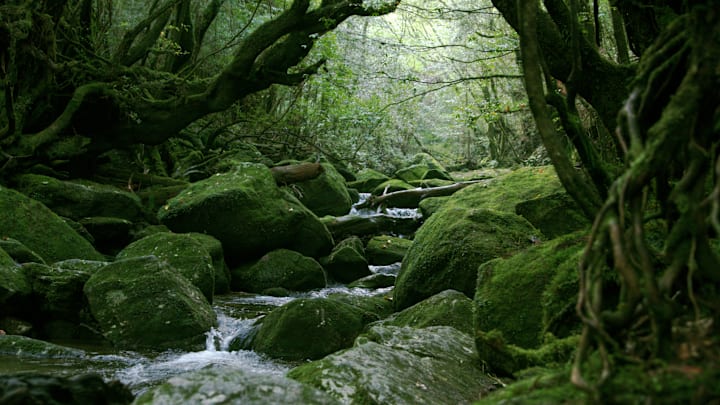
Off mainland Japan lies the mystical island of Yakushima, home to lush, mossy forests said to have inspired the setting of Princess Mononoke (1997). After visiting the Shiratani Unsuikyo Ravine in 1995, Hayao Miyazaki was captivated by the island’s ancient cedar trees and landscapes painted in nearly every shade of green imaginable—an atmosphere reflected in the film’s vibrant forest setting. Yakushima and the mountainous Shirakami-Sanchi region in northern Japan were even designated Japan’s first UNESCO World Natural Heritage sites in 1993, highlighting the ecological significance of these dreamlike forests.
Much of Princess Mononoke follows its titular character, also known as San—a human girl raised by wolf gods—as she fights to protect the fairy-tale wilderness she calls home. Deep within Yakushima’s moss-blanketed forests stands Jomon Sugi, believed to be the oldest tree in Japan and estimated to be between 2000 and 7000 years old. With landscapes this ancient, it’s no surprise the island has inspired its own legends, including the Kodama—tree spirits in Japanese folklore that inspired the small white forest spirits symbolizing a healthy woodland in the movie.
Gotland, Sweden

The whimsy of Studio Ghibli isn’t limited to Japan. On Sweden’s Gotland Island, the medieval coastal town of Visby looks straight out of Miyazaki’s animated world. Perched on the western coast, Visby is a picture-perfect blend of cobblestone streets, fortified walls, and colorful timbered houses. Its history dates back to the Viking Age, and by the Middle Ages, it had become one of the principal trading hubs of the Hanseatic League, giving the town its rich architectural heritage. During a formative trip to Sweden in 1971, Miyazaki encountered the charm and medieval character of towns like Visby—experiences that later informed his visual approach to the European-esque town of Koriko in Kiki’s Delivery Service (1989).
Peek closely and you might imagine a young witch and her black cat soaring between red-roofed buildings, past flower-lined squares and the charming harbor. The town’s historic architecture, including church ruins, city walls, and harbor piers, mirrors the enchanting sense of history and small-town wonder in the film. Today, strolling through Visby, visitors can picture Kiki gliding over pastel-colored façades, delivering packages and catching glimpses of the Baltic Sea, feeling the same magic Miyazaki captured in his depiction of Europe.
Tomonoura, Japan

Along the Seto Inland Sea in Hiroshima’s Fukuyama city lies the quiet fishing port of Tomonoura, widely believed to have inspired the seaside setting of Ponyo (2008). When Miyazaki spent time in the historic harbor town in 2005, he was captivated by its gentle waves, old stone breakwaters, and rows of traditional wooden houses overlooking the water—elements that later appeared in the film’s charming coastal landscapes. The movie follows a magical goldfish named Ponyo who escapes from the ocean and befriends a young boy named Sosuke, sparking a whimsical adventure that blurs the boundary between land and sea—much like Hans Christian Andersen’s The Little Mermaid, which helped inspire the story. From its calm Edo-period harbor near the rocky beach where Sosuke meets his fishy friend to the red-roofed house perched above the sea, Tomonoura still feels like a place where a whimsical sea creature might wash ashore at any moment.
Colmar, France

Nestled in the Alsace region of northeastern France, the picturesque town of Colmar looks like it was pulled straight from the pages of a fairy tale—and a famed Ghibli film. With its winding canals, cobblestone streets, and rows of colorful half-timbered houses, Colmar is often cited as one of the inspirations behind the European-style setting of Howl’s Moving Castle (2004). While traveling through Europe, Miyazaki drew inspiration from towns like Colmar, whose storybook German Renaissance architecture and charming town squares mirror the whimsical streets and market scenes seen in the film.
In the movie, a young woman named Sophie is transformed into an elderly woman by a witch’s curse and seeks refuge in the mysterious moving castle of the wizard Howl. Walking through Colmar today—especially along the flower-lined canals of its “Little Venice” district—it’s easy to imagine Sophie wandering its pastel-colored streets. Among its many historic buildings, the 16th‑century Pfister House, with its ornate frescoes and wooden galleries, is plucked straight from Colmar's cobbled streets and into the backdrop of Sophie's hometown.
Sayama Hills, Japan

Just outside Tokyo in Tokorozawa, Saitama Prefecture, lies Sayama Hills, a serene patchwork of rolling hills, rice paddies, and mossy woodlands affectionately nicknamed "Totoro’s Forest." This tranquil countryside is widely regarded as the real-life inspiration for the setting of My Neighbor Totoro (1988), where Miyazaki drew on memories of the area from his time living nearby in the 1960s and later visits while working on other projects in the 1970s.
In the film, sisters Satsuki and Mei discover the iconic Totoro, a friendly forest spirit, hiding among the trees behind their old house. Today, much of Sayama Hills is protected by the National Trust of Totoro no Furusato, preserving the trails and woodlands that inspired the movie. Visitors can wander the same paths Miyazaki once walked and explore landmarks like Kurosuke's House, a 120-year-old farmhouse that resembles the family’s countryside home, complete with tatami rooms, sliding doors, and playful recreations of the film’s soot sprites. Just as the mossy, mystical forests of Yakushima evoke the darkly enchanting world of Princess Mononoke, the bright, verdant grasslands and woodlands of Sayama Hills capture the innocent, playful spirit of My Neighbor Totoro.