%20%20--%3E%0A%3Csvg%20version%3D%221.1%22%20id%3D%22Layer_1%22%20xmlns%3D%22http%3A%2F%2Fwww.w3.org%2F2000%2Fsvg%22%20xmlns%3Axlink%3D%22http%3A%2F%2Fwww.w3.org%2F1999%2Fxlink%22%20x%3D%220px%22%20y%3D%220px%22%0A%09%20viewBox%3D%220%200%20684.6%2068.1%22%20style%3D%22enable-background%3Anew%200%200%20684.6%2068.1%3B%22%20xml%3Aspace%3D%22preserve%22%3E%0A%3Cg%3E%0A%09%3Cpath%20d%3D%22M444.1%2C29.3h-17.4v14.5h17.4V29.3z%20M36.4%2C68.1l29.3-50.8V0H50.4L32.9%2C36.8L15.5%2C0H0v68.1h16.7V45.8l12.4%2C22.3H36.4z%0A%09%09%20M49.1%2C68.1h16.6V23.4L49.1%2C52.1V68.1z%20M76.6%2C68.1h45V53.8H93.3V41.6h21V27.1h-21V14.8h28.3V0.1h-45V68.1z%20M175.6%2C68.1h17.3v-68%0A%09%09h-16.5v40.3L150%2C0.1h-17.6v68h16.7V27.7L175.6%2C68.1z%20M235.8%2C14.8h15.4V0.1h-47.4v14.7H219v53.2h16.8V14.8z%20M290.3%2C45.9h-17.1%0A%09%09l7.5-15.6h2L290.3%2C45.9z%20M298.7%2C68.1h18l-32.2-68h-5.7l-32%2C68h18l3.3-7.1h27.1L298.7%2C68.1z%20M325.2%2C68.1h46.2V53.8h-29.6V0.1h-16.7%0A%09%09V68.1z%20M423.7%2C14.8h27.2V0.1H407v68h16.7V14.8z%20M462%2C68.1h46.2V53.8h-29.6V0.1H462V68.1z%20M564.8%2C34.1c0%2C10.7-7.2%2C19.2-18.5%2C19.2%0A%09%09c-11.4%2C0-18.5-8.5-18.5-19.2s7.1-19.2%2C18.5-19.2C557.6%2C14.9%2C564.8%2C23.4%2C564.8%2C34.1%20M580.6%2C34.1c0-19-14.2-34-34.3-34%0A%09%09c-20.2%2C0-34.3%2C15-34.3%2C34c0%2C19%2C14.1%2C34%2C34.3%2C34C566.4%2C68.1%2C580.6%2C53.1%2C580.6%2C34.1%20M604.8%2C20.5c0-4.1%2C3.3-6.2%2C6.7-6.2%0A%09%09c4.4%2C0%2C6.6%2C3%2C6.6%2C6.6h14.7C631.8%2C9.1%2C625.1%2C0.1%2C611%2C0.1c-12%2C0-21.7%2C9.3-21.7%2C20.6c0%2C10.9%2C5.9%2C15.9%2C16.7%2C19.8%0A%09%09c5.2%2C1.8%2C11.5%2C3.2%2C11.5%2C8c0%2C3.3-2.4%2C5.5-6.4%2C5.5c-3.6%2C0-6.6-3-6.6-6.7h-15.2c0%2C11.5%2C7.9%2C20.8%2C21.8%2C20.8c12%2C0%2C21.6-9.3%2C21.6-20.6%0A%09%09c0-10-5.3-16.4-16.7-19.8C610.6%2C26.1%2C604.8%2C25.3%2C604.8%2C20.5%20M670%2C20.9h14.7C683.8%2C9.1%2C677.1%2C0.1%2C663%2C0.1c-12%2C0-21.7%2C9.3-21.7%2C20.6%0A%09%09c0%2C10.9%2C5.9%2C15.9%2C16.7%2C19.8c5.2%2C1.8%2C11.5%2C3.2%2C11.5%2C8c0%2C3.3-2.4%2C5.5-6.4%2C5.5c-3.6%2C0-6.6-3-6.6-6.7h-15.2c0%2C11.5%2C7.9%2C20.8%2C21.8%2C20.8%0A%09%09c12%2C0%2C21.6-9.3%2C21.6-20.6c0-10-5.3-16.4-16.7-19.8c-5.4-1.6-11.3-2.4-11.3-7.2c0-4.1%2C3.3-6.2%2C6.7-6.2C667.7%2C14.4%2C670%2C17.3%2C670%2C20.9%0A%09%09%22%2F%3E%0A%3C%2Fg%3E%0A%3C%2Fsvg%3E%0A)

The world’s oceans and seas are studded with hundreds of thousands of islands. While some of these islands are barren, uninviting outcroppings, others look like picturesque paradises thanks to their lush greenery and sandy beaches. But looks can be deceiving—some of these scenic islands actually have incredibly dark histories. Here are six islands and atolls with pasts that are surprisingly filled with misery, death, and destruction.
- Aogashima // Japan
- Jeju Island // South Korea
- Devil’s Island // French Guiana
- Clipperton Island // Pacific Ocean
- Poveglia // Italy
- Gruinard Island // Scotland
Aogashima // Japan


Around 200 miles south of Tokyo lies Aogashima—a volcanic island that is home to a small village. The island is undeniably beautiful; the southern half of the landmass is comprised of a steep cliff-walled caldera with a secondary volcanic cone in its center. But living on an active volcano comes with obvious risks. On May 18, 1785, the volcano erupted, ejecting smoke and debris into the air. The 327 residents waited to see if the eruption would get any worse, and by June 4, it was clear that everyone needed to evacuate. Sadly, it was too late, and around half of the islanders died.
That tragedy didn’t end the village permanently, though—some surviving residents returned several decades later, and the island has been inhabited ever since. Although the threat of another eruption is ever-present, there are benefits to living on Aogashima. “I often travel to the mainland on business, but I’m intimidated by the congestion—there’s just too many people,” Masanubu Yoshida, one of the island’s residents, told Smithsonian. “[On Aogashima] we can feel great nature that you cannot experience in big cities.” The island is also now monitored by the Japan Meteorological Agency, so residents should have fair warning about another eruption.
Jeju Island // South Korea


Jeju Island, located in the Korea Strait, is commonly known as the “Hawaii of South Korea,” but it wasn’t always a dreamy vacation destination. Back in the late 1940s, after Korea had been freed from Japanese occupation, there was much political upheaval on this island. Many people in Jeju were concerned that electing a president in the South would deepen the political division that already existed within the peninsula. Strikes, protests, and violence followed, and the South Korean government’s backlash was brutal. It’s estimated that around 30,000 people (roughly 10% of Jeju’s population) were killed by government forces. Information about the decimation on the island was then suppressed, and it took five decades before the uprising was even officially acknowledged and another two decades before surviving victims were offered compensation.
Devil’s Island // French Guiana

From afar, Devil’s Island looks like a postcard-perfect tropical paradise with its lush covering of palm trees. But the island’s ruined buildings and ominous name hint at its dark past. In 1852, Emperor Napoleon III of France turned Devil’s Island into a penal colony. Thousands of prisoners were sent to the island and subjected to inhuman treatment. Living conditions were abysmal and death was common due to tropical diseases and violence inflicted by the guards.
In 1895, French Army officer Alfred Dreyfus was sentenced to life in prison on Devil’s Island after being wrongly convicted of treason. But Dreyfus was then exonerated in 1906, and the high-profile nature of his case meant that the brutal conditions on Devil’s Island were brought to the public’s attention. This attention is largely why attempts to extradite Eddie Guerin—a bank robber who sought refuge in the UK after escaping the island in a hollowed-out tree trunk—failed. In Guerin’s own words, everyone agreed that “whatever I had done, it was not sufficiently bad to condemn me to a poisonous hole where men rotted away and were never heard of for ever more.”
In 1953, a century after the colony opened, the French government finally closed the prison on Devil’s Island. Visitors can now explore the abandoned prison cells that still stand as reminders of the island’s dark history.
Clipperton Island // Pacific Ocean

Around 1,300 miles off the southwest coast of Mexico lies a tiny circular atoll known as Clipperton Island. The two-square-mile spit of land is ringed by sand, features a few coconut groves, and is home to many crabs and birds. Throughout the 19th century, the island was mined for its guano (which makes an excellent fertilizer), but it wasn’t until the early 20th century that proper colonization was attempted. In 1910, around 100 men, women, and children were living and working on the island, dependent on regular supply deliveries from the mainland.
But when the Mexican Revolution started ramping up, the islanders were left to fend for themselves, and within a few years, most of the colonists had died of scurvy, malnutrition, or drowning. Lighthouse keeper Victoriano Álvarez was the last surviving man, and he declared himself “King of Clipperton.” Álvarez ruled as a tyrant, beating, raping, and murdering many of the few remaining women. But in July of 1917, the tides turned: Tirza Randon killed Álvarez and almost immediately afterwards, the survivors were rescued by a U.S. Navy ship. Just three women and eight children made it off of Clipperton Island, which has remained uninhabited ever since.
Poveglia // Italy

At the end of the 18th century, the bubonic plague tore through Venice. In an effort to prevent the disease from spreading further, the forest-covered island of Poveglia in the Venetian Lagoon was turned into a quarantine zone for the infected. It’s estimated that around 160,000 people died on Poveglia, many of whom were buried in plague pits.
Then, in 1922, the island became home to a psychiatric hospital. Conditions in the hospital might have been grim, but the spooky story sometimes told about a sadistic doctor throwing himself from the bell tower (or being pushed by the ghosts of his victims) is just that—a story. The island has been abandoned since 1968, but it’s currently being turned into a Venetians-only park. “The memories of the island are steeped in pain, but we will transform it into a place of joy,” project patron Massimo Pera told CNN.
Gruinard Island // Scotland

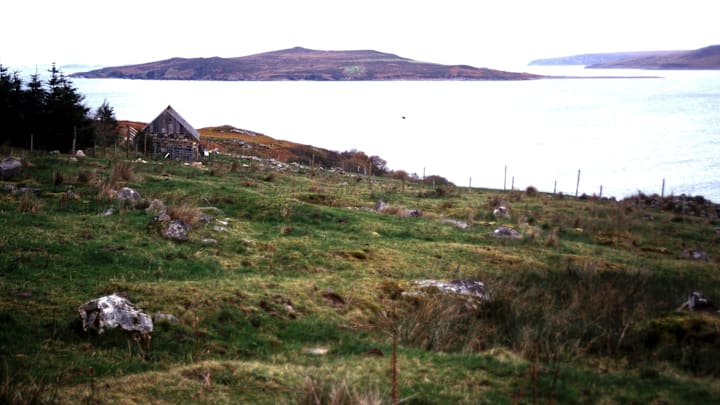
Although Scotland’s Gruinard Island might not have the same charm as a tropical island, it has its own rugged beauty. But for half a century, that beauty was deliberately contaminated. During World War II, the British government launched Operation Vegetarian, which sought to weaponize anthrax against the Germans. The plan was to lace linseed cakes with the lethal bacterium and airdrop them into cattle pastures, thereby infecting Germany’s meat supply and poisoning the population. In 1942, the military started testing the effectiveness of this plan on Gruinard Island; it was successful, leading to the deaths of many sheep there.
But the plan was abandoned when the war turned in favor of the Allies. When the military left Gruinard, the soil was left contaminated with anthrax and the entire island had to be quarantined. It wasn’t until 1990 that decontamination efforts—which were undertaken due to pressure from environmental group Dark Harvest Commandos—were successful and the island was declared safe (though it remains uninhabited).