%20%20--%3E%0A%3Csvg%20version%3D%221.1%22%20id%3D%22Layer_1%22%20xmlns%3D%22http%3A%2F%2Fwww.w3.org%2F2000%2Fsvg%22%20xmlns%3Axlink%3D%22http%3A%2F%2Fwww.w3.org%2F1999%2Fxlink%22%20x%3D%220px%22%20y%3D%220px%22%0A%09%20viewBox%3D%220%200%20684.6%2068.1%22%20style%3D%22enable-background%3Anew%200%200%20684.6%2068.1%3B%22%20xml%3Aspace%3D%22preserve%22%3E%0A%3Cg%3E%0A%09%3Cpath%20d%3D%22M444.1%2C29.3h-17.4v14.5h17.4V29.3z%20M36.4%2C68.1l29.3-50.8V0H50.4L32.9%2C36.8L15.5%2C0H0v68.1h16.7V45.8l12.4%2C22.3H36.4z%0A%09%09%20M49.1%2C68.1h16.6V23.4L49.1%2C52.1V68.1z%20M76.6%2C68.1h45V53.8H93.3V41.6h21V27.1h-21V14.8h28.3V0.1h-45V68.1z%20M175.6%2C68.1h17.3v-68%0A%09%09h-16.5v40.3L150%2C0.1h-17.6v68h16.7V27.7L175.6%2C68.1z%20M235.8%2C14.8h15.4V0.1h-47.4v14.7H219v53.2h16.8V14.8z%20M290.3%2C45.9h-17.1%0A%09%09l7.5-15.6h2L290.3%2C45.9z%20M298.7%2C68.1h18l-32.2-68h-5.7l-32%2C68h18l3.3-7.1h27.1L298.7%2C68.1z%20M325.2%2C68.1h46.2V53.8h-29.6V0.1h-16.7%0A%09%09V68.1z%20M423.7%2C14.8h27.2V0.1H407v68h16.7V14.8z%20M462%2C68.1h46.2V53.8h-29.6V0.1H462V68.1z%20M564.8%2C34.1c0%2C10.7-7.2%2C19.2-18.5%2C19.2%0A%09%09c-11.4%2C0-18.5-8.5-18.5-19.2s7.1-19.2%2C18.5-19.2C557.6%2C14.9%2C564.8%2C23.4%2C564.8%2C34.1%20M580.6%2C34.1c0-19-14.2-34-34.3-34%0A%09%09c-20.2%2C0-34.3%2C15-34.3%2C34c0%2C19%2C14.1%2C34%2C34.3%2C34C566.4%2C68.1%2C580.6%2C53.1%2C580.6%2C34.1%20M604.8%2C20.5c0-4.1%2C3.3-6.2%2C6.7-6.2%0A%09%09c4.4%2C0%2C6.6%2C3%2C6.6%2C6.6h14.7C631.8%2C9.1%2C625.1%2C0.1%2C611%2C0.1c-12%2C0-21.7%2C9.3-21.7%2C20.6c0%2C10.9%2C5.9%2C15.9%2C16.7%2C19.8%0A%09%09c5.2%2C1.8%2C11.5%2C3.2%2C11.5%2C8c0%2C3.3-2.4%2C5.5-6.4%2C5.5c-3.6%2C0-6.6-3-6.6-6.7h-15.2c0%2C11.5%2C7.9%2C20.8%2C21.8%2C20.8c12%2C0%2C21.6-9.3%2C21.6-20.6%0A%09%09c0-10-5.3-16.4-16.7-19.8C610.6%2C26.1%2C604.8%2C25.3%2C604.8%2C20.5%20M670%2C20.9h14.7C683.8%2C9.1%2C677.1%2C0.1%2C663%2C0.1c-12%2C0-21.7%2C9.3-21.7%2C20.6%0A%09%09c0%2C10.9%2C5.9%2C15.9%2C16.7%2C19.8c5.2%2C1.8%2C11.5%2C3.2%2C11.5%2C8c0%2C3.3-2.4%2C5.5-6.4%2C5.5c-3.6%2C0-6.6-3-6.6-6.7h-15.2c0%2C11.5%2C7.9%2C20.8%2C21.8%2C20.8%0A%09%09c12%2C0%2C21.6-9.3%2C21.6-20.6c0-10-5.3-16.4-16.7-19.8c-5.4-1.6-11.3-2.4-11.3-7.2c0-4.1%2C3.3-6.2%2C6.7-6.2C667.7%2C14.4%2C670%2C17.3%2C670%2C20.9%0A%09%09%22%2F%3E%0A%3C%2Fg%3E%0A%3C%2Fsvg%3E%0A)

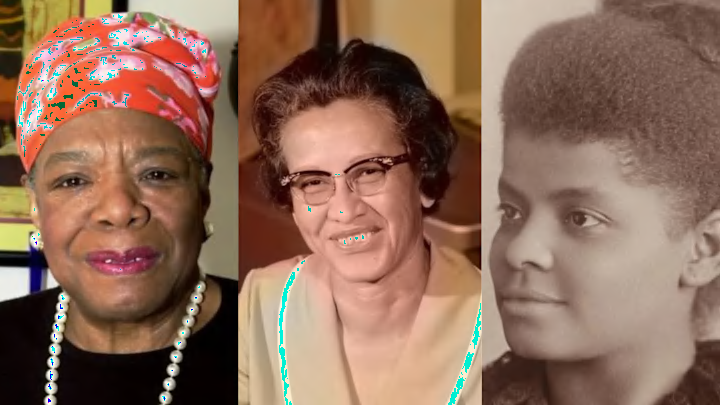
February is Black History Month, but the contributions of the legendary women on this list continue to reverberate every month of the year.
These extraordinary women represent just a small portion of the incredible Black women who have changed history for the better, and of course, history is also full of Black women whose achievements have not been publicly recognized but have also impacted countless people.
Still, each of the women on this list has undeniably made an indelible mark on countless systems, institutions, and lives. From Rosa Parks to Ida B. Wells, these women’s legacies span history, science, politics, and art. Each one triumphed over incredible odds, and their lives are reminders of just how truly powerful one person’s dreams and impact can be.
- Harriet Tubman
- Sojourner Truth
- Rosa Parks
- Fannie Lou Hamer
- Shirley Chisholm
- Ida B. Wells
- Katherine Johnson
- Mary McLeod Bethune
- Maya Angelou
Harriet Tubman

Perhaps no name is more synonymous with liberation and bravery than Harriet Tubman, who famously led over 70 slaves to freedom across 13 journeys on a 650-mile stretch of the Underground Railroad. She fought for civil rights throughout her entire life even after the Civil War, tirelessly supporting women’s rights and giving what she had to help others, and in her later years, she also turned part of her property into a home for older Black Americans.
Sojourner Truth

Sojourner Truth spent much of her early life as a slave, but in 1843, she changed her name and began a life as an abolitionist preacher who dedicated her life to achieving liberty and justice for all. Her many achievements included being the first Black woman to successfully sue a white man, and publishing an autobiography that outlined her vision for abolition and women’s equality.
She was a brilliant preacher and influential public figure, and legendary speech “Ain’t I a Woman?” braided a vision of women’s equality with racial equality and equity that she fought for throughout her life. Her many additional achievements included working with organizations that helped formerly enslaved people find jobs and advocating for land grants for freed Americans, and she also liaised with Abraham Lincoln, Susan B. Anthony, and other leaders of the time, all to bring her vision of a better world to life.
Rosa Parks

Few women are more synonymous with defiance and courage than Rosa Parks, whose simple refusal to give up her seat on a bus helped fuel a wave of change that rippled from the protests of the Civil Rights Movement into the courthouses and everyday lives of all Americans.
The day of her refusal is the stuff of legend. On December 1, 1955, Parks refused to give her seat up for a white passenger on a bus in Montgomery, Alabama. She was arrested, and later wound up losing her job. "I did this because I felt I was being violated as a human being. I had had a hard day at work on the job, [I was] physically tired as well as mentally vexed. I was sick of this type of thing we had to endure as a people because of our race," she said in an interview with the BBC.
Yet her defiance helped catalyze the Civil Rights movement, which helped dismantle segregation across America. In 1999, she was awarded the Congressional Gold Medal, the U.S. Congress’s highest honor, and was titled “the mother of the Civil Rights movement.”
Fannie Lou Hamer

Fannie Lou Hamer was raised in a sharecropping family in the early 20th century. In 1962, at the age of forty-five, she attended a meeting led by the Student Nonviolent Coordinating Committee and the Southern Christian Leadership Conference and learned that she could register to vote. The next day, she took a bus to Indianola to register—and returned over and over until she passed the difficult test, despite threats, intimidation, and violence from white supremacists.
She eventually started the Mississippi Freedom Democratic Party alongside other activists, and later spoke about her difficulties registering to vote and a beating she had experienced in prison at the 1964 Democratic National Convention. “Is this America, the land of the free and the home of the brave, where we have to sleep with our telephones off of the hook because our lives be threatened daily because we want to live as decent human beings, in America?” she said in a nationally televised speech that went on to make her famous.
She went on to run for the Mississippi House of Representatives, helped launch the National Women’s Political Caucus, and founded a 640-acre farm that provided Black people economic security called the Freedom Farm Cooperative. Her tireless bravery and activism have made her a civil rights icon and an embodiment of leadership and commitment to justice.
Shirley Chisholm

In 1968, Shirley Anita St. Hill Chisholm became the first Black woman to win a seat in Congress. The daughter of immigrant parents, she began her career as a schoolteacher and earned a master’s degree in early childhood education. She soon joined the board of a number of organizations, including the League of Women Voters and the National Association for the Advancement of Colored People (NAACP), and became the first Black woman in the New York State Legislature in 1964 before going on to earn her seat in Congress.
During her seven terms in the U.S. House of Representatives, she introduced over 50 pieces of legislation and fought for racial and gender equality. In 1972, she decided to run for President of the United States and, against challenging odds, earned 152 delegates’ votes at the Democratic National Convention. She later co-founded the National Political Congress of Black Women. “I want to be remembered as a woman … who dared to be a catalyst of change,” she said of her legacy, and she certainly is.
Ida B. Wells

Born into slavery, Ida B. Wells became one of the most revolutionary journalists of all time during her career. After the Civil War ended and the Reconstruction began, Wells began pursuing higher education, but following her parents’ deaths, she became her siblings’ primary caretaker at the age of 16. In 1884, Wells was forcefully removed from a train after refusing to move to the smoking car despite having purchased a first-class ticket; she wound up suing the Chesapeake, Ohio & Southwestern Railroad for harassment.
The decision was later reversed, but Wells remained a powerful advocate for justice for her whole life. She began her career as the editor of a local newspaper in Memphis, and later became an owner of two newspapers: The Memphis Free Speech and Headlight and Free Speech. Across her career, many of her stories focused on investigating lynchings and advocating for anti-lynching legislation. She also founded and co-founded numerous civil rights organizations, including the National Association for the Advancement of Colored People and the National Association of Colored Women, and was a passionate advocate for gender and racial equality. She received a posthumous Pulitzer Prize citation for her work in 2020.
Katherine Johnson

Born in 1918, Katherine Johnson was a mathematician whose extraordinary abilities helped many spacecraft take flight and even helped send astronauts to the moon. In 1953, she began working for the National Advisory Committee for Aeronautics (NACA), which was segregated at the time, and she joined a team of Black female engineers known as the West Computers, whose work was integral to the U.S. space program’s launch.
She also co-authored 26 research papers during her career, and in 1961, she calculated the path for Freedom 7, which was the first spacecraft to bring a U.S. astronaut into space. She also helped calculate the launch of the 1969 Apollo 11 mission, and received the Presidential Medal of Freedom in 2015.
Mary McLeod Bethune

Born to formerly enslaved parents, Mary McLeod Bethune was a passionate and influential advocate for education who started her career by opening a boarding school after her marriage ended and she needed to support her son. The school became a college called the Bethune-Cookman College in 1923.
Bethune also led voter registration drives and founded and led many organizations that supported women’s rights, and was the founding president of National Council of Negro Women. In 1936, she became the highest-ranking Black woman in politics when she was named the Director of the Division of Negro Affairs of the National Youth Administration by President Franklin Roosevelt. She also worked to end lynching and discrimination, and organized a conference on the Problems of the Negro and Negro Youth, among many other achievements. Additionally, she was the only Black woman to appear in the U.S. delegation at the United Nations’ founding conference in 1945, and her contributions to business, equity, and activism have left an indelible impact on American society and the world at large.
Maya Angelou

A writer and civil rights activist, Maya Angelou’s contributions to the fields of literature and social justice can’t be understated. Angelou overcame immense difficulties and violence in her early life and went on to write seven autobiographies. Her career began to blossom with the publication of the autobiography I Know Why the Caged Bird Sings in 1969, and she was also a successful Grammy-nominated singer, dancer, screenwriter, and Pulitzer Prize-nominated poet. Her work explored racial oppression and sexual violence but is always suffused with a message of healing and hope that continues to influence the world today.