%20%20--%3E%0A%3Csvg%20version%3D%221.1%22%20id%3D%22Layer_1%22%20xmlns%3D%22http%3A%2F%2Fwww.w3.org%2F2000%2Fsvg%22%20xmlns%3Axlink%3D%22http%3A%2F%2Fwww.w3.org%2F1999%2Fxlink%22%20x%3D%220px%22%20y%3D%220px%22%0A%09%20viewBox%3D%220%200%20684.6%2068.1%22%20style%3D%22enable-background%3Anew%200%200%20684.6%2068.1%3B%22%20xml%3Aspace%3D%22preserve%22%3E%0A%3Cg%3E%0A%09%3Cpath%20d%3D%22M444.1%2C29.3h-17.4v14.5h17.4V29.3z%20M36.4%2C68.1l29.3-50.8V0H50.4L32.9%2C36.8L15.5%2C0H0v68.1h16.7V45.8l12.4%2C22.3H36.4z%0A%09%09%20M49.1%2C68.1h16.6V23.4L49.1%2C52.1V68.1z%20M76.6%2C68.1h45V53.8H93.3V41.6h21V27.1h-21V14.8h28.3V0.1h-45V68.1z%20M175.6%2C68.1h17.3v-68%0A%09%09h-16.5v40.3L150%2C0.1h-17.6v68h16.7V27.7L175.6%2C68.1z%20M235.8%2C14.8h15.4V0.1h-47.4v14.7H219v53.2h16.8V14.8z%20M290.3%2C45.9h-17.1%0A%09%09l7.5-15.6h2L290.3%2C45.9z%20M298.7%2C68.1h18l-32.2-68h-5.7l-32%2C68h18l3.3-7.1h27.1L298.7%2C68.1z%20M325.2%2C68.1h46.2V53.8h-29.6V0.1h-16.7%0A%09%09V68.1z%20M423.7%2C14.8h27.2V0.1H407v68h16.7V14.8z%20M462%2C68.1h46.2V53.8h-29.6V0.1H462V68.1z%20M564.8%2C34.1c0%2C10.7-7.2%2C19.2-18.5%2C19.2%0A%09%09c-11.4%2C0-18.5-8.5-18.5-19.2s7.1-19.2%2C18.5-19.2C557.6%2C14.9%2C564.8%2C23.4%2C564.8%2C34.1%20M580.6%2C34.1c0-19-14.2-34-34.3-34%0A%09%09c-20.2%2C0-34.3%2C15-34.3%2C34c0%2C19%2C14.1%2C34%2C34.3%2C34C566.4%2C68.1%2C580.6%2C53.1%2C580.6%2C34.1%20M604.8%2C20.5c0-4.1%2C3.3-6.2%2C6.7-6.2%0A%09%09c4.4%2C0%2C6.6%2C3%2C6.6%2C6.6h14.7C631.8%2C9.1%2C625.1%2C0.1%2C611%2C0.1c-12%2C0-21.7%2C9.3-21.7%2C20.6c0%2C10.9%2C5.9%2C15.9%2C16.7%2C19.8%0A%09%09c5.2%2C1.8%2C11.5%2C3.2%2C11.5%2C8c0%2C3.3-2.4%2C5.5-6.4%2C5.5c-3.6%2C0-6.6-3-6.6-6.7h-15.2c0%2C11.5%2C7.9%2C20.8%2C21.8%2C20.8c12%2C0%2C21.6-9.3%2C21.6-20.6%0A%09%09c0-10-5.3-16.4-16.7-19.8C610.6%2C26.1%2C604.8%2C25.3%2C604.8%2C20.5%20M670%2C20.9h14.7C683.8%2C9.1%2C677.1%2C0.1%2C663%2C0.1c-12%2C0-21.7%2C9.3-21.7%2C20.6%0A%09%09c0%2C10.9%2C5.9%2C15.9%2C16.7%2C19.8c5.2%2C1.8%2C11.5%2C3.2%2C11.5%2C8c0%2C3.3-2.4%2C5.5-6.4%2C5.5c-3.6%2C0-6.6-3-6.6-6.7h-15.2c0%2C11.5%2C7.9%2C20.8%2C21.8%2C20.8%0A%09%09c12%2C0%2C21.6-9.3%2C21.6-20.6c0-10-5.3-16.4-16.7-19.8c-5.4-1.6-11.3-2.4-11.3-7.2c0-4.1%2C3.3-6.2%2C6.7-6.2C667.7%2C14.4%2C670%2C17.3%2C670%2C20.9%0A%09%09%22%2F%3E%0A%3C%2Fg%3E%0A%3C%2Fsvg%3E%0A)

When the head of your country throws a Christmas party, it’ll usually be a standard affair, arranged to maintain diplomatic relations. The worst that’ll happen is some scandal over how a decorator didn’t give the tree all the attention it deserved. Occasionally, however, you can count on people winding up hurt or dead.
- Guinea’s Deadly Mass Celebration
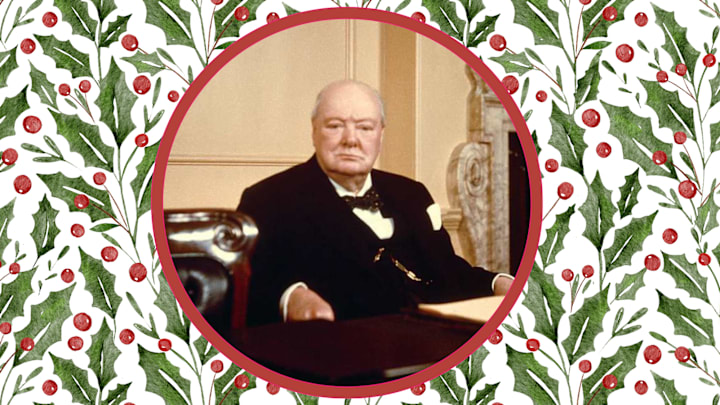
- Churchill’s Poor Arteries
- A Swedish King Starved His Guests
- Jimmy Carter Found One Party a Pain in the Butt
- William the Conqueror and the Fire
Guinea’s Deadly Mass Celebration

Francisco Macías Nguema spent 10 years as the president of Equatorial Guinea, and he did not rule the country in a conventional manner. For example, he demanded that all the country’s witch doctors give him their wooden staffs so he could wield their combined magic, and that was considered an odd move, even by people who believe magic is real. By the end of his reign, he kept a collection of human heads nearby and spoke with them.
Naturally, he faced some opposition from others in the country. Then, for Christmas in 1969, he brought 150 of these opponents to a football stadium in the capital city of Malabo. Loudspeakers played the song “Those Were the Days” by Mary Hopkin. Then, guards took out guns and killed all 150 of the prisoners.
Some sources claim Nguema dressed the guards as Santa Claus for this event. Others leave that fact out, so it might not be true, and is anyway not necessary to make this a ghoulish story of note. Nguema ultimately went on to be deposed and executed, but he first made it a point to move the nation’s treasury to his bedroom and then (literally) set all the money on fire.
Churchill’s Poor Arteries

Winston Churchill spent Christmas of 1941 at the White House. He invited himself. But this was just weeks after the attack on Pearl Harbor, and Churchill thought this was an essential time to show up and exert a little influence on U.S. policy.
Though Britain had actually responded to the attack by declaring war on Japan even before America did, it was important to them that America not concentrate too much on Japan. There was a big war in Europe, and they needed America’s help there.
Franklin Roosevelt and Churchill attended Christmas mass together, and the two sat for a private screening of The Maltese Falcon, which had been released just a couple of months earlier. Then Churchill had a heart attack.
He did not announce this publicly. In fact, he did not even know it had happened. His doctor examined him and privately diagnosed the prime minister as having suffered a heart attack but thought it prudent not to tell anyone at the time, not even Churchill himself. If he did, word could get out that the head of England’s government was “an invalid with a crippled heart and a doubtful future.” The outcome of the war and the fate of the world could rest on keeping this secret.
Though Churchill would go on to have several strokes, he never had another heart attack—unless it was also covered up.
A Swedish King Starved His Guests
In 1317, the king of Sweden was Birger Magnusson, son of Magnus Birgersson. He had been king since the age of 10, and he’d long had a rivalry with his two younger brothers, dukes named Eric and Valdemar. At one point, the brothers fled to Norway, which didn’t quite free them from Birger’s rule, as Birger quickly took Norway over.
Then the brothers tried to overthrow Birger in a coup (dubbed the “Håtuna Games”), and the king settled this matter by giving each of them a chunk of the country to rule over.
On Christmas 1317, Birger invited both brothers to a banquet. Their own guards couldn’t stay in the castle, as there was no room, said Birger. They enjoyed a fine feast. The two dukes retired to their rooms for the night. Then Birger went to each of these rooms with men holding crossbows, and he moved both the brothers to his dungeon.
They never left. They both signed wills disposing of their property, and then they both died while imprisoned, presumably of starvation.
Note that sources are a little unclear about exactly how the arrest went down. For example, the chronicler of this said that Birger delivered a quip about the brothers’ coup against him, saying, “Remember ye aught of the Håtuna Games? I remember them clearly.” We can’t confirm that, but then, there’s a lot about 14th-century Sweden that we can’t confirm.
Jimmy Carter Found One Party a Pain in the Butt

Halfway through his single term as president, Jimmy Carter had a problem: hemorrhoids. Hemorrhoids are actually a kind of vein that everyone has, but when we say someone “has hemorrhoids,” we mean those veins have become inflamed, causing much pain in their posterior region.
Carter hosted a Christmas party in 1978, and he had to suddenly leave it because the hemorrhoids hurt him too much. He did not announce this embarrassing fact to the assembled thousand guests, and even though the White House had previously disclosed his hemorrhoid problem, he only admitted that this was the reason for his leaving the party in a memoir he wrote in 2001.
A little bit into the new year in 1979, the White House needed to make another announcement about those hemorrhoids, as they’d gotten worse and Carter might need surgery. But between those two flare-ups, on the day after Christmas, he suddenly experienced a period of relief. He attributed this to prayers from the Egyptians. Egyptian president Anwar Sadat had known about the hemorrhoids and had publicly asked his citizens to pray for the American leader, and these prayers were followed by a Christmas miracle.
William the Conqueror and the Fire

William the Conqueror received his coronation at Westminster Abbey on Christmas Day, 1066. Much of the ceremony went as you’d expect because coronations haven’t changed much in a thousand years. William showed up as part of a procession. People chanted. The incoming king stepped onto a raised dais.
The bishop overseeing the coronation asked the assembled noblemen if they accepted William as their king. The nobles replied with cheers of affirmation, some in English, some in French.
Outside, guards heard this loud commotion, and they feared the worst. These guys did not have many years of movies telling them what coronations are like, and they leapt to the conclusion that someone had tried to assassinate William. Rather than rushing in to save him, they figured they had to avenge him, and they moved to set fire to the city around the Abbey.
History does not record how many people inside those homes burned to death. It does record that the smoke entered the Abbey itself, sparking a riot. People from within fled out, terrified. Clearly, this whole monarchy concept was a terrible idea, so let’s hope that those present got around to abolishing it as soon as possible.
You May Also Like:
Add Mental Floss as a preferred news source!