%20%20--%3E%0A%3Csvg%20version%3D%221.1%22%20id%3D%22Layer_1%22%20xmlns%3D%22http%3A%2F%2Fwww.w3.org%2F2000%2Fsvg%22%20xmlns%3Axlink%3D%22http%3A%2F%2Fwww.w3.org%2F1999%2Fxlink%22%20x%3D%220px%22%20y%3D%220px%22%0A%09%20viewBox%3D%220%200%20684.6%2068.1%22%20style%3D%22enable-background%3Anew%200%200%20684.6%2068.1%3B%22%20xml%3Aspace%3D%22preserve%22%3E%0A%3Cg%3E%0A%09%3Cpath%20d%3D%22M444.1%2C29.3h-17.4v14.5h17.4V29.3z%20M36.4%2C68.1l29.3-50.8V0H50.4L32.9%2C36.8L15.5%2C0H0v68.1h16.7V45.8l12.4%2C22.3H36.4z%0A%09%09%20M49.1%2C68.1h16.6V23.4L49.1%2C52.1V68.1z%20M76.6%2C68.1h45V53.8H93.3V41.6h21V27.1h-21V14.8h28.3V0.1h-45V68.1z%20M175.6%2C68.1h17.3v-68%0A%09%09h-16.5v40.3L150%2C0.1h-17.6v68h16.7V27.7L175.6%2C68.1z%20M235.8%2C14.8h15.4V0.1h-47.4v14.7H219v53.2h16.8V14.8z%20M290.3%2C45.9h-17.1%0A%09%09l7.5-15.6h2L290.3%2C45.9z%20M298.7%2C68.1h18l-32.2-68h-5.7l-32%2C68h18l3.3-7.1h27.1L298.7%2C68.1z%20M325.2%2C68.1h46.2V53.8h-29.6V0.1h-16.7%0A%09%09V68.1z%20M423.7%2C14.8h27.2V0.1H407v68h16.7V14.8z%20M462%2C68.1h46.2V53.8h-29.6V0.1H462V68.1z%20M564.8%2C34.1c0%2C10.7-7.2%2C19.2-18.5%2C19.2%0A%09%09c-11.4%2C0-18.5-8.5-18.5-19.2s7.1-19.2%2C18.5-19.2C557.6%2C14.9%2C564.8%2C23.4%2C564.8%2C34.1%20M580.6%2C34.1c0-19-14.2-34-34.3-34%0A%09%09c-20.2%2C0-34.3%2C15-34.3%2C34c0%2C19%2C14.1%2C34%2C34.3%2C34C566.4%2C68.1%2C580.6%2C53.1%2C580.6%2C34.1%20M604.8%2C20.5c0-4.1%2C3.3-6.2%2C6.7-6.2%0A%09%09c4.4%2C0%2C6.6%2C3%2C6.6%2C6.6h14.7C631.8%2C9.1%2C625.1%2C0.1%2C611%2C0.1c-12%2C0-21.7%2C9.3-21.7%2C20.6c0%2C10.9%2C5.9%2C15.9%2C16.7%2C19.8%0A%09%09c5.2%2C1.8%2C11.5%2C3.2%2C11.5%2C8c0%2C3.3-2.4%2C5.5-6.4%2C5.5c-3.6%2C0-6.6-3-6.6-6.7h-15.2c0%2C11.5%2C7.9%2C20.8%2C21.8%2C20.8c12%2C0%2C21.6-9.3%2C21.6-20.6%0A%09%09c0-10-5.3-16.4-16.7-19.8C610.6%2C26.1%2C604.8%2C25.3%2C604.8%2C20.5%20M670%2C20.9h14.7C683.8%2C9.1%2C677.1%2C0.1%2C663%2C0.1c-12%2C0-21.7%2C9.3-21.7%2C20.6%0A%09%09c0%2C10.9%2C5.9%2C15.9%2C16.7%2C19.8c5.2%2C1.8%2C11.5%2C3.2%2C11.5%2C8c0%2C3.3-2.4%2C5.5-6.4%2C5.5c-3.6%2C0-6.6-3-6.6-6.7h-15.2c0%2C11.5%2C7.9%2C20.8%2C21.8%2C20.8%0A%09%09c12%2C0%2C21.6-9.3%2C21.6-20.6c0-10-5.3-16.4-16.7-19.8c-5.4-1.6-11.3-2.4-11.3-7.2c0-4.1%2C3.3-6.2%2C6.7-6.2C667.7%2C14.4%2C670%2C17.3%2C670%2C20.9%0A%09%09%22%2F%3E%0A%3C%2Fg%3E%0A%3C%2Fsvg%3E%0A)

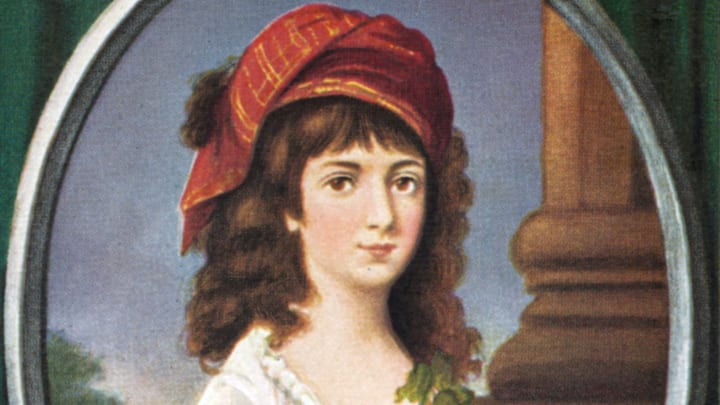
Although our history books are filled to the brim with the names of men who helped lead globally consequential revolutions, what’s often missing is the women. While some took to the frontlines, others assisted in great social change from the sidelines, influencing and shaping revolutions from within the confines of their time.
While you might not have learned about them in history class, their actions have helped shape the world we live in, regardless.
- Charlotte Corday
- Nadezhda Krupskaya
- Nwanyeruwa
- Edith Garrud
- Kathleen Neal Cleaver
- Meena Keshwar Kamal
Charlotte Corday

A French aristocrat turned revolutionary, Charlotte Corday is best known for her role in the assassination of Jacobin leader Jean-Paul Marat in July 1793.
Following the onset of the French Revolution in 1789, Corday found herself politically aligned with the Girondins, a French revolutionary group with comparatively moderate views in contrast with the increasingly radical Jacobins. Known for his incendiary political writing and extremist approach to the revolution, Marat quickly became one of the Jacobin movement’s most vocal and visible public allies.
Concerned with the direction men like Marat might take the revolution, 24-year-old Corday began plotting to have Marat eliminated following the September Massacre, a series of more than a thousand executions in September 1792 that many, Corday included, held Marat responsible for.
After traveling to Paris, Corday was granted a meeting with Marat after giving him the impression she had information about a planned Girondin uprising. While he lay convalescing in the bathtub to treat a chronic skin condition, Corday stabbed Marat once in the chest, killing him. After being immediately arrested for Marat’s murder, Corday would be executed via guillotine just days later.
Marat’s assassination would later be immortalized by artist Jacques-Louis David in his seminal work The Death of Marat.
Nadezhda Krupskaya

Wife of Russian politician and founder of the Soviet Union, Vladimir Lenin, Nadezhda Krupskaya was a highly regarded Bolshevik leader and revolutionary in her own right. Born to a formerly wealthy noble family in Saint Petersburg, Krupskaya first became involved in the percolating Bolshevik Revolution through political student groups in the 1890s.
Particularly drawn to the work of Leo Tolstoy, these groups first exposed Krupskaya to Marxism, the foundational ideology her future husband, Vladimir Lenin, would establish the Soviet Union upon. After meeting Lenin through one such Marxist philosophy group, Krupskaya and the future head of the U.S.S.R. quickly bonded over their shared devotion to the working class and communist political identities.
After Lenin was exiled to Siberia for his involvement with Russia’s growing communist revolution, Krupskaya remained in St. Petersburg, continuing Lenin’s work, spreading communist ideology and bolstering their popular support. In 1896, Krupskaya would be arrested for her involvement with the communist revolution, leading to her nearly being exiled to Ufa before she and Lenin decided to wed, allowing them to spend their exile together in Siberia. Reunited in Siberia, Krupskaya and Lenin continued their political partnership, reading and writing extensively to shape their shared ideology.
Following the conclusion of their exile, Krupskaya and Lenin relocated to Europe, where they’d continue to lead Lenin’s followers, the Bolsheviks, from outside Russia. By then a figure of central importance to the Bolshevik Revolution, Krupskaya returned to Russia following the February 1917 revolution that led to the dissolution of the Russian monarchy.
By October 1917, the Bolsheviks had seized total control of Russia and formed the newly established Soviet Union under Lenin’s leadership. Once Lenin’s new government was in place, Krupskaya turned her attention to growing Russian literacy initiatives and establishing comprehensive teacher training programs.
After Lenin died from a stroke in 1924, Krupskaya remained active in Soviet politics, continuing her work in national education and literacy. Though they’d initially fostered a cooperative relationship, Krupskaya quickly found herself at odds with her late husband’s successor, Joseph Stalin.
Critical of Stalin’s growing authoritarian tendencies, Krupskaya aligned herself with the Left Opposition, a faction of Russia’s communist party headed by Leon Trotsky in dissent of Stalin’s rise to power. Despite this, the Left Opposition was squashed by the conclusion of the 1920s, and Krupskaya remained politically sidelined until her death in 1939.
Nwanyeruwa
On November 18, 1929, colonial Warrant Chief Mark Emereuwa approached a Nigerian Igbo woman, Nwanyeruwa, at her home in Oloko, Nigeria. After informing Nwanyeruwa she would be made to pay British colonial taxes, a break from Igbo tradition wherein women were historically exempt from such taxes, the Warrant Chief unknowingly catalyzed the single largest anti-colonial protest in the country’s history.
Following her confrontation with Emereuwa, Nwanyeruwa informed the local women that the colonialists intended to tax them, and the women began organizing fellow Nigerian women across the country to stand up to what they saw as unfair taxation. Under Nwanyeruwa’s leadership, a group of nearly 10,000 Nigerian women was assembled to protest at the local Warrant Chief’s office, demanding they remain exempt from colonial taxation.
Though Nwanyeruwa’s singular protest led to little immediate material change, she has been credited with helping catalyze the Nigerian Women’s War of 1929 that led to sizable social and political change for Nigerian women. A paramount figure in the Nigerian women’s rights movement, Nwanyeruwa remains a revered symbol of gender equality across Africa today.
You May Also Like:
Add Mental Floss as a preferred news source!
Edith Garrud

Sick and tired of being roughed up by policemen and male counterprotestors, the suffragettes of the UK’s Women’s Social and Political Union (WSPU) decided it was time to fight back.
Eager to properly defend themselves following a deadly women’s suffrage protest in November 1910, the group asked martial artist and fellow suffragette Edith Garrud to attend one of their gatherings to teach the group the basics of jiujitsu. The first female martial arts instructor in England, Garrud and her husband, William Garrud, trained under legendary martial artist Sadakazu Uyenishi before opening a studio of their own in London.
Despite being just 4’11”, Garrud was a renowned martial artist, providing countless self-defense presentations to women’s groups across the country, effortlessly flipping men nearly twice her size to showcase her skills.
Quickly dubbed “suffrajitsu,” Garrud’s self-defense pedagogy quickly became a mainstay at women’s suffrage groups across the United Kingdom. In response to the growing hostility against suffragettes, the WSPU formed “the Bodyguard,” a 30-woman battalion armed with clubs and trained in combat by Garrud. The Bodyguard had numerous violent clashes with the police, earning the moniker “Amazons” in the press after the mythological Greek tribe of female warriors.
About a year later, the Bodyguard would disband upon the onset of WW1 as the movement largely shifted its efforts to supporting the war. After the women’s suffrage movement concluded in 1918, Garrud and her husband continued to teach jiujitsu and self-defense from their London studio before retiring in 1925.
Kathleen Neal Cleaver

A central figure in the Black Panther Party (a leftist Black liberation group active in California’s Bay Area from the mid-‘60s until the early ‘80s), Kathleen Neal Cleaver is an American activist, lawyer, and writer primarily associated with the Black Power movement of the early 1970s.
An offshoot of the civil rights movement, the Black Power movement was heavily influenced by the work of Malcolm X, a figure whose views sometimes contrasted with Martin Luther King Jr.’s staunchly nonviolent approach to Black activism. Whereas King emphasized nonviolent civil disobedience, X and the Black Power movement advocated for more direct, forthright action.
The daughter of activists Earnest Eugene Neal and Pearl Juette Johnson, Cleaver’s life in community organizing began in college when she became involved with the Student Nonviolent Coordinating Committee (SNCC). While working for the SNCC, Cleaver became acquainted with fellow activist Eldridge Cleaver, one of the Black Panther Party’s early leaders and Cleaver’s future husband. After the couple wed in late 1967, Kathleen became the Party’s Communications Secretary, helping the group organize demonstrations and making frequent appearances in the media advocating on the group’s behalf.
Soon becoming one of the most visible members of the Party, Cleaver quickly became one of the group’s few female figureheads (despite the group being predominantly composed of women).
Following a shootout with the police in 1969, Kathleen and Eldridge relocated to Algeria, remaining in exile until returning to the United States in 1975. After Kathleen and Eldridge’s marriage deteriorated, Kathleen earned undergraduate and juris doctor degrees from Yale University, beginning an illustrious career as a lawyer involved in civil rights and prison reform.
Meena Keshwar Kamal
Founder of the Revolutionary Association of the Women of Afghanistan (RAWA), Meena Keshwar Kamal was an Afghan revolutionary, activist, and feminist.
After founding RAWA in 1977 while a student at Kabul University, Meena became heavily involved in women’s rights activism, later founding a bilingual feminist magazine called Payam-e-Zan (Women’s Message) to help spread awareness for the movement. Working to establish schools for refugee children and advance women’s education, Meena quickly found herself at the forefront of Afghanistan’s contentious women’s rights movement.
Staunchly opposed to the Soviet puppet regime that had been established in Afghanistan in the late 1970s, Meena quickly became a prime target for the newly established Afghan regime and their Soviet supporters.
After publicly rejecting and castigating both the Soviet and prior Mujahadeen fundamentalist regimes, Meena was assassinated in the Pakistani city of Quetta on February 4, 1987.
While the perpetrators of the assassination have been contested for decades, it’s widely believed to have been carried out by the Afghan secret police in collaboration with the KGB. Despite this, RAWA has continued its founder’s mission of furthering women’s rights across Afghanistan.