%20%20--%3E%0A%3Csvg%20version%3D%221.1%22%20id%3D%22Layer_1%22%20xmlns%3D%22http%3A%2F%2Fwww.w3.org%2F2000%2Fsvg%22%20xmlns%3Axlink%3D%22http%3A%2F%2Fwww.w3.org%2F1999%2Fxlink%22%20x%3D%220px%22%20y%3D%220px%22%0A%09%20viewBox%3D%220%200%20684.6%2068.1%22%20style%3D%22enable-background%3Anew%200%200%20684.6%2068.1%3B%22%20xml%3Aspace%3D%22preserve%22%3E%0A%3Cg%3E%0A%09%3Cpath%20d%3D%22M444.1%2C29.3h-17.4v14.5h17.4V29.3z%20M36.4%2C68.1l29.3-50.8V0H50.4L32.9%2C36.8L15.5%2C0H0v68.1h16.7V45.8l12.4%2C22.3H36.4z%0A%09%09%20M49.1%2C68.1h16.6V23.4L49.1%2C52.1V68.1z%20M76.6%2C68.1h45V53.8H93.3V41.6h21V27.1h-21V14.8h28.3V0.1h-45V68.1z%20M175.6%2C68.1h17.3v-68%0A%09%09h-16.5v40.3L150%2C0.1h-17.6v68h16.7V27.7L175.6%2C68.1z%20M235.8%2C14.8h15.4V0.1h-47.4v14.7H219v53.2h16.8V14.8z%20M290.3%2C45.9h-17.1%0A%09%09l7.5-15.6h2L290.3%2C45.9z%20M298.7%2C68.1h18l-32.2-68h-5.7l-32%2C68h18l3.3-7.1h27.1L298.7%2C68.1z%20M325.2%2C68.1h46.2V53.8h-29.6V0.1h-16.7%0A%09%09V68.1z%20M423.7%2C14.8h27.2V0.1H407v68h16.7V14.8z%20M462%2C68.1h46.2V53.8h-29.6V0.1H462V68.1z%20M564.8%2C34.1c0%2C10.7-7.2%2C19.2-18.5%2C19.2%0A%09%09c-11.4%2C0-18.5-8.5-18.5-19.2s7.1-19.2%2C18.5-19.2C557.6%2C14.9%2C564.8%2C23.4%2C564.8%2C34.1%20M580.6%2C34.1c0-19-14.2-34-34.3-34%0A%09%09c-20.2%2C0-34.3%2C15-34.3%2C34c0%2C19%2C14.1%2C34%2C34.3%2C34C566.4%2C68.1%2C580.6%2C53.1%2C580.6%2C34.1%20M604.8%2C20.5c0-4.1%2C3.3-6.2%2C6.7-6.2%0A%09%09c4.4%2C0%2C6.6%2C3%2C6.6%2C6.6h14.7C631.8%2C9.1%2C625.1%2C0.1%2C611%2C0.1c-12%2C0-21.7%2C9.3-21.7%2C20.6c0%2C10.9%2C5.9%2C15.9%2C16.7%2C19.8%0A%09%09c5.2%2C1.8%2C11.5%2C3.2%2C11.5%2C8c0%2C3.3-2.4%2C5.5-6.4%2C5.5c-3.6%2C0-6.6-3-6.6-6.7h-15.2c0%2C11.5%2C7.9%2C20.8%2C21.8%2C20.8c12%2C0%2C21.6-9.3%2C21.6-20.6%0A%09%09c0-10-5.3-16.4-16.7-19.8C610.6%2C26.1%2C604.8%2C25.3%2C604.8%2C20.5%20M670%2C20.9h14.7C683.8%2C9.1%2C677.1%2C0.1%2C663%2C0.1c-12%2C0-21.7%2C9.3-21.7%2C20.6%0A%09%09c0%2C10.9%2C5.9%2C15.9%2C16.7%2C19.8c5.2%2C1.8%2C11.5%2C3.2%2C11.5%2C8c0%2C3.3-2.4%2C5.5-6.4%2C5.5c-3.6%2C0-6.6-3-6.6-6.7h-15.2c0%2C11.5%2C7.9%2C20.8%2C21.8%2C20.8%0A%09%09c12%2C0%2C21.6-9.3%2C21.6-20.6c0-10-5.3-16.4-16.7-19.8c-5.4-1.6-11.3-2.4-11.3-7.2c0-4.1%2C3.3-6.2%2C6.7-6.2C667.7%2C14.4%2C670%2C17.3%2C670%2C20.9%0A%09%09%22%2F%3E%0A%3C%2Fg%3E%0A%3C%2Fsvg%3E%0A)

Thanks to a pesky little thing called the Electoral College, the presidential candidate with the most national votes isn’t always the one awarded victory. Though the Electoral College and the popular vote often point to the same winner, there have been a handful of instances across American history where that hasn’t been the case.
Here’s how five elections (and counting) have highlighted the quirks and peculiarities of the Electoral College.
- 2016: Donald Trump vs. Hillary Clinton
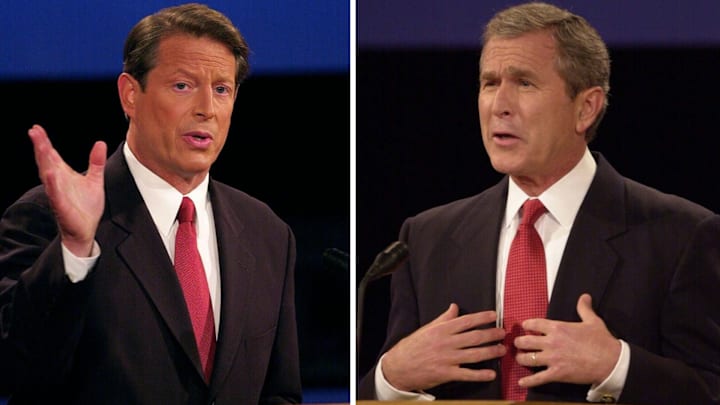
- 2000: George W. Bush vs. Al Gore
- 1888: Benjamin Harrison vs. Grover Cleveland
- 1876: Rutherford B. Hayes vs. Samuel Tilden
- 1824: John Quincy Adams vs. Andrew Jackson
2016: Donald Trump vs. Hillary Clinton

The most recent occurrence on our list, the 2016 election between former Secretary of State Hillary Clinton and businessman/media personality Donald Trump, was by far one of the most contentious presidential elections of the 21st century. Although Trump started as a sort of novelty candidate, he’d later become a dark horse in the Republican primary, snatching the nomination from presidential hopefuls and lifelong political operators like Senator Ted Cruz and Jeb Bush, son of former President George H.W. Bush.
While Clinton struggled to unite the Democratic primary through a turbulent primary against Vermont senator Bernie Sanders, Trump came to signify a change in the status quo for his largely disaffected voter base.
Despite Clinton earning nearly 3 million more votes than Trump in the general election, Trump won the electoral college by a landslide, securing his position as the 45th President of the United States.
2000: George W. Bush vs. Al Gore

Widely considered to be one of the closest presidential elections in American history, the 2000 U.S. presidential election pitted Republican governor of Texas George W. Bush (son of former president George H.W. Bush) against Vice President Al Gore, the incumbent VP under Bill Clinton, whose second term had just ended. On the night of the general election, Florida remained undecided, keeping the election in a state of purgatory for more than a month while recounts were conducted. Following the Florida recounts, it was determined that Bush had won the state by a mere 537 votes, pushing his electoral votes to 271, just over the 270 threshold needed to secure the presidency.
Although Bush had won the Electoral College and presidency, Gore took the popular vote, securing 48.4% of the votes, while Bush received only 47.9%. For the first time since 1888, the nominee who won the popular vote did not take the presidency.
1888: Benjamin Harrison vs. Grover Cleveland

During the November 1888 U.S. presidential election, incumbent Democratic president Grover Cleveland faced off against Republican nominee Benjamin Harrison. Right in the middle of the Gilded Age, economic policy took center stage during this election cycle. While Cleveland advocated for greater free trade and lower tariffs, Harrison pushed for higher protective tariffs to appease his industrialist backers. Although Cleveland had the incumbency and a clean reputation on his side, his odds were hurt by his divisive stance on tariffs and the publication of the Murchison letter, a political scandal orchestrated by the Republicans that painted Cleveland as pro-free trade and unpatriotic. When the election arrived, Harrison won the Electoral College by a landslide (though he lost the national popular vote to Cleveland by about 100,000).
Despite this, Harrison’s singular term in office was marred with controversy, leading to the Democrats renominating Cleveland as their presidential candidate in 1892. After Cleveland crushed Harrison in their second election, he became the first ever U.S. president to serve two nonconsecutive terms.
1876: Rutherford B. Hayes vs. Samuel Tilden

After President Ulysses S. Grant served two terms as president, Republican Rutherford B. Hayes faced off against Democrat Samuel J. Tilden to become the 19th president of the United States. Occurring at the tail end of the Reconstruction Era, the election arrived as Republican power was waning. With Grant’s administration continually beset by scandal, the Democrats were able to retake the House of Representatives.
On election day in 1876, it appeared that Tilden had won the popular vote, but was one electoral vote shy of claiming a majority. Despite this, results from states like Florida, South Carolina, and Louisiana were disputed, leading to the creation of the Electoral Commission to address the issue.
In early 1877, the Commission voted in favor of Hayes, awarding him 20 disputed electoral votes. This decision raised his total from 165 to 185, giving him the majority needed to win the presidency. Under Hayes, the South was able to reestablish Jim Crow laws, seriously tarnishing his presidential legacy and ultimately leading to his declining to seek a second term.
1824: John Quincy Adams vs. Andrew Jackson

In an uncharacteristically crowded general election, Andrew Jackson, John Quincy Adams, William H. Crawford, and Henry Clay duked it out to take the presidency. All members of the now-defunct Democratic-Republican Party, the contentious election marked the end of the Era of Good Feelings, a period of political harmony and united national purpose that began in the aftermath of the War of 1812. While former U.S. Army general Andrew Jackson rallied voters in the South and West, Adams, a leading political figure in Massachusetts, secured votes across New England and the Northeast.
Although Jackson successfully obtained the popular vote, he’d only garnered 99 electoral votes, far below the margin needed for a majority win. Eventually, Clay was eliminated from consideration, and Congress debated between electing Jackson, Adams, and Crawford. With Clay out of the race, Congress threw its support behind Adams, ultimately awarding him the presidency. Adams later appointed Clay as Secretary of State, leading many to speculate that the pair had made a deal to win Adams the White House.
Adams’ divisive victory fractured the Democratic-Republican Party and galvanized Jackson’s supporters, ultimately leading to Jackson’s victory in the 1828 presidential election.